Successful short selling isn’t just about picking the right entry; it’s about mastering the exit. To cover a short position (or ‘buy to cover’) means purchasing shares to replace those you borrowed, effectively closing your trade. Whether you are securing a profit or cutting a loss, understanding the mechanics of short covering is vital to protect your account from a volatile short squeeze. This guide explains exactly how the process works and when to exit safely.
Key Takeaways
- Short Covering Meaning: The act of buying back borrowed shares to officially close a short position.
- Two Triggers: A trader covers a position to either take profit (if the price fell) or cut losses (if the price rose).
- A short squeeze is a forced, chaotic price rally. It happens when rising prices force all short sellers to cover at once, pushing prices higher.
- “Short Interest” measures how many shares are shorted. A high short interest ratio can be “fuel” for a potential short squeeze.
- “Covering” in Forex trading is simpler. It’s just a standard “buy” order to close a “sell” position, as no shares are borrowed.
1. What Does Short Covering Mean In Stocks?
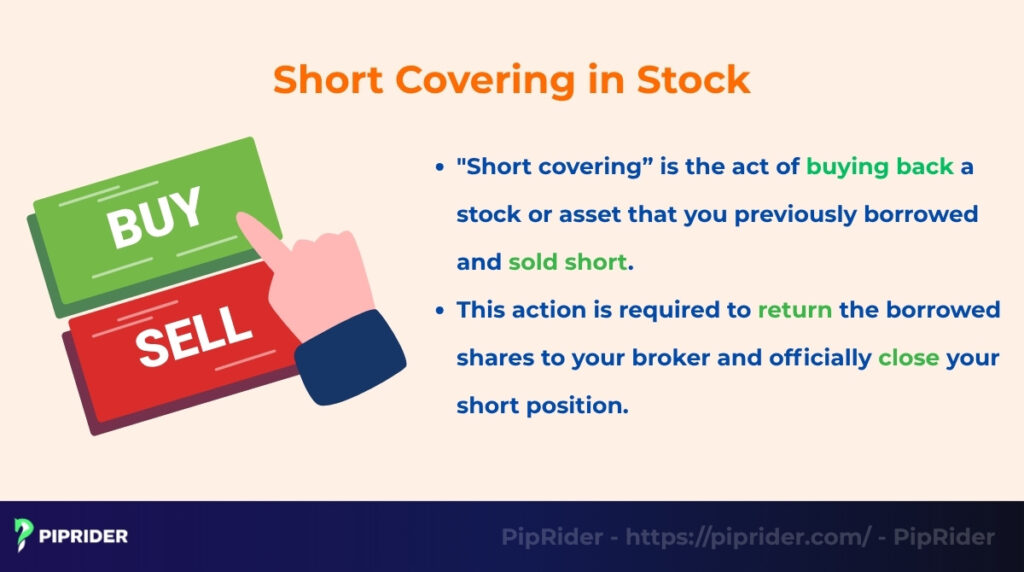
“Short covering” (also known as “buying to cover”) is the act of buying back a stock or asset that you previously borrowed and sold. This action is mandatory to return the borrowed shares to your broker (the lender) and officially close your short position.
As described by financial experts at Investopedia (2024), short covering is technically defined as “buying back borrowed securities in order to close an open short position at a profit or loss.”
A trader typically decides to cover a short position for one of two reasons:
- To take a profit: The stock price has dropped to their target level.
- To limit a loss: The stock price has risen, and they must exit to prevent further losses.
This action is the final step in the short-selling cycle. It is often triggered voluntarily by the trader or forced by a margin call. Because short covering requires buying, a large number of traders covering at the same time can create a surge in demand, causing the stock’s price to jump quickly.
2. The Mechanics of Short Covering
The mechanics of short covering are best understood as the second half of a short-selling trade. The process involves two main phases: opening the short and closing it.
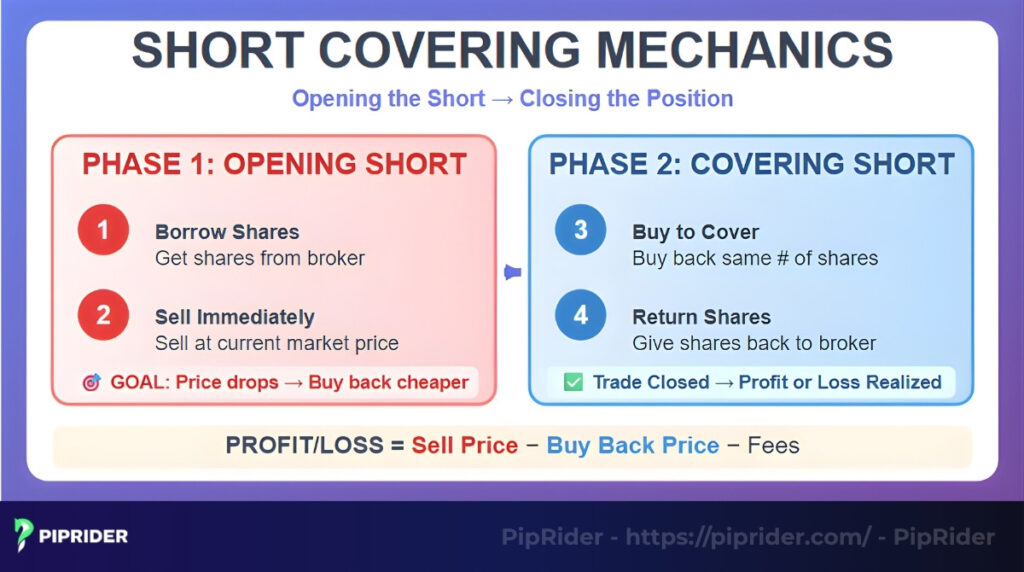
2.1. The Short Selling Phase (Opening the Trade)
First, a trader must open a short position.
- A trader borrows shares of a stock (e.g., 100 shares of XYZ) from their broker.
- They immediately sell those borrowed shares at the current market price (e.g., $50).
- The trader’s goal is for the stock’s price to fall so they can buy it back later at a cheaper price.
2.2. The Covering Phase (Closing the Trade)
Second, the trader must buy to cover.
- To close the trade, the trader must buy back the same number of shares (100 shares of XYZ) from the open market. This action is called “buying to cover.”
- When this purchase is complete, the shares are returned to the broker (the stock lender), and the short trade is finished.
Platform Tip: “Buy” vs. “Buy to Cover”
On most equity trading platforms, you must specifically select “Buy to Cover” on the order ticket rather than a standard “Buy.” This label explicitly tells the broker you are closing a debt. Using the wrong order type can confuse the system, potentially causing order rejections due to insufficient buying power or accidentally opening a separate long position.
2.3. Profit or Loss Realization
The outcome of the trade is determined when the trader covers the position.
| Outcome | Market Movement | Result |
|---|---|---|
| Price Drops | Trader buys back at a lower price | Profit |
| Price Rises | Trader buys back at a higher price | Loss |
In short, the final profit or loss is simply the difference between the price you originally sold the borrowed shares for and the price you paid to buy them back, minus any margin interest and fees.
3. Why Short Covering Matters
Short covering is important because it represents buying demand. When many traders buy at the same time to close their positions, this demand can significantly impact the market.
- Increases volatility: A sudden rush of buy orders from traders needing to close their short positions can cause sharp price spikes and increase market volatility.
- Trigger short squeezes: This is the biggest risk. A short squeeze is a panic-buying feedback loop. It happens when a rising price forces short sellers to cover short positions, which pushes the price even higher, forcing more sellers to cover. This phenomenon, sometimes called a market cover, is extremely dangerous.
- Signal a market reversal: A short cover rally (a rapid price jump caused by short covering) can sometimes be a technical signal that a long downtrend (a bear market) has exhausted itself and the stock may have found a bottom.
4. How to Monitor Short Interest
To identify the risk of a short squeeze before it happens, professional traders monitor “Short Interest” data. This data shows how many investors are currently betting against a specific stock.
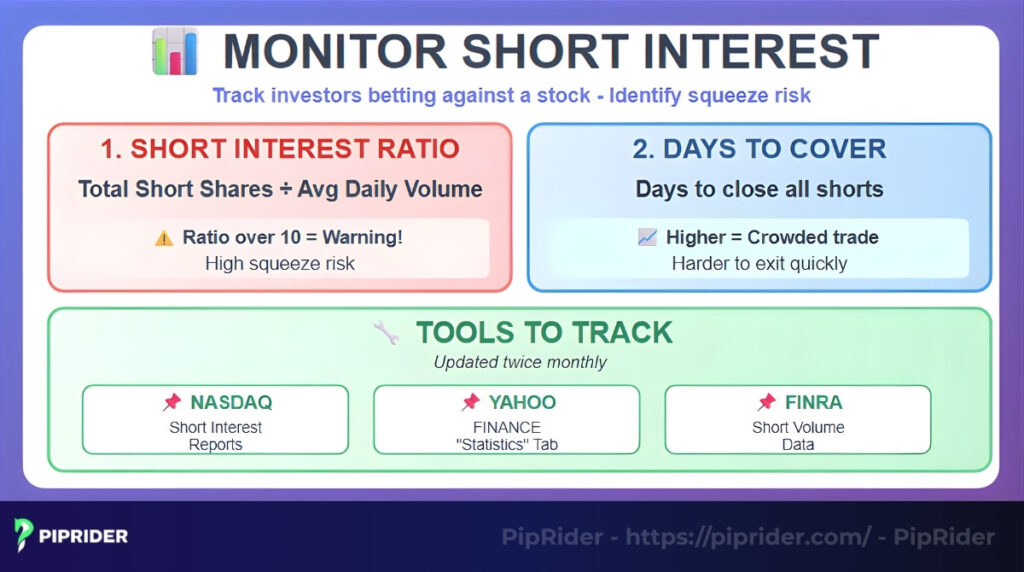
4.1. Short Interest Ratio
This is a key metric used to measure risk. It is the ratio of the total number of shares currently sold short divided by the stock’s average daily trading volume.
A very high ratio (e.g., over 10) is a major warning sign. It indicates that there are many short positions open. If the stock price starts to rise, all these short sellers will need to buy back shares, which can fuel a short squeeze.
4.2. Days to Cover
This metric (which is the same calculation as the Short Interest Ratio) shows how many trading days it would take for all current short sellers to buy back (cover) their shares, based on the average trading volume.
The higher the “Days to Cover” number, the more crowded the trade is. It means it will be very difficult for short sellers to exit their positions quickly if the price moves against them.
4.3. Tools to Track
Traders can find this data, which is usually updated twice a month, from several official and financial sources:
- Nasdaq Short Interest Reports
- Yahoo Finance (This data is available in the “Statistics” tab for a stock)
- FINRA Short Volume Data
⚠️ Critical Distinction: Short Interest vs. Short Sale Volume
Do not confuse these two metrics. Relying on the wrong one can lead to false signals.
- Short Interest (The Snapshot): This is the total number of open short positions held by investors at a specific moment. It is the true measure of bearish sentiment but is only reported twice a month (settlement dates).
- Short Sale Volume (The Flow): This is the number of short trades executed daily. According to FINRA, high short volume does not necessarily mean high bearish interest.
Why the discrepancy? Market Makers often “short” shares momentarily to fill buy orders from customers (providing liquidity) and buy them back immediately. This inflates the “Short Volume” data but adds nothing to the actual “Short Interest” (FINRA, 2023).
5. Short Covering Example
To understand the profit and loss mechanics, consider this practical scenario where a trader decides to short a tech stock.
The Scenario:
- Action: Trader shorts 100 shares of XYZ stock.
- Entry Price: Sold at $60.
- Initial Proceeds: $6,000 (credited to margin account).
The Formula:
To calculate the outcome, use this simple formula:
Scenario A: The Winning Trade (Covering for Profit)
The stock price falls to $50 due to poor earnings. The trader decides to cover the short position to lock in gains.
- Action: Buy back 100 shares at $50.
- Cost to Cover: $5,000.
- Calculation: ($60 – $50) x 100 shares = +$1,000 Profit.
- (Note: Net profit will be slightly lower after deducting broker commissions and borrow fees).
Scenario B: The Losing Trade (Forced Cover)
The stock price unexpectedly rises to $70. The trader hits their stop-loss and must buy to cover immediately to limit damage.
- Action: Buy back 100 shares at $70.
- Cost to Cover: $7,000.
- Calculation: ($60 – $70) x 100 shares = -$1,000 Loss.
Key Takeaway: When covering a short, you want the Exit Price to be significantly lower than your Entry Price. Unlike buying a stock (where loss is limited to the amount invested), a short position theoretically carries unlimited risk if the price keeps rising without a stop-loss.
6. Short Covering in Stocks vs. Forex (Key Differences)
While the goal of “exiting a sell trade” is the same, the mechanics of short covering in Forex trading are fundamentally different from the stock market.
6.1. No “Locating” Lenders Required
In the stock market, you must find a lender to borrow shares before selling (which can be hard or expensive). In Forex, the process is seamless.
- Automatic Execution: When you open a Short position on EUR/USD, the broker automatically handles the “borrowing” of Euros behind the scenes. You don’t need to worry about “Hard-to-Borrow” fees or finding available shares.
- The Cover: Therefore, “covering” in Forex is simply clicking “Close Order”. There is no risk of a “Share Recall” (where a lender forces you to return shares unexpectedly), giving Forex traders more control over their exit timing.
6.2. The Squeeze Risk: Leverage & Stop Hunts
If there is no share recall, can a “short squeeze” still happen in Forex? Yes, and it happens faster.
Unlike stocks (where leverage is typically 1:2), Forex traders often use high leverage (1:50 or 1:100). This amplifies the squeeze risk:
- Stop-Loss Cascades: Clusters of stop-loss orders often accumulate above key resistance levels.
- The “Stop Hunt”: If news breaks and price pushes through this level, these “Buy Stop” orders trigger simultaneously.
- Liquidity Gap: This flood of buy orders creates a “Liquidity Grab”, causing the price to gap up instantly.
PipRider Note: In Forex, a short squeeze is often short-lived but violent. While you won’t get a “Share Recall,” you face a different threat: the margin call. High leverage means a small price spike can force your broker to automatically cover (liquidate) your position to prevent a negative balance.
7. Short Covering vs. Short Squeeze
It is critical to understand the difference between “short covering” (a normal action) and a “short squeeze” (a chaotic market event).
| Feature | Short Covering | Short Squeeze |
|---|---|---|
| Definition | Buying back shares to close a position (Routine). | Forced buying due to lack of supply (Chaotic). |
| Trigger | Voluntary: Trader hits profit target or stop-loss. | Forced: Market pressure forces immediate exit. |
| Common Catalyst | Technical support levels, taking profit, portfolio rebalancing. | Unexpected positive news, Earnings beat, Margin calls, Share recall. |
| Effect on Price | Price moves up gradually or moderately. | Price spikes sharply and vertically. |
| Control | High: Part of the trading plan. | None: Panic-induced reaction. |
In summary, short covering is a planned decision made by an individual trader to exit their position. A short squeeze is a chaotic, cascading reaction forced upon a large crowd of short sellers, where their own panicked buying feeds the price spike against them.
8. Case Study – The GameStop Short Squeeze (2021)
The most famous real-world example of short covering turning into a historic “short squeeze” is the GameStop (GME) event in January 2021.
The Trigger: Hedge funds and institutional investors had heavily shorted GameStop, betting the company would fail. According to a legal report by the U.S. Securities and Exchange Commission (SEC), GameStop was the most heavily shorted stock in the market. At its peak, short interest rocketed to 122.97% of the shares available for trading (SEC, 2021).
The Squeeze: Retail traders on social media identified this vulnerability and began buying aggressively. As the price rose, short sellers faced massive losses and were forced to buy back shares to cover their positions.
- The Surge: In just a few weeks, GME stock skyrocketed from approximately $20 in early January to an intraday peak of $483 on January 28, 2021.
- The Result: This represented a staggering increase of over 2,300%. The SEC report confirmed that while short covering was a key factor, the massive buying pressure from retail investors created a feedback loop that overwhelmed market liquidity.
Lesson: This event proved that even professional funds can be wiped out if they ignore the “Days to Cover” metric and get trapped in a crowded trade.
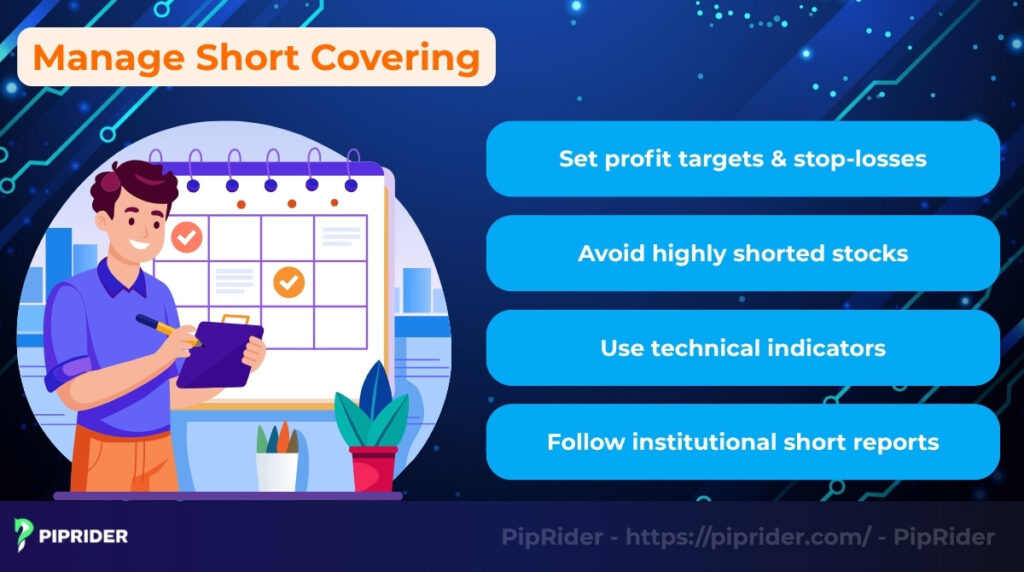
9. Strategies to Manage Short Covering
Effective risk management relies on data, not guesswork. Experienced traders use these three specific strategies to determine the safest time to cover a short position:
9.1. Monitor Crowd Metrics (Short Interest & Days to Cover)
Crowded trades carry high squeeze risks. Before entering, you must quantify market sentiment using these two key metrics to avoid getting trapped:
- Short Interest %: If Short Interest exceeds 20% of the float, the trade is overcrowded. A small price rise can trigger a panic.
- Days to Cover: If this metric is above 10, it indicates that buying pressure will be intense if a squeeze starts.
- Strategy: Avoid shorting stocks with these high metrics. If you are already short and these numbers are rising, it is safer to cover early and exit.
9.2. Watch Borrow Fees & Utilization
Short selling is not free. You must monitor the borrowing costs and supply availability to ensure daily fees don’t eat into your potential profits:
- Stock Borrow Fee: This is the interest rate you pay to borrow shares. If this fee spikes (e.g., jumps from 1% to 20%), it means shares are becoming “Hard-to-Borrow.”
- Utilization Rate: This measures how many lendable shares are currently being shorted. If utilization hits 100%, there are no more shares to borrow.
- Strategy: If Borrow Fees skyrocket or Utilization hits 100%, the risk of a Share Recall (forced buy-in by the broker) is imminent. You should buy to cover immediately.
9.3. Catalyst Risk & Stop-Losses
Volatility can wipe out accounts instantly. Never hold a short position through major news events without a strict exit plan in place:
- Catalyst Events: Avoid holding short positions during earnings reports, FDA approvals, or major product launches. Positive news can cause the stock to gap up instantly.
- Hard Stop-Loss: Always use a “hard” stop-loss order (not a mental one). Since a stock can theoretically rise infinitely, a stop-loss order is your only insurance against unlimited liability.
- Strategy: Place a buy stop order slightly above key resistance levels. If the price breaks out, the system will automatically cover your position to cap your losses.
10. Frequently asked questions about Cover Short Position
11. The Bottom Line
Covering a short position is the essential act of buying back securities to officially close a trade. While this action locks in profits, the buying pressure it generates can fuel volatility or even trigger a dangerous short squeeze. To succeed, traders must treat short interest data and hard stop-losses as non-negotiable tools in their risk management plan, rather than relying on market predictions alone.
To master more advanced techniques in both Stock and Forex markets, explore the in-depth trading strategies available on PipRider.
Infographic Section
-
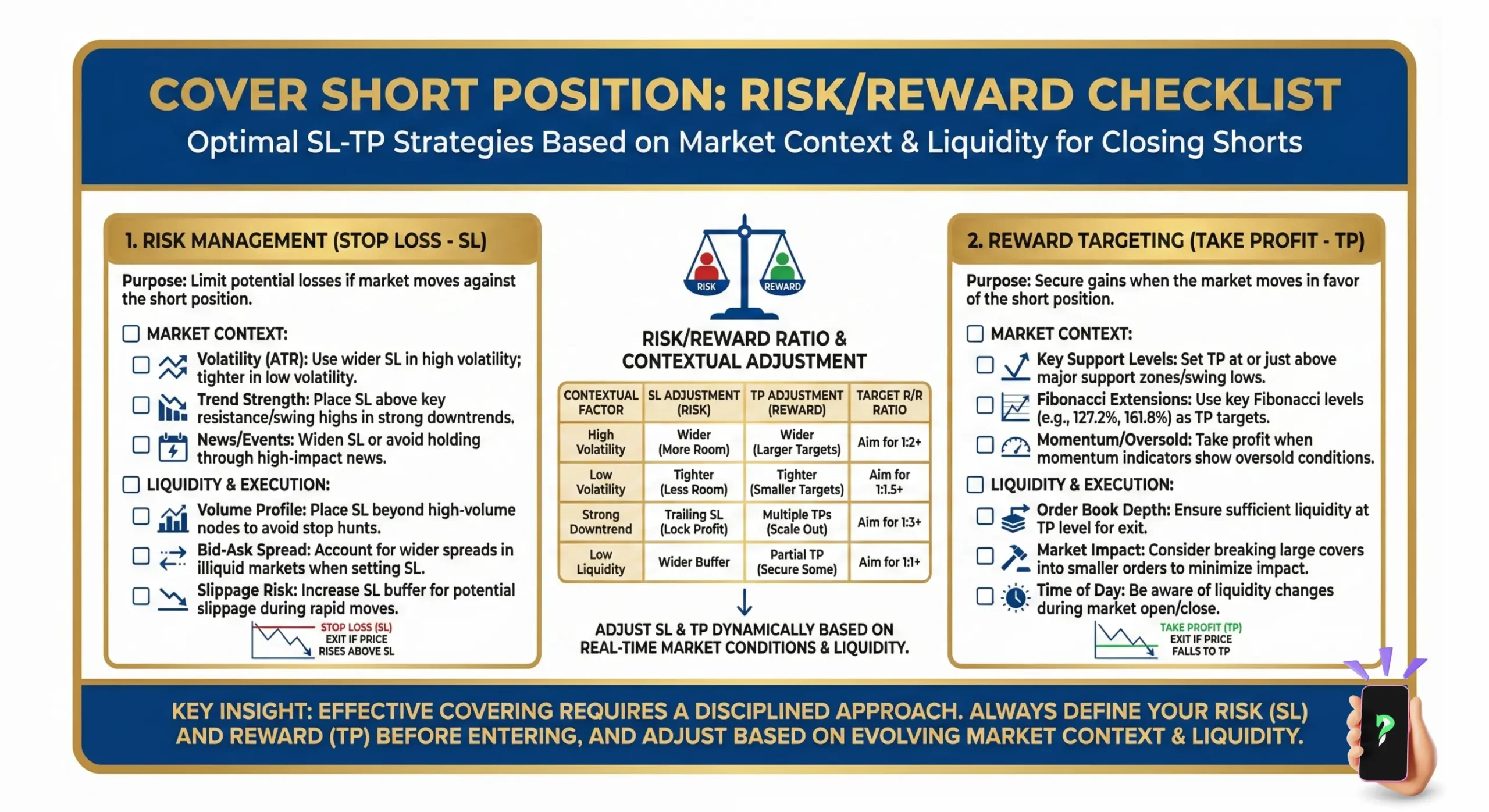
Risk and Reward Checklist -
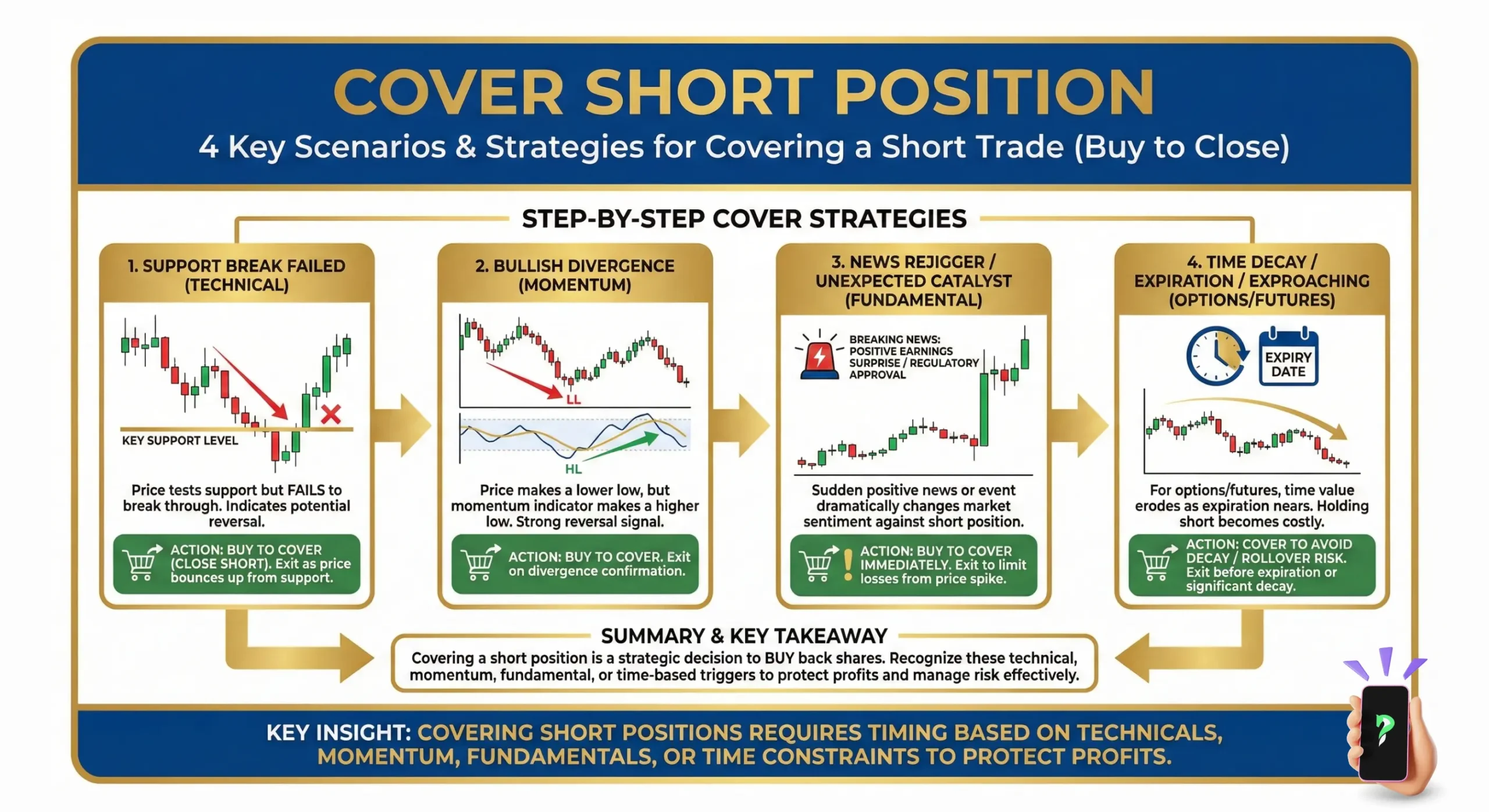
4 Key Scenarios and Strategies -
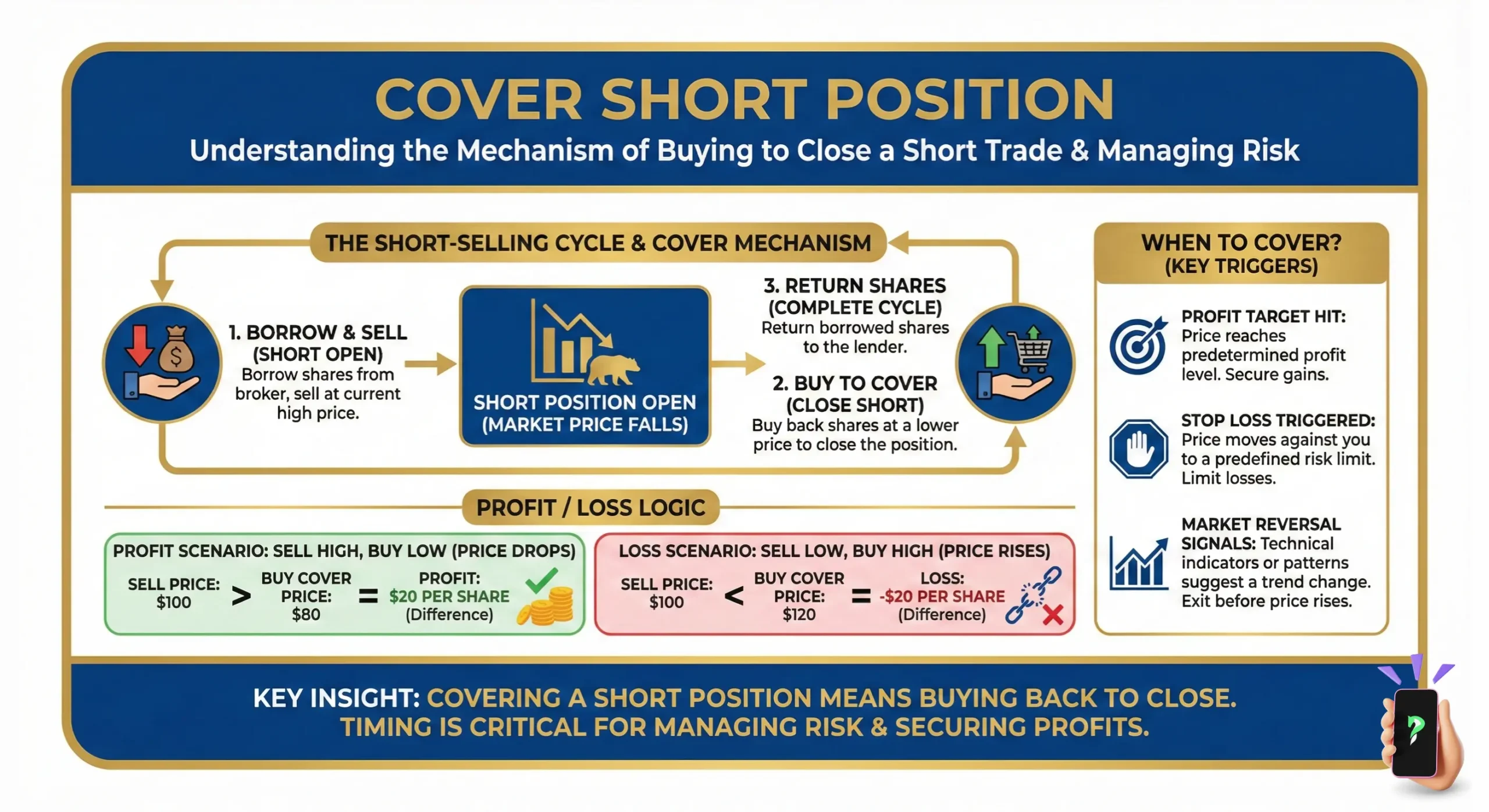
Cover Short Position