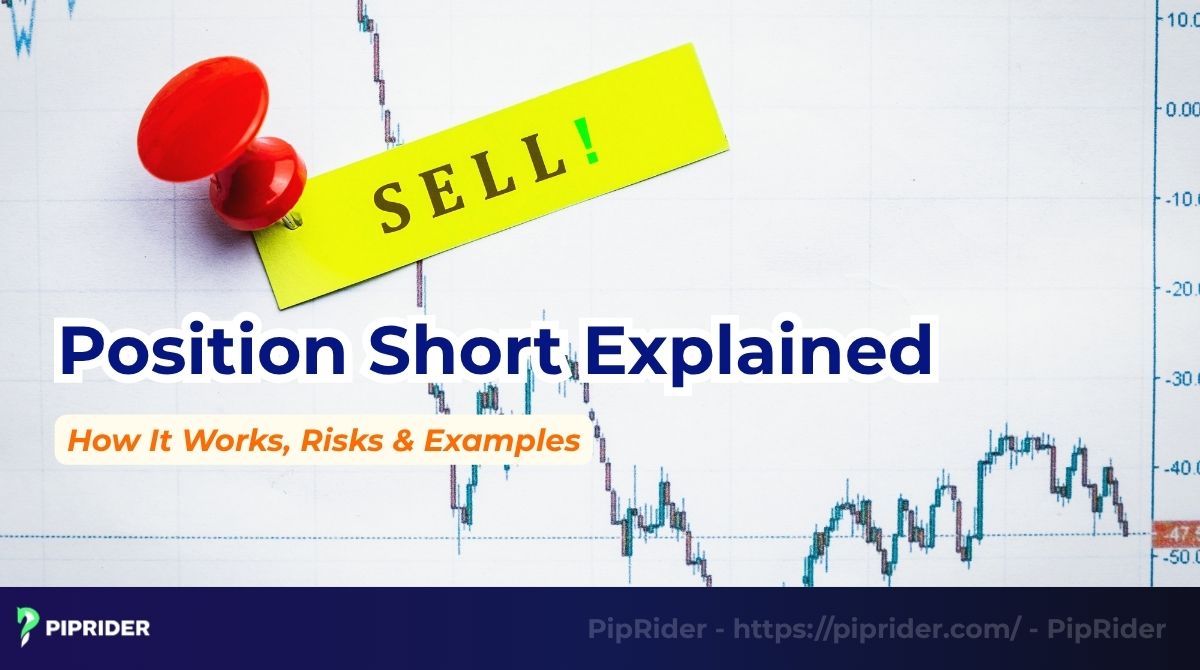
Most investors profit when prices rise. But how do you profit when you believe an asset’s price will fall? The answer is a position short, a strategy designed to profit from a declining market’s price movements.
This guide explains how a short position works, provides a clear shorting example, and details the significant risks, such as “short squeezes.” Piprider will also explain the important difference between shorting stocks and shorting Forex.
Key Takeaways
- What is a financial short? A strategy to profit when an asset’s price goes down.
- What is a short position in stocks? Borrowing shares, selling them, and buying them back later at a lower price to return to the lender.
- The biggest danger of shorting stocks is unlimited loss, as a stock’s price can rise indefinitely.
- Short position is not allowed in a standard cash account; it requires a margin account to borrow shares.
- A “short squeeze” occurs when a rising price forces short sellers to buy back, pushing the price even higher and causing rapid losses.
1. Definition of a Short Position
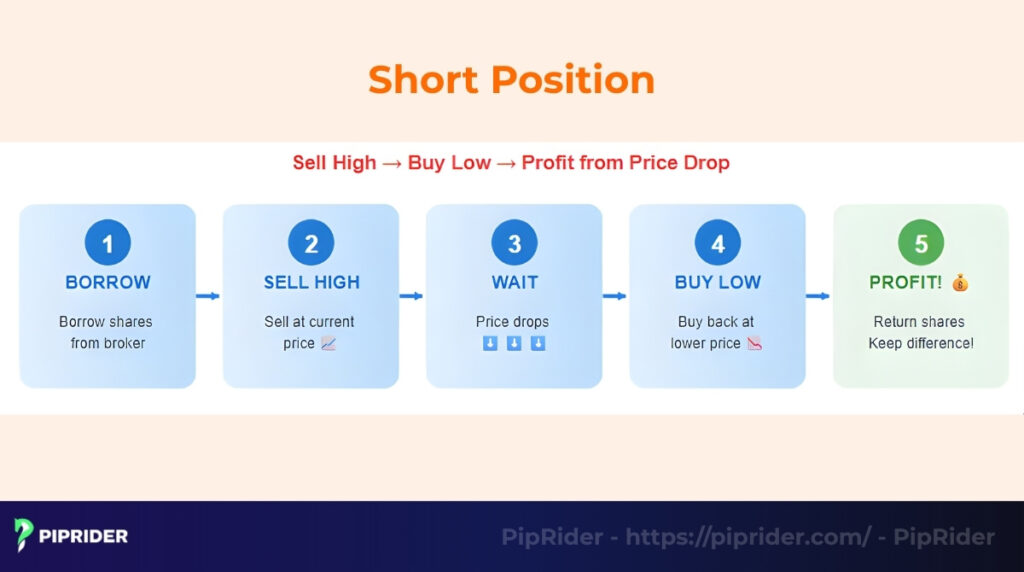
A position short (short selling) involves selling a financial asset that the investor does not currently own, with the expectation that the asset’s price will fall in the future. The trader then plans to buy the asset back at a lower price to return it to the lender, profiting from the price difference.
This strategy is used for two main purposes:
- Speculation: To profit from a market that is going down (a bearish strategy).
- Hedging: To act as a defensive measure to manage risk or protect gains in another long position.
According to financial regulators like the U.S. Securities and Exchange Commission (SEC), a short position is an important part of the market, contributing to price discovery and providing liquidity (SEC, 2024). This strategy is used across many financial markets, including stocks, ETFs, forex trading, foreign exchange, futures, and options trading.
2. Risks and Mechanics of Short Positions
A short position is more complex than a standard “long” position (buying). It involves a specific set of mechanics and carries significant, unique risks that investors must understand.
2.1. How Short Selling Works
This process explains how short positions work in the stock market:
- Borrow shares: The trader first borrows the shares (or security) from their broker. They must borrow the asset before they can sell it.
- Sell the shares: They immediately sell these borrowed shares at the current market price. The cash from this sale is credited to their account, but it is held as collateral.
- Buy to cover: Later, the trader must buy the same number of shares back from the market. This is called “buying to cover.” If the price has dropped as they hoped, they buy the shares back for less money. They then return the shares to the broker and keep the price difference as their profit (minus fees).
2.2. Margin Requirement
Unlike buying stocks, you cannot execute a short sale in a standard cash account. You must use a margin account because you are borrowing an asset.
How much money do you need? Under the Federal Reserve’s Regulation T, the standard Initial Margin requirement is 50%. This means to short sell a stock, you must deposit 50% of the trade’s value in cash, while the other 50% is covered by the short sale proceeds.
The Mechanics (The 150% Rule): When you sell the borrowed shares, the cash from that sale (100% of value) is frozen in your account. Plus, you add your own margin (50% of value).
- Example: To short $10,000 worth of stock:
- Short Sale Proceeds (Frozen): $10,000
- Your Cash Deposit (Margin): $5,000
- Total in Account: $15,000 (150% of the short value).
Maintenance Margin & Risk: After the trade is open, you must maintain a minimum equity level, typically 25% to 30% (Maintenance Margin).
- Warning: Brokers often set higher “house requirements” (e.g., 40-50%) for volatile stocks. If your account equity falls below this limit due to a rising stock price, you will trigger a Margin Call and must deposit more funds immediately.
2.3. Short Squeeze
This is a major risk for short sellers. A short squeeze happens when a stock’s price begins to rise rapidly. This sudden rise forces many short sellers to “cover” (buy back shares) to cut their losses. This flood of new buying pressure pushes the price even higher, creating a panic loop and causing massive losses for any remaining short sellers.
How to gauge Squeeze Risk? (The 2 Key Metrics)
Before entering a short position, smart traders analyze two critical data points to assess the danger level:
- Short Interest (% of Float): This shows the percentage of available shares that are currently being shorted. A Short Interest above 20% is considered extremely high and indicates a crowded trade with high squeeze potential.
- Days to Cover (Short Ratio): This measures how many days of normal trading volume it would take for all short sellers to close their positions. If “Days to Cover” is above 10, it means short sellers will struggle to exit quickly without causing a massive price spike.
Pro Tip: If you see Short Interest climbing while the price refuses to drop, the market is signaling a potential squeeze. In this scenario, it is often safer to Cover short position early rather than risking a catastrophic loss.
2.4. Unlimited Loss Potential
This is the single biggest risk associated with short selling stocks.
- When you buy a stock (a long position), the most you can lose is your initial investment (if the stock price goes to $0).
- When you short a stock, the price can theoretically rise forever. Because you must buy the security back eventually to return it, your potential loss is unlimited. This is the primary risk of unlimited losses.
2.5. Hidden Costs & Operational Risks
Beyond the risk of the price rising, short sellers face unique operational costs that can turn a winning trade into a losing one. Unlike a long position, holding a short position is not free (Charles Schwab, 2024).
A. Hard-to-Borrow (HTB) Fees
Supply and demand dictate the cost of borrowing.
- Easy-to-Borrow: For highly liquid stocks (like Apple or Microsoft), fees are usually negligible.
- Hard-to-Borrow (HTB): For volatile, small-cap, or heavily shorted stocks, brokers charge a Stock Borrow Fee. This is an annualized interest rate that can range from 10% to over 100%. These fees accrue daily, making long-term short positions extremely expensive.
B. Paying Dividends (The “Payment in Lieu”)
This is a common trap for beginners. Since you borrowed the shares from a lender who still expects their benefits, you are liable for any corporate actions.
- The Rule: If you hold a short position through the ex-dividend date, YOU must pay the dividend amount to the lender.
- Impact: This cash is debited directly from your account, instantly raising your break-even price.
C. Share Recall (Forced Buy-In Risk)
In a short sale, you do not have total control over the trade duration.
- The Risk: The lender retains the right to recall their shares at any time. If the broker cannot find other shares to borrow, they will issue a Buy-In Notice.
- Consequence: You will be forced to close your position immediately at the current market price, regardless of whether you are in profit or loss. This often happens during market rallies, forcing you to buy at the top.
3. Setting Up a Short Position: A Step-by-Step Guide
Opening a short position is an active process that involves more steps than simply buying a stock. Here is a step-by-step guide to how it works.
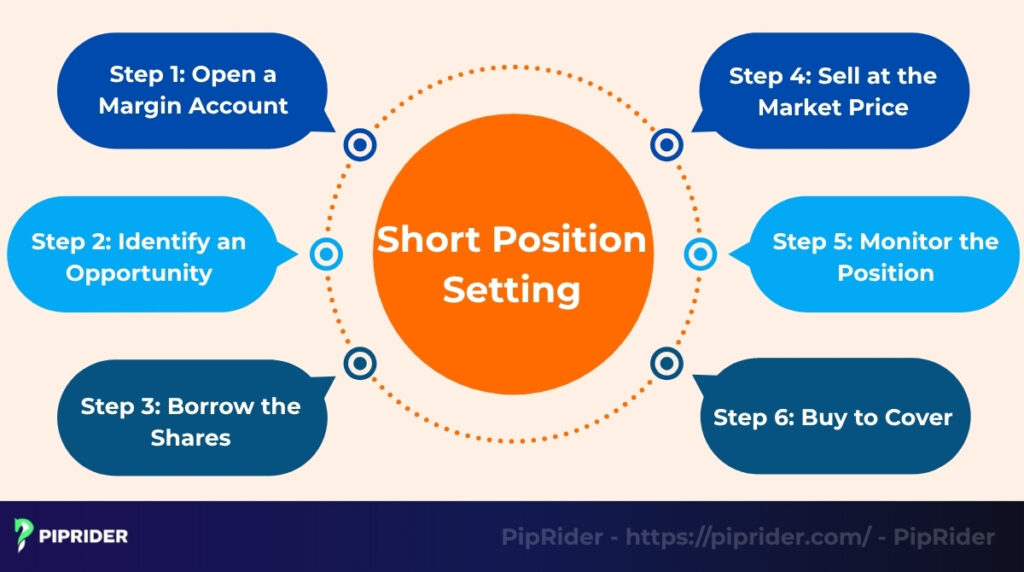
Step 1: Open a Margin Account
You must have a margin account with a licensed broker. A standard cash account does not allow short selling. The margin account is necessary to borrow the shares and to hold the collateral for the loan.
Step 2: Identify an Opportunity
The trader must find a stock or other security they believe is overvalued or likely to fall in price. This analysis can be based on weak company fundamentals, poor technical indicators, or a negative market outlook.
Step 3: Borrow the Shares
The trader instructs their broker to “sell to open” a position. The broker finds the shares to lend and confirms the shares are available (a covered short). Selling a security without first borrowing it is called a naked short, which is illegal for most investors (SEC, 2015). The broker also informs the trader of any borrowing fees (or interest costs).
Step 4: Sell at the Market Price
The broker sells the borrowed shares at the current price. The cash from this sale is credited to the trader’s margin account, where it is held as collateral.
Step 5: Monitor the Position
This is a critical step. The trader must monitor the position constantly. If the stock price rises, their account equity will decrease. A significant price rise could lead to a margin call.
Step 6: Buy to Cover
To close the position, the trader must buy the same number of shares back from the market. This is called “buying to cover.”
- If the price dropped: The trader buys the shares back for less than they sold them for, returning them to the broker and keeping the profit.
- If the price rose: The trader must buy the shares back at a higher price, taking a loss.
4. Real-World Example: Shorting a Stock
This simple shorting example shows how does short position work.
A. The Setup:
A trader believes XYZ stock is overvalued.
- They borrow 100 shares of XYZ stock at $50 per share.
- They immediately sell these borrowed shares for $5,000.
B. Profit Scenario (Price Falls):
- The stock price falls to $40.
- The trader buys back 100 shares for $4,000.
- They return the shares to the broker.
- Result: The trader makes a $1,000 profit (minus interest and fees).
C. Loss Scenario (Price Rises):
- The stock price rises to $60.
- The trader buys back 100 shares for $6,000 to cut their losses.
- They return the shares to the broker.
- Result: The trader takes a $1,000 loss (plus interest and fees).
If the stock price had continued rising to $80 or $100, the loss would have grown larger, demonstrating the unlimited loss potential of this short position.
5. Short position in stocks vs. Forex/CFDs
While the goal is the same—profiting from a price drop—the mechanics of shorting a stock differ significantly from shorting in Forex or using CFDs (Contracts for Difference).
In the Stock Market (Physical Shorting):
As explained above, shorting a stock is a borrowing process. You must locate a lender, borrow the physical shares, and be subject to strict regulations like the “uptick rule” (which prevents shorting while a stock is dropping too fast) or “hard-to-borrow” lists.
In Forex & CFDs (Synthetic/Direct Shorting):
In these markets, shorting is inherent to the product.
- Forex: Currencies always trade in pairs (e.g., EUR/USD). When you “short” EUR/USD, you are simply selling Euros and buying US Dollars simultaneously. No borrowing of shares is involved; it is a direct exchange.
- CFDs: You are entering a contract with your broker to exchange the difference in price. You do not own or borrow the underlying asset. This makes shorting as easy as clicking a “Sell” button.
Comparison: Stock Shorting vs. Forex/CFD Shorting
| Feature | Shorting Stocks | Shorting Forex / CFDs |
| Mechanism | Borrowing: You must borrow shares from a broker/lender. | Exchange/Contract: You buy one currency/contract while selling another. |
| Accessibility | Difficult: Shares may be “hard to borrow” or unavailable. | Instant: Always available (high liquidity). |
| Costs | High: Interest on margin + Stock borrowing fees. | Low: Spread + Swap fees (overnight interest). |
| Dividends | You Pay: You must pay the dividend to the lender if holding during ex-dividend. | Swap Adjustment: You may pay or receive swap/rollover rates. |
| Restrictions | Strict: Subject to “Uptick Rule” or regulatory bans during crashes. | None: You can short freely at any time. |
Key Takeaway: For beginners, shorting via CFDs or Forex is often much simpler and accessible than traditional stock shorting because it removes the complex “borrowing” mechanics and liquidity issues.
6. Comparing Long and Short Positions
The easiest way to understand a position short is to compare it directly to a standard “long position” (buying a stock).
| Feature | Long Position | Short Position |
| Objective | To profit from a price increase. | To profit from a price drop. |
| Initial Action | Buy first, sell later at a higher price. | Sell first (using borrowed shares), buy back later at a lower price. |
| Risk Level | Limited. The maximum loss is your initial investment (if the price falls to $0). | Unlimited. A stock’s price can theoretically rise forever, resulting in potentially infinite loss. |
| Account Type | Can be done in a standard or margin account. | A margin account is mandatory. |
| Example of Profit | Buy at $50 and sell at $70. | Sell at $50 and buy back at $40. |
In summary, a long position has limited risk and unlimited profit potential. A short position in stocks has limited profit potential (the stock can only fall to $0) but unlimited loss potential.
7. Advantages and Disadvantages of Short Selling
Short selling acts as a double-edged sword for investors. While it offers the unique ability to profit during market downturns and hedge portfolios, it introduces an asymmetrical risk profile: your potential profit is capped at 100%, but your potential loss is theoretically unlimited.
7.1. Advantages
Why would a trader accept the risk of unlimited losses? The answer lies in flexibility. Short selling unlocks profit potential during market downturns and provides sophisticated tools for portfolio protection that “long-only” strategies cannot match.
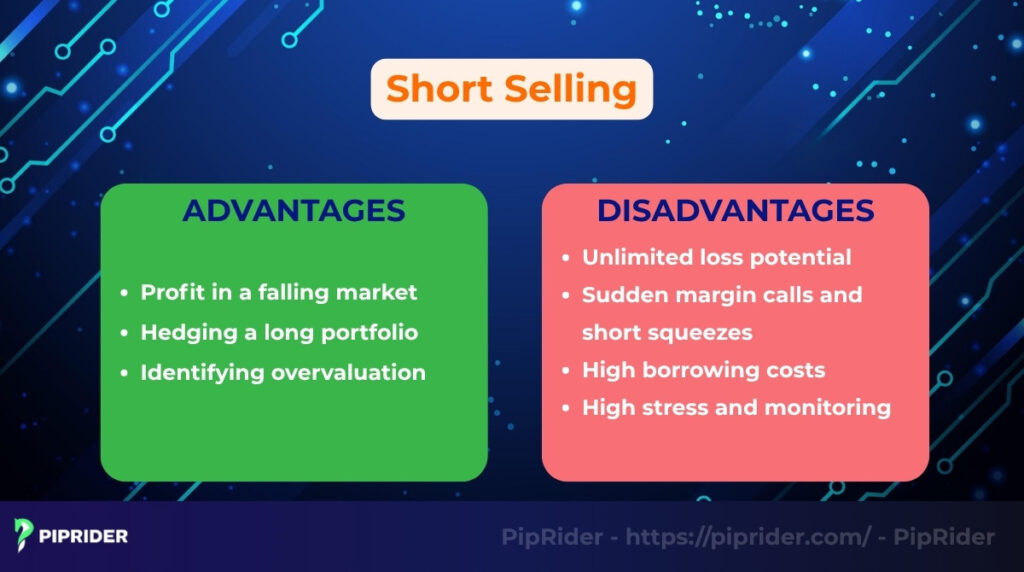
- Profit in a falling market: This is the primary advantage. Short selling is one of the main strategies that allow traders to profit during a bear market or when an individual stock’s price is declining.
- Hedging a long portfolio: Short selling can be used as a “hedge,” or a form of financial insurance. If an investor has a large portfolio of stocks (long positions), they can short an index ETF. This hedging can help offset losses in their long portfolio if the overall market falls.
- Identifying overvaluation: This strategy allows traders to act on research that suggests a stock is overvalued or overpriced. It provides a direct way to profit from identifying (and being correct about) a company’s fundamental weaknesses or inflated stock price.
7.2. Disadvantages
However, the mechanics of shorting create a lopsided risk profile. The math of short selling works against you: your maximum profit is capped at 100% (if the stock goes to zero), but your potential loss has no ceiling.
- Unlimited loss potential: When an investor buys a stock, the most they can lose is their initial investment (if the price goes to $0). When shorting a stock, its price can theoretically rise forever. Because the trader must buy the shares back, the potential loss is unlimited.
- Sudden margin calls and short squeezes: A rapid price increase can trigger a margin call, forcing you to deposit more money or be liquidated. Worse, a “short squeeze” (where a rising price forces all short sellers to buy back at once) can cause extremely fast and massive losses.
- High borrowing costs: Shorting is not free. You must pay interest on the margin loan, and you may also have to pay stock borrowing fees. These fees can be very high for stocks that are popular to short or hard to find (illiquid).
- High stress and monitoring: The knowledge of unlimited risk creates a high-pressure, stressful trading environment. A position short requires constant monitoring and strong emotional control.
8. Risk Management Tips for Short Sellers

Given the high risks, managing a position short requires a strong plan. Here are some key tips that professional traders use.
- Use stop-loss orders: This is the most important rule. A stop-loss order automatically buys back the stock if it rises to a certain price. This defines your maximum loss upfront and protects you from the risk of unlimited losses. A trailing stop can also be used to lock in profits as the price falls.
- Avoid highly volatile stocks: Do not try to short stocks that show extreme volatility. These securities (or any security) are unpredictable and can lead to a short squeeze.
- Maintain a cash buffer: Always keep extra cash or equity in your margin account, far more than the minimum maintenance margin. This “safety buffer” helps you avoid a surprise margin call.
- Diversify your bets: Avoid putting all your borrowed capital into one single short position. A diversified portfolio of different short positions reduces the risk that one bad trade will wipe out your account.
- Monitor news closely: A short seller must always monitor company and market news. Sudden positive news (like good earnings) can cause a stock’s price to gap up instantly, leading to large losses.
9. Frequently asked questions about Position Short
10. The Bottom Line
Position short is a strategy that allows traders to profit from falling prices, but it contains very high risks. It is best suited for experienced, professional traders who fully understand how to manage a margin account. Before ever attempting to short a stock, it is mandatory to understand the mechanics of borrowing a security, the danger of margin calls and the explosive risk of a short squeeze.
For most beginners, safer alternatives like Inverse ETFs or put options offer a way to bet against the market while strictly limiting the potential loss. To learn more about this and other powerful trading strategies, follow PipRider for regular updates and expert analysis.