Learning how to use AI to trade involves using machine learning, automated bots, and big data to analyze the market. This technology helps you speed up your analysis, remove emotions from your decisions, and find opportunities that the human eye might miss. This guide explains the practical ways to use AI, from backtesting and scanning to fully automated trading.
Key Takeaways
- AI trading uses machine learning, automation, and bots to analyze massive amounts of market data.
- AI can detect complex patterns, generate trade signals, analyze market sentiment, and optimize risk management.
- The best results often come from combining AI tools with human analysis, such as price action and market structure.
- AI is a powerful assistant to help you make better decisions; it is not a magic “money machine” that replaces the trader.
- The most popular ways to use AI are through market scanners, automated backtesting systems, and AI-powered signal generators.
1. What Is AI Trading?
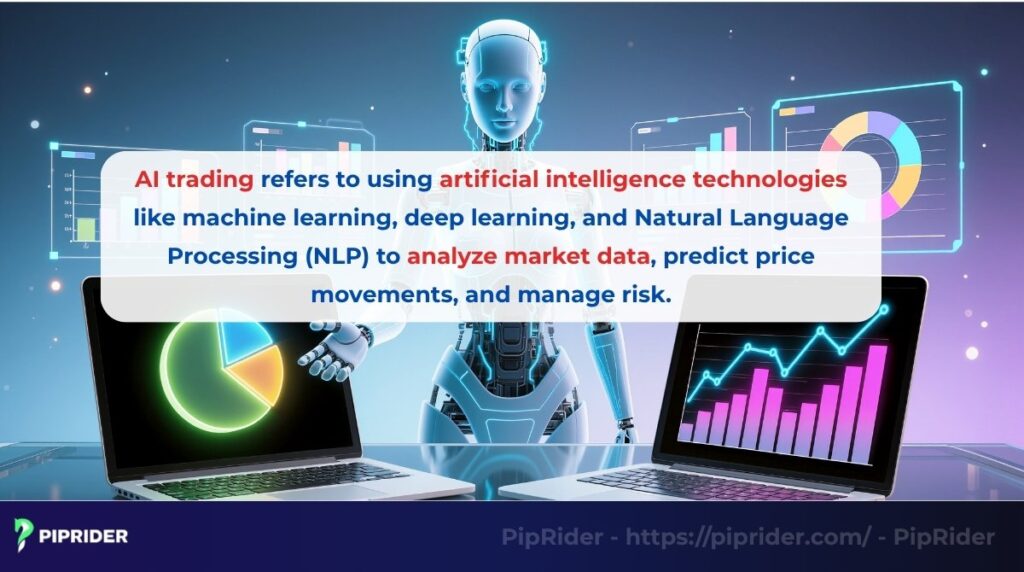
AI trading refers to using artificial intelligence technologies like machine learning, deep learning, and Natural Language Processing (NLP) to analyze market data, predict price movements, and manage risk.
According to the U.S. Securities and Exchange Commission (SEC, 2023), AI-driven tools can process vast datasets faster and with better pattern recognition than traditional human analysis.
It’s helpful to understand how AI trading is different from older concepts:
- Algorithmic trading (which uses simpler trading algorithms) relies on fixed rules (e.g., “IF Relative Strength Index (RSI) is below 30 AND price is above 200-period Exponential Moving Average (EMA), THEN buy”). A human sets these rules, and they do not change.
- Automated trading simply means a bot executes trades for you. Its strategy can be simple (like an Algo) or complex (like an AI).
- AI trading (The evolution) is different because it uses machine learning to identify complex patterns rather than just following fixed rules. While advanced models can learn from new data (like market sentiment), true “adaptation” in live trading still requires a controlled process involving retraining, validation, and strict risk limits. In reality, most retail “AI bots” sold today are closer to advanced automation than fully autonomous, self-evolving AI.
The reason AI is a massive trend in finance is due to big data and faster processing speeds. Computers can now analyze billions of data points (like all market news, social media posts, and price history) in real-time, which was impossible just a decade ago.
2. How Does AI Work in Financial Markets?
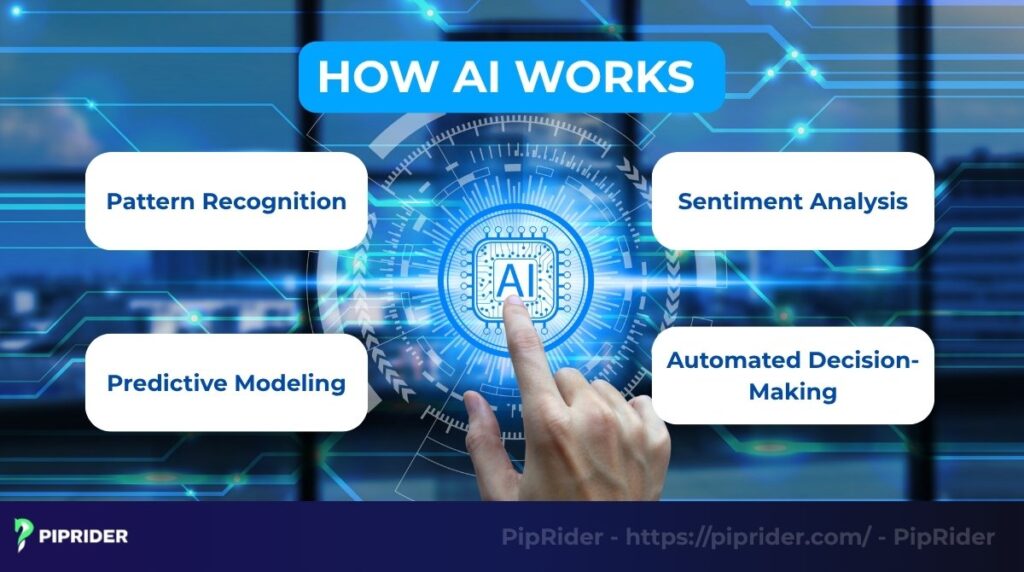
AI functions as a high-speed parallel processing engine. It ingests massive amounts of structured data (price, volume) and unstructured data (news, social media) to transform raw information into actionable trading intelligence through four core technical processes:
2.1. Advanced Pattern Recognition
AI algorithms scan thousands of symbols simultaneously to detect complex price formations. Beyond simple visual patterns, AI identifies multi-dimensional correlations and volume clusters in milliseconds. Through a process known as “Feature Extraction,” the system recognizes recurring technical setups across different asset classes that are mathematically significant but often invisible to the human eye.
2.2. Probabilistic Predictive Modeling
Using Machine Learning (ML), AI builds models designed to forecast probabilities rather than “predict the future.” By analyzing decades of historical tick data, the system identifies “statistical edges”, specific market conditions where a certain price move is more likely to occur than its alternative. These models are validated through rigorous testing to ensure a quantifiable mathematical advantage.
2.3. NLP & Sentiment Analysis
This process bridges the gap between human narrative and quantitative data. Using Natural Language Processing (NLP), AI “reads” millions of unstructured data points, such as news headlines, X (Twitter) feeds, and company earnings transcripts. It quantifies the “market mood” by assigning a Sentiment Score, allowing the system to react to fundamental shifts, like a change in central bank tone, long before the narrative is fully reflected on the price chart.
2.4. Systematic Execution & Logic
Based on its analysis, an AI is programmed to act as a mechanical execution engine. AI trading bots automatically execute trades when specific, pre-programmed conditions are met. This includes opening positions, calculating precise position sizes, and managing exits. This phase is designed to eliminate human emotional bias, ensuring the strategy is followed with 100% consistency.
3. What Are the Benefits of Using AI in Trading?
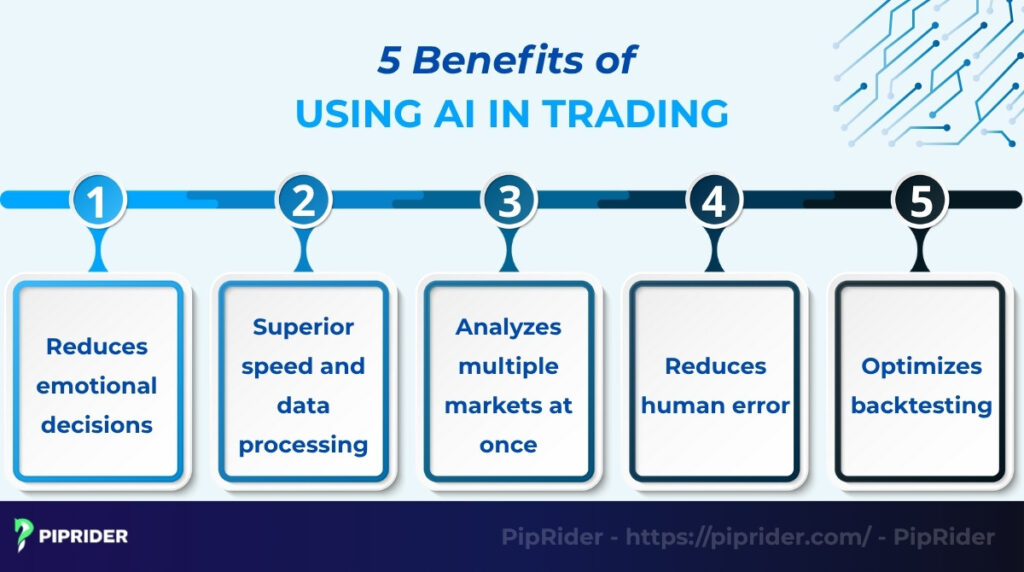
Using AI in your trading process can offer several major advantages over purely manual trading. The main benefits are speed, emotional discipline, and data processing power.
- Reduces emotional decisions: AI is a machine. It does not feel fear, greed, or hope. It will follow the trading plan 100% of the time, removing the biggest weakness all human traders have.
- Superior speed and data processing: The system can analyze millions of data points, read thousands of news articles, and scan every stock in the market in seconds. A human cannot.
- Analyzes multiple markets at once: An AI bot can monitor the Forex, Crypto, and stock trading markets all at the same time, 24/7. It never needs to sleep and will not miss an opportunity.
- Reduces human error: AI reduces the risk of subjective “gut feelings” or common human errors, like making a typo when placing an order (e.g., buying 1000 lots instead of 100).
- Optimizes backtesting: Backtesting a strategy over 20 years of data can be done in just a few minutes. The system can also run thousands of optimizations to find the best parameters, a process that would take a human months.
4. What Are the Limitations and Risks of AI Trading?
AI is a powerful tool, but it is not a magic crystal ball. It has significant limitations, and relying on it blindly is extremely risky. This is the “honest” part of AI trading that you must understand.
- Overfitting to past data: An AI model can be “over-optimized” on historical data. This means it may look perfect in a backtest (e.g., “90% win rate!”), but it will fail completely and give bad trading signals when it faces new, live market conditions that it has never seen before.
- Lack of real-world context: An AI only knows the data it was trained on. It doesn’t understand why a central bank is raising rates (the “human” context) or the “feeling” of a market panic. It cannot “read the room” during a major global event.
- High costs and complexity: Professional-grade, adaptive AI models are extremely expensive to develop and run. Many cheap “trading bots” sold online are often just simple algorithms, not true AI.
- Risk of “black swan” events: AI models learn from the past. They cannot predict a sudden, unprecedented event (like a global pandemic or a surprise war) (Taleb, 2007). When a “black swan” event happens, most AI models are programmed to fail badly because they have no data for it.
5. How to Use AI to Trade (A Step-by-Step Guide)
Learning how to use AI to trade is a process. It starts with defining your goals, choosing the right tool, and testing it thoroughly on historical data before you risk any real money.
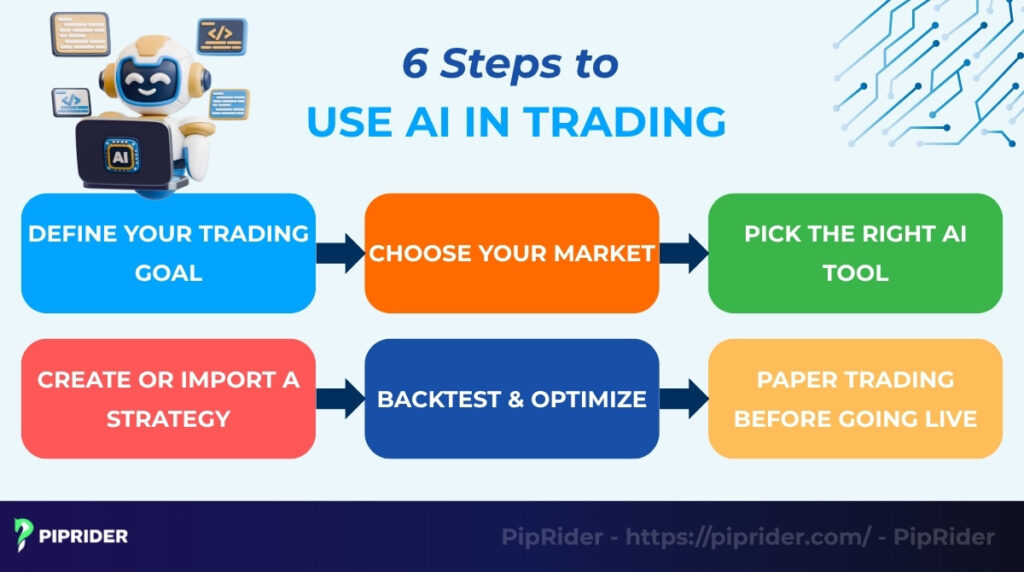
5.1. Step 1: Define Your Trading Objective & Edge
First, you must explicitly define what you want the AI to achieve. Are you using it for high-frequency scalping or medium-term swing trading? Decide if the AI will act as an alpha generator (finding the trade setups based on patterns) or purely as an execution engine (managing risk and executing your manual orders). Knowing your exact “edge” prevents the AI from taking random trades.
5.2. Step 2: Choose Your Market & Data Environment
Second, select your market based on its specific data structure. An AI trained on centralized stock market data will fail in the decentralized Forex market. You must match the AI to the market’s microstructure:
- Forex: Highly liquid but decentralized (OTC data, no universal volume).
- Crypto: 24/7 trading, highly volatile, strongly driven by sentiment and liquidations.
- Equities/Futures: Regulated, with highly accurate Level 2 order book data perfect for volume-based AI models.
5.3. Step 3: Pick the Right AI Tool (Based on Tech Skills)
Next, align the tool with your technical proficiency so you don’t get overwhelmed:
- No-Code Automation (Capitalise.ai): For traders who want to translate their manual rules into automated execution using plain English.
- AI Scanners (TradingView / TrendSpider): For discretionary traders who want AI to spot patterns (like FVGs or Breakouts) but want to pull the trigger themselves.
- Quant Platforms (QuantConnect / MetaTrader): For advanced users who want to build, backtest, and run complex algorithmic models using Python or MQL5.
5.4. Step 4: Define the Logic & Inputs
An AI tool needs strict rules to prevent it from finding meaningless correlations. Define its inputs clearly: will it analyze price action, order flow, or news sentiment? Then, build the core logic. For example: “If the price closes above the 50-EMA, AND confirmed order flow spikes by 200%, AND the FinBERT news sentiment is bullish, THEN look for a pullback entry.”
5.5. Step 5: Backtest & Validate (The Anti-Overfitting Checklist)
This is the most critical step. A strategy that looks like a “holy grail” on historical data can easily destroy your account in live trading if it is “overfitted” (curve-fitted). To ensure your AI model is robust, you must run it through this strict validation checklist before risking a single dollar:
- Data Split (In-Sample vs. Out-of-Sample): Never test the AI on the same data it was trained on. Train it on “In-Sample” data (e.g., 2015–2020), then validate its performance on completely unseen “Out-of-Sample” data (2021–2025).
- Walk-Forward Analysis: Use rolling windows to continuously test how the AI adapts to new, unseen blocks of data over time, simulating real-world forward execution.
- Include Execution Costs: Always program your backtest to deduct real-world spread, broker commissions, and expected slippage. A strategy that wins by 1 pip will bleed to death from hidden costs.
- Ban “Lookahead Bias”: Ensure your code isn’t accidentally cheating by using data from the future (e.g., calculating a signal at the market open using the daily close price that hasn’t happened yet).
- Stress Test Across Regimes: A good AI must survive different “weather conditions.” Test it specifically in high-volatility news periods, grinding sideways ranges, and aggressive runaway trends.
- Max Drawdown Guardrails: Define a hard “Max Drawdown” limit (e.g., 15%). If the strategy breaches this limit during the out-of-sample test, the model goes straight to the trash.
5.6. Step 6: Forward Paper Trading (The True Test)
Finally, never use a new AI strategy with real money right away. You must forward-test it on a live demo account (Paper Trading). However, do not just test it for “a few weeks.” A robust forward test requires statistical significance—aim for at least 100 executed trades or let it run long enough to experience multiple market regimes (both trending and chopping phases). This proves the AI’s logic holds up against live broker feeds and changing market sentiment.
6. What Are the Best Ways to Use AI in Trading Today?
Today, traders use AI in many practical ways, not just for complex automated trading bots. The most popular uses include AI-powered market scanners to find setups, advanced backtesting systems to test strategies, and sentiment analysis tools to read the news.
6.1. AI Signal Generators
These tools use complex machine learning (ML) models to analyze market data in real-time. When the AI’s algorithm finds a high-probability pattern, it generates a simple “Buy” or “Sell” signal. The trader is then expected to review this signal (not follow it blindly) before acting. This approach is especially effective when using swing trading signals filtered by AI to identify medium-term trends without being distracted by short-term market noise.
6.2. AI Market Scanners
Think of these as an “all-market” watch list. AI scanners can monitor thousands of stocks or forex pairs in real-time. They are programmed to find specific technical setups like breakouts, volume spikes, Fair Value Gaps (FVGs), or liquidity sweeps.
6.3. Automated Trading Bots
These are systems that can execute an entire trade from start to finish. Once programmed, they can automatically place orders, manage the position with a trailing stop-loss, and take profit at a set target, all without human intervention.
6.4. AI Backtesting Systems
This is one of the most powerful uses of AI. An AI-driven backtester can test a trading strategy across decades of historical data (millions of data points) in just a few minutes. This process yields a statistical report on its performance metrics. By backtesting AI-generated trading ideas, you can verify the robustness of a strategy before committing real capital to the market.
6.5. AI Sentiment Analysis Tools
Using Natural Language Processing (NLP), these tools “read” the news for you. They scan thousands of news articles, social media (X) posts, and company earnings transcripts to give you a “sentiment score” (e.g., 75% Bullish) on an asset.
6.6. AI Risk Management Tools
These tools act as a professional risk manager to standardize your risk rules. They can automatically calculate your position size based on a strict 1% risk rule and set your volatility-based stop-loss (SL) and take-profit (TP) levels to maintain a target risk-reward ratio. However, remember that no AI can calculate a “perfect” position—actual results will always depend on your strategy’s underlying assumptions, market slippage, and execution costs. Utilizing AI here is about maintaining cold consistency and protecting your account from emotional decisions during volatile sessions.
7. How Do You Combine AI With Technical Analysis? (Confluence)
The true power of AI lies not in replacing human judgment, but in acting as a high-speed quantitative filter. The most robust trading systems in 2026 utilize a “hybrid” model: AI handles the data-heavy processing, while the trader provides the qualitative context. This synergy creates a high-conviction Confluence.
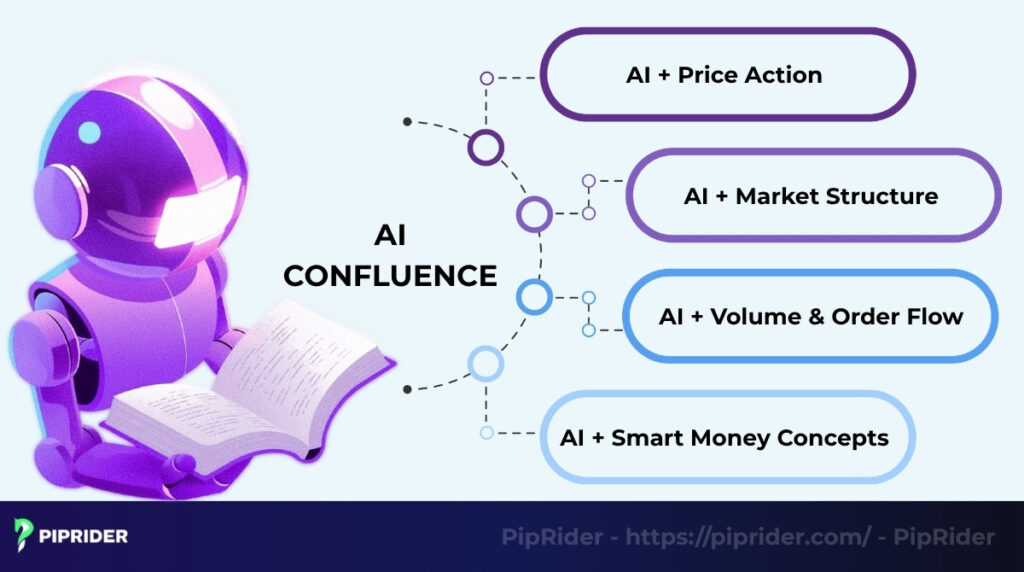
7.1. AI + Price Action (Pattern vs. Narrative)
AI can process thousands of price candles to identify statistical anomalies, but it often lacks the ability to interpret the “narrative” behind a specific move.
- The Process: Use an AI scanner to identify patterns like a statistical deviation or an RSI extreme. You, the trader, then perform a qualitative check on the candle’s reaction at a key level (e.g., verifying if a Pin Bar is actually rejecting a high-volume zone or just a minor fluctuation).
7.2. AI + Market Structure (Macro Filtering)
Standard AI models can sometimes suffer from “recency bias,” focusing too heavily on immediate data. Human oversight ensures the system remains aligned with the broader market trend.
- The Process: When an AI generates a “Buy” signal on a lower timeframe (M15), you apply a Higher Timeframe (HTF) filter. If the H4 structure is bearish, you ignore the AI’s signal. This ensures that the algorithm only operates in the direction of the institutional flow.
7.3. AI + Volume & Order Flow (Data Integrity)
AI is exceptionally efficient at analyzing data that is invisible to the human eye, such as high-frequency order flow and volume depth. However, the integrity of this confirmation depends entirely on the data environment.
Important Note for Forex Traders: Because spot FX is decentralized (OTC), there is no central exchange to show true “market-wide institutional volume.” In spot FX, your AI must treat volume metrics as broker-specific activity (Tick Volume). Conversely, if you trade Futures or Crypto, the AI can use actual DOM (Depth of Market) or Level 2 data to identify institutional “iceberg orders” and filter out “fakeouts” with much higher precision.
The Workflow: When you see a breakout on the chart, the AI acts as a secondary verification layer. It cross-references the price move with a sudden spike in order flow or momentum acceleration. If the volume (or tick activity) doesn’t support the move, the AI flags it as a low-conviction setup, helping you avoid “bull traps.”
7.4. AI + Smart Money Concepts (SMC Efficiency)
Identifying Fair Value Gaps (FVGs), Order Blocks, and Liquidity Pools across 20+ pairs is a repetitive, low-value task for a human but a high-efficiency task for AI.
- The Process: Use an AI tool to map out these complex SMC zones automatically. This allows you to focus 100% of your energy on the Trade Execution and Risk Management phases once the price enters your pre-identified “Point of Interest” (POI).
8. What Are the Top AI Tools for Trading? (With Use Cases)
To choose the right tool, you must distinguish between Generative AI (which assists with logic) and Machine Learning Models (which identify statistical patterns). Here is the 2026 industry-standard classification:
| Tool | Primary Function | Skill Level | Ideal For |
|---|---|---|---|
| ChatGPT / Claude | Strategy Logic & Coding | Low / No-code | Strategy brainstorming |
| TradingView AI | Visual Pattern Analysis | No-code | Technical analysis |
| TrendSpider | Automated Scanning (ATA) | No-code | Multi-market monitoring |
| Capitalise.ai | NLP Execution (Rules-to-Code) | No-code | Automating manual rules |
| QuantConnect / MT5 | Algo Dev & Backtesting | High (Python/MQL5) | Professional Quants |
| FinBERT / AlphaSense | News & Sentiment Analysis | Medium (API/Data) | Macro & News traders |
8.1. ChatGPT & Claude (Strategy Logic & Code Generation)
Generative AI acts as a “Human-in-the-loop” assistant. It is the bridge between a trading idea and an executable script.
- Best for: Discretionary traders who need to brainstorm, debug Pine Script/Python code, or simplify complex economic reports.
- Typical Use Case: Asking Claude to “Convert this manual EMA-Cross logic into a backtestable TradingView script with risk management parameters.”
8.2. TradingView AI-Powered Indicators (Visual Statistical Analysis)
TradingView has evolved to support scripts utilizing ML Libraries (like Lorentzian Classification or KNN). These tools don’t just plot lines; they classify historical data clusters.
- Best for: Chartists who want a statistical “second opinion” on trend shifts and price exhaustion points.
- Typical Use Case: Using an AI-based “Probability Overlay” to see the statistical likelihood of a reversal based on similar historical price action.
8.3. TrendSpider (Automated Technical Analysis – ATA)
TrendSpider specializes in “Chart Fatigue” reduction. It uses AI to automate the tedious work of finding patterns across thousands of symbols.
- Best for: Swing traders who monitor a wide watchlist and need instant detection of breakouts, SMC liquidity sweeps, or chart patterns (VCP).
- Typical Use Case: Setting an AI-Scanner to alert you only when a stock from the S&P 500 forms a “Bullish Divergence” on the H4 timeframe.
8.4. Capitalise.ai (NLP-Based Automation / Rules-to-Code)
This is a “Rules-to-Code” engine that uses Natural Language Processing (NLP) to democratize algorithmic execution for non-coders.
- Best for: Discretionary traders who have a strictly defined manual system and want to automate execution without learning Python or MQL5.
- Typical Use Case: Typing “If BTC/USD crosses above the Previous Day High AND Volume is above 2 times the 20-bar moving average, buy $500 of BTC/USD and set a 5% Trailing Stop.”
- Crucial Note: This is strictly an execution tool, not a predictive AI model. It does not forecast market direction. Furthermore, the NLP engine requires mathematically definable inputs (e.g., “Previous Day High” or “50-EMA”) and cannot process subjective human concepts (e.g., “when the price hits my resistance line”).
8.5. QuantConnect & MetaTrader 5 (Quantitative Research & Execution)
These are the heavyweights for Quant Developers. They provide high-fidelity backtesting engines and direct market access for custom-built neural networks.
- Best for: Advanced traders and Quants who build, train, and deploy custom machine learning models on massive tick-data sets.
- Typical Use Case: Using QuantConnect (Python) to run a walk-forward optimization on a statistical arbitrage model across 10 years of historical data.
8.6. FinBERT & AlphaSense (Institutional Sentiment Analysis)
These tools utilize Financial NLP models specifically trained on 10-K filings, earnings transcripts, and financial news.
- Best for: Fundamental and Macro traders who want to quantify “market mood” (Sentiment) from unstructured text data.
- Typical Use Case: Generating a real-time Sentiment Score for a company’s earnings call to anticipate a price move before the market fully digests the text.
9. Example: Using AI in a Real Trading Scenario
Professionals don’t use AI to replace judgment but as a powerful assistant for a hybrid model that combines automation with manual confirmation.
- AI detects trend shift: An AI script monitors multiple markets and alerts the trader to a potential trend shift on the H4 timeframe.
- Manual confirmation: The trader does not trade the alert blindly. They manually confirm the signal using market structure, looking for a “Break of Structure” (BOS) or “Change of Character” (CHoCH).
- AI scans for setups: Once the trend is confirmed, an AI scanner finds specific setups, like Fair Value Gaps (FVGs), within that new trend.
- Human confirms confluence: The trader only takes the FVG trade if it aligns with their manual analysis (e.g., it’s in a “discount” zone or near a key support level).
- AI optimizes risk: Before entering, an AI-powered risk management or portfolio management tool automatically calculates the position size (for a 1% risk rule) and helps set a volatility-based stop loss using the ATR indicator.
10. What Are Some AI Trading Strategies That Work?
AI-powered trading strategies are not “magic.” They are essentially advanced, rule-based quantitative models that use machine learning to process multi-dimensional data, calculate probabilistic scores, and execute trades with higher consistency than a human. Here is how institutional-grade systems actually deploy AI:
10.1. Multi-Factor Trend Following
Instead of relying on a single static indicator (like a 50-EMA), an AI model utilizes a multi-factor scoring system. The model weighs multiple inputs simultaneously: price momentum, relative volume depth, and NLP-derived news sentiment. It does not look for a “perfect setup” but rather a high-probability confluence. A “Buy” signal is only generated when the combined weighted score crosses a strictly defined threshold, reducing the emotional bias of entering a trend too early or too late.
10.2. Volatility-Adjusted Mean Reversion
Machine Learning (ML) is highly effective at identifying statistical anomalies where an asset’s price has deviated significantly from its historical mean. Unlike basic retail oscillators (like RSI), an AI model calculates dynamic volatility bands based on current market regimes. It triggers a mean-reversion trade only when the price reaches a statistical extreme (e.g., a 3x standard deviation Z-score) while identifying an exhaustive order flow pattern. This prevents the bot from “catching a falling knife” during strong trending moves.
10.3. AI-Assisted Pattern Recognition (VCP & Breakouts)
AI excels at scanning thousands of symbols to detect Volatility Contraction Patterns (VCP) or tight consolidation ranges that are invisible to the naked eye. When a breakout occurs, the AI acts as a verification engine. It cross-references the breakout with micro-structural data—such as a sudden surge in confirmed order flow or momentum acceleration. This objective data filtering helps traders distinguish between a high-conviction breakout and a low-liquidity “bull trap” or “fakeout.”
10.4. Dynamic Trade Management (Volatility-Based Trailing)
One of the strongest applications of AI is in trade execution and management rather than just entry. Instead of using a fixed, arbitrary Risk-Reward ratio (like 1:2), the AI manages open positions based on real-time market behavior. If the model detects a surge in institutional backing and low counter-party pressure, it may utilize a volatility-adjusted trailing stop (often based on a multiple of the Average True Range – ATR). This allows the system to systematically capture larger price swings during high-momentum phases while protecting capital when volatility spikes.
11. What Breaks AI Systems in Live Trading (The Execution Trap)
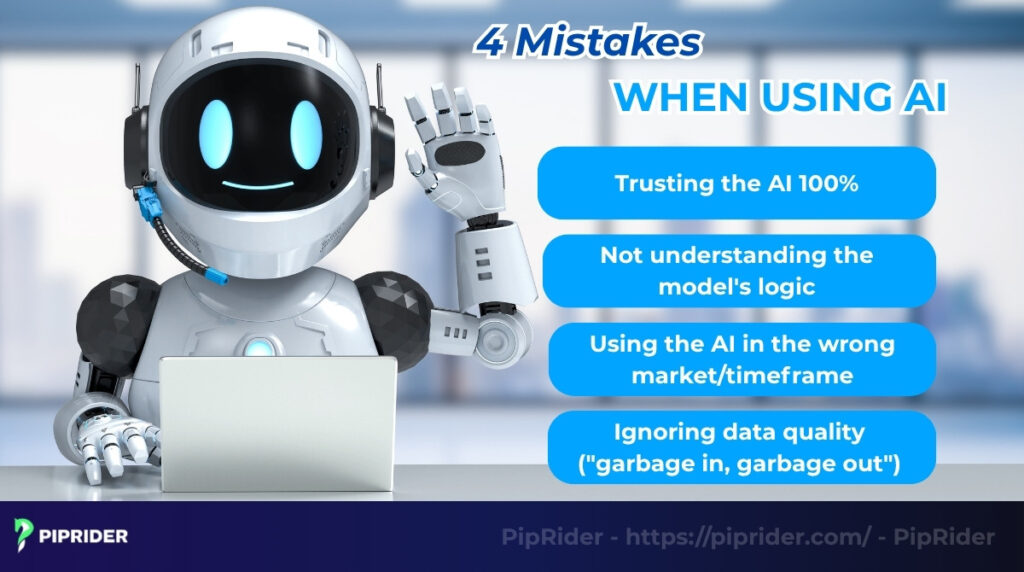
An AI strategy can display a flawless equity curve in a backtest but severely underperform in a live account. This discrepancy occurs because backtests often assume perfect execution. In live markets, AI models must navigate a hyper-competitive environment where “microscopic friction” can quickly erode a statistical edge. Here are the primary factors that break AI systems in live conditions:
- Transaction Cost Attrition: High-frequency or scalping AI models are extremely sensitive to costs. If an AI’s average winning trade yields a tight margin, the cumulative impact of broker spreads, overnight swap fees, and commissions can turn a mathematically winning model into a losing one.
- Liquidity Voids & Slippage: An AI might generate a precise “Buy” signal exactly during a major news release (e.g., CPI or NFP). However, during these events, top-of-book liquidity is often pulled. The bot will not get filled at its requested limit price; it will suffer severe negative slippage or face requotes (order rejections).
- Varying Market Regimes & Impact: An AI model optimized during the high-volume London/New York overlap may generate false signals during the thin Asian session. Furthermore, if the bot executes large position sizes in a low-liquidity environment, its own orders can move the price against it (known as Market Impact).
- Partial Fills (Equities, Futures & Crypto): The AI calculates an exact position size (e.g., 10 contracts) to maintain its risk parameters. But if the live order book lacks sufficient depth at that price, the bot receives a “partial fill” (e.g., 3 contracts). The system is now managing a skewed risk exposure that the backtest never accounted for.
- Infrastructure & Latency Risk: Running an automated strategy on a standard home internet connection introduces unacceptable operational risk. Institutional algorithms operate in milliseconds. To minimize latency and prevent execution failures from connection drops, retail automated systems must run on a dedicated VPS (Virtual Private Server) co-located near the broker’s trade servers.
12. Combating “Model Drift”: The Live Monitoring Playbook
Markets are highly dynamic, meaning an AI model that dominates today will slowly lose its edge as market regimes shift, a phenomenon known as Model Drift (or Alpha Decay). You cannot simply turn on an automated bot and walk away. Professional algorithmic traders enforce a strict weekly monitoring playbook and a mechanical “kill switch” to protect their capital.
The Weekly Key Performance Indicator (KPI) Tracker:
- Win Rate & Average R: Compare the live win rate and Risk-to-Reward (R) ratio against your out-of-sample backtest baseline. A sudden drop indicates the market environment has shifted.
- Max Adverse Excursion (MAE): Measure how deeply trades go into the red (against you) before eventually hitting your take-profit. If the MAE starts widening, your AI’s entry precision is deteriorating.
- Execution Friction: Log the exact slippage and spread paid per trade to ensure broker costs aren’t secretly consuming your statistical edge.
The Hard “Kill Switch” Rules:
You must define mathematical thresholds to pull the plug before emotional panic sets in.
- Hard Drawdown Limit: If the live account hits a predefined maximum drawdown (e.g., -10%), the bot is paused automatically. No exceptions.
- Edge Breakdown (Consecutive Fails): If the model suffers a statistically improbable losing streak (e.g., 8 losses in a row) or underperforms over a rolling 50-trade sample, the edge is considered broken.
- The Protocol: Once the kill switch is triggered, the AI is taken offline. It must go back to the lab for retraining, parameter re-optimization, and fresh out-of-sample validation before touching live funds again.
13. The Dark Side of AI: How to Avoid AI Bot Scams
As AI technology dominates the financial narrative in 2026, bad actors have flooded the market with fraudulent tools. Regulatory bodies are taking strict notice. The U.S. Commodity Futures Trading Commission (CFTC) explicitly issued a customer advisory stating that “AI won’t turn trading bots into money machines“ (CFTC, 2024), warning retail investors against scams exploiting AI hype. Similarly, the UK’s Financial Conduct Authority (FCA, 2023) regularly flags unauthorized firms offering algorithmic trading with unrealistic promises.
Before purchasing any AI tool or funding an automated account, run it through this strict scam-detection checklist. If you spot any of these red flags, walk away immediately:
- Promises of “Guaranteed Returns”: Financial markets are inherently probabilistic. Any vendor promising “zero risk,” “guaranteed daily profits,” or “99% win rates” is running a scam.
- The “Black Box” of Secrets: Scammers hide behind marketing buzzwords like “Secret Wall Street AI” or “Institutional Algorithm.” A legitimate developer will explain the model’s core logic rather than hiding behind “secret math.”
- No Verifiable Track Record: The vendor shows screenshots of massive profits but refuses to provide a live, third-party audited track record (like Myfxbook) or broker-verified statements.
- Unregulated Brokers: You are forced to deposit your trading capital into a specific, unknown, or unregulated offshore broker chosen by the vendor.
- Anonymous Crypto Wallets: The vendor demands that you pay for the bot or fund your trading account via direct cryptocurrency transfers to an unverified wallet.
- The Withdrawal Trap: When you attempt to withdraw your “profits,” the platform refuses the request, claiming you must first pay upfront “AI maintenance taxes” or release fees.
- “VIP” Upsells for Losing Bots: When the basic AI bot inevitably loses your money, the vendor claims the market has changed and pressures you to buy a more expensive “VIP/Pro Algorithm” to recover your losses.
14. Frequently asked questions
15. Conclusion
AI is a powerful tool in trading, but it is not a magic solution. The real power of how to use AI to trade comes from combining AI’s data analysis with a trader’s own price action skills and strict risk management.
Always start with backtesting and paper trading on a demo account. Most importantly, you must understand the logic of the AI model you are using before risking real money. To learn more about the trading strategies that AI can help you test, explore the free guides at Piprider.