Have you ever noticed how on some days, the stock market soars and high-yield currencies rally, while on other days, everyone seems to rush into the safety of the US dollar or gold? This is the global financial markets’ “mood” swinging between two states: risk on and risk off.
Understanding this market sentiment is a crucial skill for Forex traders, as it dictates the flow of capital across the globe and determines which currencies are in demand. This guide explains what drives these cycles, which assets to watch, and how to use this knowledge in your risk on risk off trading strategy.
Key Takeaways
- Defines sentiment: “Risk-on” = optimistic investors seek risk; “Risk-off” = fearful investors seek safety.
- Asset flows: Risk on favors stocks & AUD/NZD; Risk off favors bonds, gold, USD/JPY/CHF.
- Driven by: Economic data, central bank policy, and geopolitical events shift sentiment.
- How to spot: Monitor key indicators like the S&P 500, VIX, and bond yields.
- Forex barometer: The AUD/JPY pair often reflects current risk appetite (up = risk-on, down = risk-off).
1. What Does Risk On / Risk Off Mean?
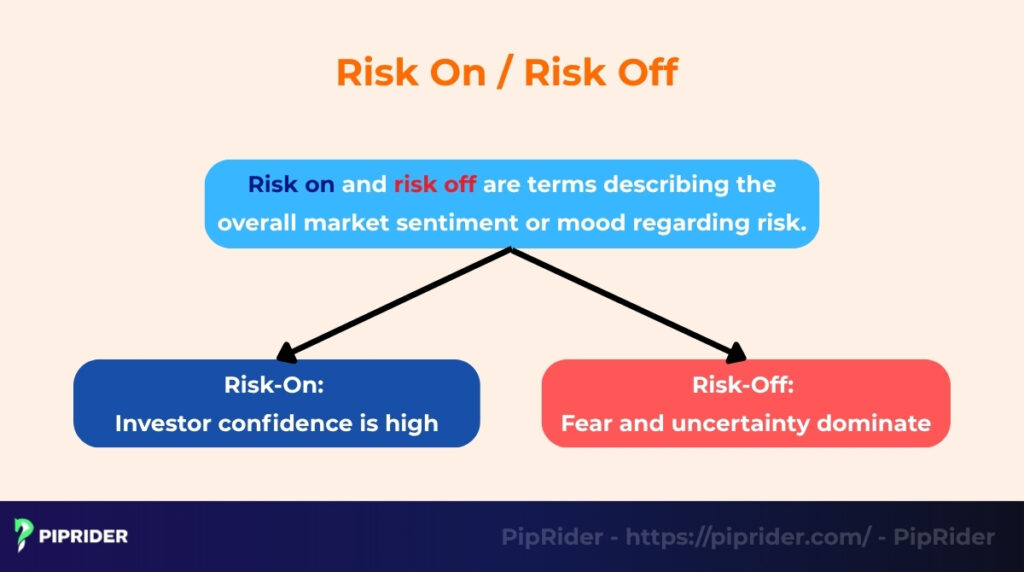
Risk on and risk off are terms describing the overall market sentiment or mood regarding risk. They reflect whether investors are optimistic and willing to take chances (risk on, sometimes called the “risk-accepting” state) or fearful and prioritizing safety (risk off, the “risk-avoiding” state). This collective psychology directly influences capital flow, impacting prices across Forex trading, stocks, and commodities.
- Risk-on: Investor confidence is high. Optimism about growth encourages buying risk on assets (and other risk assets), like stocks, emerging market currencies, high-yield bonds, and oil, seeking higher returns.
- Risk-off: Fear and uncertainty dominate. Investors sell riskier assets and move capital into risk-off assets (safe havens) like government bonds, gold, USD, JPY, and CHF, prioritizing capital preservation.
Understanding these shifts is crucial. As highlighted by the CFA Institute (2023), tracking this sentiment helps anticipate market volatility and optimize investment strategies. For example, the 2008 financial crisis was a classic risk-off period, with investors fleeing stocks for the safety of bonds and the US dollar. Conversely, periods of significant monetary stimulus often trigger risk-on phases, boosting stocks and riskier currencies (Investopedia, 2023).
Important note: Risk-on/risk-off is a spectrum, not a binary switch. Markets can occasionally be mixed. For example, equities may rise while the USD also strengthens, depending on the specific fundamental driver behind the move.
2. How Market Sentiment Drives Risk On and Risk Off Cycles
Market sentiment isn’t random; it’s driven by real-world events and changing economic conditions that shape investors’ perception of future risk and reward. These shifts in perception trigger the cycles between risk on and risk off.
2.1. Key Triggers for Sentiment Shifts
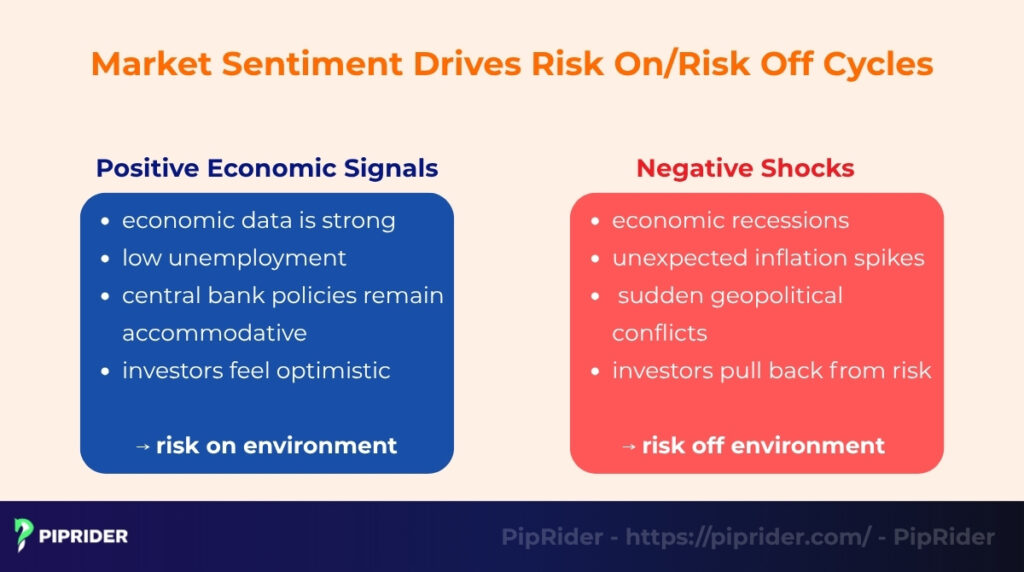
- Positive economic signals (risk-on): When economic data is strong (like rising GDP, low unemployment, or robust corporate earnings) and central bank policies remain accommodative (like low interest rates), investors feel optimistic. This encourages them to take on more risk, fueling a risk on environment.
- Negative shocks (risk-off): Conversely, negative news or uncertainty triggers fear. Events like economic recessions, unexpected inflation spikes, sudden geopolitical conflicts (like wars), or financial crises cause investors to pull back from risk. This leads to a risk off environment where safety becomes the priority.
2.2. Tracking Global Capital Flow
Professional traders closely monitor global capital flow to gauge the prevailing sentiment. They watch how large amounts of money move between different countries and asset classes. A significant shift of funds away from emerging markets and into U.S. Treasury bonds, for example, is a clear sign that the market is turning risk off. Understanding these large-scale flows helps traders align their positions with the dominant market mood.
3. Risk-On and Risk-Off Assets
Shifts in overall market sentiment cause predictable flows of capital between different types of assets, influencing asset allocation decisions globally. Understanding which specific assets typically gain or lose value during these risk on versus risk off phases is essential for effective risk on risk off trading. Knowing where the money is likely flowing helps traders position themselves accordingly.
Here’s a general breakdown of how capital moves across different market sectors:
| Market Type | Typical Risk-On Assets | Typical Risk-Off Assets |
| Forex | AUD, NZD, CAD, Emerging Market Currencies | USD, JPY, CHF |
| Stocks | Growth stocks (Tech), Small Caps, Cyclicals | Utilities, Consumer Staples, Healthcare |
| Commodities | Oil, Copper, Industrial Metals | Gold |
| Bonds | High-Yield Corporate Bonds (“Junk Bonds”) | U.S. Treasuries, German Bunds, UK Gilts |
Recognizing these patterns helps traders anticipate which markets are likely to strengthen or weaken based on the prevailing risk mood.
4. Risk Sentiment in Forex Markets
The Forex market is particularly sensitive to shifts in global risk appetite. Certain currency pairs act as excellent real-time barometers of market mood due to their underlying economic ties.
4.1. Key Forex Barometers
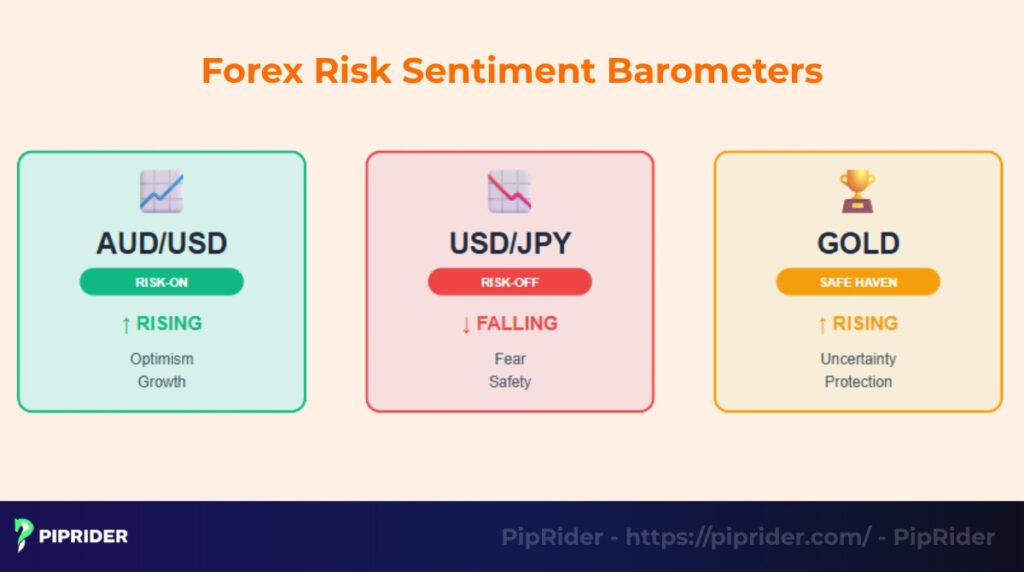
- AUD/USD (the “risk-on” proxy): The Australian Dollar is considered a “commodity currency” closely linked to global growth. When AUD/USD rises, it often signals a risk on environment, as investors are optimistic about growth and demand for commodities.
- USD/JPY (The “risk-off” proxy): The Japanese Yen is a traditional safe-haven currency. When USD/JPY falls (meaning the JPY is strengthening against the USD), it’s often a clear sign of risk off sentiment, as investors seek refuge.
- Gold (XAU/USD): While technically a commodity, Gold often acts like a safe-haven currency. A rising Gold price frequently coincides with risk off periods, as investors seek its perceived safety during times of uncertainty.
4.2. Broader Market Indicators Used by Forex Traders
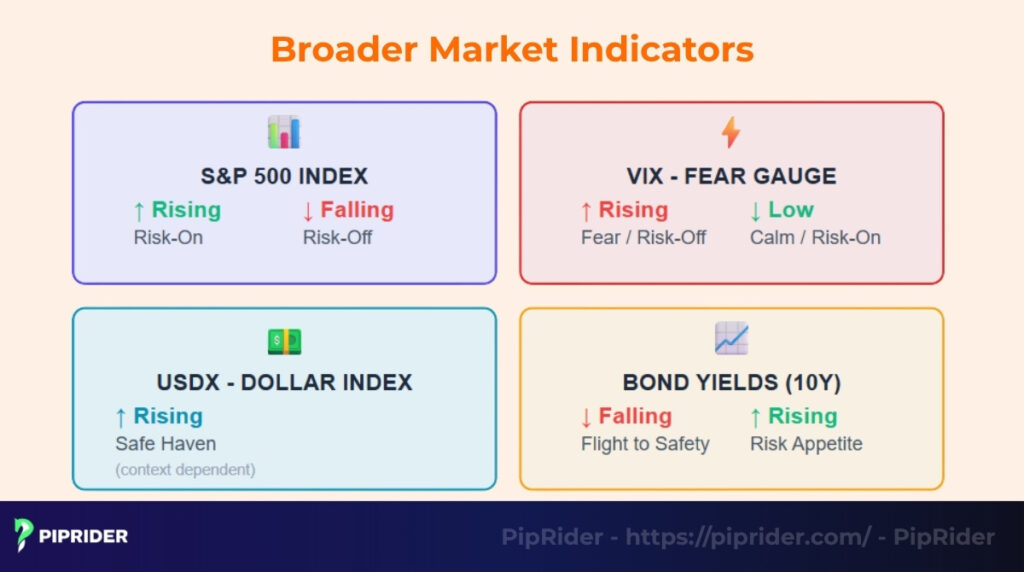
Professional Forex traders don’t just watch currency pairs. They monitor a “dashboard” of key inter-market indicators to get a holistic view of risk sentiment:
- S&P 500 index: A rising S&P 500 generally reflects risk on. A sharp fall often indicates risk off.
- VIX (volatility index): Often called the “fear gauge.” A rising VIX signals increasing fear (risk off), while a low VIX suggests complacency (risk on).
- USDX (U.S. dollar index): The USD is unique because its strength depends on the specific driver:
- Risk-off panic / Liquidity stress: USD strengthens due to the massive demand for cash and liquidity.
- Risk-on but Fed hawkish: USD can also strengthen if U.S. yields rise due to aggressive central bank policy, even if stocks are performing well.
- Bond yields (e.g., US 10-Year Treasury): Falling yields typically signal a flight to safety (risk off), as bond prices rise when demand increases. Rising yields can indicate risk on sentiment, as investors sell safe bonds to buy riskier assets.
5. Indicators That Reflect Risk Appetite
Traders use a combination of inter-market indicators to get a real-time read on market sentiment. Monitoring these provides the necessary context for high-probability trading.
5.1. The 2-Minute Risk Dashboard
For a quick diagnostic of current sentiment, professional traders look for alignment across these five areas:
- S&P 500: ↑ Risk-On / ↓ Risk-Off.
- VIX: ↑ Risk-Off / ↓ Risk-On (Note: 20/15 are general rules-of-thumb for fear/complacency).
- US10Y yield: ↓ Typically = Flight to safety (Risk-Off); ↑ Typically = Rotation to risk (Risk-On).
- AUD/JPY: ↑ Typically = Risk-On; ↓ Typically = Risk-Off.
- Gold: ↑ Often correlates with Risk-Off (though can also move as an inflation hedge).
5.2. Stock Market Indices and Volatility
Major stock indices are primary indicators of risk appetite. Trending indices like the S&P 500 and NASDAQ signal optimism. Conversely, a sharp decline indicates a shift toward defensive positioning. This is mirrored by the VIX (Volatility Index):
- High VIX (>20-25): Heightened fear and uncertainty (Risk-Off).
- Low VIX (<15-20): Market complacency and stability (Risk-On).
5.3. Currency Strength Flows (The Forex Barometer)
Observing which currencies are attracting capital provides direct insight into risk flows.
- Risk-on: Capital flows into high-yielding or commodity-linked currencies. JPY usually weakens. Rising AUD/USD or Rising USD/JPY (JPY weakening against USD) signals Risk-On.
- Risk-off: Capital retreats to safe havens. According to IMF research, the JPY tends to appreciate significantly against the USD during these periods. Falling AUD/USD or Falling USD/JPY (JPY strengthening) signals Risk-Off.
5.4. Bond Yields and Credit Spreads
Government bond yields reflect the demand for safety. Yields typically rise during Risk-On phases as investors sell bonds to buy equities. During Risk-Off phases, yields fall as investors rush into the safety of U.S. Treasuries.
Advanced Professional Indicators: To confirm a “Risk-Off” move, professionals also watch Credit Spreads (the difference between Corporate Bond yields and Treasury yields). When these spreads widen, it indicates that investors are demanding more compensation for taking on credit risk, a hallmark of deep Risk-Off sentiment.
6. Risk On vs. Risk Off Examples
Looking at recent history provides clear examples of how these sentiment cycles play out in real markets.
6.1. Risk-On Example (2020–2021)
Following the initial shock of the COVID-19 pandemic, global central banks unleashed unprecedented monetary stimulus. Governments also launched massive fiscal stimulus packages (International Monetary Fund [IMF], 2021). This flood of liquidity, combined with positive corporate earnings surprises, created a powerful risk on environment.
- Market reaction: Capital flowed aggressively into higher-risk assets. We saw stock markets surge to record highs, cryptocurrencies experience a massive bull run, and commodity-linked currencies like the Australian Dollar (AUD) strengthen significantly. Investors were clearly prioritizing growth and yield over safety.
6.2. Risk-Off Example (Late 2022)
By late 2022, the economic picture had shifted dramatically. Inflation surged globally, forcing central banks like the U.S. Federal Reserve to aggressively raise interest rates (IMF, 2022). Fears of a recession grew, triggering a distinct risk off phase.
- Market reaction: Investors fled from risk. Stock markets experienced sharp declines, and weaker corporate earnings added to the pessimism. In Forex, safe-haven currencies dominated: the U.S. Dollar (USD) strengthened broadly, and even the Japanese Yen (JPY) saw periods of recovery as investors sought refuge. Navigating these downturns effectively requires specific bear market trading strategies that prioritize capital preservation and short-selling opportunities.
7. How Traders Can Use Risk Sentiment in Forex
Understanding the prevailing risk-on/risk-off mood provides a powerful edge for developing forex trading strategies. Forex traders use sentiment as a crucial filter to select high-conviction pairs, confirm technical signals, and avoid low-probability setups.
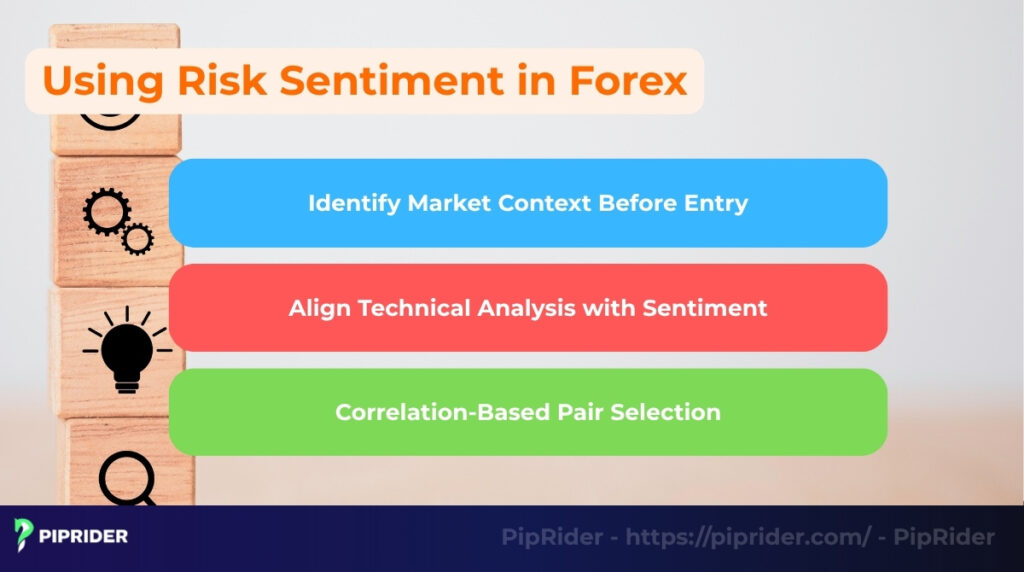
7.1. Identify Market Context Before Entry
The simplest application is using sentiment to establish a directional bias, ensuring your trades align with the dominant global capital flow.
- In a clear risk on environment: Traders should prioritize buying opportunities in commodity-linked or high-yielding currencies like the AUD, NZD, and CAD.
- In a clear risk off environment: The focus shifts to buying opportunities in safe-haven currencies like the USD, JPY, and CHF.
This approach helps manage overall risk exposure by filtering out trades that fight against the prevailing market “tide”.
7.2. Align Technical Analysis with Sentiment
Risk sentiment provides the fundamental “why” behind price action. A technically perfect buy signal at a support level is much less likely to succeed if the broader market is in a state of deep risk-off panic.
Traders should verify that the current risk mood supports their technical thesis. For example, a bullish breakout in AUD/USD carries more weight when global sentiment is also risk-on. This alignment typically improves trade quality and helps traders reduce participation in low-probability trades.
7.3. Correlation-Based Pair Selection (The Risk Barometer)
Certain currency pairs act as real-time indicators of risk sentiment due to their unique composition. The AUD/JPY pair is the classic example:
- AUD (Australian Dollar): Highly sensitive to global growth (risk-on).
- JPY (Japanese Yen): The primary global safe-haven (risk-off).
Because of this contrast, the AUD/JPY pair typically rises during risk-on periods and falls sharply during risk-off phases. Monitoring this “barometer” gives traders an immediate sense of the market’s current appetite for risk.
8. Factors That Shift Risk Sentiment
Market sentiment isn’t static; it constantly ebbs and flows based on new information and global events. Understanding the key drivers that can flip the switch between risk on and risk off is crucial for anticipating market reactions. Understanding these drivers helps you anticipate market shifts. Our 2025 market review and outlook breaks down which factors matter most right now.
Here are some of the most significant factors:
- Central Bank policies: Announcements regarding interest rates, required reserve ratio explained as a liquidity tool, or quantitative easing/tightening from major central banks are massive drivers. Lower rates generally boost risk on, while rate hikes signal risk off.
- Major economic data releases: Key economic reports significantly impact sentiment. Strong GDP growth or NFP figures can fuel risk on, while high inflation (CPI) readings or weak manufacturing data often trigger risk off.
- Geopolitical events: Unexpected geopolitical tensions, major elections, outbreaks of conflict, or energy crises can dramatically increase uncertainty and cause a rapid shift to risk off.
- Commodity price shocks: Significant, sudden moves in the price of essential commodities, particularly crude oil, can ripple through the global economy, influencing overall risk sentiment.
9. Frequently asked questions about Risk On Risk Off
10. The Bottom Line
Understanding the risk on risk off dynamic is central to reading market sentiment and anticipating global capital flows. This ebb and flow between optimism and fear directly impacts Forex pairs, commodities, bonds, and equities, creating distinct opportunities and risks.
Learning how to identify whether the market is in a risk-seeking or risk-averse phase allows traders to align their strategies with the dominant mood, leading to higher-probability decisions. Mastering this concept is a key step towards trading with greater insight.
To discover the specific strategies, indicators, and tools professionals use to monitor market sentiment, explore our guides in the Trading Tools section at Piprider.