Most investors only see risk in a bear market. For active traders, it’s a prime opportunity to profit. Learning how to make money in a bear market involves using specific offensive strategies like short-selling, inverse ETFs, and put options, not just defensive moves.
This guide goes beyond theory. It provides an actionable playbook to profit from a downturn, defensive strategies to protect your capital, real-world case studies, and a step-by-step Decision Framework to help you choose the exact tools that fit your experience level.
Key Takeaways
- A bear market is a 20%+ market decline, but it also creates unique high-volatility trading opportunities.
- Offensive strategies to profit from a falling market include short-selling, buying put options, and using Exchange-Traded Funds (ETFs) like Inverse ETFs.
- Defensive strategies to protect capital include tactical hedging, rotating into defensive stocks (like healthcare), and building a cash buffer.
- Long-term investors can use a bear market as a rare opportunity to dollar-cost average (DCA) into quality assets at a deep discount.
- Strategy alignment is crucial: The right approach depends on your profile. Beginners should focus on DCA and 1x Inverse ETFs, while pros can utilize margin shorting and CFDs.
- Risk and psychology: Managing your trading emotions and using strict stop-losses are critical, as offensive strategies carry exceptionally high risk.
1. What Is a Bear Market?
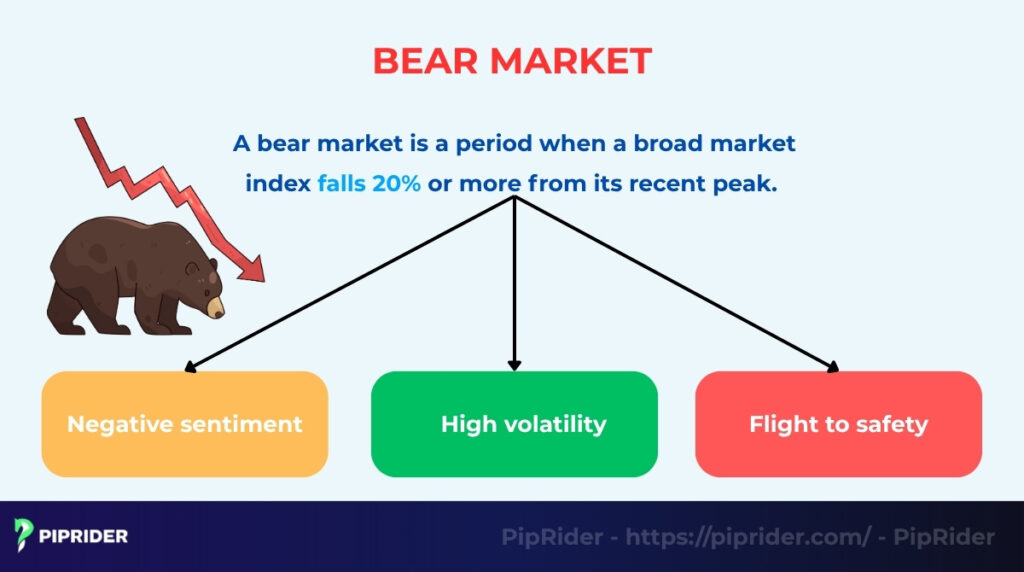
According to Investopedia (2025), a bear market is a period when a broad market index (like the S&P 500) falls 20% or more from its recent peak. These declines are typically accompanied by falling stock prices and widespread negative investor sentiment and pessimism.
1.1. How to Recognize a Bear Market
You can’t just look at the 20% number. A bear market also has a “feeling” of fear, which you can spot in these signs:
- Negative sentiment: Widespread fear (pessimism) dominates the news. Investors ignore good news and sell on bad news.
- High volatility: Volatility often spikes (as seen in the VIX index). Price swings are wild, with sharp drops and sudden, failed rallies (known as “bear market rallies”).
- Flight to safety (cash flow): Investors typically sell “risk” assets (like tech stocks) and move their money into “safe-haven” assets (like cash, gold, or government bonds), a shift that defines the prevailing risk-off sentiment in bear markets.
1.2. Bear Market vs. Market Correction
It is critical to know the difference between a dip and a deep decline.
- Market Correction: A correction is a short-term drop of 10% to 20% from a peak. It is a common, healthy pullback in a larger bull market.
- Bear Market: A bear market is a long-term decline of 20% or more. It is much more severe and often signals an upcoming or current economic recession.
1.3. Historical Examples of Bear Markets
Bear markets are a normal part of the economic cycle. Three recent examples are:
- The 2008 global financial crisis: A severe, long-term bear market caused by the subprime mortgage crisis.
- The 2020 COVID-19 crash: An extremely fast and deep (34%) bear market that lasted only 33 days (Charles Schwab, 2024).
- The 2022 inflation/rate hikes: A prolonged bear market driven by the Fed raising interest rates to fight high inflation.
2. Why Bear Markets Create Opportunities
Bear markets create significant opportunities because of the chaos and the inevitable market downturn. High volatility leads to more short-term trading setups (like short-selling), while falling prices offer long-term investors a rare chance to buy quality assets at a deep discount.
2.1. Volatility Increases → More Trading Setups
Fear and panic cause market volatility to spike. A “boring” market that only moves 20 points a day might suddenly move 100 points. For active traders (especially day traders and short-sellers), this high volatility is a requirement. It creates more price swings and, therefore, more trading setups and profit potential in a shorter amount of time.
2.2. Prices Become Discounted for Long-Term Investors
A bear market is essentially a “Black Friday sale” for long-term investors. High-quality, fundamentally strong companies (blue-chip stocks) that were too expensive during the bull market are now “on sale” at a deep discount. This provides a rare chance for buying low (accumulating great assets) and holding them for the next market cycle.
2.3. Smart Money Accumulates During Fear
Bear markets are driven by panic from retail traders (“dumb money”). Professional and institutional traders (“Smart Money“) understand this. They wait for this “max fear” (capitulation) and then begin to accumulate (buy) assets from the panic-sellers at the bottom, often at the cheapest prices.
3. How Do You Understand Market Sentiment in Bear Markets?
Understanding market sentiment means “reading the room.” In a bear market, the room is filled with fear. Traders use specific tools to measure this fear, which helps them decide if the market is at a “panic bottom” or just starting to fall.
3.1. The Fear & Greed Index
The fear & greed index is a popular indicator, developed by CNN Business (n.d.), that tracks multiple factors (like market momentum and volatility) to generate a simple score from 0 (Extreme Fear) to 100 (Extreme Greed). In a bear market, this index will spend a long time in the “Extreme Fear” zone. This signals that retail traders are panicking, which is often when long-term opportunities appear.
3.2. The VIX Index (The “Fear Index”)
The VIX (Volatility Index) is the most-watched sentiment indicator for the S&P 500. It measures expected volatility for the next 30 days (Cboe, n.d.).
- A low VIX (e.g., below 20) means low fear (complacency), which is common in bull markets.
- A high VIX (e.g., above 30 or 40) means high fear and panic, which is the classic sign of a bear market crash.
3.3. Macroeconomic Triggers
These are the real-world news events that cause the fear. You must watch these triggers to understand the reason for the bear market.
- The Fed (FOMC): The U.S. Federal Reserve’s decisions on interest rates are the biggest trigger. Rising rates are a major cause of bear markets.
- Inflation Reports (CPI): High inflation reports are a trigger because they force the Fed to keep rates high.
- Recession Signals: News about rising unemployment or a falling GDP confirms that the economy is weak. These economic signals fuel the bear market.
4. Active Trading Strategies: The Bear Market Playbook
For active traders, a bear market is a high-speed environment where “buy and hold” can lead to significant drawdowns. To survive and profit, you need an offensive mindset. This section serves as your execution playbook, moving beyond simple definitions into actionable setups.
Each strategy below is designed for a specific market condition, whether the market is crashing vertically or grinding sideways in exhaustion.
4.1. Quick Start: Choosing Your Offensive Weapon
Before diving into the technical execution, use this comparison table to identify which tool matches your experience, capital, and market preference. This “at-a-glance” guide helps you filter out strategies that may not fit your current risk profile.
| Strategy | Difficulty | Risk Level | Best For | Markets |
|---|---|---|---|---|
| Inverse ETFs | Low | Medium | Beginners / Long-termers | Stocks, Indices |
| Put Options | Medium | Defined (Limited) | Options-savvy traders | Stocks, Indices |
| CFDs | Medium-High | High (Leverage) | Forex & Crypto traders | Forex, Crypto, Indices |
| Short-Selling | High | Very High (Unlimited) | Pro Traders (Margin) | Stocks, Indices |
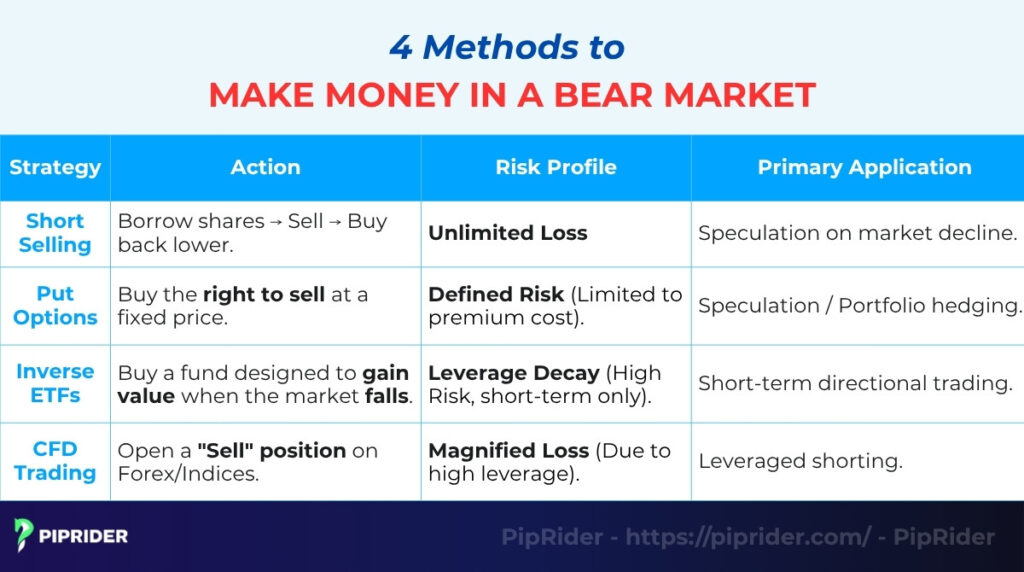
4.2. Short-Selling: Turning Pessimism into Profit
Short-selling remains the most direct way to capitalize on a market decline. Unlike traditional investing, where you profit from growth, shorting allows you to turn market fear into a mathematical advantage. It is the art of borrowing an asset, selling it high, and buying it back lower.
- Best for: Experienced traders with margin accounts who understand the mechanics of borrowing assets.
- When to Use: When the market structure is clearly bearish, characterized by a series of Lower Highs and Lower Lows on the 4-hour or Daily timeframe.
- Execution (How-to):
- The Setup: A trader borrows an asset (like a stock or index) and sells it at the current high price.
- The Goal: Buy the asset back later at a lower price to return to the lender.
- Example: Shorting the NAS100 at 15,000 and “buying to cover” at 14,000 for a 1,000-point profit.
- Main Risk: Unlimited loss. If the price goes up instead of down, your losses are theoretically infinite. Beware of the “short squeeze,” where rapid forced buying-back pushes the price even higher.
- When NOT to use: Avoid shorting during extreme “oversold” conditions (RSI < 30) or immediately before high-impact positive news (like a surprise Fed pivot).
4.3. Buying Put Options: Speculating with a Safety Net
If short-selling feels too exposed, put options offer a “limited risk” alternative. Buying a put is essentially buying a contract that gains value as the underlying asset falls. It allows for significant leverage while keeping your potential loss strictly defined to the amount you paid for the contract (the premium).
- Best for: Intermediate traders who want to speculate on a crash without the risk of an unlimited margin call.
- When to Use: When you anticipate a sharp, sudden breakdown or a high-volatility event where speed is more important than a long-term trend.
- Execution (How-to):
- Selection: Buy At-The-Money (ATM) or slightly Out-Of-The-Money (OTM) puts to balance the cost of the premium with potential gains.
- Time Management: Choose expiration dates at least 30–60 days out. This protects your trade from Theta decay (the rapid loss of value as the expiration date nears).
- The Trigger: Execute when the VIX (Fear Index) is starting to trend upward but hasn’t yet reached extreme panic levels.
- Main Risk: Time decay. If the market moves sideways or falls too slowly, the option can expire worthless even if you were “right” about the direction.
- When NOT to use: When Implied Volatility (IV) is already at record highs (VIX > 40), as the “premium” you pay will be inflated, making it hard to profit.
4.4. Trading Inverse ETFs (1x, 2x, 3x)
Inverse ETFs are a specialized type of Exchange-Traded Fund (ETF) that provide a way to profit from a falling market directly through a standard brokerage account without needing a margin account for shorting. These funds are designed to move in the opposite direction of a specific index.
- Best for: Beginners or intermediate traders looking for simple bearish exposure in a traditional portfolio.
- When to Use: When a broad index (like the S&P 500) breaks below major long-term moving averages (like the 200-day SMA).
- Execution (How-to):
- 1x ETFs: Use funds like $SH (Inverse S&P 500) for multi-day tactical holds.
- Leveraged ETFs: Only use 2x or 3x versions (like $SQQQ) for intraday scalping.
- Main Risk: Leverage decay. Due to daily rebalancing, these funds lose value in choppy, sideways markets. They are not designed for long-term “buy and hold.”
4.5. Using CFDs to Profit on Downtrends
For Forex, Crypto, and global indices traders, CFD trading (Contracts for Difference) is often the most accessible way to trade a downtrend. It requires no borrowing mechanics; you simply choose the direction of the trade with one click.
- Best for: Active traders in the Forex and Crypto markets who utilize leverage.
- When to Use: For quick, tactical trades on indices like the US30, US500, or BTC/USD during high-volume sessions.
- Execution (How-to):
- Simply open a “Sell” (short) position. Use leverage sparingly (e.g., 1:10) to avoid being liquidated by a minor bear market rally.
- Must use a strict Stop-Loss (SL) on every trade to protect capital in volatile markets.
- Main Risk: High leverage can magnify losses as quickly as gains. Adjust position size based on your specific risk tolerance (e.g., the 1% risk rule).
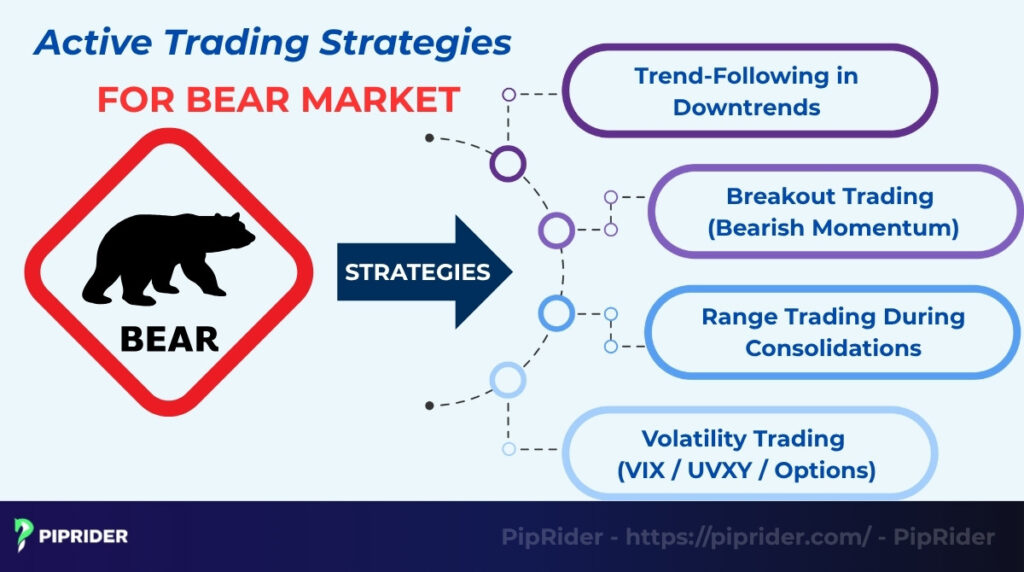
4.6. Trend-Following: Riding the Bearish Staircase
Professional traders don’t guess; they follow the trend. Trend-following is about identifying the path of least resistance. In a bear market, this means selling into every temporary rally that fails to break the overall downward structure.
- Best for: Swing traders who want to stay on the right side of the “Big Move.”
- Execution (How-to):
- Indicators: Use the 50-period EMA or the Supertrend indicator on the H4/D1 timeframe to confirm the downtrend.
- The Setup: Wait for the price to pull up to the EMA (which now acts as resistance).
- The Signal: When the price is rejected at that level (confirmed by a bearish candle like a Pin Bar), enter a “Sell” position.
- When NOT to use: When the trend is exhausted and starting to move sideways, forming a clear horizontal range.
4.7. Breakout Trading: Catching the Momentum
Breakout trading profits from the moments of “max pain,” where support levels finally snap. In a bear market, these moves are often violent and fast as stop-losses from “Buy” positions are triggered, adding fuel to the decline.
- Best for: Momentum traders and day traders who can act quickly on high-volume signals.
- Execution (How-to):
- Setup: Identify a clear, recent support level or a “swing low” that has been tested multiple times.
- The Trigger: Enter a “Sell” trade when the price breaks below that low with strong bearish momentum and a decisive candle close below the level.
- Confirmation: Higher volume on the breakdown candle is a critical confirmation signal.
4.8. Range Trading: Profiting from Market Exhaustion
Bear markets do not fall in a straight line. They often enter long periods of sideways consolidation where the market “rests” before the next leg down. Range trading allows you to profit from this indecision.
- Best for: Cautious traders during periods of market exhaustion or “dead zones.”
- Execution (How-to):
- Setup: Identify the “Resistance Ceiling” and the “Support Floor.”
- The Trade: Sell (short) at the top of the range and buy (to cover) at the bottom.
- Stop-Loss: Place SL strictly outside the range boundaries (above resistance) to avoid market “noise.”
- When NOT to use: When a major Macro Trigger (like a CPI report) is imminent, as this usually causes the range to break violently.
4.9. Volatility Trading: Betting on Fear Itself
In a crash, “Fear” becomes an asset class you can actually trade. Volatility trading doesn’t necessarily bet on price direction, but on the speed and intensity of market panic.
- Best for: Advanced traders familiar with volatility-tracking products.
- Execution: Buy products like the VIX (the “Fear Index”) or leveraged ETFs like UVXY when market complacency is high.
- Advanced Setup: Options traders can use a straddle strategy (buying both a call and a put) to profit from a massive move regardless of the direction.
- Main Risk: The “Volatility Crush.” Once the panic subsides and the market stabilizes, volatility instruments lose value extremely quickly.
5. Long-Term Wealth Accumulation: Making Money on the Recovery
While active traders profit from today’s volatility, long-term investors “make money” by securing the massive gains of tomorrow. In a bear market, your profit is often locked in at the moment of purchase, not the sale. By strategically accumulating assets when fear is at its peak, you position your portfolio for exponential growth when the market eventually cycles back to a bull run.
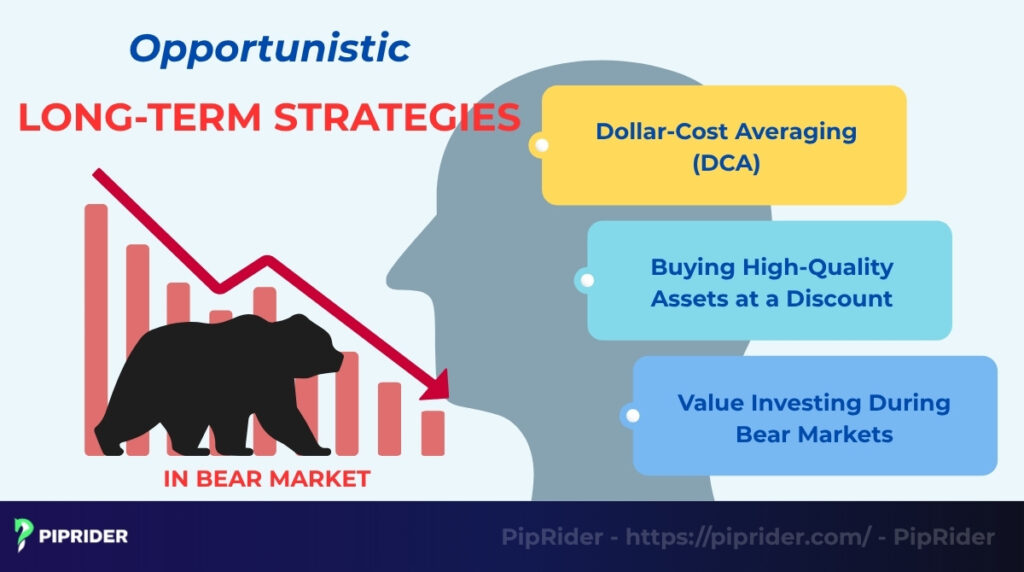
5.1. Strategic Dollar-Cost Averaging (DCA)
The biggest hurdle for investors during a crash is the psychological pressure of trying to “time the bottom.” Dollar-Cost Averaging (DCA) removes this emotional barrier by turning market volatility into a mathematical advantage, allowing you to build a large position at a fraction of the bull-market cost.
- The Goal: To systematically lower your average cost basis and ensure you are fully invested when the recovery begins.
- Execution: Invest a fixed amount (e.g., $200) every month regardless of price. In a bear market, your fixed dollar amount buys more shares at a discount.
- Why it works: Historical data shows that investors who continue DCA through a “Crypto Winter” or a stock crash reach profitability much faster during the recovery than those who try to wait for a “confirmed” bottom.
5.2. Value Investing (The “Smart Money” Approach)
Bear markets create rare periods of market inefficiency where the price of a high-quality stock falls far below its actual business value. Professional and institutional traders (“Smart Money”) use these moments of Capitulation to accumulate “blue-chip” companies that have been unfairly dragged down by general market panic.
- The Goal: To buy fundamentally strong businesses at a massive discount to their intrinsic value.
- When to use: Look for moments of extreme fear when stocks like Apple, Microsoft, or Amazon are trading at a 30% to 50% discount from their highs.
- Execution: Screen for companies with high free cash flow and low debt-to-equity ratios. Follow the Warren Buffett rule: “Be greedy when others are fearful.”
6. How to Protect Capital Before You Try to Profit
Success in a bear market isn’t just about how much you make; it’s about how much you keep. You cannot execute the offensive strategies in Section 4 if your account has been wiped out by a 40% drawdown. Capital preservation is the strategic “defense” that keeps your “Dry Powder” (available cash) ready for high-probability opportunities.
6.1. Defensive Sector Rotation & Passive Income
When the economy slows down, consumer spending shifts from “wants” to “needs.” Sector rotation involves moving your capital into industries that provide these essential services, as they tend to remain resilient even when growth-focused tech stocks are crashing.
- Strategy: Shift capital into Defensive Sectors such as Utilities (electricity/water), Healthcare (medicine), and Consumer Staples (food/household goods).
- The Profit Angle: Focus on high-quality Dividend Stocks in these sectors. The passive cash flow generated by dividends can be used to fund your active short-selling trades or be reinvested to buy more shares at the bottom.
6.2. Flight to Safety: Gold, Bonds, and Cash Buffers
In times of systemic crisis, investors execute a “Flight to Safety,” moving money out of high-risk equities and into “Risk-Off” assets. This is a critical component of a professional Asset Allocation plan, designed to provide stability when the rest of the market is in freefall.
- Gold & Treasuries: Gold acts as a classic store of value when currencies are volatile, while Treasuries provide a low-risk yield and capital protection.
- Cash Buffer (Liquidity): Maintaining a high-yield cash reserve ensures you aren’t forced to sell your long-term assets at the absolute bottom to cover daily expenses. This liquidity buffer is what gives you the power to stay in the game.
6.3. Tactical Hedging: Your Portfolio Insurance
Hedging is an advanced defensive strategy that allows you to protect your existing stock holdings without having to sell them and trigger tax events. By taking a position that profits when the market falls, you effectively “freeze” your losses and preserve your net worth during the worst of the crash.
- Strategy: Use tools that move inversely to your main portfolio to “cap” your drawdown.
- Methods:
- Put Options: Buy a put on the S&P 500. Its gains will offset your stock losses if the market continues to drop.
- Inverse ETFs: Take a small tactical “Sell” position in a fund like $SH to cushion the blow.
- Warning: Hedging must be managed carefully to avoid long-term leverage decay; it is a tactical tool, not a “set and forget” strategy.
7. Real-World Case Studies: From Theory to Execution
To truly understand how to make money in a bear market, we must move beyond definitions and analyze the actual mechanics of a trade. These case studies break down the logic, the entry signals, and the risk management used by professional traders during historic market downturns.
7.1. Case Study 1: Short-Selling the S&P 500 (The 2022 “Staircase” Down)
The 2022 bear market was a “textbook” environment for trend-followers. It wasn’t a sudden crash, but a disciplined decline driven by clear macroeconomic shifts and technical rejections.
- The Macro Context: Persistent high CPI (Inflation) reports forced the Federal Reserve to aggressively hike interest rates. This created a “Risk-Off” environment where equity valuations were slashed.
- Technical Confirmation: The index spent most of the year trading below its 50-day Exponential Moving Average (EMA). On the daily chart, the 50-day EMA acted as a “ceiling” (dynamic resistance).
- The Execution (The Playbook in Action):
- The Setup: In August 2022, the SPX rallied 17% from its June lows, leading many retail traders to think the “bottom was in.” However, the price hit the 50-day EMA and failed to break higher.
- The Entry: Short position initiated when a Bearish Engulfing candle formed exactly at the 50-EMA resistance on August 16, 2022.
- Stop-Loss: Placed 1% above the most recent swing high (approximately at the 4,320 level).
- Profit Target: The previous major support level (the June lows near 3,640), aiming for a Risk/Reward ratio of 1:3.
- The Lesson: In a prolonged bear market, shorting the pullback (selling into strength) is significantly safer than “chasing” a breakdown (selling into weakness).
7.2. Case Study 2: Strategic DCA with Bitcoin (The 2022–2023 Crypto Winter)
This case study demonstrates how long-term investors “make money” by accumulating during periods of Capitulation and extreme market exhaustion.
- The Context: Following the collapse of major crypto entities (Terra/FTX), BBitcoin fell from a peak near $69,000 down to a trough near $16,000 (CoinMarketCap, 2023). Public sentiment was at “Extreme Fear,” and the news was filled with “the death of crypto.”
- The Strategy: A disciplined Dollar-Cost Averaging (DCA) approach, investing a fixed dollar amount every Monday, regardless of the price or the news cycle.
- The Technical Logic:
- The Accumulation Zone: Instead of trying to catch the “falling knife” at $15,500, the investor focused on the sideways range between $16,000 and $20,000 that lasted for 5 months.
- Capitulation Signal: High-volume selling followed by a lack of new lows—this indicated that the “weak hands” had sold and Smart Money was absorbing the supply.
- The Result: By the time Bitcoin broke out above $25,000 in early 2023, the DCA investor had an average cost basis in the low $19,000s, positioning the portfolio for a 200%+ gain during the subsequent recovery.
- The Lesson: Time in the market beats timing the market. Systematic accumulation during “Max Fear” allows you to build a position at a price that institutions find attractive, while retail is too paralyzed by fear to act.
8. Decision Framework: Which Bear Market Strategy Fits You?
The biggest mistake many investors make during a market crash is “strategy envy”—trying to copy a professional trader’s short-selling tactics without having the necessary tools or temperament. A bear market isn’t a “one-size-fits-all” event; it is a test of your personal risk tolerance and financial goals. Use the decision framework below to identify your profile and the specific path you should prioritize to either protect your capital or grow it aggressively.
8.1. Scenario 1: The Cautious Beginner (No Shorting Experience)
If you are new to the markets, your primary goal is survival. You shouldn’t be worried about “killing it” with complex derivatives. Instead, focus on building a foundation that will make you wealthy in the long run while using simple tools to dampen the immediate pain of the crash.
- Your Focus: Strategic Accumulation and Capital Preservation.
- Your Toolkit:
- DCA (Dollar-Cost Averaging): Set up automated buys into broad index funds (S&P 500) or Top 10 Blue-chips.
- 1x Inverse ETFs (e.g., $SH): These allow you to profit from a falling market in a regular brokerage account without the risks of margin or liquidation.
- Defensive Allocation: Move 30-40% of your holdings into Utilities and Healthcare stocks.
- What to Avoid: Leveraged ETFs (3x), Short-selling on margin, and “Out-Of-The-Money” (OTM) options. These can wipe out a beginner’s account in minutes during a bear market rally.
8.2. Scenario 2: The Active Momentum Trader
As an active trader, you view the bear market as a high-speed opportunity. You aren’t looking to “wait it out”; you are looking to extract cash flow from every downward leg and every failed rally. You need speed, precision, and iron-clad discipline.
- Your Focus: High-Velocity Profit Extraction.
- Your Toolkit:
- Shorting via CFDs or Margin: Prioritize the “Short the Pullback” setup at the 50-day EMA resistance.
- Breakdown Plays: Use limit orders to enter on high-volume candle closes below major support levels (Swing Lows).
- Strict Risk Management: A mandatory 1% risk per trade rule with hard Stop-Losses to protect against “Short Squeezes.”
- The Golden Rule: Always maintain a minimum Risk/Reward ratio of 1:2. Even if you only win 40% of your trades, you will remain profitable.
8.3. Scenario 3: The Long-Term Portfolio Holder
If you already own a significant portfolio of stocks, your challenge is different. You don’t want to sell your high-quality assets at a 30% loss and trigger tax consequences, but you also don’t want to watch your net worth evaporate. Your strategy is all about “Insurance.”
- Your Focus: Portfolio Hedging and Drawdown Mitigation.
- Your Toolkit:
- Buying Put Options: Think of this as “Portfolio Insurance.” Purchase “At-The-Money” puts to offset the decline in your stock holdings.
- Tactical Inverse Hedges: Use a small percentage (5-10%) of your cash to buy an Inverse ETF to “freeze” your losses during the peak of the panic.
- Increase Cash Buffer: Halt non-essential buys and build your “Dry Powder” to deploy only when the market shows signs of a long-term bottom.
8.4. Scenario 4: The Crypto Speculator
The crypto market is the “Wild West” of bear markets. Volatility is 5x to 10x higher than traditional stocks, meaning your gains can be massive, but a single mistake can lead to a 100% loss. You must balance aggressive speculation with extreme caution.
- Your Focus: Futures Hedging and Capitulation Buying.
- Your Toolkit:
- Hedge with Futures: If you hold “Spot” Bitcoin, open a small, low-leverage “Short” position in the futures market to offset price drops.
- Accumulation Zones: Identify long-term sideways ranges (consolidation) during periods of “Extreme Fear” for spot accumulation.
- The Critical Warning: Keep your leverage below 3x. Bear market rallies in crypto are violent; a 20% bounce in a single day can liquidate high-leverage shorts even if the overall trend is still down.
9. Best Tools & Platforms for Different Bear Market Strategies
Choosing a platform in a bull market is easy, but in a bear market, the wrong infrastructure can kill your strategy. You need specific features like “deep borrow inventory” for shorting or “real-time Greeks” for options. Below is the breakdown of the best tools categorized by how you intend to make money.
9.1. For Stock Short-Selling: High Borrow Availability
The biggest challenge in shorting individual stocks is finding “locates”—actual shares your broker can borrow for you. Many retail brokers have shallow inventory, meaning you’ll often see the dreaded “Short Sale Restricted” (SSR) or “None Available” message.
- Top Choice: Interactive Brokers (IBKR) or TradeStation.
- Why it matters: IBKR is the industry leader in Borrow Inventory. They provide a “Short Availability” tool that shows exactly how many shares are available and the current borrow fee (interest).
- Key Criteria:
- Transparency: Real-time data on borrow rates.
- Margin Rates: Since shorting is done on margin, low interest rates are vital for multi-day holds.
9.2. For Options Trading: Advanced Analytics & Greeks
When the market is crashing, volatility (IV) spikes and time decay (Theta) accelerates. You cannot trade options “blind.” You need a platform that visualizes your risk and the impact of price moves on your contracts.
- Top Choice: thinkorswim (TOS) by Charles Schwab or Tastytrade.
- Why it matters: These platforms offer the best Options Chain UI and Risk Graphs. You can simulate “What if the S&P 500 drops another 5% tomorrow?” and see exactly how your Put Options will react.
- Key Criteria:
- Greeks Data: Real-time Delta, Gamma, Theta, and Vega.
- Volatility Analysis: Tools to compare “Historical Volatility” vs. “Implied Volatility” to avoid buying overpriced options.
9.3. For Index & Forex Trading: Speed & Low Spreads (CFDs)
If you are trading broad market indices (US30, NAS100) or Forex, CFDs (Contracts for Difference) are often more efficient than shorting stocks because there is no “borrowing” mechanic involved.
- Top Choice: MetaTrader 4/5 (MT4/MT5) via a regulated CFD Broker.
- Why it matters: In high-volatility crashes, “slippage” can eat your profits. You need a broker with lightning-fast execution and ultra-low spreads.
- Key Criteria:
- Spread & Commission: Every pip counts when the market is moving 500 points a day.
- Swap Fees: Check for “Positive Swaps” on short positions (sometimes you get paid to hold a short position overnight).
9.4. For Analysis & Opportunity Scanning
In a bear market, you need to find the “weakest link”—the stocks or sectors that are breaking down faster than others.
- TradingView: The gold standard for charting and technical analysis. Its Stock Screener is essential for finding “Death Cross” patterns or stocks trading below their 200-day Moving Average.
- Finviz: Use their Heat Maps to instantly identify which sectors (Tech, Energy, etc.) are bleeding the most.
- Volatility Tools (VIX Central): Essential for tracking the “Fear Index” to see if a crash is reaching a “Capitulation” peak.
10. What Are the Common Mistakes Traders Make in a Bear Market?
The biggest mistakes in a bear market are driven by fear or greed. They include panic selling at the bottom, trying to catch the bottom too early, not using a stop-loss on short positions, and trading too large in a highly volatile market.
- Panic selling: An investor ignores the initial decline and then sells all their assets in a panic after the price has already crashed 40%. This locks in the maximum loss at the worst possible time.
- “Catching a falling knife” (bottom fishing): A trader tries to “buy the dip” too early. They buy what they think is the bottom, only to watch the market fall another 20%, forcing them to sell at an even bigger loss.
- Not using a stop-loss when shorting: When you short-sell, your potential loss is unlimited. A sudden, sharp “bear market rally” (a fast bounce) can wipe out an account if there is no stop-loss in place.
- Trading too large: Using a normal position size in a high-volatility market is a mistake. Because the price swings are much bigger, you must trade a smaller position size to keep your dollar risk (your 1% rule) the same.
- Misunderstanding leveraged/inverse instruments: Traders often buy a 3x Inverse ETF and plan to hold it for months. These tools are not for long-term holds. Due to “leverage decay,” they can lose value over time, even if the market moves in the direction you predicted.
11. Frequently asked questions about Making Money in a Bear Market
12. Conclusion
The bear market is not a phase to avoid; it is a critical opportunity for traders who know the right strategy. Success comes from combining both offensive methods (shorting, options, and inverse funds) with defensive positioning.
However, the final key to profiting in any market is strict risk management, staying calm, and maintaining emotional discipline.To learn more expert trading strategies and improve your analysis, explore the free guides at Piprider.