Corporate Social Responsibility (CSR) is a voluntary business model where companies integrate social, environmental, and ethical concerns into their core operations. In today’s market, a robust CSR policy is no longer just “nice to have”—it is a strategic necessity for building brand trust, attracting top talent, and ensuring long-term sustainability.
This guide explores the four pillars of CSR, a 6-step framework for implementation, real-world examples, and the critical differences between CSR and ESG.
Key Takeaways
- Definition: CSR is a company’s commitment to operate ethically and contribute to societal well-being beyond legal requirements.
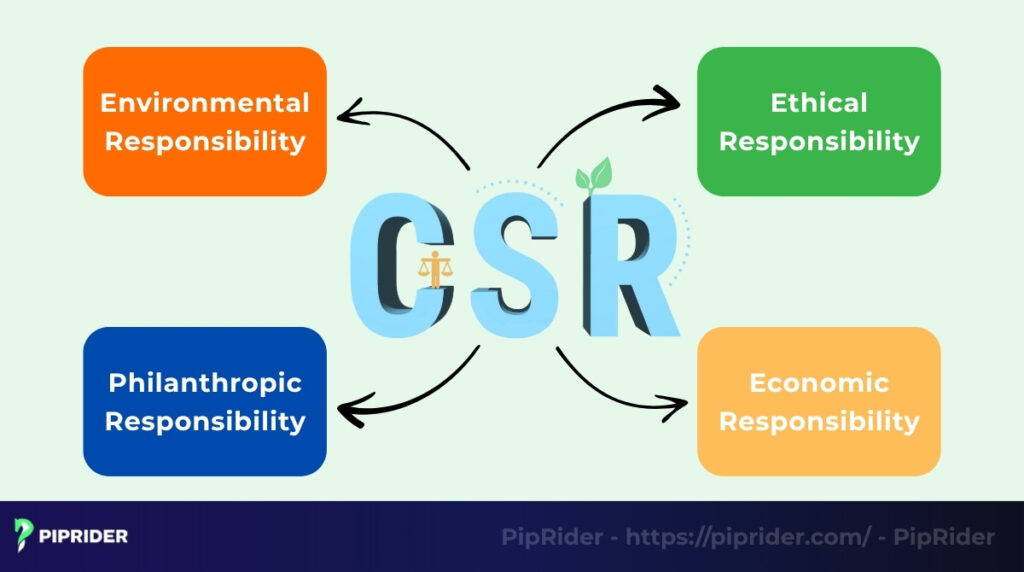
- The four pillars: Environmental, Ethical, Philanthropic, and Economic responsibilities.
- Strategic impact: Effective CSR improves brand reputation, boosts employee retention, and satisfies ESG-conscious investors.
- CSR vs. ESG: CSR is the internal cultural framework (qualitative), while ESG is the external measurement framework (quantitative) used by investors.
1. What Is CSR?
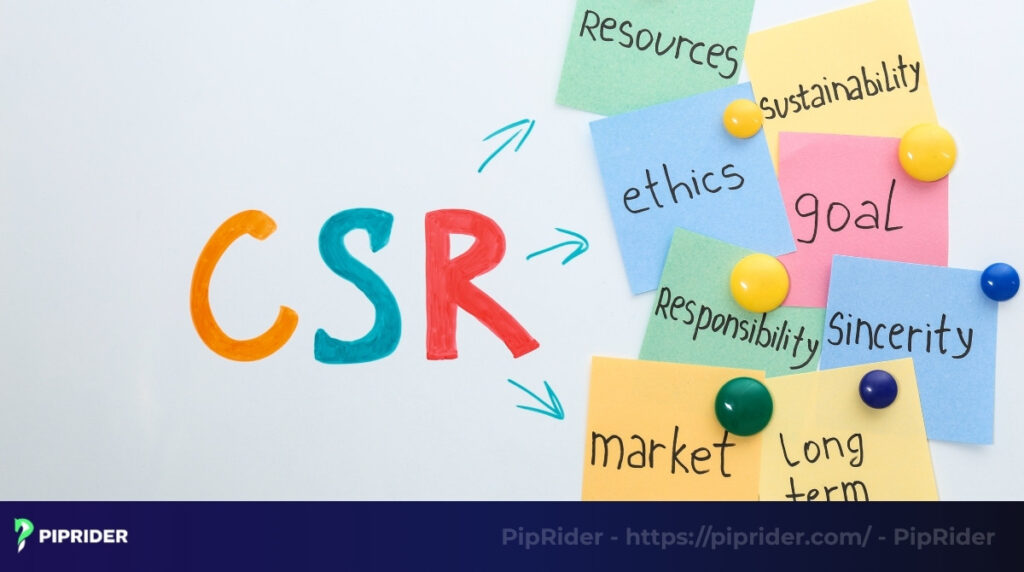
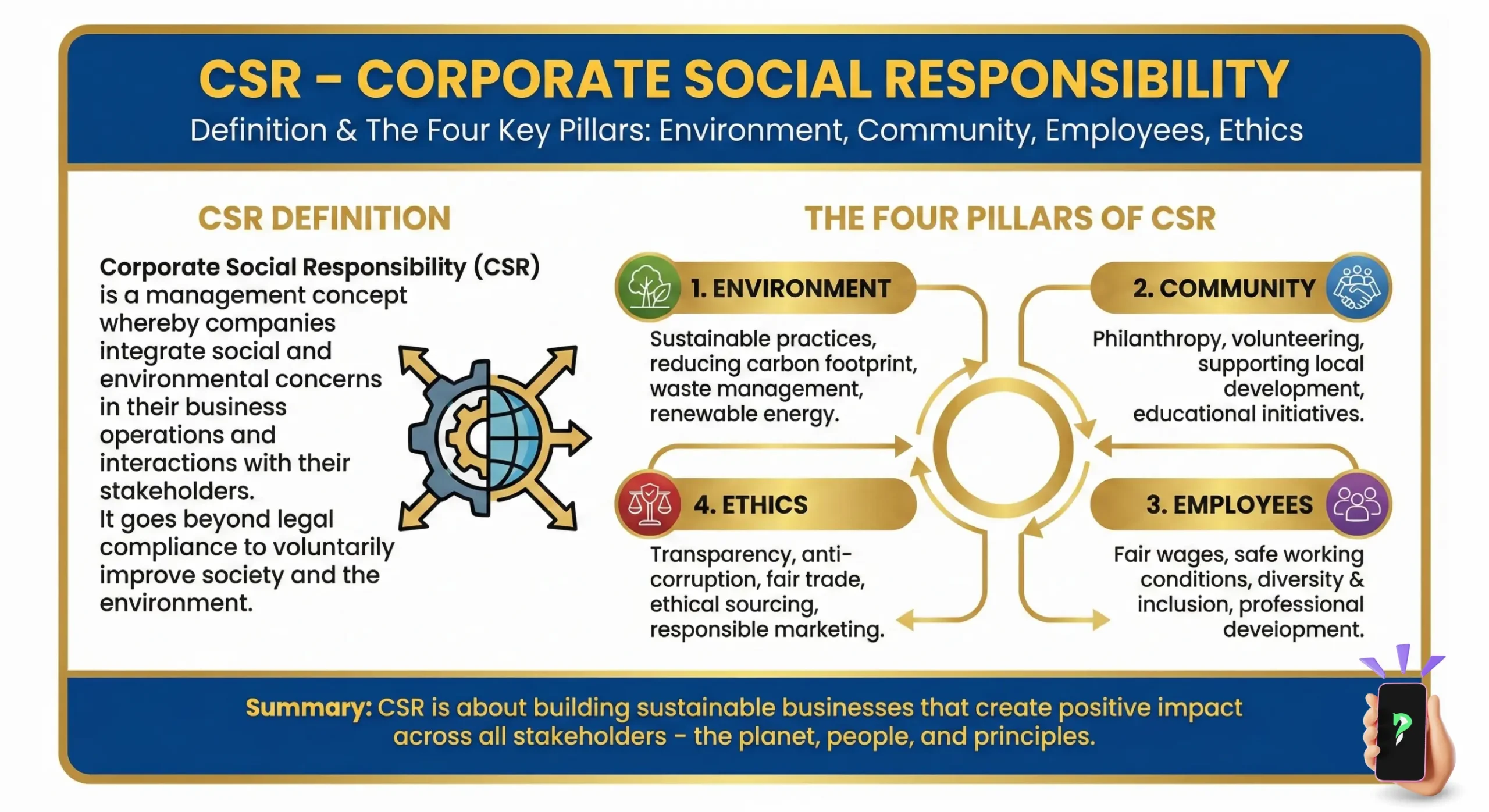
Corporate Social Responsibility (CSR) is a self-regulating business model that helps a company be socially accountable to itself, its stakeholders, and the public. By practicing CSR, companies can be conscious of the kind of impact they are having on all aspects of society, including economic, social, and environmental.
At its core, CSR is based on the concept of Corporate Citizenship. This means a business has a “social purpose” that extends beyond profit-making. Most modern CSR strategies align with the Triple Bottom Line (TBL) framework, which argues that a company’s success should be measured by three P’s: People, Planet and Profit.
2. How Corporate Social Responsibility Works
Effective CSR is not a separate public relations department; it is a system integrated into the heart of how a company operates. It functions by embedding ethical practices into daily operations and engaging with all groups the company impacts.
2.1. Integration into Business Operations
Truly effective CSR is built directly into a company’s structure. It becomes an essential part of the supply chain, manufacturing, marketing, human resources, and corporate governance.
Rather than a single charitable donation, it is a core business strategy. For example, the HR department might implement fair hiring practices, while the supply chain team ensures materials are sourced from ethical providers.
2.2. Stakeholder Engagement
CSR works by considering the needs of all stakeholders, not just shareholders. These stakeholders include investors, customers, employees, suppliers, the government, and the wider community.
A key part of this is acknowledging customer social responsibility, as modern consumers increasingly demand ethical products. The goal is to balance economic objectives with social benefits, helping the company maintain trust and a strong public reputation.
2.3. CSR Measurement
You cannot manage what you do not measure. Effective CSR relies on clear Key Performance Indicators (KPIs) to track progress, such as:
- The percentage reduction in CO₂ emissions.
- The total number of employee volunteer hours.
- The budget allocated to community programs.
This performance data is then shared in transparent sustainability reports, often following standards like the Global Reporting Initiative (GRI) or as part of a formal ESG (Environmental, Social, Governance) report.
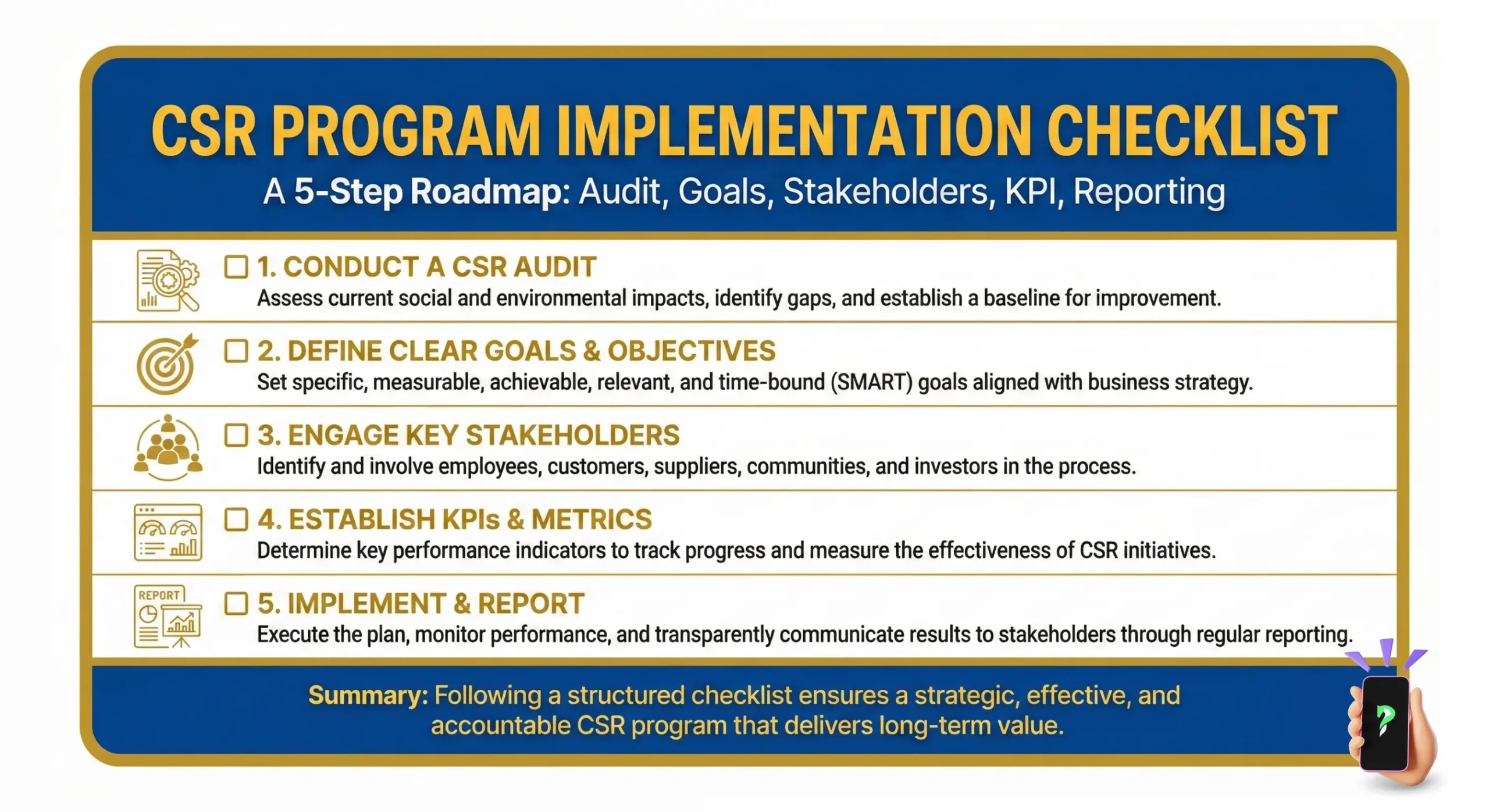
3. How to Build a CSR Program (6 Steps)
Building a credible CSR program requires a structured approach to avoid “greenwashing” and ensure genuine impact.
- Stakeholder mapping: Identify who is impacted by your business and listen to their concerns.
- Materiality sssessment: Focus on the issues where your business has the most significant impact (e.g., a shipping company should focus on carbon emissions).
- Set goals & KPIs: Establish SMART goals (Specific, Measurable, Achievable, Relevant, Time-bound). Example: “Reduce 25% of single-use plastic in packaging by 2027.”
- Operational integration: Train employees and update internal policies to align with CSR goals.
- Reporting & Disclosure: Use frameworks like GRI or the UN Global Compact to report data transparently.
- Assurance & Feedback: Seek third-party audits to verify claims and use community feedback to refine the strategy.
4. The Four Types of Corporate Social Responsibility
CSR is traditionally categorized into four pillars, which are often visualized using Carroll’s Pyramid of CSR. This model suggests that companies must fulfill their basic economic and legal duties before progressing to higher ethical and philanthropic goals.
4.1. Environmental Responsibility
This is often considered the most visible pillar of CSR. It focuses on a company’s commitment to preserving the natural world by minimizing its ecological footprint.
- Decarbonization: Aggressively reducing greenhouse gas emissions through energy efficiency and carbon offsets.
- Waste management: Transitioning to “Zero Waste to Landfill” policies and eliminating single-use plastics in the supply chain.
- Circular economy: Adopting models where products are designed for durability, repairability, and eventual recycling, as championed by the Ellen MacArthur Foundation.
4.2. Ethical Responsibility
Ethical responsibility involves ensuring that a company operates with fairness, honesty, and integrity toward all its stakeholders, even when not required by law.
- Fair labor practices: Providing living wages, ensuring workplace safety, and strictly prohibiting child or forced labor in global supply chains.
- Diversity, equity, and inclusion (DEI): Actively promoting a diverse workforce and ensuring equal opportunities for all employees regardless of gender, race, or background.
- Ethical sourcing: Vetting suppliers through rigorous audits to ensure they adhere to high social and environmental standards.
This commitment to corporate social ethics applies to all stakeholders, from the factory floor to the boardroom. In financial markets, ethical responsibility extends to promoting sound risk management practices that protect individual traders from excessive losses and systemic risks.
4.3. Philanthropic Responsibility
This pillar refers to a company’s voluntary duty to contribute to society’s well-being through the donation of resources, time, or expertise.
- Community grants: Providing financial support to local non-profits, schools, or healthcare initiatives.
- Employee volunteerism: Encouraging staff to contribute their skills to community projects during work hours.
- In-kind donations: Donating a company’s own products or services to those in need (e.g., tech companies providing free software to NGOs).
4.4. Economic Responsibility
Economic responsibility is the foundation of the CSR pyramid. It posits that a company’s first duty is to be profitable and sustainable, as it cannot fulfill other social obligations without a stable financial base.
- Long-term value creation: Moving away from “short-termism” toward strategies that ensure the business remains viable for decades.
- Shared value: Finding the intersection between business success and social progress. As Michael Porter argues, companies can increase their competitiveness while simultaneously improving the economic and social conditions in the communities where they operate.
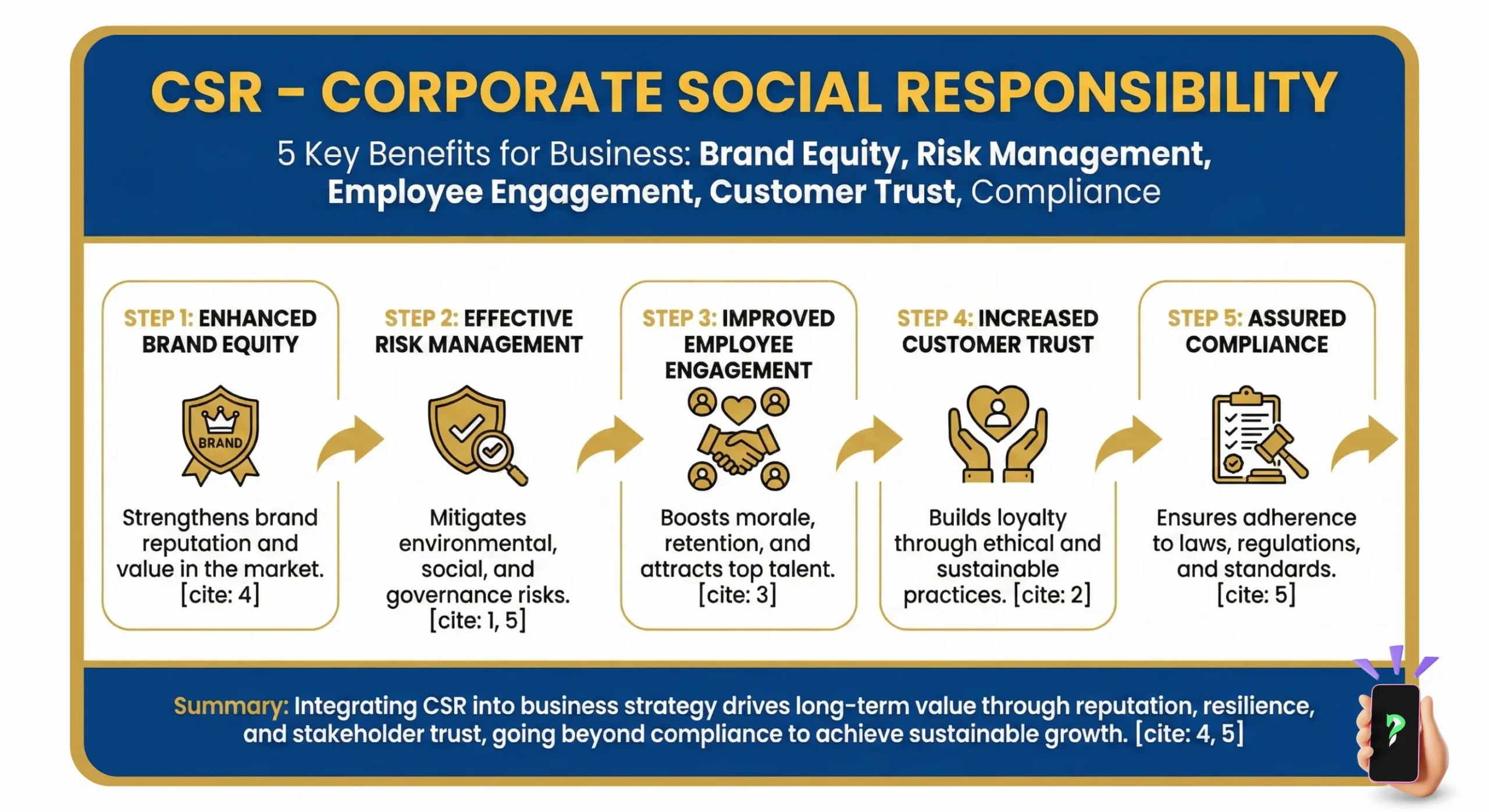
5. Why CSR Matters: Key Benefits for Business
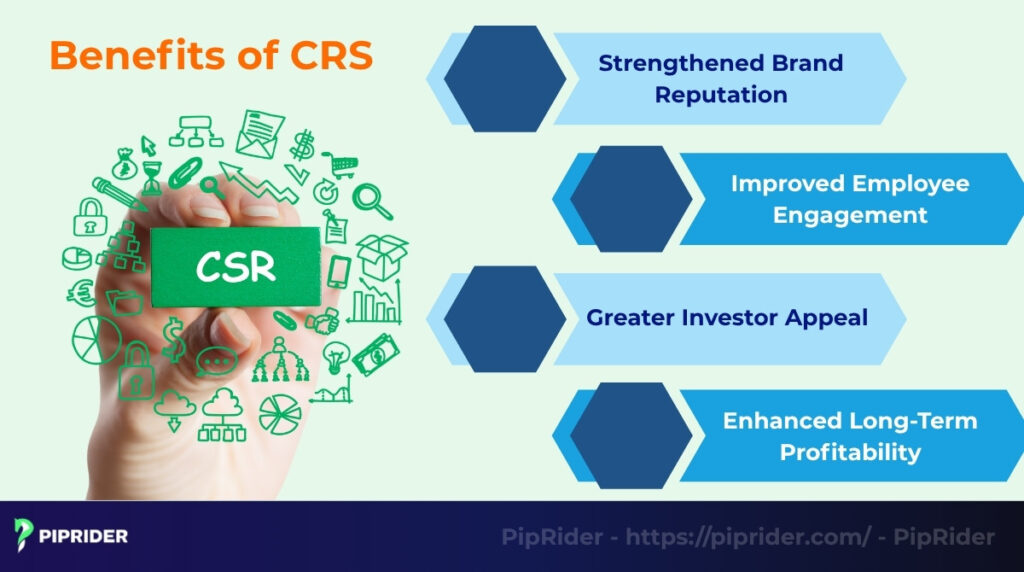
Implementing a strong corporate social policy is not a cost; it is a strategic investment that yields measurable dividends.
5.1. Strengthened Brand Reputation and Trust
In an era of hyper-transparency, consumers (particularly Gen Z) use their purchasing power as a form of activism. A genuine commitment to CSR builds deep emotional trust with customers, which translates into higher brand loyalty and a significant competitive advantage in crowded markets.
5.2. Improved Employee Engagement and Retention
People want to work for organizations that have a clear purpose beyond the bottom line. CSR programs are proven to boost workplace morale, increase productivity, and significantly lower turnover rates. Top talent is increasingly choosing employers based on their social and environmental records.
This principle applies to financial professionals as well—learning to control emotions in high-pressure trading environments is part of maintaining a healthy, sustainable career in finance.
5.3. Greater Investor Appeal and Capital Access
Institutional investors now utilize ESG ratings (from providers like MSCI) to assess a company’s long-term resilience. Strong CSR performance is often viewed as a proxy for good management and lower risk, making the company more attractive to ESG-focused funds and potentially lowering the cost of capital.
5.4. Operational Efficiency and Risk Mitigation
Many CSR initiatives directly improve the bottom line. For example, energy efficiency measures reduce utility costs, while waste reduction lowers disposal fees. Furthermore, proactive social management helps companies avoid legal battles, strikes, and regulatory fines that can devastate a company’s market value.
6. International CSR Frameworks and Standards
To provide credibility and prevent “greenwashing”, companies align their CSR strategies with globally recognized frameworks.
- ISO 26000 (Social Responsibility): An international standard that provides guidance rather than requirements. It covers seven core subjects: organizational governance, human rights, labor practices, the environment, fair operating practices, consumer issues, and community involvement. It is not a certification standard.
- UN Global Compact (UNGC): The world’s largest corporate sustainability initiative. Participating CEOs commit to ten universal principles derived from UN declarations on human rights, labor, environment, and anti-corruption.
- GRI Standards (Global Reporting Initiative): These are the most widely adopted standards for sustainability reporting. They provide a common language for organizations to report their impacts on the economy, environment, and people in a way that is comparable and credible for investors.
- SASB Standards: Focused on the subset of ESG issues most relevant to financial performance, helping companies communicate industry-specific sustainability data to investors.
7. CSR in Action: Real-World Examples
The best way to understand CSR is to see how leading companies integrate it. These examples show CSR as a core part of a business strategy, not just a simple donation.
| Company | CSR Focus | Key Initiative |
| Patagonia | Environmental | The “1% for the Planet” initiative, pledging 1% of total sales to environmental non-profits. They also offer a lifetime repair policy to reduce waste. |
| Starbucks | Carbon negative | A bold commitment to be carbon negative by 2030. By 2050, they aim to remove all the carbon they have emitted since the company was founded in 1975. |
| Unilever | Social impact | The “Unilever Sustainable Living Plan” (USLP) successfully improved health and hygiene for 1.3 billion people while sourcing 67% of agricultural raw materials sustainably. |
| Microsoft | Ethical Sourcing | The C.A.F.E. Practices (Coffee and Farmer Equity) program, which includes over 200 indicators to ensure coffee is grown ethically and farmers are paid fairly. |
8. CSR vs. ESG: Understanding the Difference
While often used interchangeably, CSR and ESG represent two different ways of looking at corporate sustainability.
| Feature | CSR (Corporate Social Responsibility) | ESG (Environmental, Social, Governance) |
| Core Concept | A company’s self-regulated ethical culture and initiatives | A framework used to measure a company’s sustainability performance |
| Goal | To “do good” and be a responsible corporate citizen | To assess financial risks and opportunities related to sustainability |
| Audience | Employees, customers, and the local community | Investors, regulators, and financial analysts |
| Data Type | Mostly qualitative (narratives and commitments) | Mostly quantitative (metrics, ratings, and scores) |
| Example | Launching a local scholarship program | Reporting the precise metric tons of Scope 1 carbon emissions |
Read more:
Companies in the financial services sector, particularly those involved in forex trading, increasingly integrate ESG metrics to demonstrate responsible market practices and attract ethical investors.
9. Challenges and Criticisms
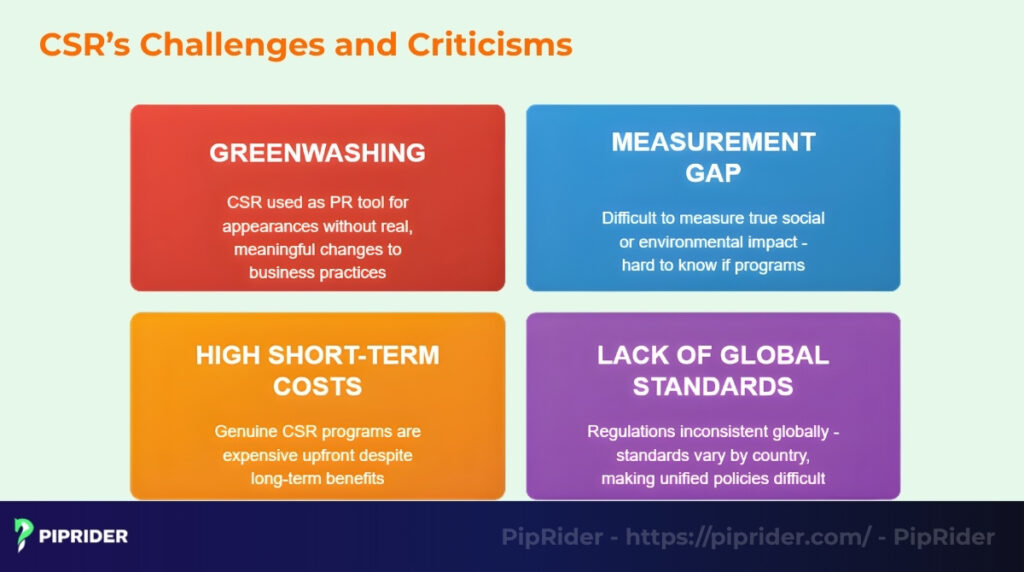
While CSR is widely praised, it is not without challenges and valid criticisms. Companies often face significant hurdles in implementing these programs effectively.
- Greenwashing: A major risk where companies spend more money on marketing their CSR than on the actual social or environmental impact. The United Nations and regulators like the SEC are increasingly cracking down on misleading “net-zero” claims.
- The measurement gap: Quantifying the return on investment (ROI) for social initiatives remains a challenge. For instance, it is difficult to put a dollar value on the benefit of “increased community trust.”
- Global complexity: For multinational companies, CSR standards and expectations vary wildly across different countries, making it difficult to maintain a consistent global policy.
Combating greenwashing requires genuine expertise and transparent communication. PipRider addresses this challenge by partnering with financial experts to ensure our content maintains the highest standards of accuracy and ethical responsibility.
10. The Future of Corporate Social Responsibility
The future of CSR is moving toward a more systemic and data-driven approach.
- CSR 2.0: A term by Wayne Visser describing a shift from “defensive” or “promotional” CSR to “transformative” CSR that changes the core business model to be inherently sustainable.
- Regulated transparency: Voluntary reporting is becoming mandatory, with new laws like the EU’s CSRD requiring thousands of companies to disclose audited sustainability data.
- AI and real-time monitoring: Companies are using AI to track ethical risks in their deep supply chains and optimize energy usage in real-time.
11. Frequently asked questions about CSR
12. The Bottom Line
CSR serves as the essential bridge between profitability and humanity.
Modern businesses are now expected to generate economic value while simultaneously contributing positively to society and protecting the planet. Corporate social responsibility is no longer just an option; it is a core strategy for sustainable survival in the 21st century.
To see how these corporate trends impact market performance, follow PipRider and read our latest Analysis. Our newly launched platform is designed to deliver transparent, ethical financial insights aligned with modern CSR principles.
Infographic Section
-
5 Key Benefits for Business -
CSR – Corporate Social Responsibility -
CSR Program Implementation Checklist