Learning how to control emotion in trading means replacing impulsive reactions like fear and greed with a disciplined, logical process. Learning how to control emotion in trading means replacing impulsive reactions like fear and greed with a disciplined, logical process. It is the fundamental skill that protects your edge and ensures long-term survival in the markets.
This guide explains the psychology behind common mistakes like FOMO and revenge trading. PipRider will then provide a practical framework to build discipline using a trading plan, risk management rules, and a trading journal to replace emotional reactions with rational thinking.
Key Takeaways
- Psychology is the foundation of execution; while a strategy provides the map, your mental discipline determines if you can actually follow it to reach your goals.
- A trading plan is your main defense. Trading without one is, by default, emotional trading.
- Risk management (like the 1-2% rule) is the best practical tool to neutralize fear and greed.
- A trading journal helps you identify and correct the specific emotional patterns and trading behavior that cause mistakes.
- Build discipline by focusing on the trading process (following rules), not the profit or loss.
1. Why Do Emotions Matter in Trading?
Emotions matter in trading because they directly interfere with your rational decision-making. Uncontrolled feelings are the main reason traders fail, often more so than a lack of technical skill. They can cause you to break your rules, ignore your risk management, and ultimately sabotage your own strategy.
Most traders focus on finding the perfect forex trading strategies, but a good strategy is useless without mental discipline. The system fails if a trader is too scared to enter, too greedy to take profits, or too hopeful that a loser will turn around. Your psychological state dictates whether you can actually follow your plan with discipline.
This emotional interference shows up in several common, destructive patterns:
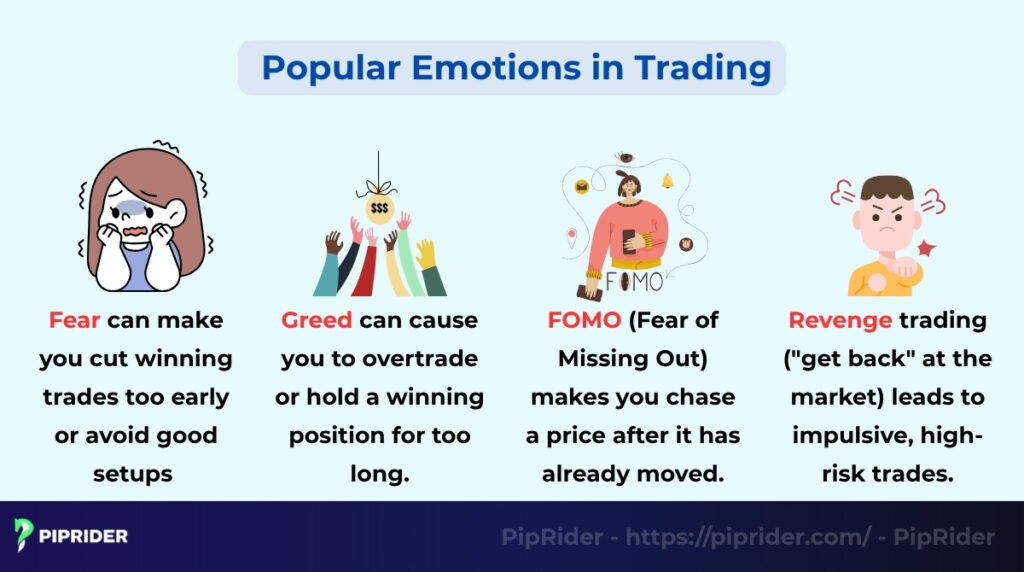
- Fear (of loss) or regret (of past losses) can make you cut winning trades too early or avoid good setups (Mann, 2025).
- Greed can cause you to overtrade or hold a winning position for too long.
- FOMO (Fear of Missing Out) makes you chase a price after it has already moved, often driven by jealousy of others’ gains.
- Revenge trading (trying to “get back” at the market) leads to impulsive, high-risk trades.
For example, fear might cause a trader to exit a profitable position as soon as it goes up slightly. Conversely, loss aversion and false hope might cause that same trader to hold a losing trade far too long. This action turns a small, manageable loss into a major one.
2. What Is the Psychology Behind Trading Decisions?
The psychology behind trading decisions is a constant battle between your logical thinking, analytical plan, and several powerful, ingrained emotional biases. These biases are hard-wired into human nature and can easily override your logic, leading to destructive habits.
2.1. Fear – The Loss Aversion Bias
Fear in trading often stems from “Loss Aversion,” a cornerstone of Prospect Theory (Kahneman & Tversky, 1979). This psychological principle posits that the pain of a loss is approximately twice as powerful as the pleasure of an equivalent gain.
In the volatile Forex market, this leads to the Disposition Effect (Shefrin & Statman, 1985). It is the irrational urge to “lock in” small profits early just to avoid the pain of seeing them vanish. Conversely, it causes you to “hold and hope” on losing trades because closing them makes the psychological pain of the loss feel “real.” This imbalance destroys your risk-reward ratio and is the primary reason why many traders with high win rates still lose money in the long run.
2.2. Greed – Overconfidence and Overtrading
Greed is the euphoric high that follows a string of winning trades, quickly building overconfidence and making traders feel invincible. This psychological state leads to abandoning rules, often by uncontrollably increasing position size or taking low-quality trades. Greed is how traders give back weeks of hard-earned profits in a single afternoon.
2.3. FOMO – Fear of Missing Out
FOMO (Fear of Missing Out) is a powerful anxiety that strikes when you see a price moving rapidly without you. You feel a desperate urge to jump in right now to catch the move. This emotional impulse forces you to enter the trade late, long after the safe entry is gone, which often results in buying the exact top or selling the exact bottom.
2.4. Revenge Trading
Revenge trading is the most destructive emotion. After a frustrating loss, you feel angry and want to “get back” at the market to win your money back immediately. That anger completely abandons your trading plan, replacing it with impulsive, high-risk gambles. It is a total loss of discipline that almost always leads to more losses and can quickly blow up an account.
3. What Are the Signs of Trading Emotionally?
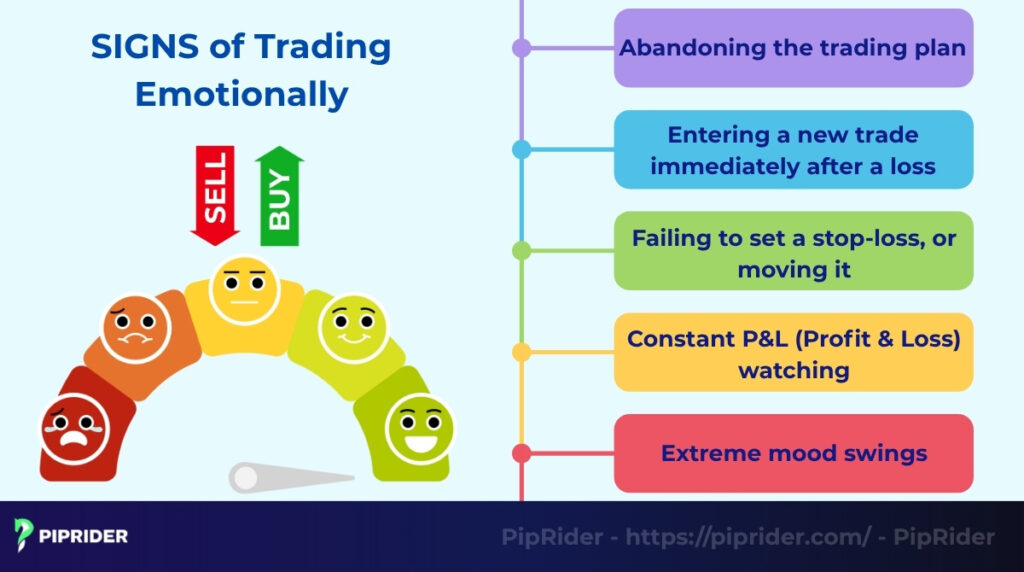
The first step to control is recognition. Noticing these behaviors is a clear sign that emotions, not a pre-defined plan, are driving decisions.
- Abandoning the trading plan. This includes entering trades that don’t meet pre-defined rules or ignoring exit signals based on a “gut feeling” or false hope that the market will turn around.
- Entering a new trade immediately after a loss. A classic sign of revenge trading. This action is driven by anger and a need to erase the last loss, rather than waiting for a valid setup.
- Failing to set a stop-loss, or moving it. Such behavior involves either entering a trade with no protection or, worse, moving a stop-loss further away based on hope. This action directly turns a small, defined loss into a large one.
- Constant P&L (Profit & Loss) watching. The focus shifts from the chart’s price action to the fluctuating dollar amount, creating intense stress and leading to decisions based on the account balance, not the strategy.
- Extreme mood swings. Feeling euphoric after a win and devastated after a loss. A trader’s personal mood should not be tied to the outcome of the last trade; the goal is neutrality and consistency.
4. How to Control Emotion in Trading
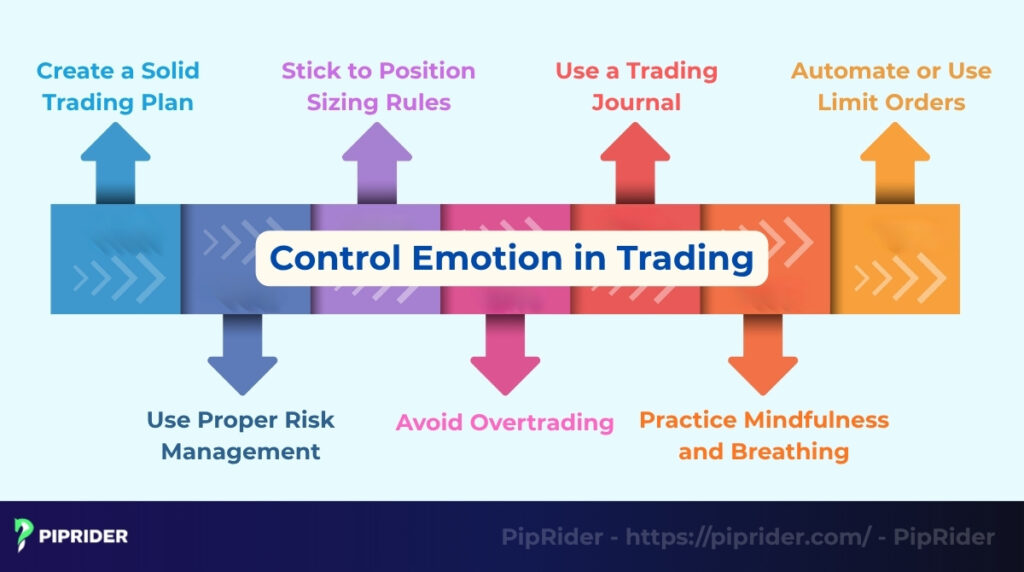
Controlling emotions is not about eliminating them; it’s about neutralizing them with a logical process. This is achieved by creating a non-negotiable trading plan, enforcing strict risk management, and using a trading journal to maintain objectivity.
4.1. Create a Solid Trading Plan
A trading plan, which outlines your entire trading strategy, is the single most important tool against emotion. It is a set of rules created before your trading session starts, when you are logical and calm. This plan must clearly define:
- Specific Currency Pairs and Timeframes to be traded (to avoid overscanning).
- Exact entry signal (based on pre-defined technical or fundamental setups).
- Exact stop-loss price (the point where you objectively accept the trade is wrong).
- Exact take-profit target and desired risk-reward ratio.
- Risk per trade (e.g., 1% of the account balance).
A trader’s job is not to guess the market but to execute this plan perfectly, often by following pre-defined technical setups to remove guesswork and using a trading checklist to ensure every rule is met before clicking “Buy” or “Sell”.
4.2. Use Proper Risk Management
Strict risk management is the most practical way to maintain emotional neutrality. The core rule is to never risk more than 1-2% of your account balance on a single trade. Knowing your maximum downside in advance reduces stress by making losses predictable rather than a source of panic.
When a loss is calculated and accepted before the trade is opened, it ceases to be a threat to your mental stability. Instead, it becomes a manageable “cost of doing business” that you have already accounted for in your trading plan. This objective approach ensures that no single losing trade can trigger a fight-or-flight response, allowing you to stay focused on the next opportunity.
4.3. Stick to Position Sizing Rules
Greed will inevitably tempt you to increase your lot size on a setup that feels like a “sure thing.” You must enforce a rigid position sizing model for every single execution. Consistency here is absolutely non-negotiable. If you risk 5% on a losing trade and only 1% on a winning trade, you destroy your statistical edge entirely. Using a digital position size calculator automates this mathematical process before you enter the market.
This ensures your financial risk remains strictly fixed. It prevents your account balance from being dictated by a fleeting gut feeling or a temporary spike in overconfidence.
4.4. Establish Hard Session Limits
Overtrading is a direct manifestation of anxiety, FOMO, or the dangerous urge to revenge trade. Because the Forex market operates 24/5, the temptation to constantly be in a position is relentless. To neutralize this, your trading plan must define strict operational boundaries. This includes setting a maximum number of trades per session or establishing a hard cut-off time for your screen exposure.
If you catch yourself aggressively scanning the charts for sub-par setups after hitting your quota, you must step away immediately. Prolonged screen time degrades cognitive function, turning logical analysis into emotional gambling.
4.5. Maintain an Objective Trading Journal
A detailed journal is your ultimate diagnostic tool for psychological growth. Human memory is highly biased, meaning you will naturally forget the intense fear or hesitation you felt right before a losing trade.
Beyond simply tracking profits and losses, you must document your mental state and rule compliance during every execution. Over time, this written data exposes your specific emotional triggers and behavioral patterns. Building this habit prepares you perfectly to use the 6-Point Post-Trade Reflection detailed later in this guide. It transforms vague frustration into actionable system improvements.
4.6. Practice Pre-Session Grounding
Navigating the volatile Forex market often triggers a high-adrenaline response. Transitioning directly from a stressful day at work to the trading desk is a recipe for disaster.
Before opening your charts, perform a simple grounding exercise. This can involve deep tactical breathing or taking a short walk away from all digital screens to reset your mind. Deliberately lowering your cortisol levels clears residual mental clutter. This routine ensures you approach the session with logical clarity and a neutral baseline, rather than a reactive impulse.
4.7. Utilize Pending Orders
One of the most effective ways to eliminate impulsive execution is utilizing pending orders. Relying on Buy Limits or Sell Stops is far superior to live market execution when you are struggling with emotional control.
Watching a sudden bullish green candle often triggers intense FOMO, baiting you into buying at the absolute top. Pre-programming your exact entry, stop-loss, and take-profit levels in advance completely removes this anxiety. It eliminates the pressure of having to click the mouse during rapid price spikes. Instead, it forces the market to come to your precise parameters, keeping you entirely in control of the execution.
5. How Do You Recover After an Emotional Trade?
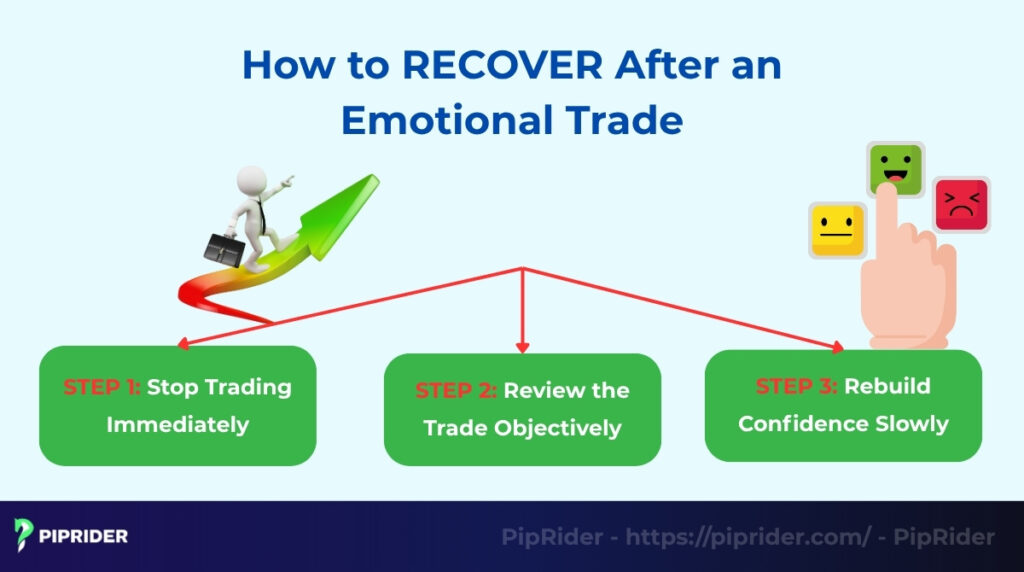
Recovering from an emotional trade requires a three-step process: Stop trading immediately to prevent revenge trading, objectively review the mistake in your journal, and slowly rebuild confidence with smaller position sizes.
5.1. Step 1: Stop Trading Immediately
The moment you realize you made an emotional mistake (like a revenge trade or a FOMO chase), stop trading immediately. The urge to open another position to “win the money back” is powerful and must be resisted. Close the platform, step away from your desk, and take a break to let the adrenaline, anger, or frustration fade. Your first job is to stop the bleeding.
The “Zen” Circuit Breaker Protocol
Use this emergency checklist to stop emotional spirals before they blow your account. If any of these triggers occur, apply the rule immediately.
- Stop at Max Daily Loss: If you hit your limit (e.g., -2R or -2% of balance), close the platform. No exceptions.
- The “Two-Strike” Rule: Walk away after two consecutive losses in a single session. Your mindset and the market are currently out of sync.
- 15-Minute Cooling Buffer: Never open a new trade for at least 15 minutes after a loss. Let the adrenaline fade before re-evaluating.
- Anti-Greed Size Lock: Maintain your fixed position size (e.g., 1%). Never increase size during a winning streak to “chase” bigger gains.
- Journal Over Action: If the urge to “get it back” hits, open your trading journal instead. Document the impulse rather than clicking the mouse.
5.2. Step 2: Review the Trade Objectively
Once you are calm, open your trading journal to perform a “post-mortem” on the trade. You must determine if the strategy itself was technically flawed or if you simply mismanaged a valid setup due to emotion.
To find the true source of the error, avoid vague descriptions. Instead, answer these 6 specific questions to diagnose your performance:
The 6-Point Post-Trade Reflection
- Rule Compliance – Did this setup follow 100% of my pre-session plan? (Yes/No)
- Logic Check – Which specific technical rule triggered this entry?
- Emotional Intensity – On a scale of 0–10, how strong was my fear or greed before clicking?
- Process Integrity – Did I break any rules during entry, management, or exit?
- Reflective Action – What is one specific thing I would do differently if retaking this trade?
- The “Fix” Rule – What one checklist item can I add to prevent this mistake next time?
Identifying whether the failure was a system error (strategy) or a human error (emotion) is the only way to achieve long-term consistency. By answering these questions, you turn a frustrating loss into a data-driven lesson.
5.3. Step 3: Rebuild Confidence Slowly
A severe emotional loss completely shatters your trading confidence. Jumping directly back into full-sized positions is a guaranteed recipe for a destructive revenge trading spiral. You must rebuild your psychological baseline slowly and deliberately by dropping your risk parameters down to a demo environment or strictly using micro lots (0.01) for your next series of setups.
This approach removes the intense financial pressure while keeping you engaged with live market mechanics. During this critical recovery phase, your objective is never to recover lost capital. Your only goal is to execute your predefined plan flawlessly. Once you prove to yourself that your emotional discipline has fully returned, you can gradually scale back to your normal risk parameters.
6. What Long-Term Habits Build Emotional Discipline?
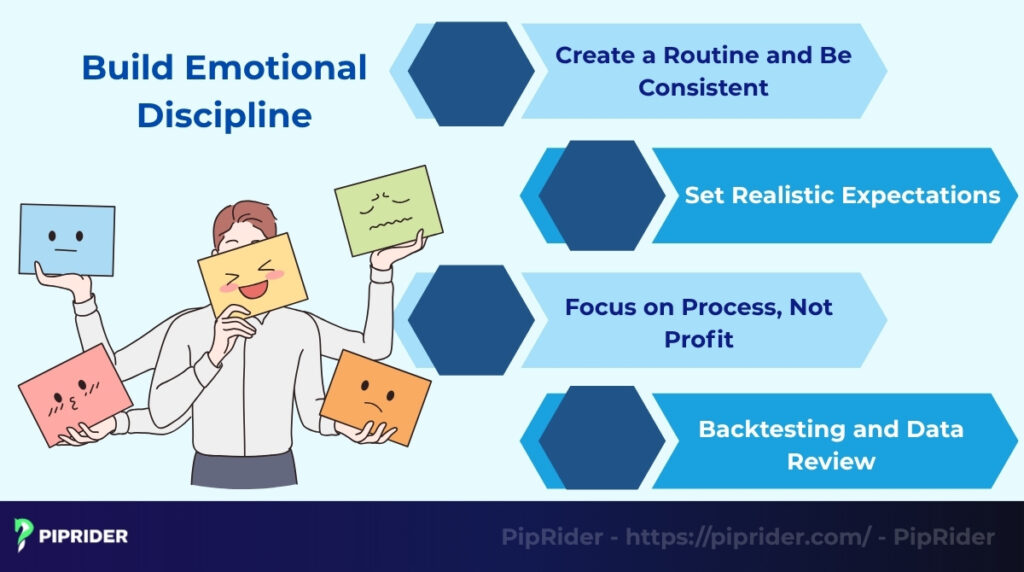
Emotional discipline isn’t an overnight fix; it’s built through long-term, consistent habits. These habits train your brain to be logical and systematic, even under pressure.
6.1. Create a Routine and Be Consistent
Professionalism in trading is built on a “boring” foundation of consistency. By operating at the same time and on the same timeframes each day, you create a controlled environment that filters out market noise. This repetition trains your brain to recognize high-probability “A+” setups automatically, drastically reducing the mental fatigue that leads to impulsive errors.
To master this consistency, implement a 5-Minute “Zen” Pre-Session Routine. This ritual acts as a psychological bridge, moving your mind from daily life into a state of high-performance focus:
The 5-Minute Pre-Session Checklist
- Review Plan & Bias – Read your trading plan and confirm the High Time Frame (HTF) market bias to stay aligned with the “big picture.”
- Map the Battlefield – Mark your key support and resistance levels on the current charts to avoid reactionary trading.
- Identify No-Trade Windows – Check the economic calendar for high-impact news and assess your personal stress levels. If you are not 100% present, do not trade.
- Lock Session Limits – Explicitly state your maximum daily loss (e.g., -2R) before you open your first position.
- Ready the Mirror – Open your trading journal template so it is ready for immediate, objective recording after every trade.
By following this routine, you stop being a gambler reacting to price movements and start being a professional executing a business plan. Consistency in your routine eventually leads to consistency in your equity curve.
6.2. Set Realistic Expectations
To achieve emotional neutrality, you must embrace probabilistic thinking. Stop viewing individual trades as a reflection of your self-worth; instead, treat them as data points in a larger series. Even elite institutional traders accept that losing is simply the cost of doing business, an unavoidable expense in the pursuit of long-term profit.
Expecting a perfect win rate is a direct path to frustration, false hope, and the revenge trading trap. When you accept that a loss is a statistical certainty, it loses its emotional power. Your objective is not a perfect streak, it is consistent profitability maintained over hundreds of trades by strictly executing your edge.
6.3. Focus on Process, Not Profit
This is a key mindset shift taught by trading psychologists like Mark Douglas (2000). You cannot control the market or the immediate profit/loss. You can only control your actions. Focus 100% on your process: Did you follow your plan? Did you execute your rules perfectly? If the answer is yes, you have already ‘won’ the trade psychologically. Over a large enough sample size, a disciplined process is what allows the profits to eventually take care of themselves.
6.4. Backtesting and Data Review
Confidence is the ultimate antidote to fear. The best way to build unshakable confidence in your strategy is through backtesting rules to avoid emotional trades. When you have personally tested your system over hundreds of historical trades, you have data-driven proof that it works. This deep trust in your trading strategy builds true emotional resilience and makes it much easier to stay calm and follow the plan during a losing streak.
7. Practical Tools to Maintain Emotional Neutrality
Beyond a solid plan, specific tools provide the mental distance required for logical decision-making. These resources help you transition from a reactive state to a proactive, “Zen” mindset.
- Digital Journaling Platforms – Tools like Notion or specialized apps allow you to track the “why” behind every trade. They transform subjective feelings into objective data, making it easier to spot emotional patterns before they become habits.
- Time-Boxing & Loss Limits – Professional trading requires high cognitive energy. Use session timers to limit your screen time (e.g., 2 hours per session) and trading platform “Kill Switches” that automatically lock your account once a daily loss limit is hit.
- Mental Rehearsal (Visualization) – Spend two minutes before your session visualizing yourself calmly accepting a stop-loss or patiently waiting for a setup. This “dry run” prepares your nervous system for the reality of the market, reducing the shock of a loss.
- Biofeedback (Optional) – Advanced traders may use an Apple Watch or HeartMath to monitor heart rate variability (HRV). If your heart rate spikes, it is a physical signal to step away from the desk and reset your breathing before touching the mouse.
8. What’s an Example of Emotional vs. Controlled Trading?
The difference between an emotional trader and a disciplined trader is most obvious in how they react to wins and losses. Here is a clear comparison of their actions in the same situations.
| Situation | The Emotional Trader | The Controlled Trader |
|---|---|---|
| After 3 winning trades | Doubles the position size on the next trade, feeling invincible and greedy. | Sticks to the exact same position size as defined in the trading plan. |
| When a trade reverses | Moves the stop-loss further down, “hoping” the price will come back. | Accepts the original stop-loss and lets the trade close for a small, defined loss. |
| After one large loss | Immediately opens a new trade (often larger) to “get the money back.” | Stops trading for the day and reviews the trade journal to see what went wrong. |
As the table shows, the controlled trader operates from a logical plan, while the emotional trader operates from in-the-moment feelings of greed, hope, and anger.
9. What Common Mistakes Undermine Emotional Control?
Even with a good plan, simple daily habits and external factors can undermine your emotional discipline.
- Using caffeine or stimulants: Relying on coffee or energy drinks while trading can increase anxiety, jitteriness, and the impulse to overtrade, mistaking a caffeine high for a market signal or ignoring market noise.
- Lack of sleep: Trading while fatigued significantly reduces your brain’s ability to process information logically and manage stress. This makes you far more susceptible to emotional impulses like fear and anger.
- Constantly watching open trades: Staring at your P&L every minute (known as “screen-watching”) creates intense stress and anxiety. It forces you to focus on the money instead of the technical price action, leading to panic-based decisions.
- Trading during personal stress: If you are already angry, upset, or stressed about personal issues, you are bringing that negative emotion to the market. This makes it almost impossible to trade objectively. The most disciplined action you can take on a highly stressful day is simply to close the platform and not trade at all.
10. Frequently asked questions about Controlling Emotion in Trading
11. Conclusion
Emotional control is a trader’s most vital skill. No trading system, no matter how advanced, will be effective if you do not have the discipline to follow it. The key to how to control emotion in trading is to transform emotional management from an impulse into a daily process and set of positive trading habits.
The winning trader isn’t the one who is the “smartest”, it’s the one who is the most consistent, calm, and disciplined. Ready to master the other pillars of trading? Continue your education by exploring more expert guides on trading strategies, indicators, and market analysis at Piprider.