For many investors, building a diversified portfolio is a major challenge. Buying individual securities like stocks is risky and time-consuming, while traditional mutual funds can be expensive and inflexible. This is why Exchange Traded Funds (ETFs) have become one of the most popular investment tools in the world. They offer a modern solution that blends the benefits of stocks and funds.
This guide will explain the definition of ETFs, how they work, and the simple steps to invest in ETFs.
Key Takeaways
- A fund that holds many securities (like stocks or bonds) but trades on an exchange just like a single stock.
- Exchange Traded Funds (ETFs) typically provide low expense ratios, high liquidity, and easy diversification.
- A “creation/redemption” process keeps the market price aligned with the net asset value (NAV) of the underlying assets.
- Popular options include funds tracking major indexes (like SPY for the S&P 500) or commodities (like GLD for gold).
1. Definition of Exchange-Traded Funds (ETFs)
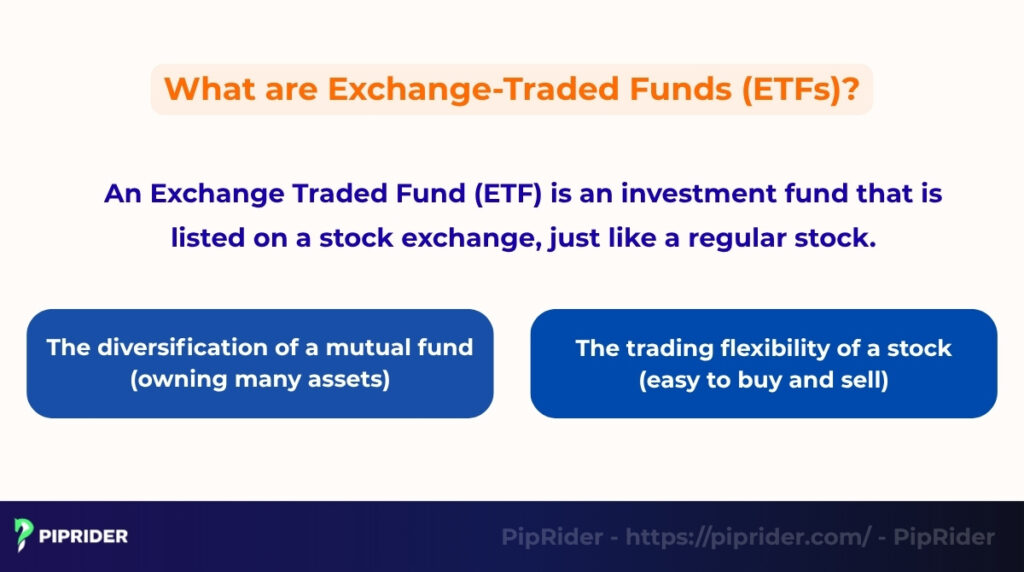
An Exchange Traded Fund (ETF) is an investment vehicle listed on a stock exchange, functioning much like a regular stock. Investors can buy and sell shares of an ETF throughout the trading day at current market prices.
Each ETF holds a “basket” of assets, which can include stocks, bonds, or commodities, designed to track different asset classes. Buying one ETF share gives you exposure to a diversified basket of assets at once.
Most ETFs are structured to track the performance of a specific index. A famous example is the SPDR S&P 500 ETF (Ticker: SPY), which holds the 500 stocks in the S&P 500 index.
The primary benefit of an ETF is that it combines two powerful features:
- The diversification of a mutual fund (owning many assets).
- The trading flexibility of a stock (easy to buy and sell).
These investment tools have surged in popularity globally because they offer broad market exposure at a low cost while maintaining high liquidity.
2. How Exchange Traded Funds Work
Understanding how ETFs work involves three key concepts: the fund’s structure, the “creation and redemption” process, and how it trades on the market.
2.1. ETF Structure
The structure of an ETF involves two main groups: the companies that create the fund and the investors who trade it.
- ETF Issuers: ETFs are created and managed by large asset management companies, often called “issuers” or “sponsors” (such as BlackRock, Vanguard, and State Street).
- How Investors Buy: As an individual investor, you do not buy shares directly from the fund issuer. Instead, you buy and sell shares of the ETF on a stock exchange (like the NYSE) through a standard brokerage account, just like buying shares of a company like Apple or Google.
2.2. Creation and Redemption Process
This special process keeps the ETF’s market price very close to the actual value of its assets (its Net Asset Value, or NAV).
- Authorized Participants (APs): Large financial institutions called APs are authorized to create or redeem large blocks of ETF shares directly with the fund.
- The Arbitrage: If the ETF’s market price starts to rise above its asset value (NAV), APs create new shares and sell them, pushing the price back down. If the ETF price falls below its NAV, APs buy the cheap shares and redeem them, pushing the price back up.
- The Benefit: This constant arbitrage mechanism is the key to how ETFs work. It ensures the ETF’s market price always stays very close to its true net asset value and helps make the fund highly liquid.
2.3. Trading and Pricing
On a day-to-day basis, ETFs are bought and sold on a stock exchange, just like any other company’s stock.
- Ticker Symbol: Every ETF trades on an exchange under a unique ticker symbol (e.g., SPY, QQQ, GLD), just like a stock.
- Market Price: Because it trades like a stock, an ETF’s price changes continuously throughout the day based on supply and demand.
- Arbitrage Mechanism: While the arbitrage mechanism helps keep the market price aligned with the Net Asset Value (NAV), premiums or discounts can occur during periods of extreme market volatility or within illiquid asset classes.
3. Understanding the Real Cost: Premium, Discount, and TCO
Evaluating an ETF requires looking beyond the sticker price. Understanding the relationship between an ETF’s market price and its underlying value is essential for accurate trade execution.
3.1. Premium and Discount Mechanics
Because ETFs trade on an exchange, the market price is driven by supply and demand, which can occasionally deviate from the Net Asset Value (NAV) of the underlying securities.
- Premium: A premium occurs when the ETF’s market price exceeds its actual NAV.
- Discount: A discount represents a scenario where the market price falls below the NAV.
The pricing gap often widens in specific scenarios. For instance, fixed income and international ETFs frequently experience larger premiums or discounts because their underlying assets (bonds or foreign stocks) may be less liquid or trade in different time zones than the ETF itself (State Street Global Advisors, 2023).
3.2. Indicative Net Asset Value (iNAV)
To help investors gauge pricing accuracy throughout the day, issuers provide an Indicative Net Asset Value (iNAV). The iNAV represents a real-time estimate of the fund’s value per share, typically updated every 15 seconds. Comparing the current market price to the iNAV allows traders to identify whether they are buying at a significant premium or selling at a deep discount.
3.3. Total Cost of Ownership (TCO)
Many beginners focus solely on the expense ratio, but the actual cost of holding an ETF is a combination of several market factors. The Total Cost of Ownership (TCO) is a more accurate metric and includes the following (Fidelity Investments, 2024):
| Cost Component | Description | Impact on Returns |
|---|---|---|
| Expense Ratio | The annual management fee charged by the issuer. | Consistent, ongoing drag on performance. |
| Bid-Ask Spread | The difference between the highest buy price and the lowest sell price. | Upfront cost incurred during every trade. |
| Premium/Discount | The variance between market price and NAV. | Can increase entry cost or decrease exit value. |
| Taxes | Capital gains or dividend taxes based on distributions. | Varies by investor and fund efficiency. |
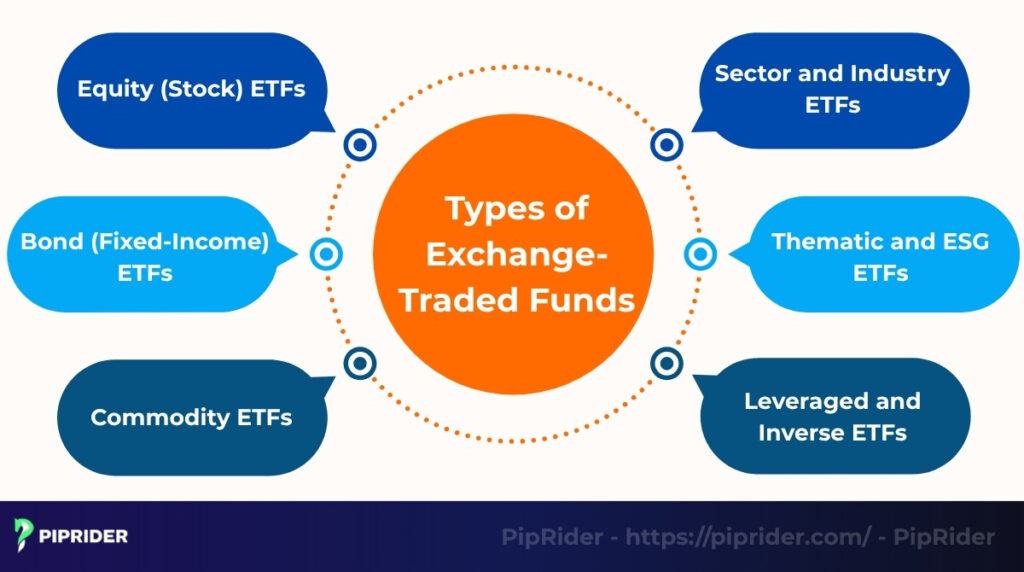
4. Types of Exchange-Traded Funds (ETFs)
The term what are Exchange Traded Funds covers a vast range of products. ETFs are categorized based on the types of assets they hold or the specific strategies they follow.
4.1. Equity (Stock) ETFs
These are the most common and popular type of ETF. They invest in a basket of stock securities (equities) and usually track a specific index. This allows investors to buy a piece of an entire market, like the S&P 500 or the Nasdaq-100, with a single share. They are the simplest way to achieve broad stock market diversification.
For traders seeking more active approaches, explore how to trade indices using leveraged instruments.
4.2. Bond (Fixed-Income) ETFs
These Exchange-Traded Funds (ETFs) invest in various types of bonds (debt), which are essentially loans to governments or corporations. They are often used by investors to generate a steady stream of income from the interest payments (coupons) made by the bonds. These funds can hold thousands of different bond securities, diversified by maturity and credit quality.
4.3. Commodity ETFs
Commodity ETFs offer a way to invest in raw materials like gold, oil, or agricultural products without physically buying or storing them. Some commodity ETFs (like Gold ETFs, Ticker: GLD) hold the physical asset (bullion). Others (like Oil ETFs, Ticker: USO) use futures contracts to track the commodity’s price.
4.4. Sector and Industry ETFs
These ETFs allow you to invest in a specific part of the economy rather than the whole market. This is for investors who believe a particular sector will outperform. For example, if you are bullish on technology, you could buy a technology sector ETF (like XLK) instead of trying to pick individual winners like Apple or Microsoft. (There are also currency ETFs that track exchange rates, like the Euro or Yen.)
4.5. Thematic and ESG ETFs
These funds group companies based on a specific theme or social criteria.
- Thematic ETFs invest in long-term trends like Artificial Intelligence (AI), robotics, or clean energy.
- ESG ETFs invest only in companies that meet certain Environmental, Social, and Governance (sustainability) criteria.
4.6. Leveraged and Inverse ETFs
These are complex, high-risk tools intended for short-term speculation, not long-term investing.
- Leveraged ETFs: Use financial derivatives to seek a 2x or 3x return of a daily index.
- Inverse ETFs: Designed to go up when an index goes down. They are used to bet against the market.
Warning: These ETFs are extremely risky due to their daily reset and are not intended for a buy-and-hold portfolio. They are only suitable for professional traders.
5. Advantages of ETFs
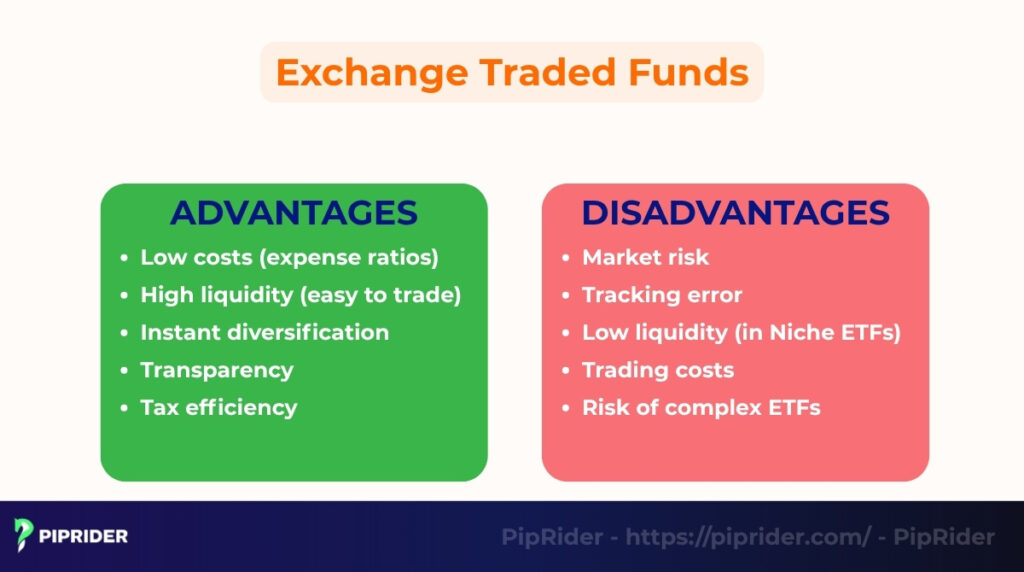
Exchange-Traded Funds (ETFs) have become extremely popular because they offer investors several key advantages over traditional mutual funds and individual stocks.
- Low costs (expense ratios): Most ETFs are “passively managed,” meaning they simply track an index. This requires less work from fund managers, so their annual management fee (called the “expense ratio”) is typically much lower than actively managed mutual funds.
- High liquidity (easy to trade): You can buy and sell ETFs at any time during the stock market’s trading day, just like a stock. This is a major advantage over mutual funds, which only price and trade once per day after the market closes.
- Instant diversification: This is a core benefit. When you buy just one share of a broad market ETF (like VTI), you are instantly investing in hundreds or even thousands of different companies. This spreads your risk across many securities.
- Transparency: High transparency is a hallmark of the ETF structure, with many issuers disclosing their full list of holdings on a daily basis; however, reporting requirements can vary depending on the fund’s specific regulatory framework and strategy.
- Tax efficiency: The unique creation and redemption process typically allows ETFs to operate with greater tax efficiency than traditional mutual funds. While actual outcomes depend heavily on the underlying asset turnover, the structure generally results in fewer and smaller capital gains tax bills for the investor each year.
6. Drawbacks and Risks of the ETFs
While ETFs offer many benefits, it is important to understand that they are not risk-free. Investors should be aware of these potential drawbacks before investing.
- Market risk: An ETF is a basket of assets. If the securities in that basket (like stocks or bonds) lose value, the price of the ETF will also fall. An ETF does not protect you from a general market downturn.
- Tracking error: This is the small difference between the ETF’s performance and the performance of the index it is supposed to track. Fees, transaction costs, and the fund’s specific structure can cause the ETF to slightly underperform its benchmark.
- Low liquidity (in Niche ETFs): Very popular ETFs (like SPY) are traded millions of times per day. However, smaller, less common ETFs may have low trading volume. This “low liquidity” can make it harder to sell your shares at a fair price.
- Trading costs: Because Exchange Traded Funds are traded like stocks, you may have to pay trading costs. This includes commissions (though many brokers now offer commission-free trading on ETFs) and the bid-ask spread.
- Risk of complex ETFs: Leveraged and Inverse ETFs are very risky and not intended for long-term investing. They are designed for short-term speculation. ecause they reset daily, they can lose value quickly over time due to “path decay” (U.S. Securities and Exchange Commission [SEC], 2023).
7. ETFs vs. Mutual Funds vs. Stocks
Building a modern portfolio requires a granular understanding of how different investment vehicles operate. The following table provides a full breakdown of the technical and strategic differences found in the guide.
| Feature | ETFs | Mutual Funds | Stocks | Strategic Note |
|---|---|---|---|---|
| Trading Frequency | Real-time on exchange throughout the day. | Once per day after market close. | Real-time on exchange throughout the day. | ETFs offer the same pricing agility as individual shares. |
| Management Costs | Typically low expense ratios. | Often higher, especially for active funds. | Zero ongoing management fees. | Lower fees directly contribute to better long-term performance. |
| Diversification | High; instant exposure to hundreds of assets. | High; professional bundling of securities. | Low; limited to a single company. | ETFs minimize the risk associated with individual stock failure. |
| Tax Efficiency | High; in-kind redemption reduces capital gains. | Lower; internal sales create taxable events. | Direct; taxes based only on your personal trades. | The “creation/redemption” mechanism protects investors from taxes. |
| Transparency | Daily disclosure of all holdings. | Limited; typically quarterly disclosure. | Absolute; you know the exact company held. | Knowing exactly what is in the “basket” daily is a key ETF feature. |
8. Dividends and Taxes: What Investors Need to Know
While ETFs are highly tax-efficient vehicles, holding them still generates taxable events that investors must actively manage. Understanding how distributions and sales are taxed is crucial for long-term portfolio growth.
Handling ETF Dividends: Most ETFs, particularly equity and bond funds, collect dividends or interest from their underlying securities and distribute them to shareholders, typically on a quarterly basis. When receiving these payments, investors generally have two options:
- Cash Payout: Receive the dividend as a direct cash deposit into the brokerage account.
- Dividend Reinvestment Plan (DRIP): Automatically use the cash distribution to purchase fractional shares of the same ETF, accelerating compound growth.
The Investor’s Tax Burden: Even though the ETF structure minimizes internal capital gains, individual investors are still responsible for specific taxes:
- Taxes on Distributions: Any dividends or interest paid out by the fund are taxable in the year they are received, regardless of whether they are taken as cash or reinvested through a DRIP.
- Capital Gains Tax: Selling ETF shares for a profit triggers a capital gains tax on the price difference. The applied tax rate depends on how long the shares were held before selling (short-term versus long-term capital gains).
Utilizing tax-advantaged retirement accounts, such as an IRA or a 401(k), is a highly effective strategy to defer or entirely eliminate these specific tax obligations.
9. How to Invest in ETFs
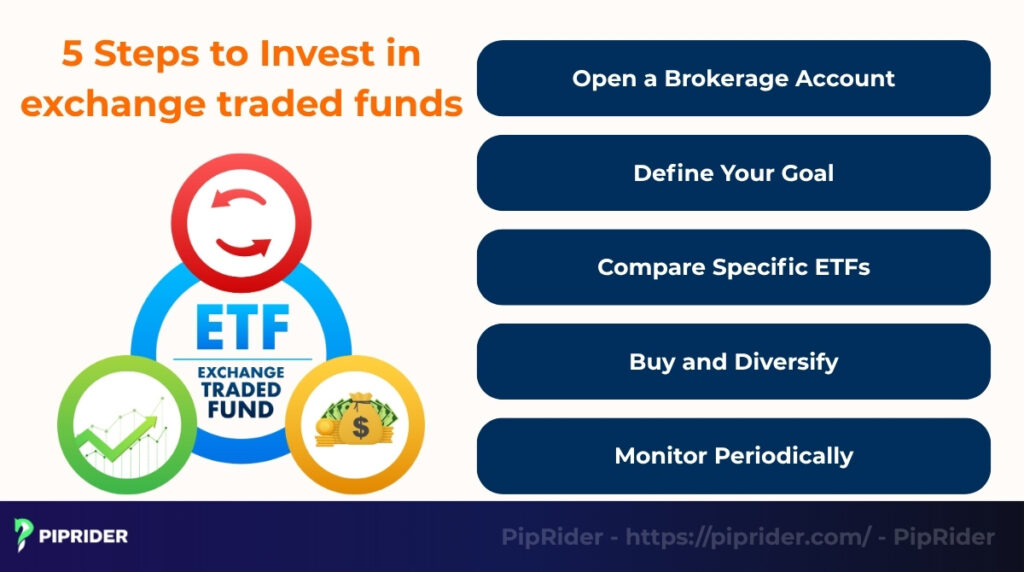
Getting started with how to invest into an ETF is a straightforward process, much like buying an individual stock.
- Open a Brokerage Account: You can buy and sell ETFs through any standard brokerage account or retirement account (like an IRA).
- Define Your Goal: Know why you are investing. Are you seeking long-term growth (e.g., S&P 500 ETF), income (e.g., Bond ETF), or capital preservation?
- Compare Specific ETFs: Once you have a goal, compare ETFs based on their Expense Ratio (the management fee; lower is better), the index they track, and their size (Assets Under Management – AUM).
- Buy and Diversify: Place a buy order using the ETF’s ticker symbol (like SPY or QQQ). To build a robust portfolio, combine different types of ETFs that cover different asset classes (e.g., stocks and bonds).
- Monitor Periodically: Review your portfolio every few months or annually to ensure it still matches your long-term goals. Rebalance if your allocation to certain asset classes drifts.
10. How to Choose the Right ETF: A Strategic Checklist
Selecting the best ETF requires looking beyond the marketing name. The following 8-point checklist provides a comprehensive framework to evaluate the quality, cost, and safety of any fund before you invest (Vanguard, n.d.).
| Criterion | What to Check | Strategic Insight |
|---|---|---|
| 1. Index & Strategy | Ensure the benchmark aligns with your goal (e.g., S&P 500 vs. Nasdaq-100). | Understanding the index methodology prevents unintended sector bias. |
| 2. Expense Ratio | Compare the annual fee against the category average. | Lower costs are the strongest predictor of future performance. |
| 3. Liquidity & Spread | Look for high daily volume and a narrow bid-ask spread. | High liquidity reduces the hidden cost of entering and exiting positions. |
| 4. Tracking Difference | Check the actual return gap between the fund and its index. | Consistent negative “Tracking Difference” signals poor fund management. |
| 5. Premium / Discount | Verify if the market price historically hugs the NAV. | Avoid funds that frequently trade at significant premiums or discounts. |
| 6. Holdings & Concentration | Review the “Top 10 Holdings” weight percentage. | A fund can be “broad” yet still have 30% risk concentrated in just a few giants. |
| 7. Replication Method | Confirm if the fund holds physical assets or uses synthetic swaps. | Physical replication removes the counterparty risk found in synthetic funds. |
| 8. Fund Domicile & Tax | Identify the fund’s legal home country. | Domicile location impacts dividend withholding tax rates for international investors. |
11. How to Trade ETFs Properly: Strategy and Timing
Effective execution is as vital as fund selection when building a portfolio. While buying an ETF may seem identical to buying a stock, specific trading strategies can significantly reduce hidden costs and protect your entry price.
11.1. Order Types: Limit vs. Market Orders
Choosing the right order type serves as the first line of defense against poor pricing. Market orders prioritize speed, executing immediately at the current available price; however, they can lead to “slippage” if the bid-ask spread is wide.
Utilizing limit orders is generally the preferred approach for ETF investors. A limit order allows you to specify the maximum price you are willing to pay (or the minimum you will accept when selling). Adopting limit orders ensures you do not overpay during a sudden price spike, which is a common risk in niche or low-volume ETFs (Fidelity Investments, 2024).
11.2. Timing and the Liquidity Window
Market liquidity is not consistent throughout the trading day. Trading activity typically follows a “U-shaped” pattern, where volume is highest at the open and close but thinnest during the middle of the session.
Avoiding the first and last 30 minutes of the trading session is a common rule of thumb. During these windows, specialized market participants are still adjusting their pricing models, which can lead to wider spreads and increased volatility. Executing trades during mid-day generally offers the most stable pricing environment for retail investors.
11.3. Structural Risks: Roll Yield and Contango
Investors targeting commodities or specific bond segments through futures-based ETFs must understand the mechanics of contract rotation. Unlike equity ETFs that hold actual shares, futures-based funds must “roll” their contracts forward as they approach expiration.
- Contango: A market is in contango when the price of a futures contract is higher than the current spot price. The fund is forced to sell cheaper, expiring contracts and buy more expensive new ones, resulting in a persistent “roll cost” that drags down performance.
- Backwardation: The opposite scenario occurs when future prices are lower than spot prices, which can create a positive roll yield.
- Long-term Decay: Because of these structural costs, commodity ETFs using futures are often unsuitable for long-term “buy and hold” strategies. The constant expense of rolling contracts can significantly decouple the fund’s return from the actual commodity’s spot price (Fidelity Investments, 2024).
12. Example ETFs
There are thousands of Exchange Traded Funds examples available, tracking nearly every market, sector, or commodity imaginable. Here are a few of the largest and most popular ETFs that investors frequently use as core holdings:
| ETF Name | Type | Ticker | Expense Ratio | Focus |
| SPDR S&P 500 ETF Trust | Equity | SPY | 0.09% | Tracks the S&P 500 index (Large-cap U.S. stock securities) |
| Vanguard Total Stock Market ETF | Equity | VTI | 0.03% | Tracks the entire U.S. stock market |
| iShares Core U.S. Aggregate Bond ETF | Bond | AGG | 0.04% | Tracks the total U.S. investment-grade bond market (a popular type of bond ETFs) |
| Invesco QQQ Trust | Equity | QQQ | 0.20% | Tracks the Nasdaq-100 (Large-cap tech/growth stocks), one of the most actively traded indices for those learning how to trade NAS100. |
| SPDR Gold Shares | Commodity | GLD | 0.40% | Tracks the spot price of gold bullion |
(Note: Expense Ratios are approximate and subject to change.)
13. Frequently asked questions about Exchange Traded Funds
14. The Bottom Line
Exchange Traded Funds (ETFs) are versatile, low-cost, and transparent investment tools suitable for both beginners and professional investors. They offer the diversification of a mutual fund combined with the easy trading flexibility of a stock, making them a key tool for risk management and building a modern portfolio.
While they are an effective strategy for building long-term wealth or income generation, investors must understand the market risks involved. An ETF’s price will fall if its underlying asset classes fall, and complex leveraged or inverse ETFs (often used for hedging) should be avoided by long-term investors.
To learn more about specific investment strategies and market analysis, explore the other in-depth articles at PipRider.