Leverage is a double-edged sword that amplifies both potential returns and the speed of capital depletion. When market movements erode account equity below mandatory maintenance levels, brokers issue a margin call, the final warning before a forced liquidation of your assets. Failing to understand these mechanics often leads to avoidable financial disasters.
The following guide provides the essential framework for calculating requirements and implementing the proactive strategies needed to safeguard your portfolio in both stock and forex markets.
Key Takeaways
- Margin Call Definition: A demand from your broker to add more funds to your account.
- The Trigger: Occurs when your account equity (the value of your assets minus the loan) falls below the “maintenance margin” requirement.
- Common Cause: Triggered when the value of your margin call stocks drops, reducing your equity.
- If you fail to meet the call, your broker has the right to sell your securities without your permission to cover the loan.
- The best ways to prevent margin calls include using less leverage, holding extra cash in your account, and using stop-loss orders.
1. What Are Margin Calls In Stocks?
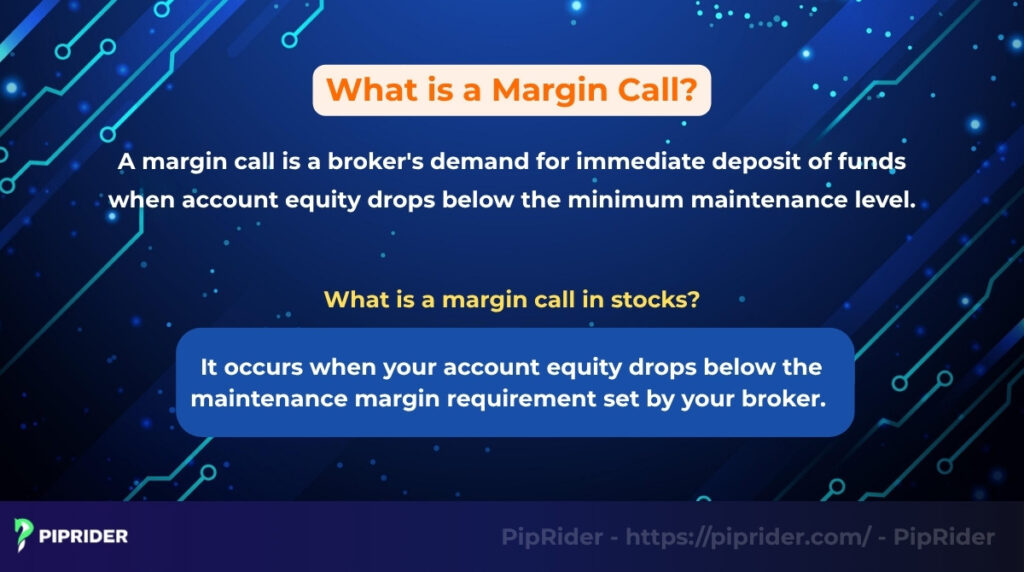
A margin call is a formal demand from a broker to deposit additional cash or marginable securities when account equity falls below the required maintenance margin.
Under SEC and FINRA regulations, brokerage firms reserve the legal right to liquidate an investor’s positions immediately, often without prior notification, to recover the loaned capital if account equity drops below mandatory thresholds (SEC, n.d.; FINRA, n.d.).
Trading on margin enables investors to control larger positions by using borrowed funds, with the purchased securities serving as collateral for the loan. When the market value of these assets declines, the value of the collateral shrinks, potentially exposing the broker to credit risk.
Receiving a margin call acts as a critical warning sign that leverage risk has exceeded safe parameters. It necessitates an urgent injection of capital or a strategic reduction in position size to prevent a total forced liquidation of assets.
2. Margin Requirements: Initial, Maintenance, and House Margin
Navigating a margin account requires a clear understanding of the three distinct equity thresholds that govern a trader’s buying power and risk exposure.
- Initial Margin (Entry Requirement): The initial margin represents the minimum equity percentage an investor must provide to open a new leveraged position. Under Regulation T (Reg T) established by the Federal Reserve, the standard requirement for equities in the United States is typically 50%. Effectively, an investor can borrow up to half the purchase price of a stock at the moment of trade execution (U.S. Securities and Exchange Commission [SEC], n.d.).
- Maintenance Margin (Regulatory Minimum): Once a position is active, the maintenance margin dictates the absolute floor for account equity. Regulatory bodies mandate a baseline requirement of 25% for stocks. Dropping below this level signals to the broker that the collateral is no longer sufficient to secure the loan (FINRA, n.d.).
- House Margin (The Broker’s Safety Buffer): Many brokerage firms impose “house margin” requirements that are strictly more conservative than regulatory minimums. A firm might set its internal threshold at 30% or 40% based on the volatility of specific assets. Brokers also retain the legal right to increase these house requirements at any time, especially during market turbulence, forcing an immediate margin call even if asset prices remain stable (FINRA, n.d.).
3. What Triggers a Margin Call?
A margin call triggers when account equity falls below the established maintenance threshold. While a decline in asset value is the primary cause, several factors can accelerate this process or initiate a call unexpectedly.
3.1. Market Volatility
The most frequent catalyst is high market volatility. When the market price of securities held on margin drops sharply, the total account value decreases while the loan amount remains constant. This rapid depreciation erodes the investor’s equity buffer, quickly pushing it toward the maintenance limit.
3.2. Excessive Leverage
Deploying maximum leverage leaves almost no room for error. An investor using the full extent of their buying power operates with a thin equity cushion. Consequently, even a minor price dip can consume the remaining margin, triggering an immediate demand for capital.
3.3. Concentration Risk
Holding a single security or a few highly correlated assets on margin increases risk. If that specific asset underperforms the broader market, the lack of diversification can lead to a sudden and deep equity drawdown, initiating a margin call that a diversified portfolio might have avoided.
3.4. Broker Margin Policy Changes
Brokers retain the right to adjust their house margin requirements at any time. During periods of heightened systemic risk, a firm may increase the maintenance requirement for specific volatile stocks (e.g., raising it from 30% to 50%). Such a policy shift can instantly push an account into a margin call, even if the underlying stock price has not moved.
3.5. Accumulated Margin Interest and Fees
Borrowing funds to trade involves ongoing costs that can trigger a margin call even in a stable market. Brokers charge interest on margin loans daily, typically debiting these expenses from the account monthly. This continuous accrual of interest directly erodes account equity over time. In scenarios where asset prices remain stagnant, the mounting debt from interest charges can eventually push the equity level below the maintenance requirement (SEC, n.d.).
3.6. Account Withdrawals or Asset Transfers
Removing capital from a margin account immediately alters the equity-to-loan ratio. Withdrawing cash or transferring securities out of the account reduces the total equity buffer while the outstanding margin debt remains unchanged. This reduction can inadvertently trigger a margin call if the remaining equity no longer satisfies the broker’s minimum maintenance threshold (SEC, n.d.).
4. Margin Call Scenario
Understanding what it means to get margin called is easiest with a clear example. Let’s look at a common scenario for an investor.
The Trade:
- You buy $10,000 worth of stock or other securities.
- You pay $5,000 (your equity).
- You borrow $5,000 (your margin loan).
The Rule:
- Your broker’s maintenance margin requirement is 25%.
- This means your equity must always be at least 25% of the total stock value.
The Market Drop:
- Your stocks fall, and the total value of your position is now only $6,000.
The Call:
- Your equity is now: $6,000 (Value) – $5,000 (Loan) = $1,000.
- Your required equity is: 25% of $6,000 = $1,500.
- Because your $1,000 in equity is below the $1,500 requirement, you get a margin call.
You must deposit $500 in cash or sell assets. If you do nothing, your broker has the right to sell your securities immediately to cover the loan, often without asking you first.
5. Margin Call Example: How to Calculate
Calculating a margin call requires understanding the precise relationship between account equity and total market value. Brokers continuously monitor the “Margin Level” (equity expressed as a percentage of total value) and compare it against their mandatory “Maintenance Margin” requirement (typically 25% for equities).
| Item | Value |
|---|---|
| Initial Investment | $10,000 |
| Loan (Margin Debt) | $5,000 |
| Current Value After Drop | $6,000 |
| Equity = $6,000 – $5,000 | $1,000 |
| Margin Level = $1,000 / $6,000 = 16.7% | Below 25% (Margin Call Triggered) |
To determine the current margin level, brokers apply the following formula:
Margin Level = Equity / Total Market Value
Applying the scenario numbers yields a clear result:
- The Calculation: $1,000 (Equity) / $6,000 (Total Value) = 16.7%
- The Broker’s Rule: The minimum Maintenance Margin is 25%.
Dropping to a 16.7% margin level clearly breaches the 25% minimum threshold, instantly triggering a margin call from the broker.
6. Margin Call in Forex/CFD: Margin Level and Stop-out
While the core concept remains the same, margin calls in the Forex and CFD markets operate with distinct mechanics compared to the stock market. Understanding these differences is vital for traders navigating high-leverage environments.
In the Forex world, brokers primarily monitor the Margin Level, expressed as a percentage. This metric represents the ratio of account equity to used margin:
Margin Level = (Equity / Used Margin) × 100%
Maintaining a healthy free margin is essential to prevent the account from reaching two critical thresholds:
- Margin Call Level: Most Forex brokers set a “Margin Call Level” (e.g., 100%). Reaching this threshold acts as an initial warning, typically disabling the trader from opening any new positions. At this stage, the broker requires the trader to either deposit more funds or close losing trades to increase the Margin Level.
- Stop-out Level: The stop-out level is the ultimate “danger zone” (e.g., 50% or 20%). When the account’s Margin Level hits this point, the broker begins the Stop-out process, automatically closing active positions, starting with the most unprofitable ones, to prevent the account from falling into a negative balance.
Unlike the stock market’s commonly cited 25% regulatory minimum, Forex margin and stop-out levels are strictly broker-specific. No universal percentage exists across the industry; therefore, traders must verify the exact specifications of their chosen platform before deploying leverage.
7. Strategies to Respond to a Margin Call
Receiving a margin call requires immediate action from the investor. Ignoring it is not an option, as it can lead to forced losses. A trader typically has several options to bring the account back into compliance.
- Deposit funds: The most direct solution is to deposit additional cash or marginable securities into the account. This action increases the account’s total equity, raising the margin level back above the maintenance requirement.
- Sell some assets (Liquidate): A trader can choose to sell some of the assets in their account. The proceeds from the sale are used to pay down the margin loan (debt), which in turn increases the equity percentage.
- Close part of your position: Similar to selling assets, a trader can close a portion of their losing position(s). This reduces the total size of the margin loan and cuts the overall risk exposure.
- Negotiate with your broker (Limited Option): In some rare cases, if the call is very small or clearly due to a temporary flash crash, a trader might be able to negotiate with their broker for a short extension. However, this is never guaranteed.
Crucial Warning: Investors must respond to a margin call immediately. Brokers are not required to grant extensions and retain the legal right to liquidate positions without further warning to protect themselves from credit risk.
8. How to Prevent Margin Calls
Getting a margin call is a stressful experience that can force an investor to sell investments at a loss. The best strategy is to manage your risk proactively to prevent one from ever happening.
Here are five effective ways to avoid margin calls.
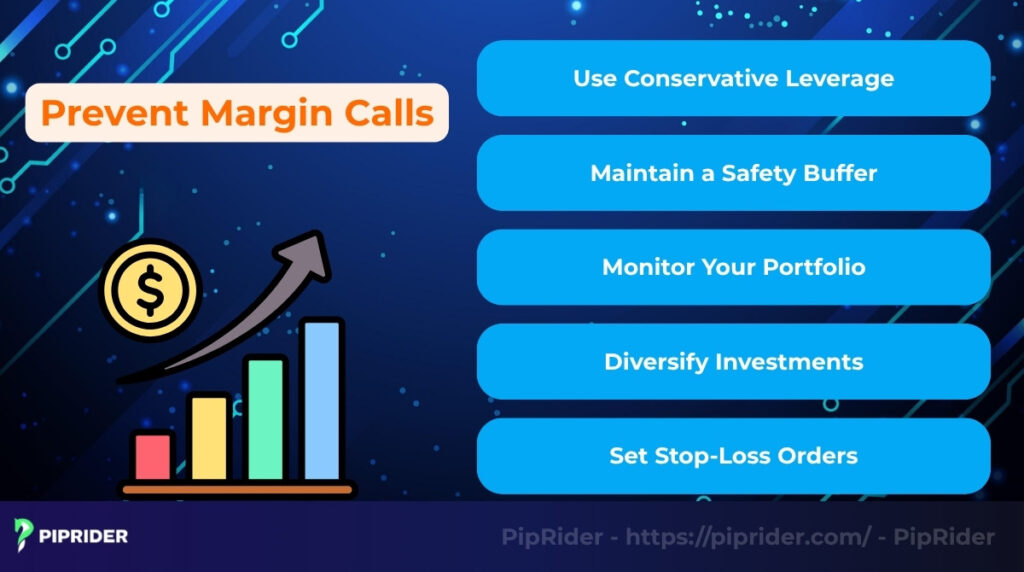
8.1. Use Conservative Leverage
The easiest way to avoid a margin call is to not use too much leverage. While many brokers offer high borrowing limits, it is safer to be conservative, which includes understanding free margin before using leverage to ensure you have enough usable funds to cover market swings. Many experts suggest never borrowing more than 30% to 40% of your total portfolio value.
8.2. Maintain a Safety Buffer
Do not let your account equity drop close to the maintenance margin requirement (e.g., 25%). It is smart to maintain a “safety buffer” of your own, by holding extra cash or equity. For example, make it your personal rule to always keep your margin ratio at least 10% to 20% higher than the broker’s minimum.
8.3. Monitor Your Portfolio
When you trade on margin, you must be an active investor. Monitor your portfolio daily to know exactly where your equity level stands. Daily monitoring becomes especially important during volatile markets, when prices can fall very quickly.
8.4. Diversify Investments
Avoid concentrating all your margin funds into one or two high-risk stocks or securities. Allocating funds across different, non-correlated assets reduces the risk that a large drop in a single stock will wipe out your equity and trigger a margin call.
8.5. Set Stop-Loss Orders
Implementing a precise exit strategy is crucial for capital preservation. Understanding how to calculate a stop-loss ensures a position automatically closes before account equity drops anywhere near the broker’s maintenance margin.
However, automated orders offer no absolute guarantee of protection. In fast-moving markets, price gaps and severe slippage can execute orders at significantly worse prices than intended (SEC, n.d.). Mastering broader risk protocols, such as knowing how to identify liquidity in trading, remains essential to ensure these stop-loss orders execute smoothly without devastating slippage during extreme market events.
9. Advantages and Risks of Margin Trading
Using margin (leverage) is a high-risk strategy. It is essential for an investor to understand both the potential benefits and the significant dangers before you begin.
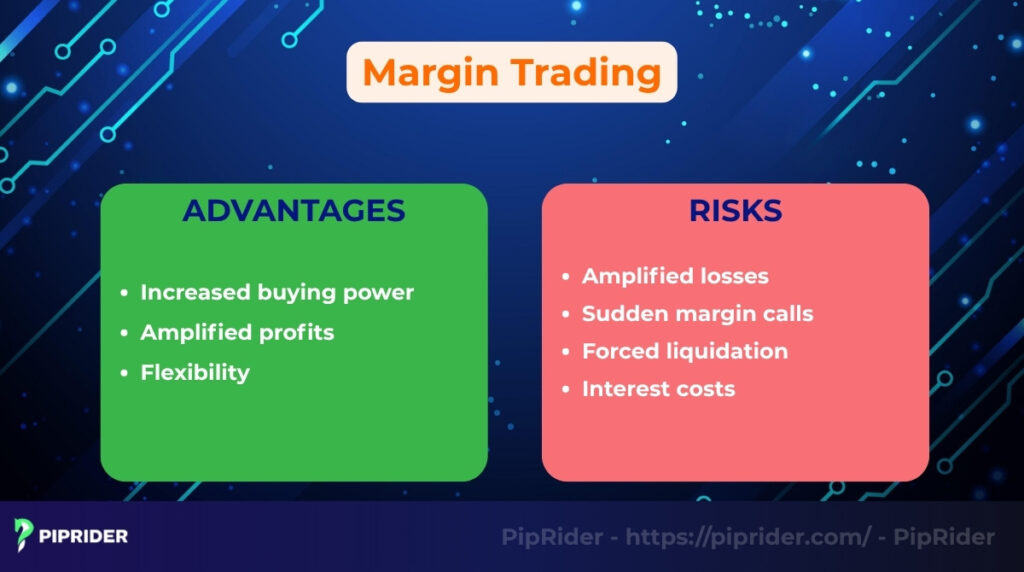
9.1. Advantages
Margin trading is popular because it offers several key benefits:
- Increased buying power: Margin allows you to increase your buying power (leverage) to control a larger position than your cash balance alone would allow.
- Amplified profits: If the market moves in your favor, margin amplifies your profits. A 5% gain on a leveraged position in securities can result in much larger percentage returns on your actual equity.
- Flexibility: Margin accounts are often required for certain strategies, such as short selling (betting that a stock’s price will fall) or hedging other positions in your portfolio.
9.2. Risks
The risks of margin trading are high and can lead to rapid losses.
- Amplified losses: Just as profits are magnified, losses are also magnified. A small price move against you can result in a very large loss to your equity.
- Sudden margin calls: A margin call can happen very quickly, especially in a volatile market downturn. You may not have much time to react.
- Forced liquidation: The most significant risk is that your broker has the legal right to sell your securities (liquidate your positions) without your permission or notification to meet a margin call.
- Interest costs: A margin loan is not free. You must pay interest on the money you borrow. This interest cost (margin interest) reduces your profits and adds to your losses over time.
10. Margin Call vs. Maintenance Margin
Investors often confuse “Margin Call” and “Maintenance Margin.” The latter represents the minimum required equity level, while the former is the broker’s demand for funds when equity falls below that level.
Here is a simple comparison:
| Feature | Maintenance Margin | Margin Call |
|---|---|---|
| Definition | The minimum equity level (e.g., 25% of total value) you must always maintain. | The action or warning from your broker demanding funds because equity is too low. |
| Triggered When | This rule is always active. It is the threshold your account equity must stay above. | Triggered when your account equity falls below the Maintenance Margin level. |
| Action Required | Monitor this level regularly to avoid a potential margin call. | Deposit cash or sell assets immediately to bring equity back up. |
| Authority | A rule set by regulators (like FINRA/SEC) and implemented by your broker. | A demand sent by your broker to your margin account. |
11. Frequently asked questions about Margin Calls
12. The Bottom Line
Margin calls are a critical warning sign that a leveraged margin account is dangerously out of balance. While margin trading can amplify profits and potential returns, it also dramatically amplifies the risk of loss.
The core protection strategies are simple: proactive money management, always using stop-loss orders, and maintaining a healthy “margin buffer” far above the minimum requirement. Understanding your account’s limits and monitoring your securities portfolio regularly is the best way for an investor to avoid a surprise liquidation.
To continue building your financial knowledge, an investor can follow PipRider for more essential trading insights and updates.