Bruce Kovner is one of the most successful and respected global macro traders in history, yet he remains relatively unknown to the public. He is the “quiet billionaire” who founded Caxton Associates, a hedge fund famous for its decades of consistent, high returns. Kovner’s legend, featured in the “Market Wizards” book, wasn’t built on reckless bets. It was built on deep analysis of global markets (currencies, commodities, and bonds) and an almost obsessive focus on risk management.
This article explores his biography, his winning trading strategy, and the essential lessons he pioneered.
Key Takeaways
- Bruce Kovner is the billionaire founder of Caxton Associates, widely recognized as one of the world’s most successful global macro hedge funds.
- A key figure in the book Market Wizards, he is known for a disciplined, low-profile approach that prioritizes risk management above all else.
- His trading philosophy focuses on deep macro analysis combined with strict stop-loss rules, famously stating, “I am a risk manager first, and a trader second.”
- Legendary Consistency: According to Bloomberg, his flagship Caxton Global Investment fund generated average annual returns of approximately 21% from its inception until his retirement in 2011.
- Net Worth & Philanthropy: Forbes estimates his net worth to be approximately $9 billion (as of 2026). He now directs this wealth toward major philanthropic causes, serving as Chairman of The Juilliard School.
Bruce Kovner: Quick Facts
| Category | Details |
| Full Name | Bruce Stanley Kovner |
| Born | 1945 (Brooklyn, New York) |
| Net Worth | ~$9 Billion (Forbes estimate, 2026) |
| Education | Harvard University (B.A. in Political Science) |
| Founder | Caxton Associates (Founded 1983) |
| Trading Style | Global Macro, Inter-market Analysis, Risk-First |
| Current Role | Chairman of CAM Capital (Family Office) |
| Philanthropy | The Juilliard School (Chairman), Lincoln Center, Met Opera |
1. Bruce Kovner’s Biography
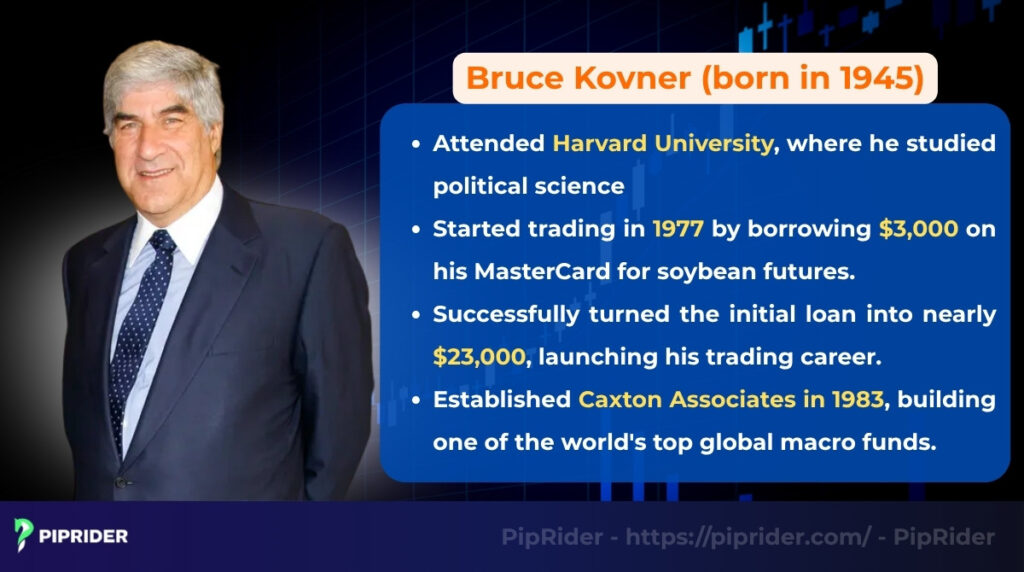
Born in 1945 in Brooklyn, New York, Bruce Kovner came from a middle-class family. Academically gifted, he attended Harvard College, where he studied political science and later continued his studies at the John F. Kennedy School of Government. However, he left the PhD program before completion, reportedly due to a case of writer’s block.
His career path was far from linear. Kovner explored several different jobs, including working on political campaigns and even driving a taxi in New York City, before he discovered the financial markets in his thirties.
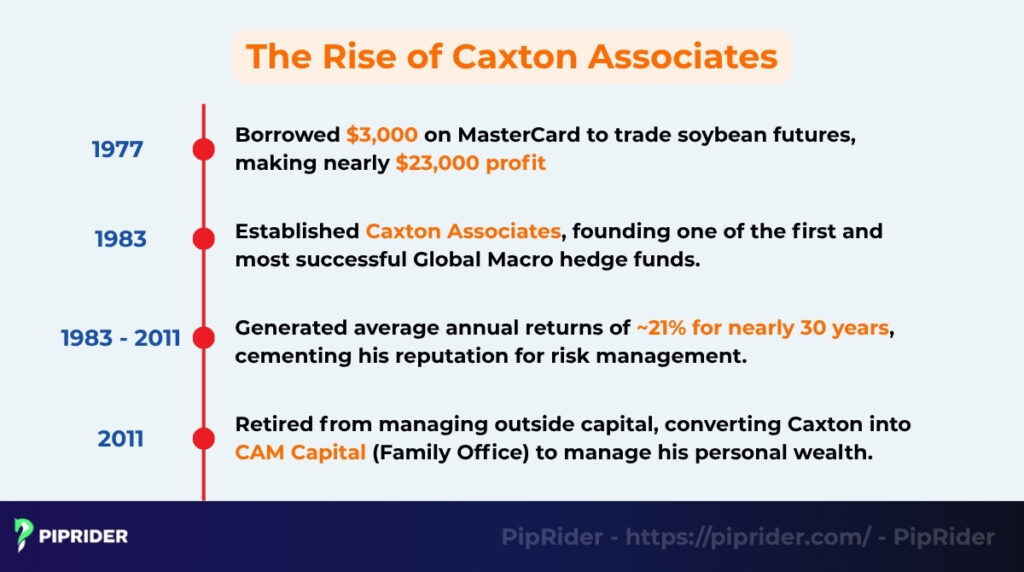
In 1977, he took his first trade, a foray into commodities trading using borrowed funds. This initial experience launched a legendary career. After working for Commodities Corporation (where he was mentored by the legendary Michael Marcus), he founded Caxton Associates in 1983. He led the firm for 28 years before retiring in 2011 to establish CAM Capital, his private family office.
2. What Is Bruce Kovner Known For?
Bruce Kovner is a Wall Street legend renowned for his disciplined, defense-first approach and his ability to anticipate global economic shifts.
Here are the three pillars of his reputation:
- Global Macro Pioneer: He established Caxton Associates as a premier Global Macro fund, trading currencies, bonds, and commodities based on world events rather than focusing on individual stocks.
- The Risk Management Titan: Kovner is famous for his almost obsessive focus on capital preservation. He views his primary job as risk management, with trading being secondary.
- A Low-Profile Operator: Often described as the “quiet billionaire,” Kovner is distinct from other celebrity investors. He avoids the media spotlight and rarely gives interviews, preferring to let his consistent returns speak for themselves. Like other famous forex traders, Kovner’s success stems from discipline and a unique trading philosophy.
3. The Rise of Caxton Associates
Bruce Kovner founded Caxton Associates in 1983, with its headquarters in New York. This firm would become one of the most successful hedge funds in history.
3.1. Founding and Philosophy
Caxton Associates was established as a global macro, multi-asset fund. This model meant the firm traded across all major markets, including currencies (Forex), bonds, stocks, and commodities.
Kovner’s primary objective was clear and disciplined. The fund’s goal was to: “Exploit global economic trends through disciplined risk management.” This philosophy placed risk control at the very center of its operations, right from the beginning.
3.2. Performance Legacy
Caxton’s performance record is legendary not just for its gains, but for its stability.
- Average Returns: According to his official biography and data from Bloomberg, the fund generated an average annual net return of approximately 21% during Kovner’s tenure.
- Drawdown Control: The firm was known for avoiding catastrophic losses. For instance, in 1994, a year that devastated many global macro funds, Caxton reportedly finished down only 2.5% (Business Insider). This ability to limit the downside during difficult years solidified Kovner’s reputation as a supreme risk manager.
4. The Kovner Trading Framework
Bruce Kovner’s strategy isn’t magic; it is a rigorous process. Most of his documented trading wisdom comes from his extensive interview in Jack Schwager’s classic book, Market Wizards (1989).
Below are the four non-negotiable pillars of his framework:
4.1. Market View First, Technicals Second
Kovner never trades on charts alone. He first builds a fundamental “story” (e.g., interest rates are rising), and only then uses technical analysis to see if the market agrees with his view.
“I almost always trade on a market view; I use technical analysis to clarify the picture… I don’t trade simply on a technical signal.”
4.2. Technical Analysis is a “Thermometer”
He does not use charts to predict the future. Instead, he views technical analysis as a diagnostic tool—a way to measure whether the “smart money” is actually backing his fundamental thesis.
“Technical analysis is like a thermometer… it tracks the past; it does not predict the future… But it alerts the practitioner to existing disequilibria.”
4.3. Position Sizing Based on Stops
This is his most famous mathematical rule. Kovner does not pick a random lot size. He finds the technical “exit point” first, then calculates his trade size so that hitting that stop will not damage his portfolio.
“Whenever I enter a position, I have a predetermined stop… The size of the position is determined by the stop, and the stop is determined on a technical basis.”
4.4. Emotional Equilibrium
Kovner believes that a stressed mind cannot trade well. If personal issues or market chaos disturb his mental clarity, he exits the market immediately to protect his capital.
“To this day, when something happens to disturb my emotional equilibrium and my sense of what the world is like, I close out all my positions.”
5. The Legendary “Soybean Trade” & Macro Framework
Unlike traders who rely on black-box algorithms, Bruce Kovner’s success was built on specific, fundamental logic. While many of his Caxton trades remain private, his very first trade is a documented legend that defined his entire career.
5.1. The Soybean Trade (1977)
This story is often cited in trading literature as the ultimate lesson in emotional discipline.
- The Setup: In 1977, Kovner identified a supply shortage in the Soybean market. Lacking capital, he famously borrowed $3,000 against his Mastercard to fund the trade.
- The Result: The trade went parabolic. His account surged to roughly $45,000 on paper. However, he became euphoric and failed to exit in time. When the market corrected, he watched his account drop to $22,000 before finally closing the position (Schwager, 1989).
- The Lesson: While he still made a huge profit, the emotional pain of losing half his paper gains taught him a lifelong lesson: Markets can turn instantly. Without a disciplined exit plan, profits are just an illusion.
5.2. The “Inter-Market” Framework
Instead of focusing on isolated charts, Kovner became a pioneer in Inter-Market Analysis. He understood that asset classes are interconnected.
- Bonds Lead Currencies: Kovner realized that interest rate differentials drive currency flows. He often analyzed Treasury Bond yields to predict the direction of the US Dollar. If yields were breaking out, he knew the Dollar would likely follow.
- Commodities as Inflation Signals: He used commodity prices (like Oil or Gold) not just as trade vehicles, but as early warning signals for inflation, which would in turn force Central Banks to adjust policy.
6. How Forex Traders Can Apply Kovner’s Strategy
Bruce Kovner was a hedge fund manager, but his methods are perfectly applicable to retail Forex trading. Here is how a modern trader can apply his “Macro-First, Technical-Second” approach without needing a billion-dollar account.
6.1. The Setup: Macro Driver + Technical Trigger
Kovner never traded based on a chart pattern alone. He needed a fundamental reason to be in the trade.
Step 1: Identify the Macro Divergence (The “Why”)
Look for Rate Differentials: For example, imagine the US Federal Reserve is raising interest rates (Hawkish) while the Bank of Japan keeps rates negative (Dovish). Fundamental logic suggests the USD/JPY pair should rise.
Step 2: Wait for the Technical Break (The “When”)
Do not buy blindly just because of the rates. Wait for the price to break a key Market Structure (e.g., breaking above a consolidation box or a weekly resistance level). This confirms that the market agrees with your view.
Step 3: The “Technical Barrier” Stop Loss
Place your stop loss behind a technical barrier—such as the recent Swing Low or a Moving Average—where the trade thesis would be proven wrong. As Kovner advised, if the market crosses that line, your fundamental view doesn’t matter; you must get out.
While Kovner’s approach was methodical and fundamentals-based, the same era saw traders like Andrew Krieger exploit currency volatility with extraordinary aggression—two contrasting styles that both capitalized on the explosive FX opportunities of the 1980s.
6.2. Practical Guideline: The 1% Risk Rule
While Kovner adjusted his risk based on conviction, his core lesson is survival. For retail traders, this translates into a strict mathematical rule.
- Determine Stop First, Size Second: Never decide your lot size before checking the chart.
- Incorrect: “I will trade 1.0 lot.”
- Correct (Kovner Style): “My technical stop is 50 pips away. To risk only 1% of my $10,000 account ($100 risk), I must trade exactly 0.2 lots.”
- The Survival Mindset: By risking only 1% per trade, you can endure a string of 10-20 losses without blowing your account, keeping you in the game long enough for the big trends to appear.
7. Bruce Kovner’s Net Worth and Philanthropy
As a result of his decades of consistent success at Caxton Associates, Forbes estimates Bruce Kovner’s net worth to be approximately $9 billion (as of 2026). This places him among the wealthiest and most successful self-made figures in finance.
7.1. CAM Capital (Family Office)
After retiring from Caxton in 2011, Kovner established CAM Capital. This private investment firm serves as his Family Office, managing his personal assets and business ventures, allowing him to maintain active involvement in the markets without outside client pressures.
7.2. Philanthropy: The Kovner Foundation
Bruce Kovner is a significant patron of the arts and education in the United States. Through The Kovner Foundation, established in 1996, he and his wife, Suzie Kovner, have made major contributions to cultural institutions and public policy.
- The Arts: He serves as the Chairman of the Board of The Juilliard School and is a Vice Chairman of the Lincoln Center for the Performing Arts. He is also a Managing Director on the board of the Metropolitan Opera.
- Public Policy & Education: He is a long-time supporter and former Chairman of the American Enterprise Institute (AEI), a conservative think tank. Additionally, his foundation actively supports education reform initiatives, including school choice programs.
8. Lessons from Bruce Kovner
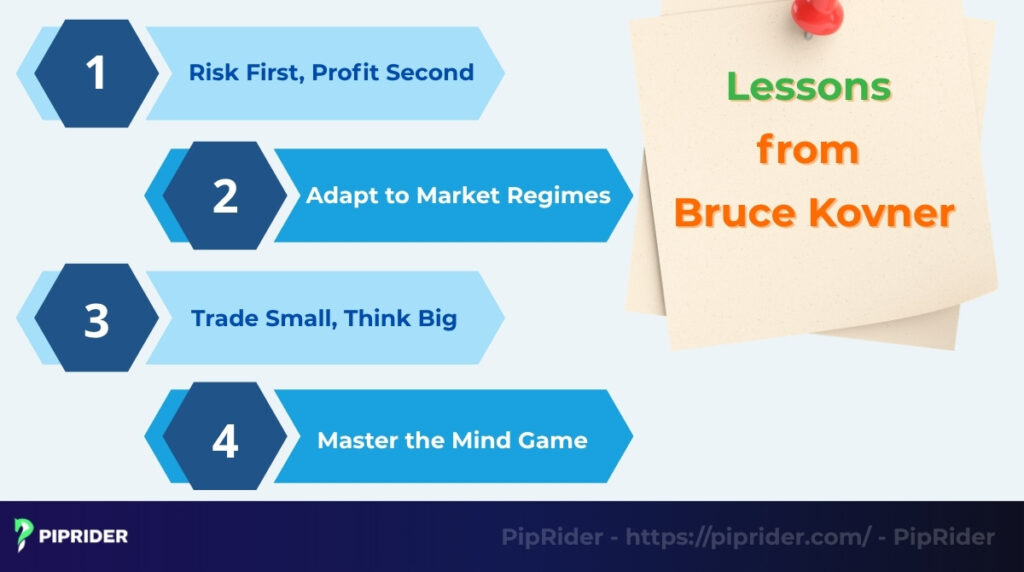
Bruce Kovner’s career provides several essential lessons for any trader. His entire philosophy can be boiled down to a few core principles.
- Risk First, Profit Second: This is Kovner’s primary rule. A trader must always define their stop-loss point before entering a trade. The first question should always be “How much can I lose?” not “How much can I make?”
- Adapt to Market Regimes: He understood that no single strategy works forever. Different economic cycles require different strategies. A trader must be able to adapt their approach as market conditions change (e.g., from an inflationary to a deflationary environment).
- Trade Small, Think Big: Kovner famously advised traders to “Size your position for survival, not excitement.” He focused on staying in the game by keeping individual trades small, even while his analysis (the “big think”) focused on major global trends.
- Master the Mind Game: He believed success was determined by mental control. If emotions drive decisions, a trader will lose. Therefore, learning how to control emotion in trading is just as critical as analyzing a chart.
Kovner’s risk-first mentality was shared by other great hedge fund managers of the 1980s, including Michael Steinhardt, who similarly emphasized capital preservation and disciplined position sizing.
9. Bruce Kovner’s Legacy in Global Macro
Bruce Kovner’s influence on modern finance is profound, yet understated. Best known to the trading world through his detailed profile in Jack Schwager’s Market Wizards, he is widely cited for proving that a macro fund could deliver consistent returns through strict risk discipline rather than just high-stakes gambling.
While George Soros was known for his high-conviction, concentrated bets, Kovner’s legacy lies in his systematic risk control. He helped set the standard for modern macro trading by demonstrating how to blend deep fundamental analysis with technical timing. His “risk-first, profit-second” philosophy remains a foundational case study for professional traders and risk managers today.
10. Frequently asked questions about Bruce Kovner
11. The Bottom Line
Bruce Kovner‘s career proves that legendary trading success isn’t built on recklessness, but on relentless, systematic control. He is an icon of macro rationality, viewing the global market as an interconnected system and famously prioritizing his role as a “risk manager first, trader second.”
While his profits were enormous, Kovner’s greatest legacy is his philosophy and mindset. He taught generations of traders that discipline, adaptability, and deep humility before the market are the true keys to long-term survival and success.
To learn more from trading legends like Kovner and to master your own Trading Strategies, follow PipRider for expert insights.
Infographic Section
-
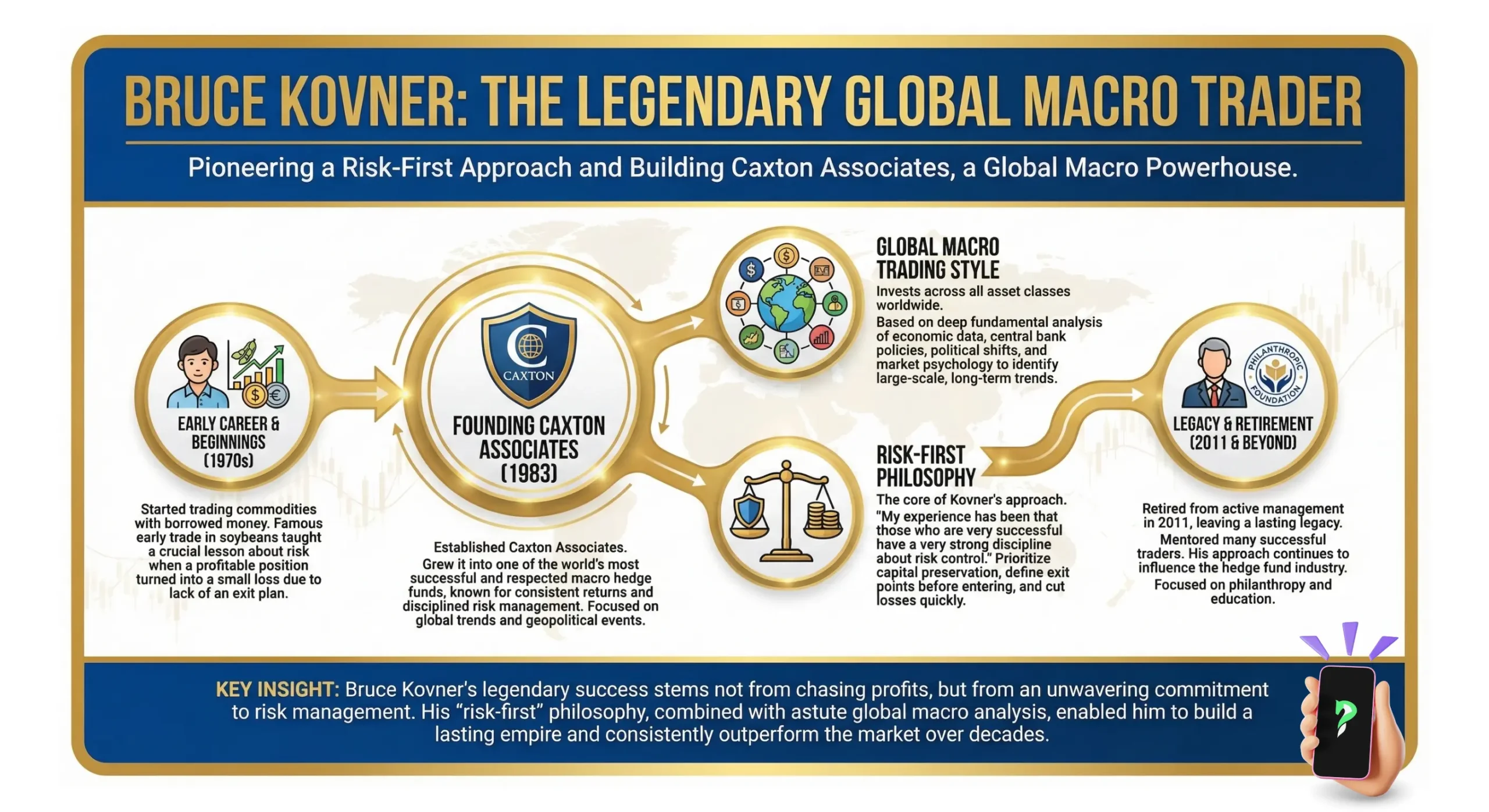
Bruce Kovner: The Legendary Global Macro Trader -
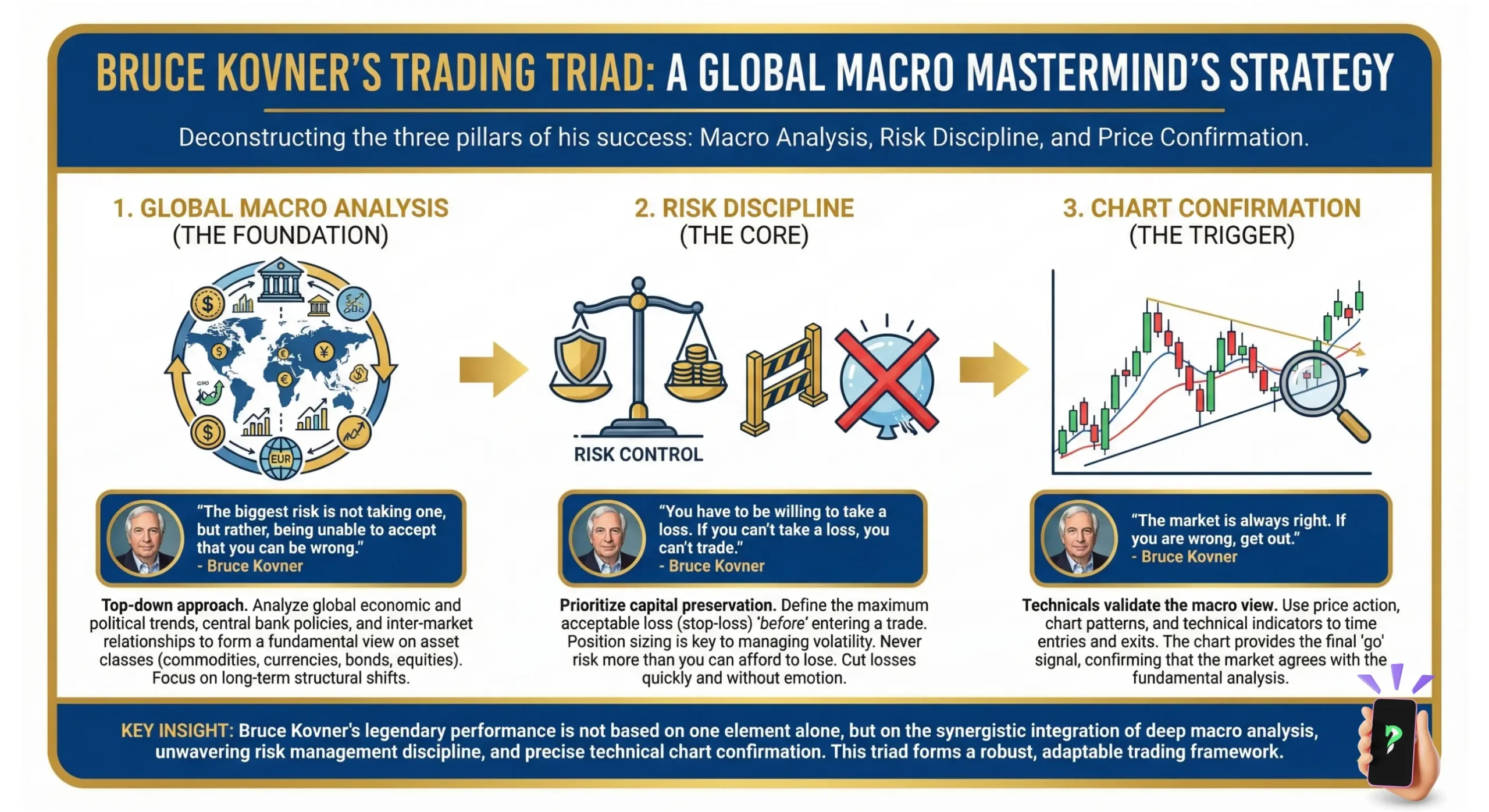
Bruce Kovner's Trading Triad -
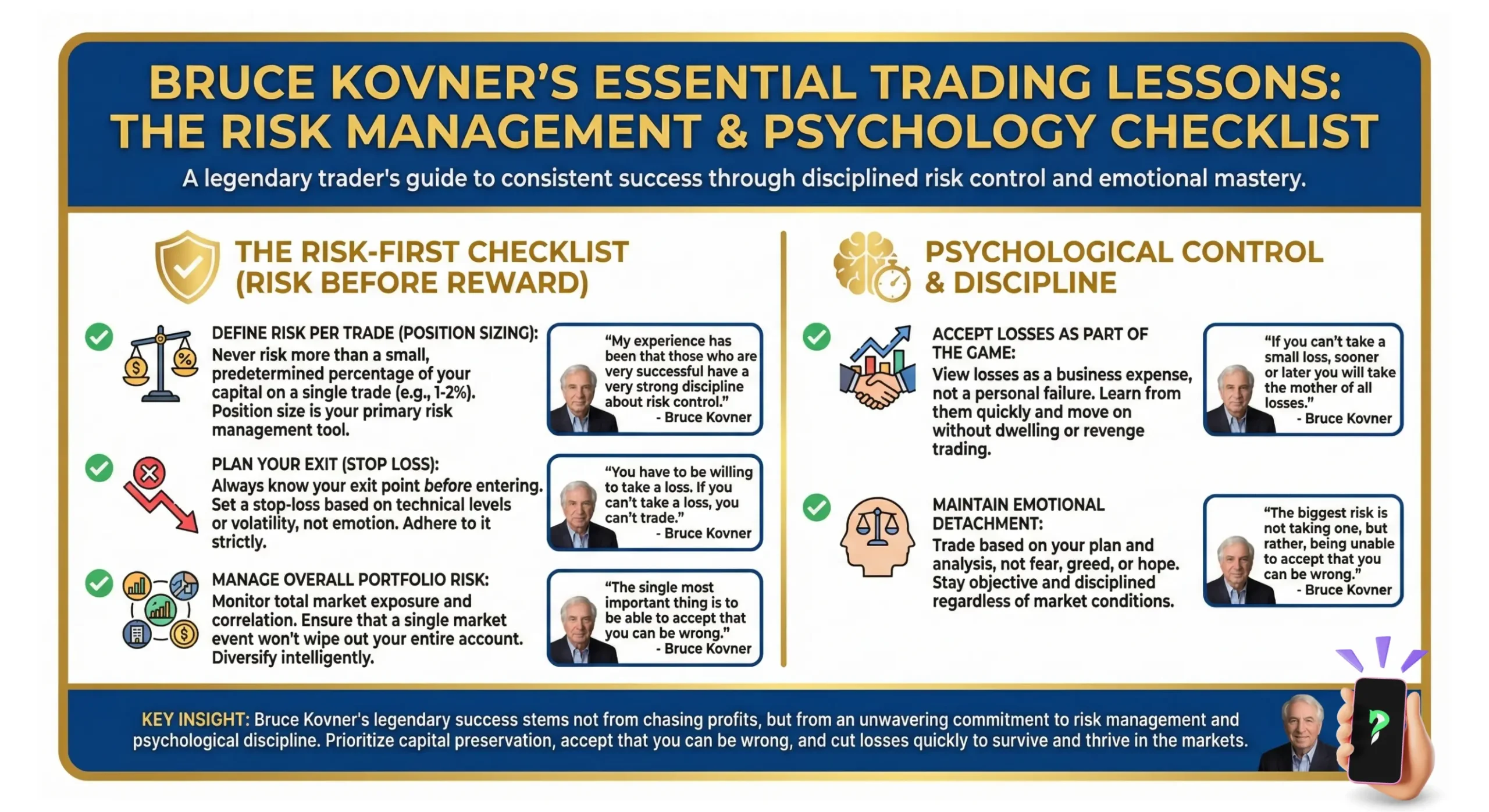
Bruce Kovner's Essential Trading Lessons