The Forex market draws millions, yet consistent success is rare. However, a select group of famous forex traders has managed to master these volatile waters.
Studying these FX legends offers more than just inspiration; it provides a blueprint for profitability. From George Soros’s macro bets to Bill Lipschutz’s risk control, their stories reveal the universal principles of trading. This article explores the careers of the world’s most influential currency speculators and extracts actionable takeaways for your own journey.
Key Takeaways
- Profiles iconic traders like George Soros, Bill Lipschutz, and Paul Tudor Jones.
- Explores various approaches, from global macro to technical analysis and systematic trading.
- Highlights common traits like strict risk management, psychological discipline, and adaptability.
- Extracts key principles and philosophies applicable to modern Forex trading.
- Showcases real forex trading success stories to motivate developing traders.
| # | Trader Name | Known For | Primary Style | Best Lesson | Best For Level |
|---|---|---|---|---|---|
| 1 | George Soros | Black Wednesday | Global Macro | Bet big when odds are high. | Advanced |
| 2 | Stanley Druckenmiller | 30 Yrs Consistency | Global Macro | Preserve capital first. | Advanced |
| 3 | Bill Lipschutz | Salomon Bros FX | Psychology & Risk | Manage the downside. | All Levels |
| 4 | Andrew Krieger | Short NZD (Kiwi) | Aggressive Macro | Identify major imbalances. | Advanced |
| 5 | John R. Taylor Jr. | FX Concepts | Quantitative | Trust data over emotions. | Advanced (Quant) |
| 6 | Paul Tudor Jones | Black Monday 1987 | Contrarian Tech | Play great defense. | Intermediate |
| 7 | Peter Brandt | Classical Charting | Technical Patterns | Discipline > Prediction. | Beginner |
| 8 | Michael Marcus | $30k to $80m | Trend Following | Let winners run. | Intermediate |
| 9 | Ed Seykota | Market Wizards | Systematic Trend | Follow the rules strictly. | Intermediate |
| 10 | Bruce Kovner | Caxton Associates | Macro + Tech | Know your exit first. | Advanced |
| 11 | Raghee Horner | 34 EMA Wave | Technical Structure | Structure before strategy. | Beginner |
| 12 | Kathy Lien | BK Asset Mgmt | News + Technicals | Combine news with charts. | Beginner |
| 13 | Dr. Alexander Elder | Trading for a Living | Psychology (3Ms) | Master your mind first. | All Levels |
| 14 | Cathie Wood | ARK Invest | Thematic Macro | Focus on innovation. | Investor |
| 15 | Joe Lewis | GBP Short (1992) | Long-term Positional | Diversify assets. | Investor |
1. Who Are the Most Successful Forex Traders in the World?
The best forex traders are defined by more than just profit. They are individuals whose strategies and legendary trades left a lasting impact on the financial markets.
Also known as “Forex legends,” these famous forex traders are recognized for their exceptional skill in navigating the world’s largest market, which handles over $7.5 trillion daily (Bank for International Settlements, 2022).
Their influence extends beyond mere profit figures. They often pioneer new analytical approaches, demonstrate extraordinary psychological discipline, and manage risk with exceptional skill. Their success stories in the financial market serve as benchmarks and sources of inspiration for aspiring traders globally.
While each successful trader is unique, their approaches often fall into several broad categories:
- Global macro: Analyzing large-scale economic and political events to anticipate major currency shifts (e.g., George Soros).
- Technical analysis: Relying heavily on chart patterns, price action, and indicators to identify trading opportunities (e.g., Peter Brandt).
- Trend following: Developing systems to identify and ride established market trends for extended periods (e.g., Ed Seykota).
- Systematic/Quantitative: Using algorithms and mathematical models to execute trades automatically (e.g., John R. Taylor Jr.).
How We Selected These Famous Forex Traders
To ensure this list provides genuine educational value, we curated these 15 legends based on three strict criteria:
- Significant FX Impact: Each figure has influenced the currency markets through historic trades (such as the 1992 GBP crisis) or by founding major Forex-focused financial institutions.
- Credible Track Record: We prioritized traders with success stories documented in reputable financial literature (e.g., Market Wizards), public fund reports, or verified industry achievements, avoiding unverified social media personalities.
- Strategic Diversity: The list represents a balanced mix of trading styles—from Global Macro and Systematic Trend Following to Technical Analysis and Modern Strategy—giving you a comprehensive view of the different paths to profitability.
2. Top Famous Forex Traders and Their Success Stories
Learning from the best offers invaluable insights. However, not all legendary traders operate the same way. To help you study the style that fits you best, we have categorized these 15 legends into three distinct groups: FX & Macro Titans, Multi-Asset Legends, and Influential Strategists & Educators.
| Category | Famous Names | Best For… |
|---|---|---|
| Group A: FX & Macro Titans (The Big Players) |
George Soros, Stanley Druckenmiller, Bill Lipschutz, Andrew Krieger, Bruce Kovner, John R. Taylor Jr. | Traders looking for fundamental, global macro & institutional strategies. |
| Group B: Multi-Asset Legends (The Market Wizards) |
Paul Tudor Jones, Michael Marcus, Peter Brandt, Ed Seykota | Those interested in technical analysis, trend following & systems applied to FX. |
| Group C: Strategists & Educators (Teachers & Investors) |
Kathy Lien, Raghee Horner, Dr. Alexander Elder, Cathie Wood, Joe Lewis | Learning specific setups, trading psychology, and long-term vision. |
2.1. Group A: FX & Global Macro Titans
This group represents the purest form of institutional Forex trading. These titans are famous for utilizing Global Macro strategies to profit from central bank policies, geopolitical shifts, and massive economic trends. Study them to understand how fundamental analysis moves the market.
2.1.1. George Soros – The Man Who Broke the Bank of England
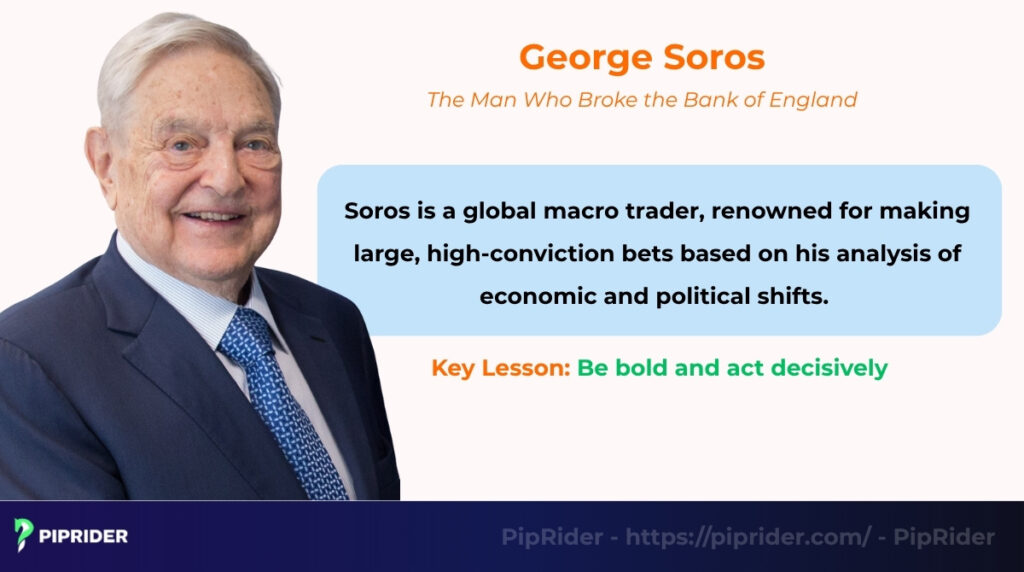
Soros is a global macro trader, renowned for holding long-term position trades based on economic shifts. Perhaps the most famous name associated with currency trading, George Soros cemented his legend during the 1992 “Black Wednesday” crisis. His famous Black Wednesday trade involved betting heavily against the British Pound (GBP). Soros and his Quantum Fund reportedly made over $1 billion in profit in a single day (Investopedia, 2024). They achieved this by correctly anticipating that the UK government could not sustain the British pound’s peg within the European Exchange Rate Mechanism (ERM).
- Trading Style: Soros is a global macro trader, renowned for making large, high-conviction bets based on his analysis of economic and political shifts. His “Theory of Reflexivity,” suggesting market participants influence outcomes, guided many of his trades.
- Key Lesson: Be bold and act decisively when the odds are overwhelmingly in your favor. Soros wasn’t afraid to risk significant capital when his analysis gave him strong conviction.
Read more:
David Tepper, like Soros, is a global macro trader known for making bold, high-conviction bets during periods of extreme market stress. During the 2008-2009 financial crisis, Tepper bought heavily into distressed bank stocks when others were fleeing, betting that government intervention would stabilize the financial system—his fund returned over 130% in 2009.
2.1.2. Stanley Druckenmiller – The Visionary Macro Trader
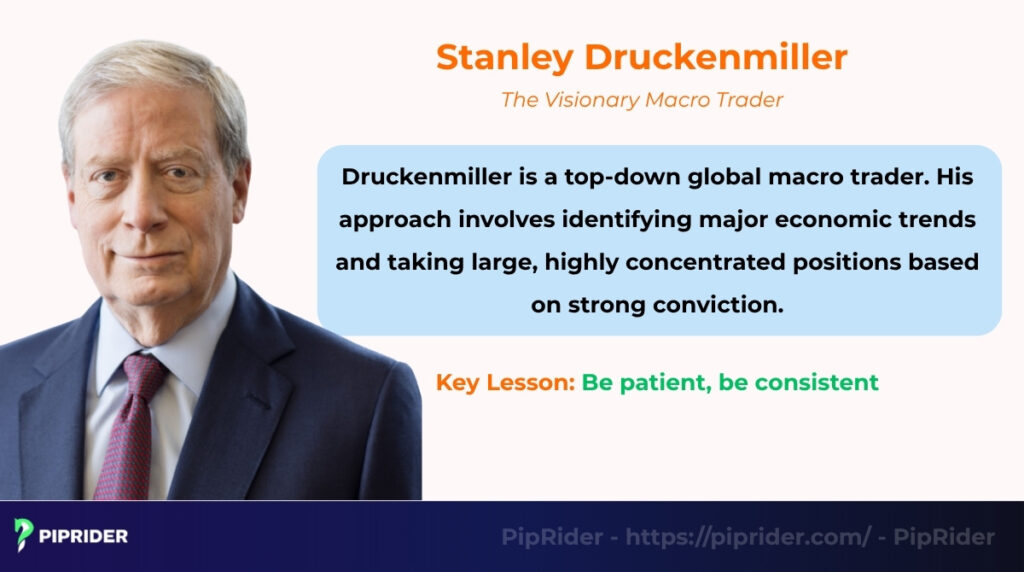
Druckenmiller is widely cited by financial analysts for his extraordinary track record, which included over 30 years of consistent returns without a single down year (Bloomberg, 2022). He later founded Duquesne Capital, where he continued to apply the top-down global macro approach he refined alongside Soros.
- Trading Style: Like Soros, Druckenmiller is a top-down global macro trader. His approach involves identifying major economic trends and taking large, highly concentrated positions based on strong conviction. He is known for his ability to shift biases quickly when the evidence changes.
- Key Lesson: Be patient, be consistent, but bet big when you have high conviction. Druckenmiller emphasizes the importance of preserving capital during low-probability periods and aggressively deploying it when a high-probability setup appears.
2.1.3. Bill Lipschutz – The “Sultan of Currencies”
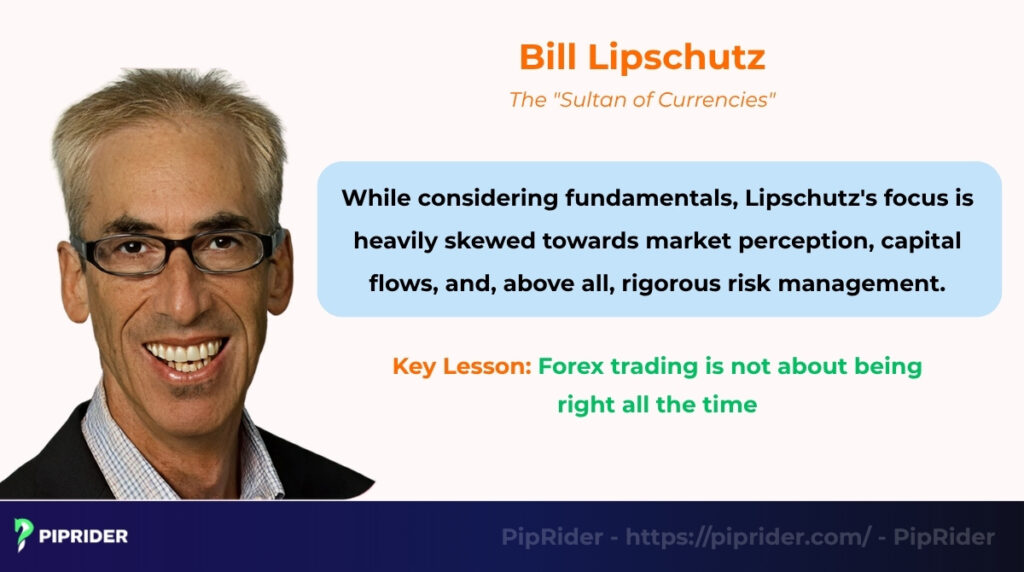
Bill Lipschutz is widely regarded as one of the best forex traders, despite starting with relatively little. While at Cornell University, he reportedly turned a $12,000 inheritance into $250,000 (Schwager, 1992), although he later lost it all due to poor risk management, a formative experience. He then joined Salomon Brothers in the 1980s and became a principal trader in their newly formed Forex department, reportedly earning the firm hundreds of millions per year.
- Trading Style: Lipschutz views Forex as a fundamentally psychological market. While considering fundamentals, his focus is heavily skewed towards market perception, capital flows, and, above all, rigorous risk management. This trading philosophy stresses that the win rate is less important than the size of wins versus losses.
- Key Lesson: Forex trading is not about being right all the time; it’s about managing risk to survive long enough to capitalize on the times you are right. Lipschutz famously believes that managing the downside is the absolute key to longevity and success.
2.1.4. Andrew Krieger – The Aggressive Currency Short Seller
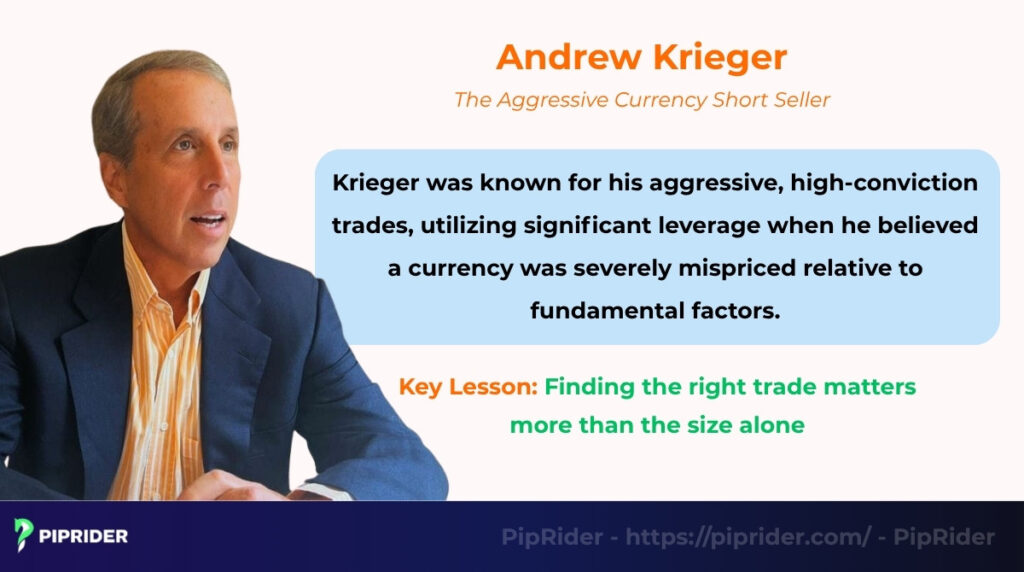
Andrew Krieger gained notoriety for his 1987 short position against the New Zealand Dollar (NZD). According to widely cited accounts in trading literature, Krieger utilized high leverage through options to build a position that reportedly exceeded New Zealand’s entire money supply at the time (Schwager, 1989). This trade is estimated to have generated approximately $300 million in profit for Bankers Trust.
- Trading Style: Krieger was known for his aggressive, high-conviction trades, utilizing significant leverage when he believed a currency was severely mispriced relative to fundamental factors.
- Key Lesson: Finding the right trade (timing and conviction) matters more than the size alone. Krieger’s success came from accurately identifying a major imbalance and acting decisively.
2.1.5. Bruce Kovner — The Disciplined Macro Trader
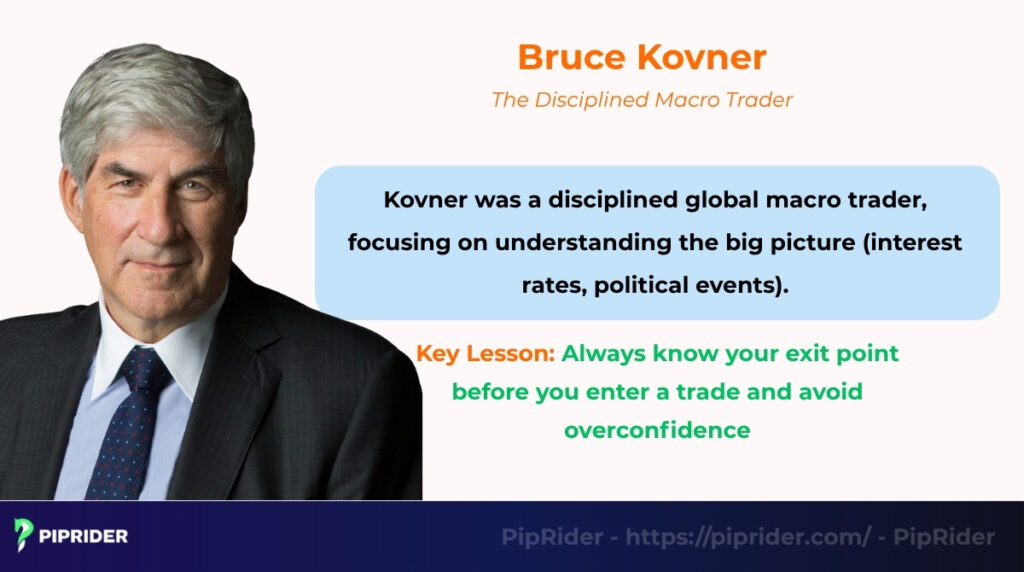
Bruce Kovner, founder of the highly successful global macro hedge fund Caxton Associates, is another titan of the trading world, known for generating consistent returns over decades before retiring. He initially started trading commodities using his own money before building his impressive fund.
- Trading Style: Kovner was a disciplined global macro trader, focusing on understanding the big picture (interest rates, political events). He emphasized diversification across various markets (currencies, commodities, and bonds) and rigorous risk management as the cornerstone of his approach.
- Key Lesson: Always know your exit point before you enter a trade and avoid overconfidence. Kovner stressed the importance of managing risk relentlessly and staying humble, recognizing that any single trade could be wrong.
2.1.6. John R. Taylor Jr. – The Quant Pioneer of FX Hedge Funds
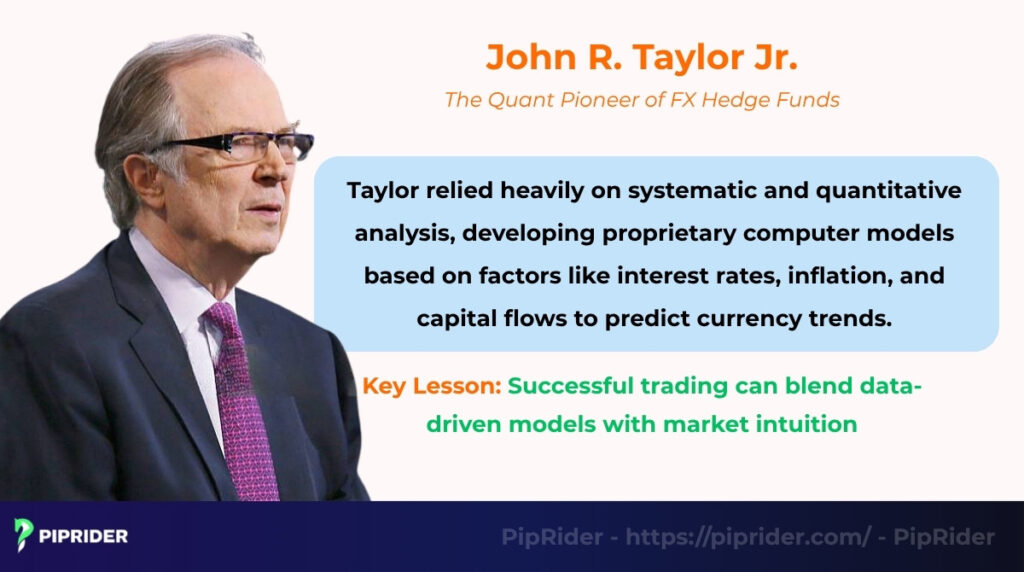
John R. Taylor Jr. is considered a pioneer in quantitative currency trading. He founded FX Concepts in the 1980s, one of the world’s first and largest hedge funds specializing solely in Forex, managing over $14 billion at its peak (Euromoney, 2007). His firm used computer models to analyze currency movements and make trading decisions.
John R. Taylor Jr. founded FX Concepts, which grew to become the world’s largest currency hedge fund, managing over $14 billion at its peak (Euromoney, 2007). He was a pioneer in using computer models specifically for the Forex market.
- Trading Style: Taylor relied heavily on systematic and quantitative analysis, developing proprietary computer models based on factors like interest rates, inflation, and capital flows to predict currency trends.
- Key Lesson: Successful trading can blend data-driven models with market intuition. While Taylor was a quant, he acknowledged that human oversight and understanding market context were still important alongside algorithmic signals.
2.2. Group B: Multi-Asset Legends (The Market Wizards)
While these legends trade across Futures and Commodities, their methodologies are the gold standard for retail Forex traders. This group focuses on Technical Analysis, Systematic Trend Following, and Price Action—universal concepts that apply perfectly to currency pairs.
2.2.1. Paul Tudor Jones – The Contrarian Hedge Fund Genius
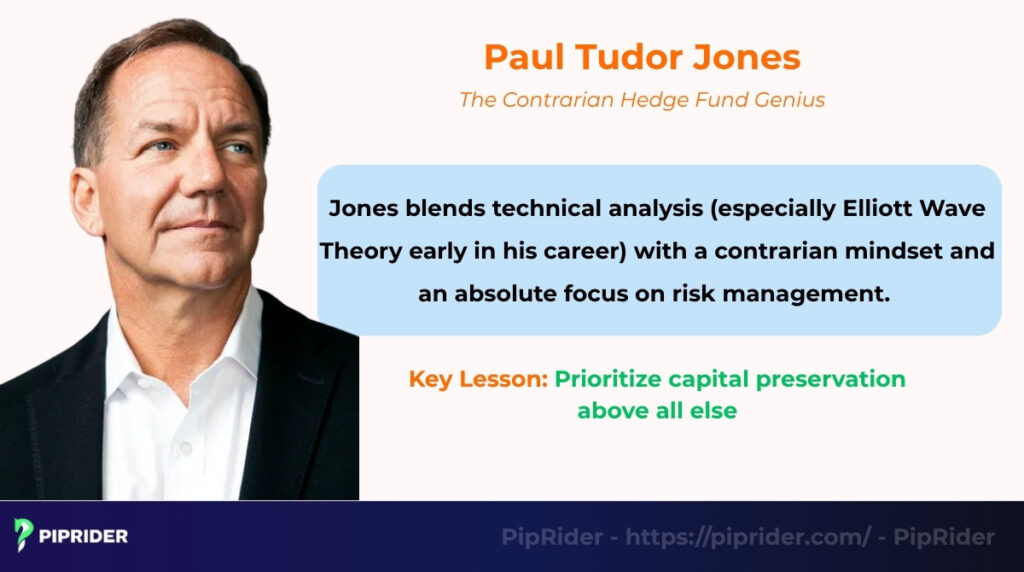
Paul Tudor Jones is another iconic hedge fund manager, best known for his famous “Black Monday” call. He correctly predicted and profited massively from the 1987 stock market crash, a trade that defined his early career. While primarily known for his work in futures and equities, his global macro approach inherently involves currency analysis and trading.
- Trading Style: Jones blends technical analysis (especially Elliott Wave Theory early in his career) with a contrarian mindset and an absolute focus on risk management. He famously stated his goal is to “play great defense, not great offense,” a core part of his trading philosophy.
- Key Lesson: Prioritize capital preservation above all else. Jones emphasizes rigorous risk control, believing that if you protect your capital during losing periods, the profits will eventually come. “Losers average losers” is a mantra associated with his risk-averse approach.
2.2.2. Michael Marcus – The Trend-Following Mentor
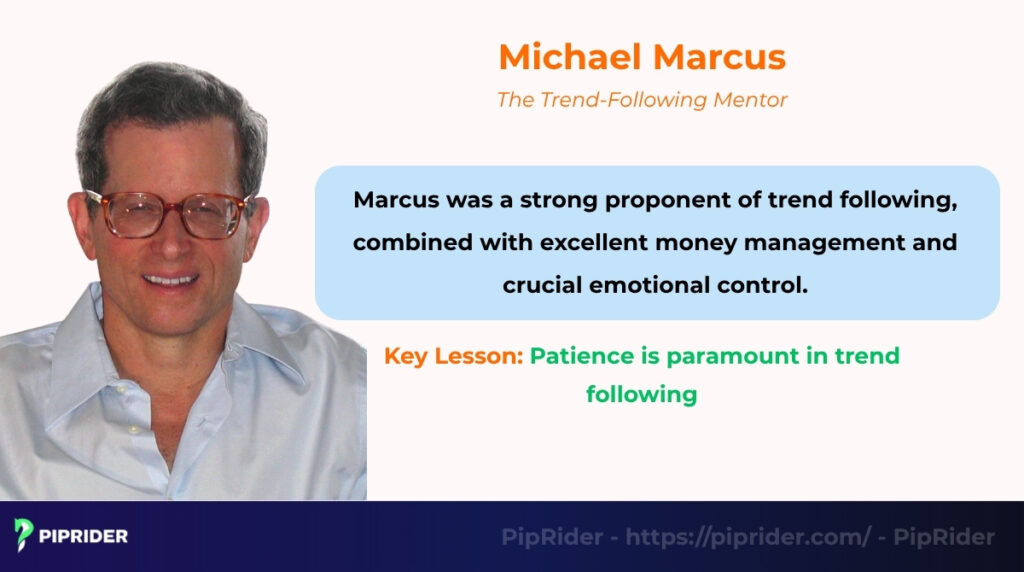
Michael Marcus is a legendary trader featured in Jack Schwager’s “Market Wizards” book. He learned from Ed Seykota (another trading legend) and later became a mentor to Bruce Kovner. This chain of mentorship is common among top traders. Marcus is famous for turning an initial stake of $30,000 into $80 million over about a decade, primarily trading commodity futures, which inherently involves currency risk and analysis.
- Trading Style: Marcus was a strong proponent of trend following, combined with excellent money management and crucial emotional control. He believed in cutting losses quickly and letting winners run.
- Key Lesson: Patience is paramount in trend following. Marcus emphasized that the largest profits often come from having the discipline to hold onto a winning trend for a long time, resisting the urge to exit too early.
2.2.3. Peter Brandt – The Classical Chart Pattern Master
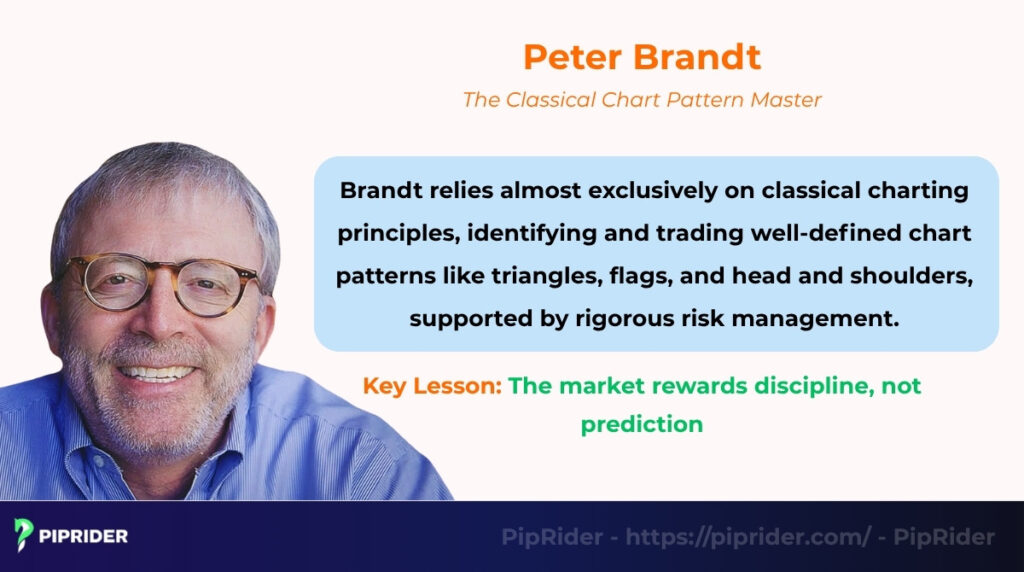
Peter Brandt is a highly respected veteran trader with decades of experience, starting his career in the 1970s. He is renowned for his expertise in classical chart patterns and disciplined approach to technical analysis, primarily focusing on futures and Forex markets. Brandt is also known for his transparency, openly sharing both winning and losing trades.
- Trading Style: Brandt relies almost exclusively on classical charting principles, identifying and trading well-defined trading patterns like triangles, flag pattern trading, head and shoulders, supported by rigorous risk management.
- Key Lesson: “The market rewards discipline, not prediction.” Brandt consistently emphasizes that successful trading comes from executing a well-defined plan with discipline, especially regarding risk control, rather than trying to perfectly predict market moves. This trading philosophy is detailed in his books, Diary of a Professional Commodity Trader (Brandt, 2011).
2.2.4. Ed Seykota – The Father of Systematic Trend Following
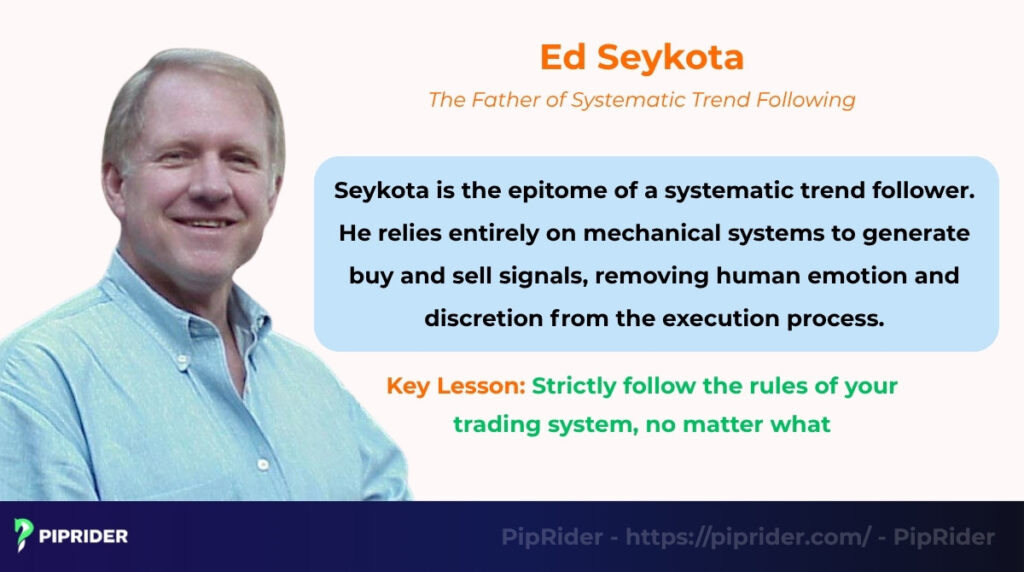
Starting in the 1970s, Seykota developed automated trend-following systems that achieved historic returns. One of his most famous accounts was reported to have grown from $5,000 to $15 million over a 12-year period (Schwager, 1989).
- Trading Style: Seykota is the epitome of a systematic trend follower. He relies entirely on mechanical systems to generate buy and sell signals, removing human emotion and discretion from the execution process.
- Key Lesson: Strictly follow the rules of your trading system, no matter what. Seykota famously said, “Win or lose, everybody gets what they want out of the market.” He stresses the importance of eliminating emotional interference and adhering to a proven methodology.
2.3. Group C: Strategists, Educators & Investors
This category features modern strategists and trading psychologists whose frameworks are essential for developing traders. Unlike the macro titans, these experts provide actionable intraday setups, risk management rules, and the mental discipline needed to survive daily volatility.
2.3.1. Kathy Lien – The Modern Forex Strategist

Kathy Lien is a well-known currency analyst, author, and managing director at BK Asset Management. Alongside other prominent female traders like Cynthia Macy, she is frequently seen in financial media. She is respected for her ability to blend technical analysis with a deep understanding of macroeconomic news drivers in the Forex market.
- Trading Style: Lien combines technical setups (like chart patterns and indicators) with fundamental analysis, particularly focusing on trading around major economic news releases and central bank events. She often looks for momentum confirmation following key data points.
- Key Lesson: Successfully trading Forex requires integrating both technical signals and the impact of real-time news and economic data. Understanding how fundamentals drive short-term momentum is crucial.
2.3.2. Raghee Horner – The Technical Precision Trader
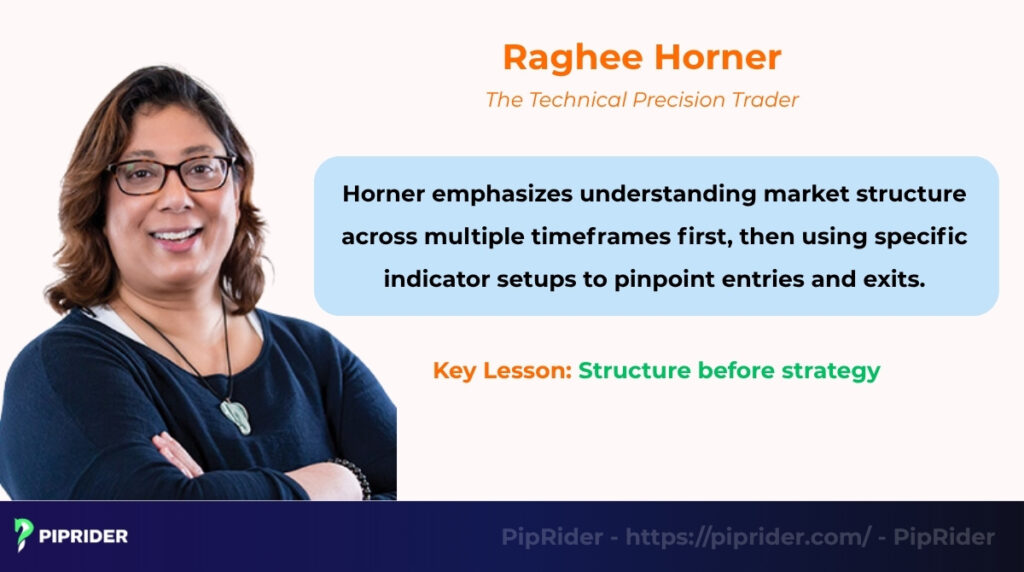
Raghee Horner is a veteran trader and educator known for her disciplined approach focused on technical analysis, particularly price structure and moving averages. She developed the “34 EMA Wave” method, a trend-following system utilizing three exponential moving averages.
- Trading Style: Horner emphasizes understanding market structure (trends, ranges) across multiple timeframes first, then using specific indicator setups (like her EMA Wave or GRaB candles) to pinpoint entries and exits.
- Key Lesson: “Structure before strategy.” Horner teaches that identifying the correct market environment (trending up, trending down, or ranging) is the essential first step before applying any specific trading strategy or indicator.
2.3.3. Alexander Elder – The Trading Psychologist
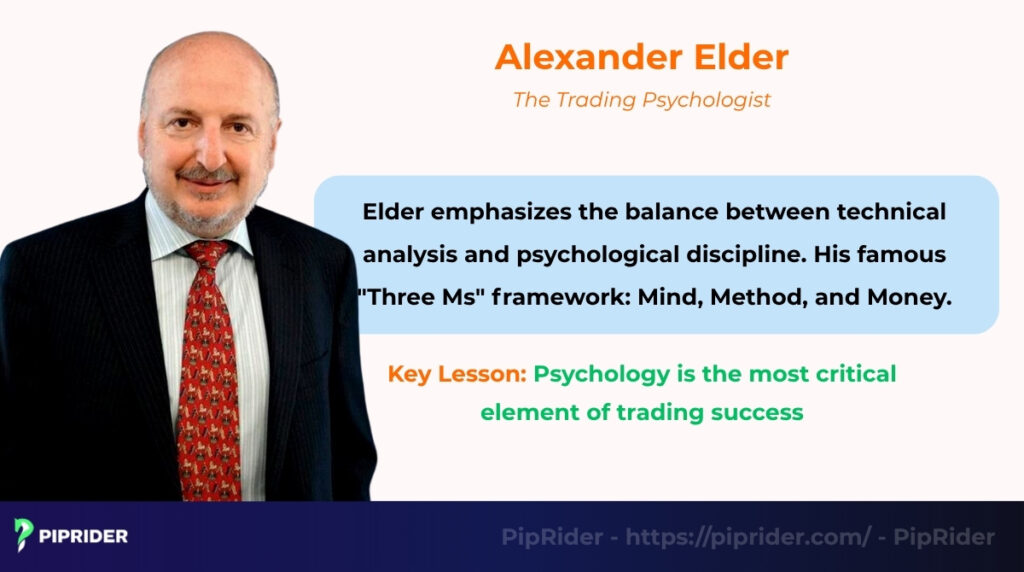
Dr. Alexander Elder, a psychiatrist by training, transitioned into a professional trader and renowned trading educator. He is the author of several best-selling trading books, including the classic “Trading for a Living” (1993).
- Trading Style: Elder emphasizes the balance between technical analysis and psychological discipline. His famous “Three Ms” framework highlights the equal importance of Mind (trading psychology), Method (trading system), and Money (risk management).
- Key Lesson: Psychology is the most critical element of trading success. Elder argues that controlling one’s emotions (fear, greed, hope) is often more decisive than the specific technical tools used. Mastering the inner game is essential.
2.3.4. Cathie Wood – The Visionary Investor Bridging Innovation and Global Markets

Cathie Wood, the founder and CEO of ARK Invest, is primarily known as a high-profile equity investor focused on disruptive innovation. While not a traditional Forex trader, her macroeconomic outlook and focus on long-term technological themes inherently intersect with global capital flows and currency dynamics.
- Investment Style: Wood employs a long-term, high-conviction approach, investing in companies poised to benefit from groundbreaking technologies (like AI, robotics, and blockchain). Since these high-growth stocks are often volatile, understanding how to trade earnings reports is crucial for optimizing entry points. This requires a deep understanding of global macro trends, including how innovation impacts productivity, economic growth, and ultimately, currency valuations and international investment flows.
- Key Lesson: Understand the link between technological innovation, global capital allocation, and currency strength. Major tech shifts can reshape economies, influence risk appetite (affecting pairs like USD/JPY), and drive long-term demand for currencies like the USD, impacting the entire Forex landscape.
2.3.5. Joe Lewis – The Long-Term Currency Investor
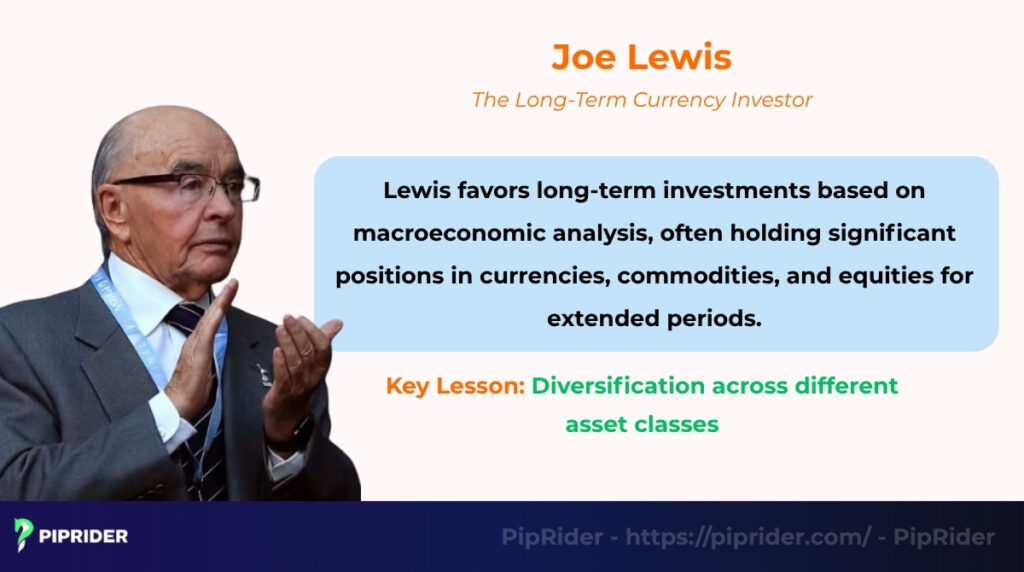
Joe Lewis, a British businessman and investor, is often mentioned alongside George Soros in relation to the 1992 trade against the British pound (GBP/USD) and the Bank of England, where he also reportedly profited significantly. Unlike many on this list, Lewis is known more for taking very large, long-term investment positions rather than frequent trading.
- Trading Style: Lewis favors long-term investments based on macroeconomic analysis, often holding significant positions in currencies, commodities, and equities for extended periods.
- Key Lesson: Diversification across different asset classes can help protect capital during market turmoil. Lewis’s broad investment portfolio demonstrates the value of not concentrating risk solely in one area.
3. What Makes These Forex Traders Successful?
While the best forex traders employed diverse forex trading strategies, several core characteristics consistently underpinned their success. These traits are arguably more important than any single trading setup.
3.1. Unshakable Risk Management
This is the most common denominator. Every single legendary trader, from Soros to Lipschutz to Kovner, placed capital preservation above profit chasing. This risk-first approach is the foundation of professional trading survival.
They understood that surviving drawdowns was key to long-term success. This involved strict position sizing, knowing their exit points before entering, and cutting losses ruthlessly when a trade went wrong.
3.2. Psychological Discipline and Patience
The ability to control emotions like fear and greed is paramount. The specific techniques top traders use to control emotions range from pre-trade rituals to strict rule-following.
Successful traders demonstrate iron discipline in sticking to their trading plans, even during losing streaks. They also exhibit immense patience, waiting for high-probability setups rather than forcing trades out of boredom, and holding winning positions long enough to capture significant trend movements.
3.3. Consistency in Strategy
Top traders develop a well-defined methodology or “edge” based on thorough research and analysis, whether it’s macro fundamentals, technical patterns, or quantitative systems. They achieve success through the consistent application of this strategy over time, rather than constantly jumping between different approaches.
3.4. Adaptability to Market Shifts
While consistent in their core approach, the best traders are not rigid. They understand that markets evolve. They possess the crucial ability to adapt their strategies or biases when market conditions fundamentally change. This adaptation prevents them from clinging to a previously successful method that has become ineffective.
4. Actionable Lessons: The Ultimate Trading Checklist
Reading about famous forex traders is inspiring, but applying their principles is what generates profit. Instead of generic advice, we have compiled a specific, actionable checklist derived directly from the strategies of legends like Soros, Lipschutz, and Seykota.
Use this checklist to validate every trade before you pull the trigger.
4.1. The “1-2% Rule” for Capital Preservation
This rule is the cornerstone of Paul Tudor Jones and Bill Lipschutz’s risk management strategies. It ensures you can survive a losing streak (drawdown) without depleting your capital.
- The Rule: Set your Risk Per Trade at 1% to 2% of your total equity.
- Action: If you have a $10,000 account, you need to calculate your Stop Loss precisely so it never exceeds $200. Adjust your position size (lots) to fit this dollar amount, not the other way around.
4.2. The “No-Trade” Filter (When to Walk Away)
Psychology expert Dr. Alexander Elder teaches that knowing when not to trade is often more profitable than knowing when to trade. Avoid entering the market under these specific conditions:
- Emotional Instability: Are you angry, frustrated, or desperate to recover a previous loss (“Revenge Trading”)? If yes, stop immediately.
- Low Liquidity: Is it a bank holiday or the “dead zone” (e.g., 5 PM – 6 PM EST)? Spreads are high, and price moves are often erratic.
- Major News Pending: Unless you use a news-based strategy like Kathy Lien, avoid opening new positions 15 minutes before high-impact data releases (NFP, CPI).
4.3. The Professional Trading Journal
Legendary trader Michael Marcus emphasized that you cannot improve what you do not measure. A professional journal goes beyond just tracking profit and loss.
- Action: Create a spreadsheet or use a journaling app with these specific columns:
- Date & Time: To identify if you lose more money during specific sessions (e.g., Asian vs. London).
- Setup Trigger: What exactly caused the entry? (e.g., “Bullish Engulfing at Support”).
- Risk/Reward Ratio: Ensure every trade offers at least a 1:2 potential return.
- Emotional State: Note how you felt (Confident, Rushed, Fearful).
- Outcome: Did you follow the plan? (This is more important than whether the trade won or lost).
4.4. System Validation (The 3-Step Process)
Systematic pioneers like Ed Seykota and John R. Taylor Jr. never trade a new strategy with real money until it has passed the “Validation Loop.”
- Step 1: Backtesting: Run your strategy on historical data (last 1–2 years). Does it show a positive expectancy?
- Step 2: Forward Testing (Demo): Trade the strategy in a Demo account for at least 1–3 months in live market conditions to test execution.
- Step 3: Micro-Lot Testing: Start with the smallest possible size (0.01 lots) in a live account to test your psychological response to risking real money before scaling up.
5. How to Become a Successful Forex Trader
While replicating the exact success of these top forex traders in the world is unlikely, aspiring traders can significantly improve their odds by following a structured path grounded in the principles they exemplified.
- Build a strong knowledge foundation: Success starts with trading education. Thoroughly understand Forex fundamentals (like pips, leverage, and margin), technical analysis, fundamental analysis, and crucially, risk management principles before risking real capital. Resources like PipRider and reputable books are essential.
- Choose a regulated broker: Protect your capital by selecting a broker regulated by a top-tier authority like the FCA (UK), ASIC (Australia), NFA (US), or CySEC (Cyprus). Regulation ensures fair practices and fund safety.
- Follow a gradual progression: Don’t jump straight into live trading. Master your strategy and emotional control by progressing through demo accounts, then micro accounts (trading with very small amounts of real money), before finally moving to a standard live account.
- Focus on drawdown management and mindset: Consistent profitability is less about maximizing wins and more about minimizing losses. Learn to manage drawdowns effectively through strict risk rules and cultivate a stable, disciplined mindset resilient to market volatility and losses.
6. Top Trading Strategies Used by Successful Traders
The famous forex traders achieved success through various trading strategies. Understanding their primary approaches in the foreign exchange market helps illustrate the different paths to profitability:
- Global macro trading involves analyzing macroeconomic and geopolitical factors to make large, directional bets on currencies, bonds, and indices.
- Practitioners: George Soros, Stanley Druckenmiller, Bruce Kovner.
- Systematic trend following uses rule-based, often automated systems to identify and follow established market trends, typically relying on technical indicators like moving averages.
- Practitioners: Michael Marcus, Ed Seykota.
- Classical technical trading focuses heavily on analyzing chart patterns, support/resistance, and price action to make trading decisions.
- Practitioners: Peter Brandt, Raghee Horner.
- News & momentum trading combines technical analysis with a focus on trading the momentum generated by major economic news releases and events.
- Practitioner: Kathy Lien.
- Long-term investing: While distinct from active trading, some successful figures made significant gains through very long-term currency positions based on fundamental outlooks.
- Practitioners: Joe Lewis, Cathie Wood (within a broader innovation focus).
7. Frequently asked questions about Famous Forex Traders
8. The Bottom Line
The success of these famous forex traders proves that sustainable wealth is built on three pillars: discipline, risk management, and emotional control.
Whether using macro bets or automated systems, these market titans share one common trait: they prioritize capital preservation above all else. The ultimate lesson isn’t to copy their trades, but to emulate their mindset. Adapting these principles is your best path to joining the ranks of successful currency traders.
Ready to build your own strategy? Continue your journey with PipRider’s in-depth guides on technical analysis and risk management.