Learning how to trade binary options safely means shifting from gambling to trading with a structured plan. Success in this high-risk market is not about a “secret system”; it is about understanding the mathematical disadvantage, using specific entry/expiry logic, and adhering to strict legal and risk management rules to survive the “all-or-nothing” structure.
This guide explains the specific strategies required for binary trading, the break-even math Important Regulatory Warningyou must understand, and the critical regulatory bans you must respect before placing a trade.
Important Regulatory Warning
- EU & UK: Binary options are strictly prohibited for retail investors by ESMA and the FCA.
- Australia: ASIC has banned the issue and distribution of binary options to retail clients until at least 2031.
- United States: Regulators (CFTC/SEC) warn that many online binary options platforms are fraudulent or operating unlawfully.
- Action: Always check your local jurisdiction’s laws before attempting to open an account.
Key Takeaways
- Nature of the asset: A high-risk, “all-or-nothing” trade where you predict price direction within a fixed time window.
- The mathematical hurdle: Because losses (-100%) outweigh wins (+70% to +95%), you need a high accuracy rate just to break even.
- Legal first: Binary options are banned or heavily restricted for retail traders in major global markets due to their high failure rate.
- Risk discipline: Professionals never risk more than 1% of their total account capital on a single binary contract.
- Platform caution: Mentioning any platform is not an endorsement; traders must verify legal authorization to avoid fraudulent offshore sites.
1. What Are Binary Options and How Do They Work?
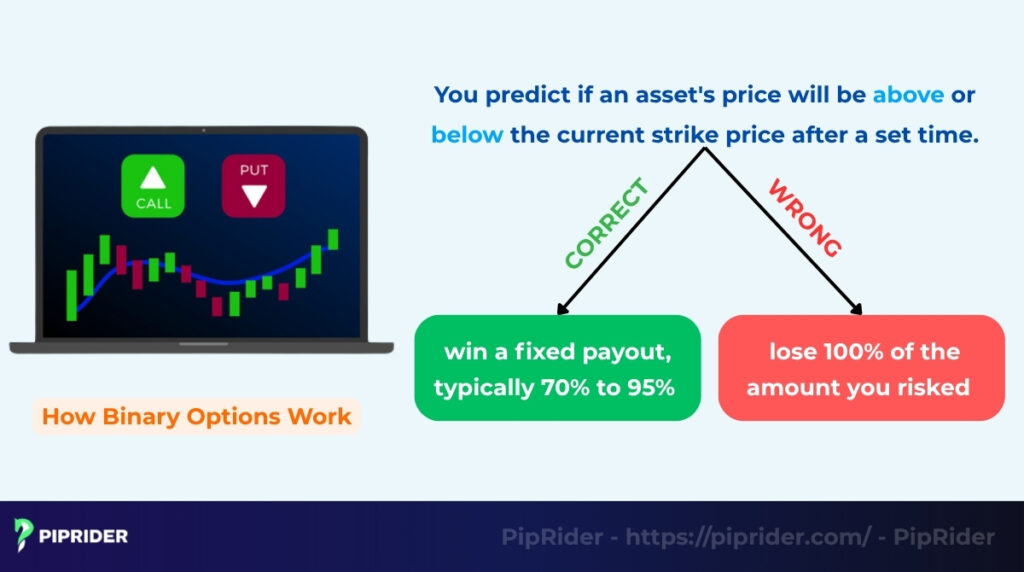
A binary option is a high-risk financial derivative where a trader predicts whether the price of an asset will be above or below a specific “strike price” at a fixed expiration time. Unlike traditional trading, there are only two outcomes: you are either 100% correct and receive a fixed payout, or you are wrong and lose your entire investment.
The “All-or-Nothing” Mechanism
This binary structure is simple to understand, but it hides a significant mathematical hurdle for the trader. Here is the breakdown:
- The prediction: You choose a direction (Call/High or Put/Low) for a specific asset and an expiration time (e.g., 5 minutes).
- The payout: If your prediction is correct by even a fraction of a pip, you win a fixed payout, typically 70% to 95% of your risked amount.
- The loss: If your prediction is incorrect, you lose 100% of the capital you committed to that single trade.
The Inherent Disadvantage
This payout structure creates a “negative expectancy.” Because you lose 100% on a failure but gain less than 100% on a success, simply winning 50% of your trades will lead to a rapidly depleting account. Success requires a significantly higher win rate just to reach a break-even point.
Binary options can be traded on forex, stocks, indices, and crypto, though it is vital to understand the difference between forex and binary options before choosing your preferred instrument. However, the U.S. Commodity Futures Trading Commission (CFTC) warns that these short-term contracts are a very high-risk form of trading often used by unregulated platforms to target retail investors.
2. Important Legal and Regulatory Warnings
Before exploring any trading strategy, you must understand that binary options are one of the most heavily restricted financial products globally. Because of their “all-or-nothing” nature and high failure rate among retail investors, major regulators have taken drastic steps to protect consumers.
Global Bans and Restrictions
- United Kingdom (FCA): The Financial Conduct Authority has a permanent ban on the sale, marketing, and distribution of binary options to all retail consumers.
- European Union (ESMA): The European Securities and Markets Authority has prohibited binary options for retail investors across the EU to prevent significant consumer detriment.
- Australia (ASIC): The Australian Securities and Investments Commission has banned binary options for retail clients, with this restriction currently extended until 2031.
- United States (CFTC & SEC): While some exchange-traded binary options are legal, the CFTC and SEC frequently issue alerts regarding fraudulent offshore platforms that operate unlawfully and refuse to return investor funds.
The “Gambling” vs. “Trading” Classification
In many jurisdictions, binary options are classified or regulated more like gambling than traditional financial investing. This is because the short-term duration (often 60 seconds) makes price movement indistinguishable from random noise, giving the “house” (the platform) a mathematical edge similar to a casino.
Actionable advice: If you are a retail investor in the UK, EU, or Australia, any platform offering you binary options is likely operating illegally or is an offshore entity that falls outside the protection of your local laws. Always verify the regulatory status of a firm via the regulator’s official register before depositing capital.
3. Why Binary Options Are So Hard to Profit From
Many beginners are drawn to binary options because of the “fixed risk” and “fixed reward.” However, professional traders rarely participate in this market because the mathematical deck is heavily stacked against the retail participant.
The Negative Expectancy Trap
In traditional Forex or Stock trading, if you win 50% of your trades and your winners are larger than your losers, you are profitable. In binary options, this is impossible.
Because a typical payout is only 70% to 90%, but a loss is always 100%, you start every trade with a mathematical disadvantage. This structure is designed to ensure that most participants eventually lose their entire account balance through a “death by a thousand cuts”.
The Psychology of “Instant Fix”
The search intent for binary options often attracts people looking for a “get-rich-quick” solution. Platforms exploit this by offering 60-second or 30-second expirations.
- The trap: On these ultra-short timeframes, price movement is essentially “white noise.” It is impossible to apply technical analysis effectively because the movement is random.
- The consequence: This leads to revenge trading—the urge to immediately “win back” a loss. Because binary trades are so fast, a trader can blow an entire account in minutes during an emotional spiral.
High Barrier to Consistency
Unlike other markets, binary options have a fixed ceiling on profit but no floor on loss. In Forex, you can ride a trend for a 5:1 reward-to-risk ratio. In binary, even if you predict a massive 200-pip move perfectly, your profit is still capped at the original payout percentage (e.g., 85%). This lack of “upside” makes it statistically much harder to recover from a losing streak.
4. What Win Rate Do You Need to Break Even?
The most important realization for any binary options trader is that winning more than 50% of your trades is not enough. Because the payout for a win is always smaller than the loss from a failure, you must maintain a very high accuracy rate just to keep your account balance stable.
The Break-Even Formula
To calculate exactly how many trades you need to win to reach a $0 profit (breaking even), use this simple formula:
Break-Even Win Rate = 1 / (1 + Payout Ratio)
Payout Examples
Depending on the payout your platform offers, your required accuracy changes significantly:
- 70% Payout (0.7 Ratio): You need a 58.8% win rate.
- 80% Payout (0.8 Ratio): You need a 55.6% win rate.
- 90% Payout (0.9 Ratio): You need a 52.6% win rate.
Why This Matters for Your Strategy
Most beginners look for a “90% win rate” system, but even professional hedge fund traders rarely maintain a 60% win rate in traditional markets.
In binary options, if your platform offers a low payout (e.g., 65% during low volatility), you are mathematically doomed to lose over time because maintaining a 60.6% win rate consistently is nearly impossible. This is why payout selection is just as important as your entry signal. If the payout is below 80%, the risk-to-reward ratio is too skewed to justify the trade.
5. A Safer Step-by-Step Process Before Any Binary Trade
To trade binary options more safely, you must follow a disciplined process that prioritizes legal compliance and risk management above all else. Do not skip these initial verification steps.
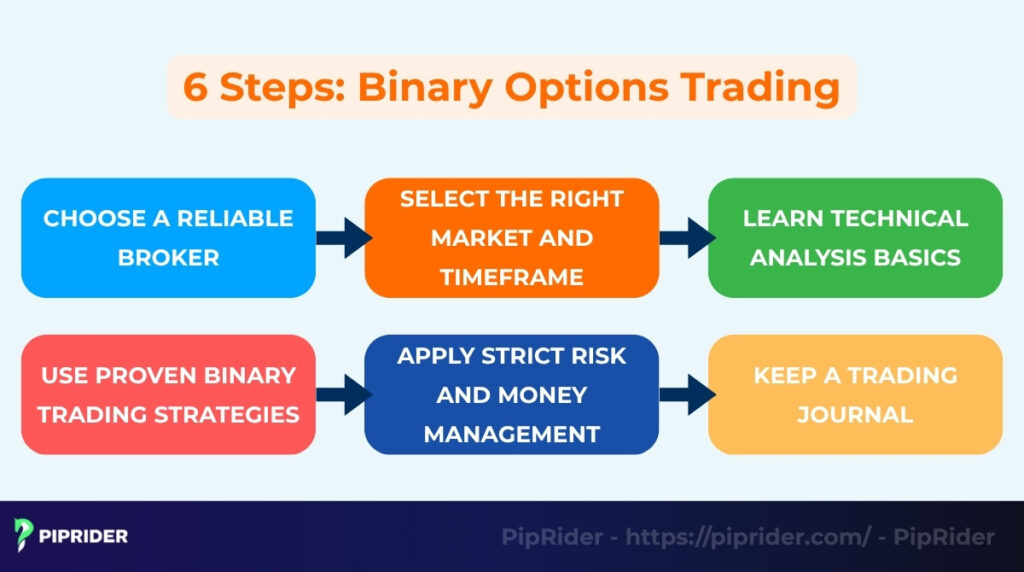
5.1. Step 1: Check Whether Binary Options Are Legal for You
Before looking for a platform, verify your local laws. As noted earlier, if you are a retail investor in the UK, EU, or Australia, binary options are prohibited. If you reside in a jurisdiction where they are legal, ensure you are not classified as a “retail client” in a restricted zone.
5.2. Step 2: Verify Platform Legitimacy and Withdrawal Terms
If binary options are legal in your region, your next task is to find a legitimate provider.
- Avoid “too good to be true” payouts: If a platform offers 100% payouts or “guaranteed returns,” it is likely a scam.
- Check withdrawal rules: Many fraudulent platforms allow you to deposit easily but create impossible “turnover requirements” that prevent you from ever withdrawing your funds.
- Regulation check: Only use platforms that are transparent about their licensing and have a track record of honoring withdrawals.
5.3. Step 3: Select High-Liquidity Markets
Focus on markets with predictable volume.
- Major pairs: New traders should stick to EUR/USD or GBP/USD. These pairs have high volume and are less likely to experience the “price spikes” that can wipe out a short-term binary trade.
- Avoid low-volume assets: Exotic currency pairs or low-cap cryptos can be easily manipulated on smaller platforms.
5.4. Step 4: Master Technical Analysis and Setup Selection
You cannot trade based on “gut feelings.” You must learn:
- Trend identification: Using 50 and 200 EMAs.
- Key levels: Identifying horizontal Support and Resistance zones.
- Momentum: Using the RSI to ensure you aren’t buying at the very top of a move.
5.5. Step 5: Apply the 1% Risk Rule
Applying strict risk management is the only way to survive the high accuracy requirements of binary options.
- Position sizing: Never risk more than 1% of your total account on a single trade.
- No martingale: Never double your investment after a loss to “break even.” This is the fastest way to hit a zero balance.
5.6. Step 6: Maintain a Strict Trading Journal
Document every trade, including the entry reason, the expiry logic, and the outcome. Reviewing your journal weekly is the only way to identify if your strategy actually meets the break-even win rate required for your platform’s payout.
6. Simple Binary Strategies for Beginners
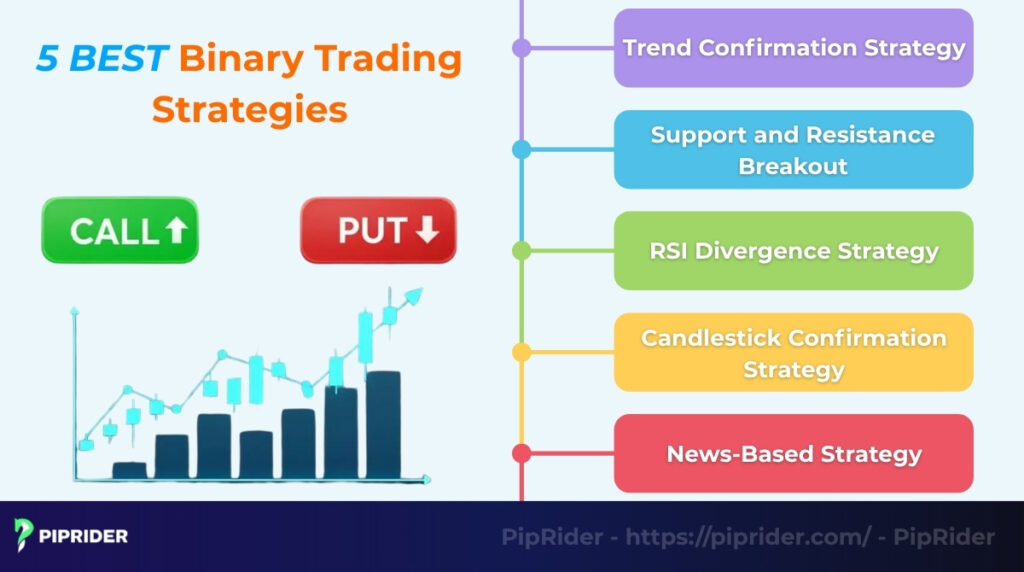
The best binary trading strategies are rule-based and remove guesswork. Because binary options have a fixed expiration, your entry must be precise. Below are the core strategies standardized for binary-specific execution.
6.1. Trend Pullback (EMA 50)
This strategy filters out noise by only trading in the direction of the dominant trend.
- Setup: Price must be consistently above (Uptrend) or below (Downtrend) the 50-period EMA (Exponential Moving Average).
- Entry: Wait for a pullback to the EMA 50 followed by a rejection candle (e.g., a Pin Bar).
- Expiry: 3 to 5 candles of your signal timeframe (e.g., if using a 5m chart, use a 15–25 minute expiry).
- Avoid when: The market is “ranging” (EMA is flat) or immediately before high-impact news.
6.2. Support & Resistance Rejection
This strategy bets on the market “bouncing” off established price floors or ceilings.
- Setup: Identify a clear horizontal level that has been tested at least twice.
- Entry: Enter a “Call” when the price touches support or a “Put” when it touches resistance, confirmed by a reversal candlestick.
- Expiry: 2 to 3 candles of your signal timeframe.
- Avoid when: The price is approaching the level with extremely high momentum (big, fast candles), as this often signals a breakout.
6.3. RSI Divergence (Reversal)
A sophisticated method to spot when a trend is losing steam and about to flip.
- Setup: Bullish Divergence (Price makes a lower low, but RSI makes a higher low) or Bearish Divergence (Price makes a higher high, but RSI makes a lower high).
- Entry: Enter at the close of the candle that confirms the RSI hook.
- Expiry: Longer duration (15 to 30 minutes) to allow the new trend to develop.
- Best market condition: High-liquidity major pairs like EUR/USD.
6.4. Breakout with RSI Confirmation
Designed to capture the momentum that occurs when a range finally breaks.
- Setup: Price is trapped in a narrow horizontal range (consolidation).
- Entry: Once a candle closes outside the range, check the RSI. If it’s >50 for a breakout up, or <50 for a breakout down, enter in that direction.
- Expiry: 5 to 10 minutes (for M1 or M5 charts) to allow the momentum to clear the “retest” phase.
- Avoid when: Trading volume is low (e.g., during the mid-Asian session).
6.5. News-Based Momentum (Advanced)
- Setup: Use an Economic Calendar to identify “Red Folder” events (NFP, CPI, Interest Rates).
- Entry: Wait for the initial 2-minute “chaos spike” to end. Enter in the direction of the secondary, sustained momentum.
- Expiry: 15 to 60 minutes.
- Note: This is high-risk and only recommended once you have mastered price action.
7. How to Choose Expiry Time
In binary options, your entry can be 100% correct, but you can still lose the trade if your expiry time is poorly chosen. Most beginners fail because they choose 60-second expiries, which are heavily influenced by random market noise.
The Golden Rule of Expiry
A professional binary strategy requires the price to have enough time to move away from the strike price and stay there. A common rule of thumb is to set your expiry for 3 to 5 candles of the timeframe you are analyzing.
Expiry Framework by Analysis Timeframe
To trade more safely, align your expiration with your chart analysis:
| Analysis Timeframe | Recommended Expiry | Why? |
| 1-minute (M1) | 5 – 10 minutes | Allows the price to clear the immediate “noise” of the entry candle |
| 5-minute (M5) | 15 – 25 minutes | Ideal for capturing micro-trends and pullback rejections |
| 15-minute (M15) | 45 – 60 minutes | Best for trading major support/resistance levels with high accuracy |
Why You Should Avoid “Turbo” Expiries (30s/60s)
Regulators like the CFTC and ESMA specifically warn against short-term “Turbo” contracts because:
- Mathematical noise: On a 30-second scale, price movement is effectively a coin flip, regardless of your technical indicators.
- Platform lag: A 1-second delay in execution (slippage) on a 60-second trade can change the outcome from a win to a loss.
- Emotional pressure: Rapid-fire trades trigger “gambler’s high,” leading to impulsive decision-making and account depletion.
Decision Checklist for Expiry:
- High volatility (news): Use longer expiries (15m+) to avoid being stopped out by a temporary “whip-saw” spike.
- Low volatility (ranging): Use shorter expiries (3-5m) as the price is unlikely to travel far from the entry point.
- Trend pullbacks: Always give the trade at least 3 candles to allow the trend momentum to resume.
8. Risk Management Rules for Binary Options
Risk management is the absolute foundation of any plan for how to trade binary options safely. Because the mathematical structure of the payout is skewed against you, even a small string of emotional mistakes can wipe out an entire account. Because you can lose 100% of your investment on a single trade, you must have strict rules to protect your capital, incorporating risk management principles beyond binary options to ensure long-term portfolio stability.
8.1. The 1% Rule (Position Sizing)
The most critical rule in binary options is to never risk more than 1% of your total account balance on a single trade.
- The math: If you have a $1,000 account, your maximum trade size is $10.
- The benefit: This conservative position sizing ensures that a losing streak of 10 trades only reduces your capital by 10%, leaving you with enough funds to recover. At a 3% risk, that same streak would wipe out nearly a third of your account.
8.2. Avoid the “Martingale” Trap
Many beginners are tempted by the Martingale strategy—doubling your trade size after a loss to “recover” quickly. This is the fastest way to blow a binary options account. Because binary trades have a fixed ceiling on profit but a 100% loss floor, a short losing streak with Martingale will lead to exponential losses that exceed your account’s recovery capacity.
8.3. Eliminate “Overlapping” and “Revenge” Trades
- No overlapping: If you place three “Call” trades on EUR/USD at the same time, you haven’t diversified; you have simply tripled your risk on a single market move.
- No revenge trading: If you lose a trade, your trading psychology will urge you to jump back in immediately. Professional traders wait for a new setup rather than “chasing” the market.
8.4. Diversify via Different Expirations
Instead of over-leveraging a single asset, look for high-quality setups across different currency pairs and timeframes. Using a trading journal to track which expiration times (e.g., 5m vs 15m) yield your highest accuracy is essential for long-term survival.
9. A Winning Example and a Losing Example
Seeing how a strategy performs in real market conditions both when it works and when it fail, is essential for building a realistic trading plan.
Case 1: The Winning Trade (Trend Pullback)
- Market condition: EUR/USD is in a clear uptrend, trading consistently above the 50-period EMA on the 5-minute chart.
- The signal: Price pulls back to the EMA 50 and forms a “Bullish Pin Bar” rejection candle. Simultaneously, the RSI is holding above 50, confirming the trend has not lost its strength.
- The entry: “Call” (High) trade opened at the close of the Pin Bar.
- The expiry: 15 Minutes (3 candles). This allows enough time for the trend to resume and push the price away from the entry point.
- The outcome: The price rallied 5 pips higher. The trade expired “In-the-Money” (ITM) with an 85% payout.
Case 2: The Losing Trade (Fake Breakout)
- Market condition: GBP/USD has been stuck in a 10-pip horizontal range for two hours.
- The signal: A green candle closes above the resistance line. The trader enters a “Call” trade immediately, hoping for a breakout.
- The mistake (invalidation): The trader ignored that the RSI was already at 75 (Overbought) and failed to notice a high-impact news release (US CPI) scheduled for 5 minutes later.
- The expiry: 5 Minutes.
- The outcome: The news release caused a massive price spike in the opposite direction (USD strength), pulling the price back inside the range. The trade expired “Out-of-the-Money” (OTM) for a 100% loss.
Key Lesson
The second trade failed not because the “Breakout Strategy” is bad, but because the trader ignored market context (overbought RSI and news volatility). To trade binary options more safely, you must always verify that your technical signal is not being overridden by external fundamental events.
10. Tools You Actually Need for Analysis
While you can trade with a clean chart, most successful traders use specific tools to confirm setups and avoid dangerous market conditions. In the binary options space, your choice of tools is critical for filtering out “market noise”.
10.1. Essential Charting and Analysis
- TradingView: This is the gold standard for technical analysis. It allows you to use high-quality data feeds, set custom price alerts, and use specialized indicators that are often more accurate than those found built into binary platforms.
- Economic calendar: A non-negotiable tool for risk management. You must check it daily to identify “Red Folder” news events (like NFP or CPI) where binary correlations often break down.
- Trading journal: Documenting every expiry and entry logic is the only way to prove your strategy meets the required break-even win rate.
10.2. Core Technical Indicators
For binary-specific setups, focus on these three categories:
- Momentum (RSI / Stochastic): Essential for identifying “overbought” or “oversold” conditions before a reversal.
- Trend (EMA 50 / 200): Helps you stay on the right side of the dominant market move.
- Volatility (Bollinger Bands): Useful for seeing how “stretched” the price is relative to its average.
10.3. Important Note on Trading Platforms
While platforms like IQ Option, Pocket Option, or Nadex are common examples of where binary trading occurs, their mention here is not a recommendation.
- Legality: Availability varies by jurisdiction. You must verify the legal status of any platform in your country before depositing.
- Verification: Always prioritize platforms with transparent withdrawal terms and avoid those that make “guaranteed profit” claims.
- Demo testing: Never trade live capital until you have tested your strategy on a demo account for at least 100 trades to verify your accuracy.
Disclaimer: Mentioning a platform is for illustrative purposes only. Traders should conduct their own due diligence and verify local legal status and platform authorization before committing funds.
11. Frequently asked questions about Trading Binary
12. Conclusion
Success in binary options does not come from a “holy grail” system. Learning how to trade binary successfully is a matter of discipline, statistical analysis, and emotional control. Good emotional intelligence is key.
Understanding the market, managing your capital with strict position sizing, and following a consistent process are the real keys to trade binary over the long term.
To learn more about professional trading strategies, market analysis, and emotional discipline, explore the free educational resources at Piprider.