Jesse Livermore (1877-1940) was a true Wall Street legend and a pioneer of technical trading. Known as the “Great Bear of Wall Street,” he famously made and lost fortunes, most notably by shorting the 1907 and 1929 market crashes. His life is both a story of trading genius and a powerful cautionary tale about risk and emotion.
This article explores his biography, his timeless trading rules, and the key lessons modern traders can learn from his incredible career.
Key Takeaways
-
Who He Was: A legendary American speculator and Wall Street icon known as the “Great Bear.”
-
Famous Trades: Made millions shorting the 1907 and 1929 crashes, proving his uncanny market-reading ability.
-
Core Philosophy: His strategy focused on following the line of least resistance (trend), cutting losses quickly, and patiently letting profits run.
-
Key Legacy: His wisdom is immortalized in Reminiscences of a Stock Operator (as “Larry Livingston”), a bible for traders.
-
Cautionary Tale: He lost his fortune multiple times, serving as a powerful warning on the dangers of leverage and unchecked emotions.
1. Who Was Jesse Livermore?
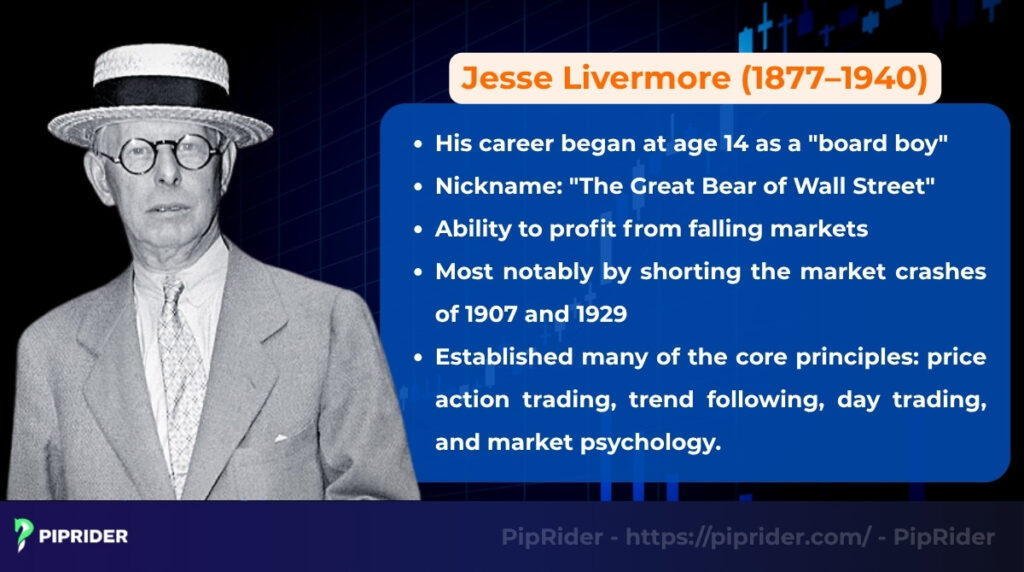
Jesse Livermore (1877–1940) is widely regarded as one of the most influential stock traders of all time. Born into poverty, his career began at age 14 as a “board boy,” where he quickly developed a genius for reading stock ticker tapes.
He honed his skills in the “bucket shops” of Boston before moving to Wall Street, where he made and lost several fortunes. He was eventually banned from many bucket shops because his winning methods were so consistent. He earned the nickname “The Great Bear of Wall Street” for his legendary ability to profit from falling markets.
More importantly, he was a pioneer. He established core principles that are now the foundation of modern technical analysis, including price action trading, trend following, and market psychology.
2. Jesse Livermore’s Early Life and Rise to Fame
Jesse Livermore’s story is a classic “rags-to-riches” tale that laid the foundation for his legend. Born into poverty in 1877, he ran away from home as a teenager and famously began his career at age 14 as a “board boy” in a Boston brokerage.
Instead of formal education, Livermore taught himself how to trade by meticulously observing and memorizing price movements on the stock ticker tape, a practice known as “tape reading.” He began trading with small sums in “bucket shops” (brokerages that took the other side of client bets) and was so successful that he was eventually banned from many of them.
His first major success came during the Panic of 1907. Sensing weakness, he shorted the market and reportedly earned his first million dollars in a single day. However, his legendary status was cemented during the Great Crash of 1929. While others were panicking, Livermore held massive short positions, correctly anticipating the collapse. This trade earned him an estimated $100 million and solidified his title as “The Great Bear of Wall Street” (Smitten, 2001).
Key Milestones: The Rise and Fall of Jesse Livermore
Here is a chronological overview of the defining moments in the volatile life of the “Boy Plunger”:
| Year | Major Event & Significance |
|---|---|
| 1877 | Born in Shrewsbury, Massachusetts, to a poor farming family. |
| 1891 | Runs away at age 14. Lands a job at Paine Webber (Boston) and makes his first trade, earning a $3.12 profit. |
| 1906 | Shorts Union Pacific stock on a hunch just before the San Francisco Earthquake, earning $250,000. |
| 1907 | Reportedly makes $1 million in a single day shorting the market panic. J.P. Morgan personally asks him to stop. |
| 1923 | The biography Reminiscences of a Stock Operator (by Edwin Lefèvre) is published. |
| 1929 | The Legendary Trade: Shorts the Wall Street Crash while others go bankrupt. Earns ~$100 million. |
| 1934 | Files for bankruptcy for the third time after losing the 1929 fortune. |
| 1940 | Publishes How to Trade in Stocks. Commits suicide later that year in New York. |
(Data source: Lefèvre, 1923 & Smitten, 2001).
3. Livermore’s Trading Philosophy
Jesse Livermore’s success and failures were guided by a set of profound market principles that he developed over decades. This core philosophy, immortalized in “Reminiscences of a Stock Operator,” remains highly relevant for traders today.
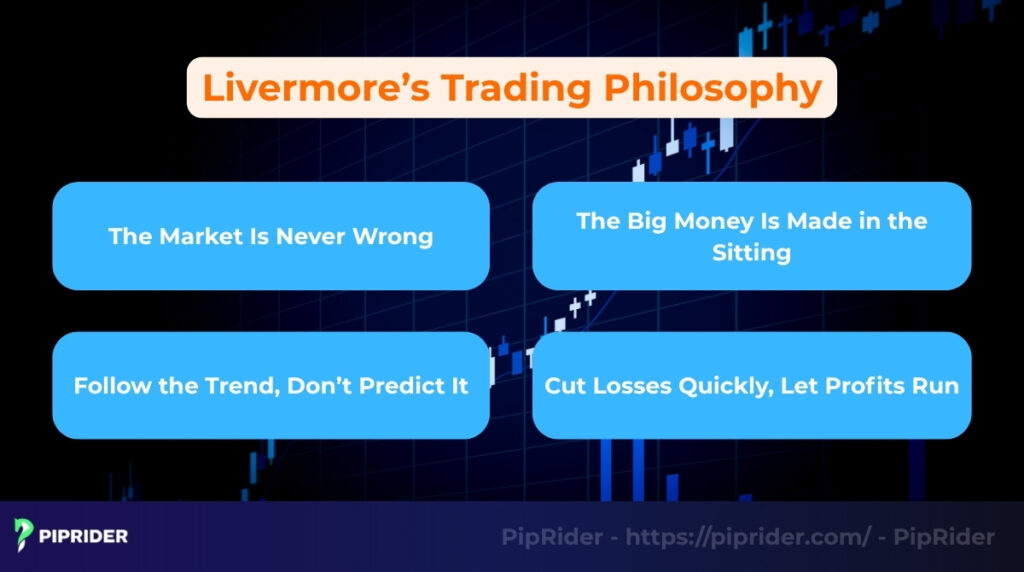
3.1. The Market Is Never Wrong
Livermore’s primary rule was that the market is never wrong; opinions often are. He believed traders get into trouble when their ego or opinion contradicts what the market is actually doing.
For modern traders, this translates to trusting price action above all else. Instead of trying to “outsmart” the market or force a trade, a trader must be flexible and respect the current price movement.
3.2. The Big Money Is Made in the Sitting
This famous quote encapsulates Livermore’s view on patience. He argued that success doesn’t come from frequent, hyperactive trading but from patiently holding a position once it has been correctly established in a major trend.
His insight was that “men who can both be right and sit tight are uncommon.” For today’s traders, this is a lesson to avoid over-trading and have the discipline to let winning trades run.
3.3. Follow the Trend, Don’t Predict It
Livermore was one of the earliest recorded trend followers. He strongly believed it was futile to predict tops or bottoms.
His philosophy was to identify the “line of least resistance”, the dominant trend, and simply trade in that direction. He would wait for the market to confirm the trend before acting, rather than trying to guess where the move would start.
3.4. Cut Losses Quickly, Let Profits Run
This is the timeless cornerstone of risk management, which Livermore learned through painful losses.
He argued that traders should not avoid losses, which are inevitable, but rather control the size of their losses. This meant cutting losing positions quickly and mechanically to preserve capital while simultaneously having the patience to let profitable trades mature.
4. Jesse Livermore’s Trading Rules
Beyond his broader philosophy, Jesse Livermore operated using a set of strict, mechanical rules. Many of these were detailed in his 1940 book, How to Trade in Stocks, and highlighted in the famous Jesse Livermore stock operator book.
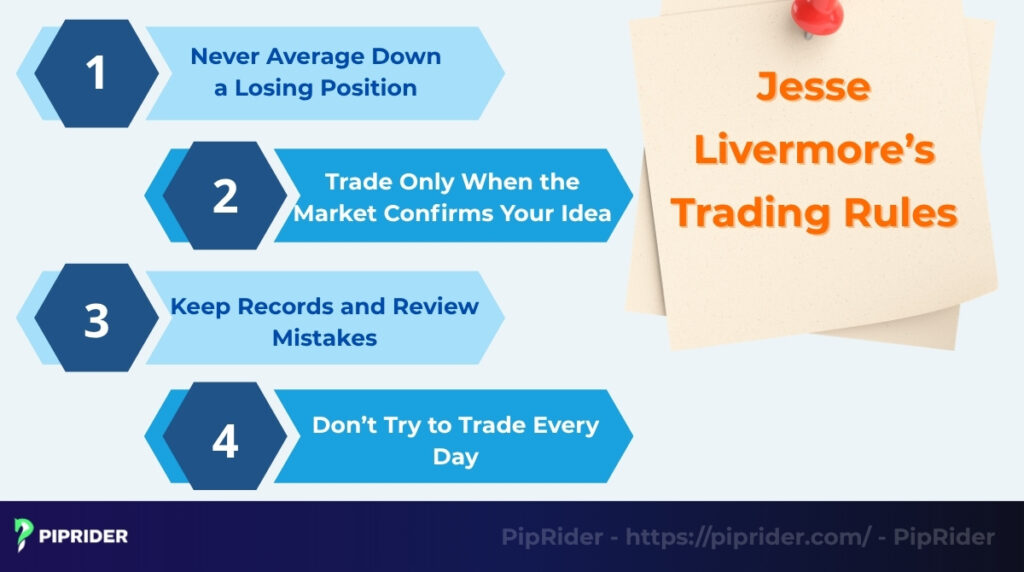
4.1. Never Average Down a Losing Position
This was one of his most rigid rules. If a trade went against him, he took it as a sign his initial judgment was wrong. He argued that investing more money in a losing position (“averaging down”) was one of the quickest ways to blow up an account, as it ties up good capital with bad.
4.2. Trade Only When the Market Confirms Your Idea
Livermore was a master of patience. He would form a market bias but would not enter a trade until the price action itself confirmed his idea. This often meant waiting for a “pivotal point” (a key support or resistance level) to break cleanly, confirming the start of a move.
4.3. Keep Records and Review Mistakes
Livermore treated trading as a business and a continuous learning process. He kept meticulous trading journals to record his trades, his reasons for entering, and his emotional state. He believed reviewing these records, especially mistakes, was the only way to learn and avoid repeating them.
4.4. Don’t Try to Trade Every Day
Livermore strongly believed that high-frequency trading was a form of gambling, not professional speculating. He taught that the key was to trade only when a clear, high-probability opportunity presented itself. If there were no clear signals, the correct action was to do nothing and wait.
5. Jesse Livermore Trading Strategy (The 6-Step Playbook)
While Livermore didn’t use modern indicators, his strategy was a disciplined process of filtering the market, selecting the right assets, and executing with mathematical precision.
Here is his complete 6-step playbook, from analysis to exit.
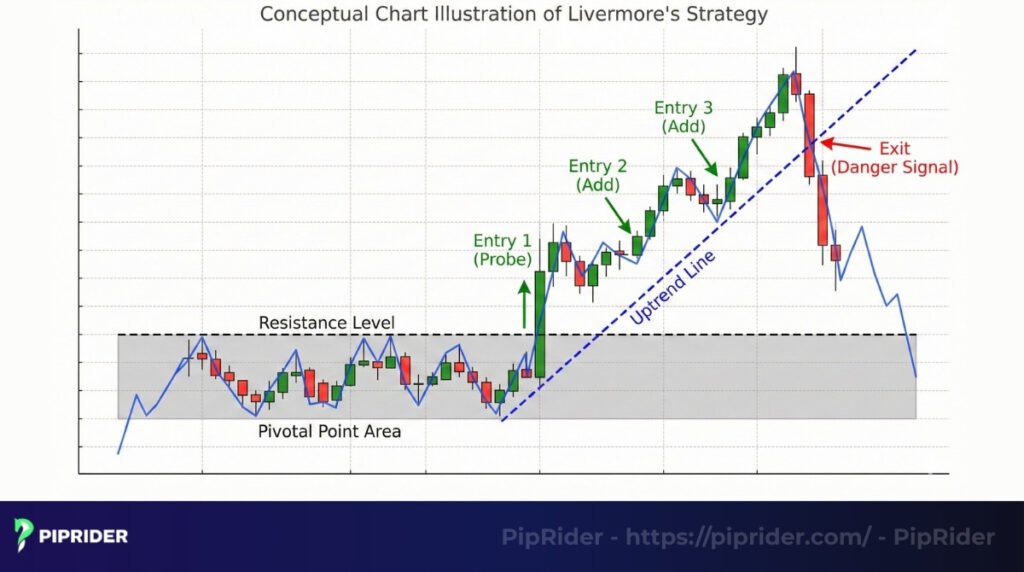
Step 1: Determine the General Trend (Line of Least Resistance)
Livermore never traded against the market. Before looking at any specific stock, he analyzed the overall market direction.
- The Rule: Determine if the “Line of Least Resistance” is Up, Down, or Sideways.
- Action: If the general market is bullish, look for longs. If bearish, look for shorts or sit in cash. Do not force trades in a choppy market.
Step 2: Select the “Leader” (Leading Assets)
Livermore did not trade random stocks. He focused exclusively on the market leaders—the stocks in the strongest industries that were moving first.
- The Rule: “Follow the leaders.” If you cannot make money in the leading active issues, you are not going to make money in the stock market.
- Action: Identify the top 2 sectors, then pick the 2 strongest stocks within those sectors. Ignore laggards.
Step 3: Wait for the Pivotal Point (The Setup)
Patience is the key. Livermore waited for a specific market structure he called a “Pivotal Point”—typically a consolidation period where price moves sideways after a trend.
- The Rule: Do not guess the bottom or top. Wait for the psychology of the market to confirm the move.
- Action: Mark the resistance level (for longs). Wait for the price to break through this level with conviction. This breakout is the “Psychological Moment” to act.
Step 4: Entry & Pyramiding (Building the Position)
Livermore didn’t go “all-in” at once. He used a probe system to test his hypothesis.
- The Probe: Buy 20-30% of your total position size at the breakout (Pivotal Point).
- Conditional Pyramiding: Only add to the position if the price moves in your favor (e.g., rises by a specific margin).
- The Logic: If the trade shows a loss, you are wrong—do not add. If it shows a profit, you are right—add more (Averaging Up).
Step 5: Stop-Loss & Risk Rules
Risk management was integrated into his execution, not an afterthought.
- The 10% Rule: Livermore famously cut any loss that exceeded 10% of his invested capital. To apply this discipline, you must know how to calculate stop loss precisely before entering any trade.
- Never Average Down: This was his cardinal sin. If the “Probe” trade (Step 4) goes negative, exit immediately. Never buy more of a losing stock to lower the average price.
Step 6: Exit on “Abnormal Weakness”
Livermore did not use fixed profit targets. He let profits run until the market signaled the trend was over.
- The Signal: Look for an “One-Day Reversal” or Abnormal Weakness—such as a massive volume spike without price progress, or a violent drop that breaks the prevailing trendline.
- Action: When the “Line of Least Resistance” changes direction, close the entire position.
6. 3 Trading Scenarios: Putting Strategy into Practice
To understand how Livermore’s rules work in real-time, let’s look at three hypothetical scenarios using his logic.
Scenario A: The Breakout (Buying the Pivotal Point)
The Setup: A stock, let’s call it “US Steel,” has been rising but spent the last 4 weeks trading sideways between $95 and $100. This $100 level is the Psychological Barrier.
- The Amateur Way: Buys at $98 hoping for a breakout (anticipating).
- The Livermore Way: Waits patiently. Does nothing until the market confirms.
- The Trigger: The moment the stock crosses $100.50 with high volume, the “Line of Least Resistance” is confirmed UP.
- Action: Enter the first position (The Probe) immediately at the breakout.
Scenario B: Pyramiding (Adding to Winners)
The Setup: You bought the breakout at $100. The stock is now moving strongly and hits $105.
- The Logic: The market has confirmed you are right. Your position shows a profit.
- The Livermore Way: Instead of selling to “take profit,” you buy more to maximize the trend.
- Execution:
- Entry 1 (Probe): Buy 200 shares at $100.
- Entry 2 (Strength): Buy another 200 shares at $105.
- Entry 3 (Final): Buy final 100 shares at $110.
- Result: You now own 500 shares. Your average price is $104, but the current price is $110. You have a massive position backed by profit.
Scenario C: Risk-First (The “Cut Loss Fast” Rule)
The Setup: You spot another stock, “Cotton Inc.,” breaking out at $50. You enter a position. However, the next day, the price feels “heavy” and drifts down to $48. Two days later, it drops to $45.
- The Trap: Most traders think, “I’ll wait for it to bounce back to $50 to break even.”
- The Livermore Way: The stock acted contrary to your prediction. The loss is now 10% ($5 loss on a $50 entry).
- Action: Sell immediately. No questions asked. No hope.
- The Lesson: You take a small loss to protect your capital (ammunition) for the next big winning trade. As Livermore said: “The money lost is nothing; it is the mental damage that kills you.”
7. Why He Lost It All: The Common Mistakes
Despite his genius, Livermore’s life was a rollercoaster of incredible highs and devastating lows. He declared bankruptcy three times (1915, 1934, and shortly before his death).
Modern traders must understand why he failed to keep his fortune. It wasn’t a lack of skill, but a failure in these three critical areas:
7.1. The Trap of Over-Leverage
Livermore was a master of Pyramiding (adding to winning positions), but this strategy is a double-edged sword.
- The Mistake: He often traded with massive margin. When he was right, the returns were exponential. But when the market gapped against him unexpectedly, the leverage wiped out his equity instantly.
- The Lesson: Never confuse “Pyramiding” with reckless gambling. Always ensure you have enough cash reserves to survive a “Black Swan” event.
7.2. Breaking His Own Rules (The Cotton Trade)
Livermore famously admitted that his biggest losses came not from the market outsmarting him, but from him ignoring his own rules.
- The Mistake: The most famous example was the 1908 Cotton Trade. Instead of following the price action, he listened to a “hot tip” from the Cotton King, Percy Thomas. He abandoned his independent analysis, averaged down on a losing position, and lost millions (Lefèvre, 1923).
- The Lesson: “Tips are for waiters.” Stick to your system. The moment you deviate from your trading plan due to boredom or outside influence, you are gambling.
7.3. Emotional Instability & Lifestyle
Livermore’s trading performance was deeply linked to his mental state.
- The Mistake: He led a lavish, chaotic personal life marked by scandals and divorce. He failed to separate his emotional turmoil from his trading desk. When he was depressed or emotionally unbalanced, he made poor, impulsive decisions.
- The Lesson: Trading requires a clear, calm mind. You cannot master the market if you have not mastered yourself. As he wrote: “A man must know himself thoroughly if he is going to make a good job out of trading.”
8. Essential Reading: Books by and about Jesse Livermore
To fully grasp Livermore’s methods, traders must distinguish between the biographical accounts of his life and the instructional material he penned himself. Here are the three essential works:
8.1. Reminiscences of a Stock Operator (1923)
- Author: Edwin Lefèvre
- Context: Written as a fictionalized biography (roman à clef) with the protagonist “Larry Livingston,” this book is widely accepted as the true story of Livermore’s early career.
- Why Read It: It is considered the “Bible of Trading Psychology.” It focuses on the emotional discipline, market manipulation, and crowd psychology that defined his era.
8.2. How to Trade in Stocks (1940)
- Author: Jesse Livermore
- Context: Published shortly before his death, this is the definitive instructional guide authored by Livermore himself. Unlike the narrative style of Reminiscences, this book details his specific mathematical formulas, timing codes, and money management rules.
- Why Read It: To learn the specific “How-To” of his strategy, including his Pivotal Point calculation and Pyramiding technique.
8.3. Jesse Livermore: World’s Greatest Stock Trader (2001)
- Author: Richard Smitten
- Context: A modern, exhaustively researched biography that fills in the gaps of his later years, including the 1929 crash details and his tragic end.
- Why Read It: For a complete, historically accurate picture of his life, specifically the details regarding his family life and the exact magnitude of his wealth.
9. From Stocks to Forex: Adapting the Master’s Rules
While Jesse Livermore traded stocks and commodities, his principles are universal. Why? Because human psychology never changes. The fear and greed that drove the 1929 stock market are the exact same emotions driving the EUR/USD chart today.
However, the modern Forex market has unique characteristics (Leverage, 24/5 trading) that require traders to adapt his playbook. Here is how to apply Livermore’s rules to FX:
9.1. Adjusting for High Leverage (The Survival Rule)
Livermore traded with ~10% margin and still blew up. Modern Forex traders often use 1:100 or 1:500 leverage.
- The Adaptation: In stocks, Livermore advised cutting losses at 10%. In the high-leverage world of Forex, 10% is too wide.
- Modern Rule: Stick to a strict 1-2% risk per trade. 9.1. Adjusting for High Leverage (The Survival Rule)
- Livermore traded with ~10% margin and still blew up. Modern Forex traders often use 1:100 or 1:500 leverage.
- The Adaptation: In stocks, Livermore advised cutting losses at 10%. In the high-leverage world of Forex, 10% is too wide.
- Modern Rule: Stick to a strict 1-2% risk per trade. Never average down without a stop-loss, to avoid a margin call that can wipe out your entire account in minutes.
9.2. Modern Tools for “Trend Finding”
Livermore used “tape reading” and hand-drawn charts to find the “Line of Least Resistance.” Today, we have better tools to do the same job.
- Then: He watched price prices on a board.
- Now: Forex traders use indicators like Moving Averages (MA), MACD, or the Ichimoku Cloud to visually define the dominant trend on the D1 (Daily) chart. If price is below the Ichimoku Cloud, the “Line of Least Resistance” is Down—only look for shorts.
9.3. Finding “Leaders” with Currency Strength
Livermore’s rule was to buy the strongest stock in the strongest sector. In Forex, we don’t have sectors, we have currencies.
- The Adaptation: Use a Currency Strength Meter.
- Action: Don’t just trade EUR/USD blindly. Identify the strongest currency (e.g., USD) and pair it against the weakest one (e.g., JPY). This creates the highest probability of a strong trend, mimicking Livermore’s “Leader” strategy.
9.4. 24/5 Market & Patience
Livermore said, “The big money is made in the sitting.” This is even harder in Forex, where the market runs 24/5.
The Adaptation: The market is always open, but you shouldn’t always be in it. Wait for the “Pivotal Points”—typically Key Support/Resistance levels or Big Round Numbers (e.g., 1.1000)—to break during high-volume sessions (London/New York) before entering.
10. Famous Quotes by Jesse Livermore
Much of Livermore’s trading philosophy is preserved in two main sources: the biographical novel Reminiscences of a Stock Operator (where he is depicted as Larry Livingston) and his own instructional book, How to Trade in Stocks.
Here are his most enduring lessons, with their specific origins:
“It never was my thinking that made the big money for me. It always was my sitting. Got that? My sitting tight!”
Source: Reminiscences of a Stock Operator (Edwin Lefèvre, 1923)
The Lesson: Real profit comes from patiently holding a position in a major trend, not from frequent, impulsive day trading.
“There is nothing new in Wall Street. Whatever happens in the stock market today has happened before and will happen again.”
Source: Reminiscences of a Stock Operator (Edwin Lefèvre, 1923)
The Lesson: Market movements are driven by human psychology (fear and greed), which remains constant throughout history.
“The game of speculation is the most uniformly fascinating game in the world. But it is not a game for the stupid, the mentally lazy, the person of inferior emotional balance, or the get-rich-quick adventurer. They will die poor.”
Source: How to Trade in Stocks (Jesse Livermore, 1940)
The Lesson: This is from Livermore’s own writing, emphasizing that emotional discipline and hard work are more important than raw intelligence.
“Markets are never wrong – opinions often are.”
Source: Reminiscences of a Stock Operator (Edwin Lefèvre, 1923)
The Lesson: A core lesson in humility. Traders must respect price action (reality) and abandon their own ego or bias when the market moves against them.
11. Jesse Livermore’s Legacy
Jesse Livermore‘s influence on modern trading is immeasurable. He is often regarded as an early pioneer of technical psychology and stands as one of the iconic trading pioneers whose insights continue to define the professional trading landscape.
His influence is evident in the strategies of many modern legends, including Paul Tudor Jones, Ed Seykota, and William O’Neil, all of whom have cited his work as foundational.
Despite his tragic end by suicide in 1940, Livermore’s dual legacy endures. He remains the ultimate trading success story—a speculator who conquered the market purely on skill. Yet, he is also the ultimate cautionary tale of a genius who failed to master his own demons. His life reminds every trader that while technical skill creates profit, only emotional discipline keeps it.
12. Frequently asked questions
13. The Bottom Line
Jesse Livermore was more than just a trader; he was a market philosopher whose core principles remain essential nearly 100 years later. His emphasis on trend following, patience, and strict discipline is timeless.
While his career serves as one of the greatest forex trading success stories, his failures provide an even more powerful lesson. Modern traders can learn from both his successes and his mistakes to develop the robust trading psychology required to trade smarter.
To discover more timeless trading lessons and strategies, explore the latest articles from PipRider.