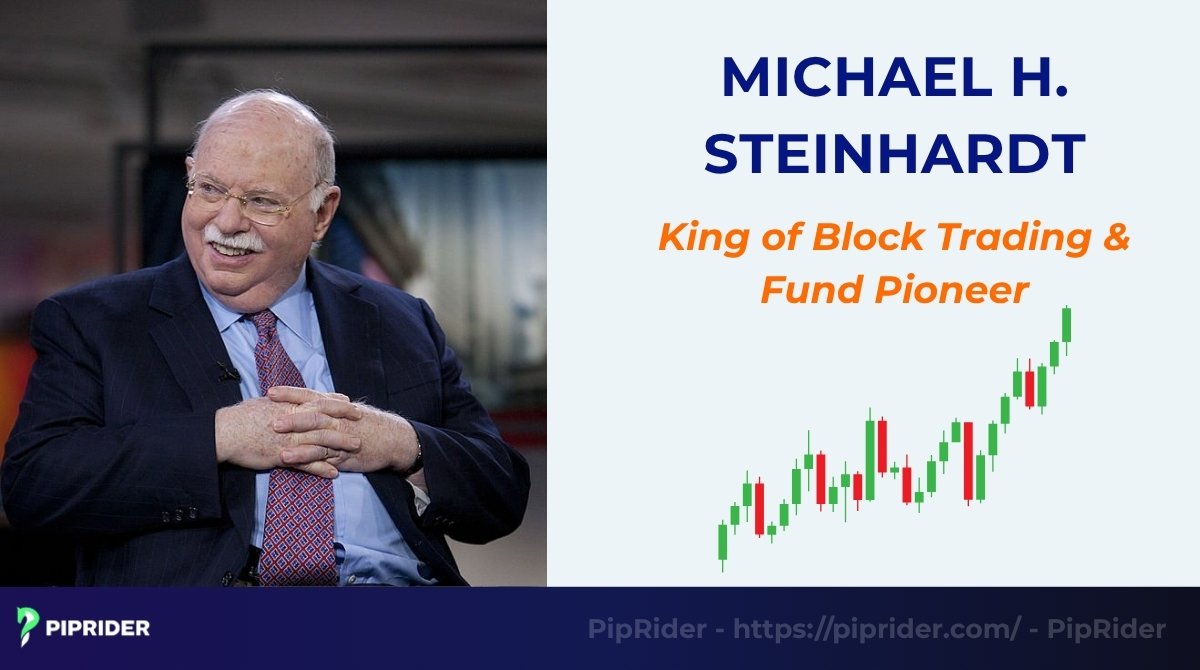
Michael H. Steinhardt is one of Wall Street’s most successful and influential figures. He is a pioneering hedge fund manager who founded Steinhardt Partners in 1967. For nearly 30 years, he delivered legendary returns (averaging 24% annually) using a mix of stocks, bonds, and currencies. He is often called “The King of Block Trading” for his unique skill in executing massive trades.
This article will explore his biography, his powerful investment philosophy, and the timeless lessons his career offers modern traders.
Key Takeaways
- Who He Is: A legendary hedge fund pioneer who founded Steinhardt Partners in 1967.
- Legendary Performance: Averaged a 24% compound annual return for 28 years, far outpacing the S&P 500.
- Core Philosophy: Used “Variant Perception”, finding a market view different from the consensus.
- Key Skill: Mastered “Block Trading,” moving huge volumes of stock without disrupting the price.
- Net Worth & Legacy: A billionaire philanthropist, he is the namesake of NYU Steinhardt.
1. Michael H. Steinhardt’s Biography
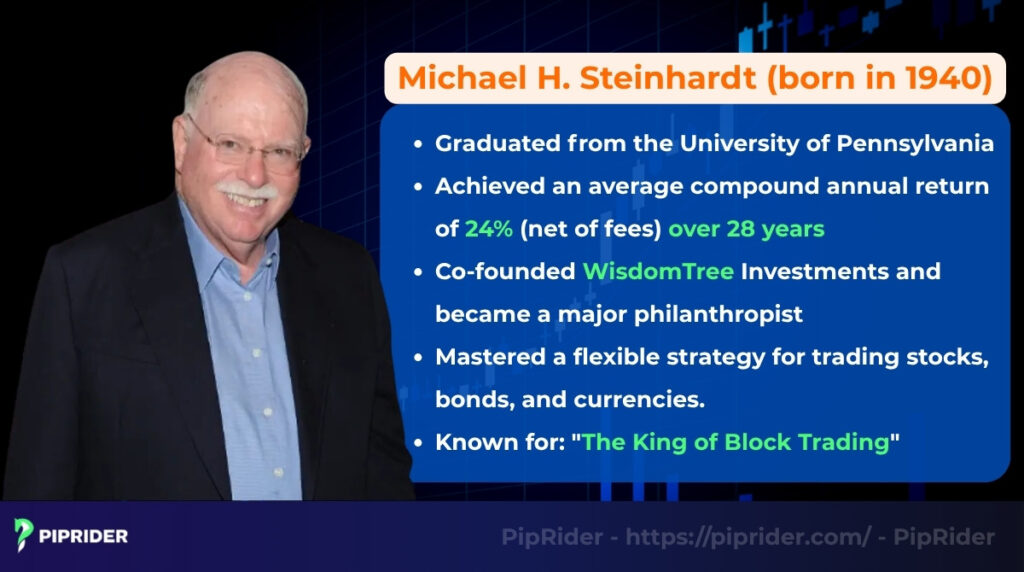
Michael H. Steinhardt was born in Brooklyn, New York, in 1940. His early life set the stage for a legendary financial career. He graduated from the prestigious Wharton School at the University of Pennsylvania in 1960.
His business career began on Wall Street as an analyst, including a notable period at the firm Loeb, Rhoades & Co.
In 1967, at just 27 years old, Steinhardt co-founded his own hedge fund: Steinhardt, Fine, Berkowitz & Co. This firm was one of the very first of its kind, pioneering the hedge fund model. He managed this fund for 28 years, which resulted in one of the most outstanding performance records in Wall Street history, and delivered a compound annual return of 24% (net of fees) for his investors (Wikipedia, n.d.). He also later helped found WisdomTree Investments.
2. What Is Michael Steinhardt Known For?
Michael H. Steinhardt is a Wall Street legend renowned for his pioneering role in the hedge fund industry and his unique trading style.
Here’s what he is known for:
- Pioneering the Hedge Fund Model: Steinhardt Partners was one of the very first modern hedge funds. He was a trailblazer in using a multi-strategy, multi-asset approach (trading stocks, bonds, currencies, and options) at a time when most funds were simpler.
- “The King of Block Trading”: He earned this nickname for his unique mastery of block trading. This involved executing massive orders (tens of thousands of shares) so skillfully that he often left minimal price footprints.
- Legendary Performance: His long-term track record (detailed in Section 1) is considered one of the best in history, solidifying his status as a great investor.
- “Market Wizards” Status: His profound insights into markets and trading psychology were prominently featured in Jack D. Schwager’s classic 1989 book, “Market Wizards”, introducing his philosophy to a global audience.
3. The King of Block Trading – How Steinhardt Changed Market Dynamics
Michael H. Steinhardt‘s nickname, “The King of Block Trading,” wasn’t just a title; it was a description of his unique competitive advantage. He revolutionized how large institutional orders were handled, turning massive trades from a high-risk liability into a strategic weapon.
3.1. What Is Block Trading?
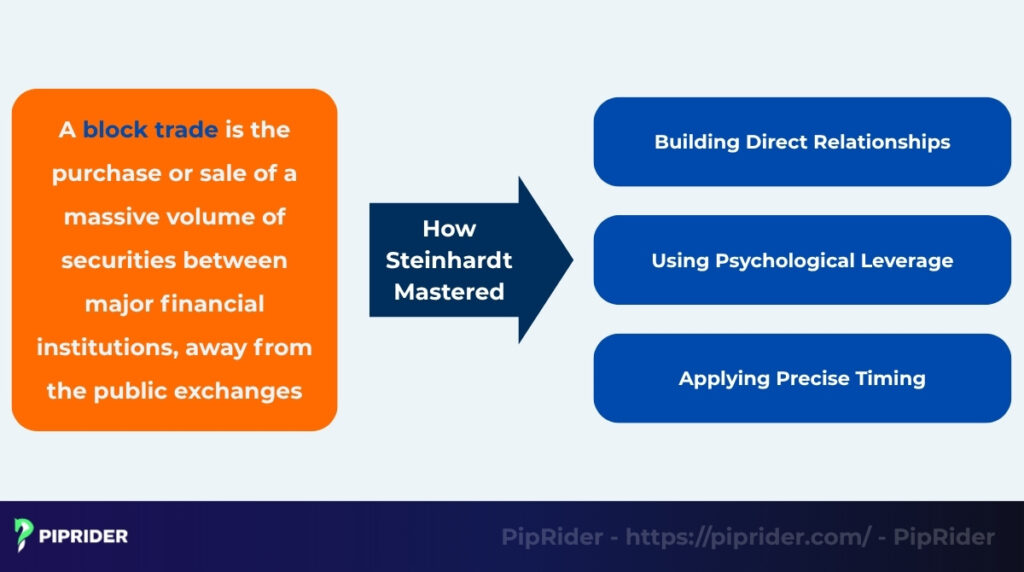
A block trade is the purchase or sale of a massive volume of securities, typically 10,000 shares or more, or a trade with a notional value in excess of $200,000, that is privately negotiated and executed between major financial institutions, away from the public exchanges (Investopedia, 2022).
While most famous forex traders feared the negative price impact (slippage) of such large orders, Steinhardt was reportedly one of the first to apply quantitative flow analysis. He used data to estimate how a block trade in the stock market would actually affect the price so that he could manage the transaction strategically rather than just accepting a poor fill.
3.2. How He Mastered It
Steinhardt didn’t just analyze the numbers; he combined data with a keen understanding of human psychology. He mastered block trading by:
- Building direct relationships: He cultivated deep, direct relationships with key dealers and brokers on Wall Street, giving him a superior “feel” for institutional supply and demand.
- Using psychological leverage: He understood market psychology and used his reputation and order flow to subtly influence price and liquidity in his favor.
- Applying precise timing: He based his execution not just on technicals but on market sentiment and cash flow analysis, waiting for the perfect moment of liquidity to place his trade with minimal impact.
3.3. Impact on Market Liquidity
Steinhardt’s methods fundamentally shaped how institutional order books operate. He demonstrated that large trades weren’t just transactions but strategic events that could be actively managed.
His techniques paved the way for modern block trading desks across Wall Street. Major investment banks eventually adopted similar quantitative and relationship-driven approaches to manage large-scale institutional trades, a legacy that defines institutional trading today.
3.4. Retail Takeaway: How to Trade Like a Whale
Retail traders do not have the capital to execute block trades, but they can adopt the execution mindset of institutional whales like Steinhardt to improve their performance. Here is how to apply these principles to your personal trading account:
- Hunt for Liquidity: Steinhardt waited for the perfect moment to move size. You should do the same. Trade during high-volume trading sessions (like the London-New York overlap) to ensure tight spreads and minimal slippage. Avoid trading during “thin” markets (like bank holidays) where price execution is unpredictable.
- Scale In and Out: Never enter your full position size in one clip. Institutions “work” an order by entering in pieces. You can mimic this by scaling in (entering 33% at a time) and scaling out (taking partial profits) to smooth out volatility and improve your average entry price.
- Master Order Types: Avoid relying solely on “Market Orders,” which make you a liquidity taker (paying the spread). Instead, use Limit Orders and Stop-Limit Orders. This allows you to dictate the price you are willing to pay, acting closer to a liquidity provider.
- Read “Liquidity Pockets”: In Forex, whales often push price toward obvious key levels (previous highs/lows) to trigger stop losses, creating the liquidity they need. As a retail trader, identify these liquidity pockets. Do not place your stop loss exactly where everyone else does, or you will become the “fuel” for a whale’s move.
4. Michael Steinhardt’s Investment Philosophy
Michael Steinhardt’s philosophy was famously summarized by his own quote: “The goal is not to be right all the time, but to make money when you are right.” His approach was an aggressive, intellectual style that blended deep analysis with psychological toughness.
4.1. Variant Perception
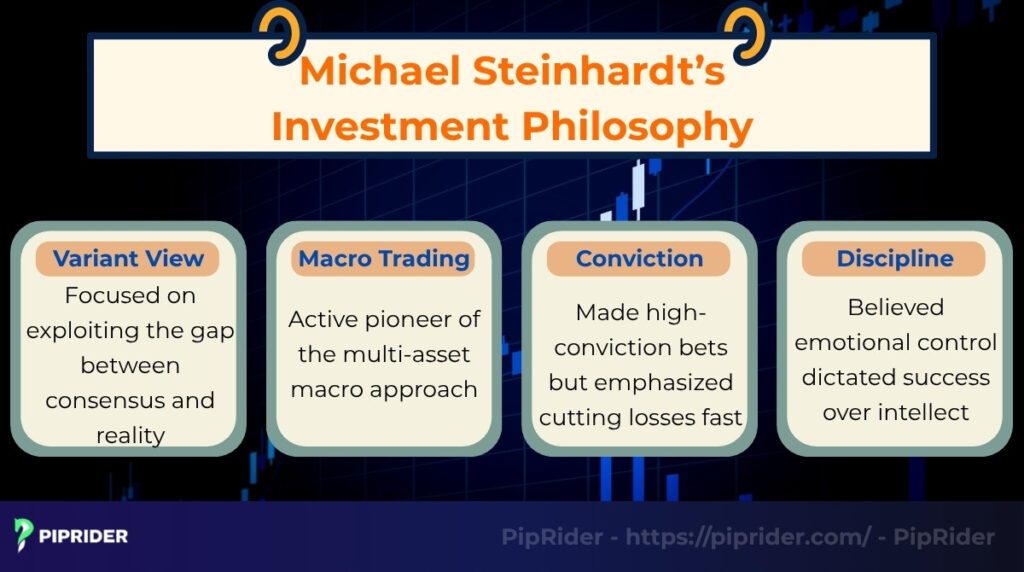
This was the core of his strategy. Steinhardt focused on finding a “variant perception”, a view that was fundamentally different from the market consensus. He believed that the biggest profits were not in following the crowd but in identifying and exploiting the gap between market perception and underlying reality. He looked for opportunities where he saw something that other market participants had missed.
Actionable Guide: The Variant Perception Framework
To apply Steinhardt’s philosophy, you cannot simply guess. You need a structured approach to validate your contrarian ideas. Use this 6-step checklist before entering a trade:
- Scale In: Do not go “All-in” at once. Enter the position in parts to test the market’s liquidity and the validity of your move. Add to your winners, not your losers.
- Analyze the Consensus (What do “They” think?): First, identify the dominant market narrative. Read headlines, check positioning reports (like the COT report), and gauge sentiment. Ask yourself: Is everyone overly bullish or bearish?
- Develop the Variant View (What do YOU see?): Find the divergence. This isn’t just a “hunch”; it must be based on hard data or fundamental logic that the crowd is ignoring. Ask: Why is the market wrong?
- Identify the Catalyst (The “Trigger”): A cheap asset can stay cheap forever without a reason to change. You must identify the specific event, such as an earnings report, a central bank decision, or a policy change, that will force the market to re-price the asset.
- Seek Asymmetric Risk/Reward: Ensure the potential payout justifies the risk. Steinhardt sought trades where the upside was multiples of the downside. Target a minimum Risk-to-Reward ratio of 1:3.
- Define Invalidation (The Exit Rule): Before you buy, know when to sell. Define the specific condition where your thesis is proven wrong. If the fundamental reason for the trade changes, cut the loss immediately.
4.2. Multi-Asset Macro Approach
Steinhardt was a pioneer in the multi-strategy approach. He didn’t limit himself to just stocks. He actively traded stocks, bonds, currencies, and commodities simultaneously, acting as a true macro trader. His strategy was a blend of top-down macro analysis (understanding interest rates, inflation, etc.) and bottom-up fundamental logic (analyzing specific company balance sheets).
4.3. Risk and Conviction
Steinhardt was known for his willingness to make massive, high-conviction bets when his analysis showed a high probability of success. He wasn’t afraid to use leverage or take large positions on his investments. However, this courage was balanced by his famous rule: “Have the courage to be wrong, but don’t stay wrong too long.” He believed in cutting losses quickly if the market proved his analysis incorrect.
4.4. Mental Discipline
Steinhardt operated in high-stress, fast-moving markets. He strongly believed that emotional control was more important than pure intelligence. Successful trading requires immense mental discipline to stick to your analysis and risk rules, especially when the market is volatile or moving against you.
5. Career Timeline and Achievements
Michael Steinhardt’s career is marked by his legendary hedge fund, his timely retirement, and his significant philanthropic work.
5.1. 1967–1995: Steinhardt Partners
This 28-year period cemented Steinhardt’s legacy. Sources commonly cite Steinhardt Partners’ long-run performance at roughly 24% to 24.5% annualized (net of fees) from 1967 to 1995, far outpacing the S&P 500 during the same period (Time, 1995; Wikipedia, n.d.).
At its peak in early 1994, the firm managed nearly $5 billion in assets (AUM), managing capital for some of the world’s wealthiest families and institutions (The Washington Post, 1995).
5.2. 1995: Retirement and Reflection
In 1995, at the top of his game, Steinhardt famously closed his hedge fund to return capital to his investors. He announced he was retiring from active money management to focus on philanthropy and public policy. He did, however, briefly return to the industry in the 2000s, serving as an investment advisor, notably helping to turn around WisdomTree Investments.
5.3. 2000s–Now: Legacy and Philanthropy
In recent decades, Steinhardt has become one of America’s most prominent philanthropists. His Donations have been vast. He has donated hundreds of millions of dollars, focusing heavily on Jewish causes (such as co-founding Birthright Israel), support for charter schools, and higher education. His contributions include major gifts to the NYU Steinhardt School of Culture, Education, and Human Development, as well as to various art museums, reflecting his deep passion for antiquities.
6. Michael Steinhardt’s Net Worth
Michael H. Steinhardt translated his legendary investment performance into a significant personal fortune. His decades of high returns at Steinhardt Partners, compounded by his successful personal investments and asset management since, have cemented his status as a billionaire.
As of 2026, Michael Steinhardt net worth is estimated by Forbes to be approximately $1.4 billion (Forbes, 2026). This figure places him consistently on the Forbes Billionaires List.
The primary source of this wealth is his share of the profits generated during his 28-year run managing his hedge fund and his subsequent activities managing his own capital. His financial success is a direct result of the investment philosophy he pioneered.
7. Lessons from Michael Steinhardt
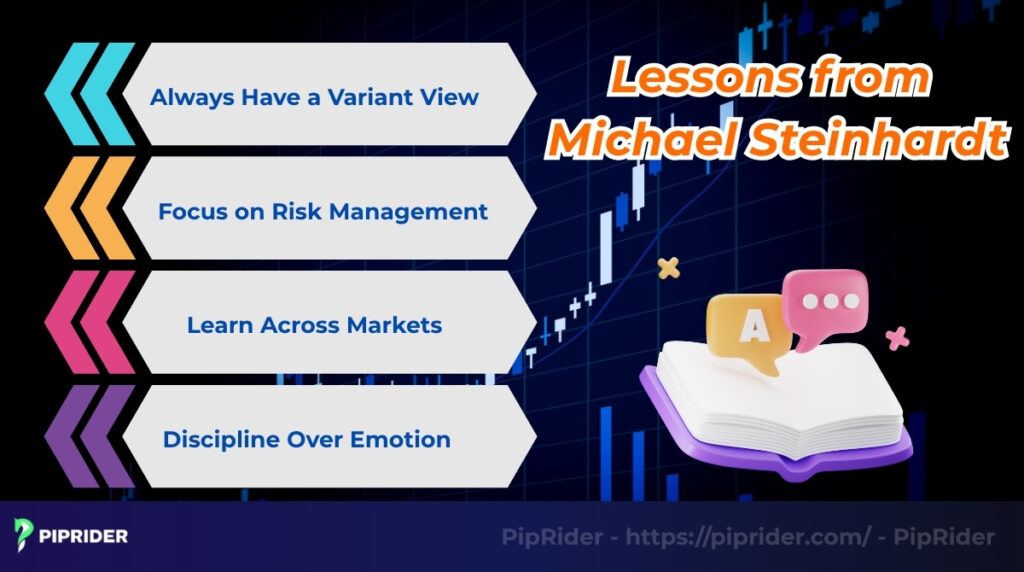
Steinhardt’s career offers a masterclass in trading. Here are the core lessons modern traders can learn from his philosophy.
- Always have a variant view: Don’t follow the crowd. Steinhardt’s “Variant Perception” teaches that significant profits come from having an independent thesis based on deep research. He believed in finding an angle that the general market consensus had missed or misunderstood.
- Focus on risk management: Steinhardt was known for his aggressive bets, but he was also ruthless with risk. His philosophy was to cut losses quickly if a trade’s premise was proven wrong but hold profitable trades as long as the variant view was intact. He managed risk in order to survive.
- Learn across markets: Steinhardt was a master of multi-asset trading. The lesson is to understand how different markets interconnect. A modern trader can benefit from knowing how bonds (interest rates) affect currencies and how currencies affect the stock market and commodities to see the bigger picture.
- Discipline over emotion: He strongly believed that systematic thinking is more important than emotional intuition. Successful trading requires you to learn how to control emotion in trading so you can stick to your analysis and risk rules, especially when the market is volatile or moving against you.
8. Controversies and Criticism
Despite his vast success in finance and philanthropy, Michael H. Steinhardt’s legacy is marked by significant legal and ethical controversies. His career has faced scrutiny across three major separate incidents:
8.1. The Treasury Auction Scandal (1994)
In 1994, Steinhardt Management Company and Caxton Corporation paid a combined $76 million to settle civil charges brought by the U.S. Department of Justice (DOJ) and the SEC. The government alleged that the firms conspired to manipulate the market for two-year U.S. Treasury notes in 1991, effectively “cornering” the market to inflate prices. While Steinhardt settled to avoid prolonged litigation, this remains one of the largest regulatory settlements of that era (Department of Justice, 1994).
8.2. Sexual Harassment Allegations (2019)
Decades later, Steinhardt faced intense scrutiny regarding his conduct in professional and philanthropic circles. An investigation by The New York Times and ProPublica detailed allegations from seven women who accused him of making inappropriate sexual requests and comments. Steinhardt denied specific accusations of harassment but apologized for what he termed “boorish” behavior meant in jest (The New York Times, 2019).
8.3. The Antiquities Trafficking Scandal (2021)
In a massive blow to his reputation as a collector, the Manhattan District Attorney concluded a multi-year investigation into Steinhardt’s private collection. It was determined that his collection contained 180 stolen antiquities looted from 11 different countries. To avoid criminal prosecution, Steinhardt agreed to surrender artifacts valued at $70 million and accepted an unprecedented lifetime ban on acquiring antiquities (The Guardian, 2021).
9. Steinhardt’s Influence on Modern Finance
Michael Steinhardt’s impact on investing is still felt today. He is credited with helping to invent the modern multi-asset hedge fund. This innovation created the foundation used by many of today’s largest funds, including firms like Appaloosa (David Tepper), Tudor Investment Corp (Paul Tudor Jones), and Bridgewater (Ray Dalio), as well as publicly traded firms like WisdomTree.
His specific methods, known as the “Steinhardt style”, blending contrarian macro views with deep fundamental stock picking, are still taught in major business schools as a case study in active management.
He also had a direct influence on the next generation of traders. The enduring nature of his methods is evident in the profiles of top traders like Paul Tudor Jones and David Tepper, who have cited Steinhardt’s aggressive, contrarian, and analytical approach as a major influence on their own trading philosophies.
10. Frequently asked questions about Michael H. Steinhardt
11. The Bottom Line
Michael H. Steinhardt remains an icon, personifying a powerful combination of critical, contrarian thinking and disciplined execution. He proved that block trading was not just a technical skill but an art form rooted in market psychology.
Although he is retired from actively managing funds, his intellectual legacy, particularly his “variant perception” philosophy, serves as a foundational concept for sophisticated investors worldwide.
If you have any questions, leave a comment below, and the PipRider team will be happy to answer. Don’t forget to follow us to update more advanced trading strategies!