Maintaining discipline and avoiding costly errors are critical elements for sustainable success in trading. A trading checklist serves as an essential risk management and execution tool to achieve this consistency.
This article introduces a comprehensive, 10-step checklist of critical steps. Implementing this pre-trade checklist helps traders systematically verify all market conditions and strategic criteria, fostering greater trading consistency and drastically reducing unforced emotional errors.
Key Takeaways
- A trading checklist helps traders maintain discipline and minimize emotion-based trading.
- An effective checklist covers market analysis, trade setup, risk mitigation plan, and trading psychology.
- A trader can customize their checklist for forex, stocks, crypto, or any other market.
- Applying a checklist consistently improves performance and fosters disciplined execution through ongoing education.
- The most effective checklists are simple and actionable; keep yours concise enough to run through in under two minutes to prevent hesitation during live execution.
1. What Is a Trading Checklist and Why Is It Essential?
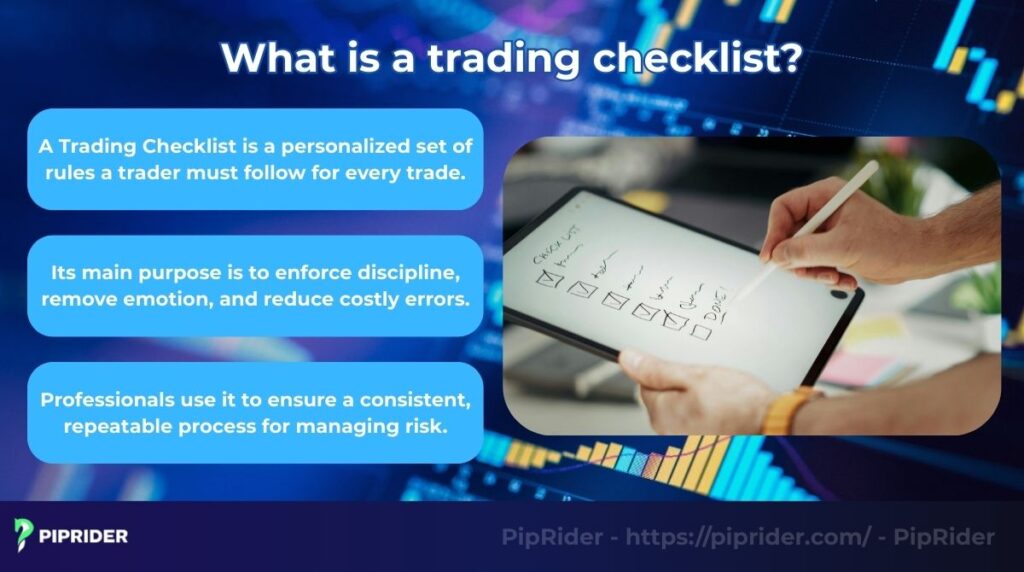
A trading checklist is a trader’s personalized set of criteria that must be met before, during, and after executing a trade. Much like a pilot’s pre-flight checklist, its purpose is to ensure no critical steps are missed and that every action is deliberate and systematic.
Why Every Trader Needs a Checklist?
The benefits of implementing a trading checklist are fundamental to a trader’s success and mental well-being:
- Enforces discipline & consistency: It helps control emotion in trading, such as fear or greed, from the emotional decision-making process. This systematic approach prevents impulsive trades and ensures every position aligns with a well-defined strategy. It cultivates crucial emotional control.
- Boosts confidence: Trading based on a clear plan, rather than gut feeling, builds trust in one’s own decisions, enhancing motivation.
- Reduces errors: By verifying a set of objective rules, a trader avoids common mistakes like forgetting to set stop-loss orders or ignoring key market indicators.
The Professional’s Edge
Professional traders understand that long-term profitability comes from a repeatable process, not from sporadic wins. A trading checklist is the tool that codifies this process. For them, it’s a non-negotiable instrument for professional execution and a robust risk mitigation plan. It’s built upon solid market insight.
2. The Ultimate 10-Step Trading Checklist (Pre, During, and Post-Trade)
A complete 10-step trading checklist must cover three critical phases: Pre-Trade (market analysis, setup validation, and risk definition), During-Trade (active position management), and Post-Trade (journaling and execution review). Here is the ultimate step-by-step process to ensure disciplined trading.
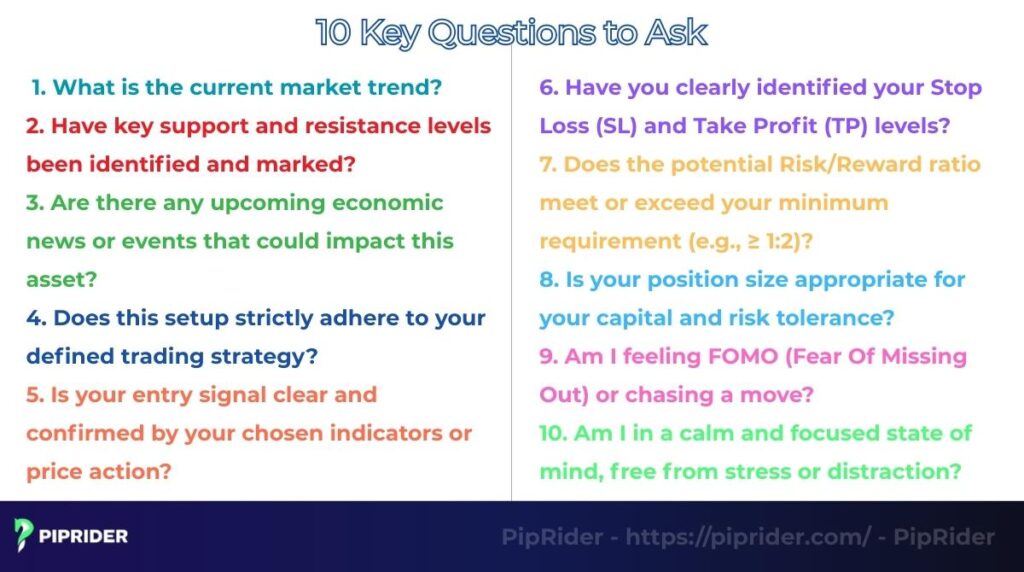
Phase 1: Pre-Trade (Analysis, Setup & Risk)
This phase focuses on assessing the market environment, confirming your setup, and mathematically defining your risk before any capital is deployed.
1. What is the current market trend and context?
Is the market in an uptrend, downtrend, or trading sideways? Understanding the prevailing trend and sector performance helps you trade with the market’s momentum, rather than against it.
2. Have key support and resistance levels been marked?
Knowing these critical price areas helps anticipate potential reversals or breakouts and is fundamental for setting accurate stop-loss and take-profit targets.
3. Are there upcoming economic news events?
Always check the economic calendar. High-impact news releases (e.g., interest rate decisions, CPI data) can cause extreme volatility and instantly invalidate a perfect technical setup.
4. Does the setup strictly adhere to your strategy and provide a clear signal?
Do not “force” a trade. Confirm that price action and your preferred indicators (e.g., RSI crossover, MACD, or a pin bar) precisely match the entry rules outlined in your trading plan.
5. Are your Stop-Loss (SL) and Take-Profit (TP) logically defined?
Before entering, know exactly where you will exit if the trade goes wrong (maximum acceptable loss) and where you aim to secure profits based on market structure.
6. Does the Risk/Reward ratio and position size meet your rules?
Ensure the potential reward is at least twice the potential risk (≥ 1:2). More importantly, verify your position size to ensure you are risking no more than 1-2% of your total account equity on this single setup.
7. Am I in a calm state of mind without FOMO?
Check your emotional state. Are you chasing a missed move out of Fear Of Missing Out (FOMO)? If you are tired, stressed, or revenge-trading, step away from the charts.
Phase 2: During-Trade (Active Management)
Once the execution button is clicked, emotions often spike. This phase keeps you grounded and prevents sabotage.
8. Am I following my trade management rules without micro-managing?
Once you are in the trade, let it breathe. Ask yourself: “Am I tempted to widen my stop-loss because I don’t want to lose?” Strictly follow your predefined plan for trailing stop-losses or taking partial profits, and never widen your initial risk.
Phase 3: Post-Trade (Review & Journaling)
Professional traders know that real growth happens after the trade is closed.
9. Have I logged the trade in my trading journal?
Immediately after the trade closes, record the details: entry price, exit price, position size, and most importantly, save a screenshot of the chart showing your setup and execution.
10. Did I follow my plan regardless of the outcome?
A winning trade where you broke your rules is a bad trade; a losing trade where you followed your plan perfectly is a good trade. Reviewing your execution discipline is the ultimate key to long-term consistency.
3. Sample Trading Checklist
To make it easier to apply these concepts, here is a practical, printable checklist template. You can use this as a starting point and customize it to fit your specific strategy and market. Remember, “If it’s not checked, it’s not a trade.”
| Checklist Item | Yes / No | Notes |
|---|---|---|
| 🚀 PHASE 1: PRE-TRADE (Analysis & Setup) | ||
| 1. Market trend & context confirmed | ☐ | Trading with the momentum (Uptrend/Downtrend/Sideways) |
| 2. Key support & resistance marked | ☐ | Clear levels identified on the chart |
| 3. Economic calendar checked | ☐ | No high-impact news conflicting with the trade |
| 4. Setup matches strategy & signal is clear | ☐ | Strictly adhering to entry rules; no “forcing” a trade |
| 5. Stop-Loss & Take-Profit defined | ☐ | Hard exits set based on technical levels |
| 6. R/R ratio ≥ 1:2 & Position size correct | ☐ | Max 1-2% risk of total account equity |
| 7. Psychology check passed | ☐ | Calm, objective, zero FOMO or revenge trading |
| ⏳ PHASE 2: DURING-TRADE (Management) | ||
| 8. Strict trade management | ☐ | No micro-managing. Never widen the SL. Take partials if planned. |
| 📝 PHASE 3: POST-TRADE (Review) | ||
| 9. Trade logged in journal | ☐ | Recorded entry/exit, sizing, and saved chart screenshot |
| 10. Execution discipline reviewed | ☐ | Did I follow my plan regardless of the financial outcome? |
Feel free to print this table or copy it into a digital format to use before every single trade you execute. This will be a valuable input for your trading diary.
4. Beyond The Entry: Management, Review & No-Trade Rules
Executing a perfect entry using your 10-step checklist is only half the battle. To complete your trading system, you must master trade management, rigorous journaling, and know exactly when to walk away from the screens.
4.1. The During-Trade Checklist (Active Management)
Once your capital is at risk, emotions run high. Run through these 5 checkpoints while the trade is live to prevent self-sabotage:
- Spread & Volatility Check: Are spreads normal and is liquidity sufficient? (Crucial for scalpers to avoid massive slippage upon execution).
- The Absolute Stop-Loss Rule: Is the initial Stop-Loss strictly respected? Never widen your SL to give a losing trade “more room.”
- The “1R” Partial Profit Strategy: Has the trade reached the 1R milestone? Execute your mechanical rule for taking partial profits (e.g., closing 50%) to secure capital and create a risk-free position.
- Logical Trailing Strategy: Is the trailing stop-loss following market structure (e.g., moving under new swing lows) or a dynamic indicator? Never trail randomly based on your floating PnL.
- Mid-Trade News Radar: Are there high-impact news events approaching while you are holding the open position? Proactively decide to either close early or tighten stops.
4.2. The Post-Trade Checklist (The Growth Phase)
Professional traders treat every closed trade—win or lose—as valuable data. After every trade, run through this quick 5-item review:
- Screenshot & Rationalize: Capture a screenshot of the chart showing both the entry and exit points. Document the exact technical or fundamental reasons for your execution.
- Grade Your Execution: Ask the ultimate question: “Did I follow my plan? (Yes/No)”. A winning trade where you broke your rules is a bad trade; a losing trade where you followed your plan perfectly is a good trade.
- Log the Mistakes & Adapt: If you broke a rule, write down the emotional or technical trigger. Then, add one specific item to your pre-trade checklist to act as a roadblock against that same mistake.
- Update Core Statistics: Input the trade into your journal to recalculate your core metrics: current Win Rate, Average R-multiple (e.g., risking 1R to make 2.5R), and Max Drawdown.
- Set “One Improvement”: Based on the week’s data, write down exactly one actionable improvement for the next trading week (e.g., “I will stop moving my SL to break-even too early”).
4.3. The “No-Trade” Rules (Capital Preservation)
Sometimes, the best trade is no trade at all. A professional checklist must include conditions that immediately veto any setup. Do not trade if:
- The 60-Minute News Window: A high-impact economic news release (like NFP, CPI, or a central bank rate decision) is scheduled within the next 30 to 60 minutes. Algorithmic volatility will disrespect technical analysis.
- Abnormal Spread or Low Liquidity: You notice spreads are unusually wide, or the market is in a “dead” session (e.g., the late Asian session for GBP/USD). Low liquidity leads to erratic price action and fakeouts.
- The Emotional Veto (FOMO & Revenge): You are feeling the urge to revenge-trade after a painful loss, or experiencing FOMO after watching a massive candle take off without you. If your heart rate is rising, close the platform.
5. How to Customize Your Trading Checklist
A trading checklist is not a one-size-fits-all solution; it’s a dynamic tool that should evolve with a trader’s experience and adapt to their specific trading environment. Customization is key to making it truly effective for their strategy.
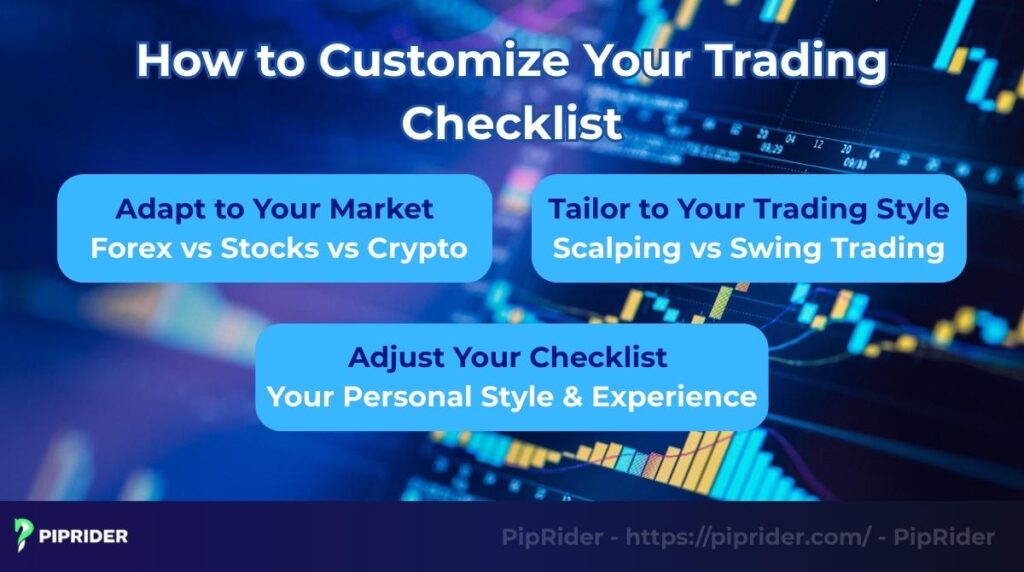
5.1. Adapt to Your Market: Forex vs Stocks vs Crypto
The specifics of a market will influence certain checklist items, particularly in the “Market Analysis” section.
- Forex trading: A trader might emphasize checking for central bank announcements, interest rate decisions, and intermarket forex pair correlations.
- Stocks: Focus on earnings reports, company news, industry trends, and overall stock market indices (e.g., S&P 500), considering industry trends.
- Crypto: Pay attention to blockchain news, regulatory updates, project developments, and social sentiment, as price fluctuations can be extreme. Requires strong market insight.
5.2. Tailor to Your Trading Style: Scalping vs. Swing Trading Templates
A trading checklist is not a one-size-fits-all tool. Your chosen timeframe dictates how much time you have to run through your steps and which factors matter most.
The 2-Minute Scalping Checklist (Speed & Execution)
For ultra-short-term trades, hesitation is fatal. Your checklist must be memorized and executed in under 2 minutes, focusing heavily on immediate momentum and execution costs:
- Spread & Liquidity: Is the spread tight enough for my strategy? (High spreads destroy scalping profitability).
- Micro-Trend Alignment: Are the 1-minute (M1) and 5-minute (M5) charts aligned in momentum?
- The 30-Minute Clear Horizon: Are there absolutely NO high-impact news events in the next 30 minutes?
- Instant SL/TP: Is my 1-click trading enabled with a hard, automatic Stop-Loss preset?
- Session Volume: Is the current trading session highly active (e.g., London or New York overlap)?
The 10-Minute Swing Trading Checklist (Patience & Macro)
Holding trades for days or weeks requires a deeper, more methodical approach. Speed is less important than structural and fundamental alignment:
- Macro Trend Alignment: Does the Daily (D1) or Weekly (W1) chart support this setup?
- Fundamental Catalyst: Is there an underlying economic theme (e.g., central bank divergence) supporting this long-term move?
- ATR-Based Stop-Loss: Is my stop-loss placed safely beyond market noise, using the Average True Range (ATR) to avoid being wicked out?
- Swap Fees & Rollover Risk: Have I calculated the overnight swap fees? Will holding this position over the weekend expose me to excessive gap risk?
- Reward Scaling: Does this setup offer a minimum Risk/Reward ratio of 1:3 to justify the long holding period?
5.3. Adjust Your Checklist to Your Personal Style & Experience
A trader’s checklist is a reflection of their trading journey.
- Start simple: As a beginner, keep it concise (5-7 items) to avoid overwhelming oneself. Focus on the absolute essentials like risk mitigation plan and trend identification. This builds emotional control.
- Add complexity gradually: As a trader gains experience and thrives on continuous learning, they can add more nuanced items, such as specific indicator confluence, advanced technical analysis patterns, or refined exit plan criteria.
- Learn from your trading journal: Regularly review your trading journal. If recurring mistakes are noticed (e.g., forgetting to check news, entering against a major trend), add a specific item to your checklist to address that weakness. A checklist should be a living document that constantly improves decision-making, fueled by drive.
6. Common Mistakes Traders Make Without a Checklist
Without a structured process, traders are highly susceptible to a series of costly, unforced errors. A checklist is specifically designed to prevent these common mistakes:
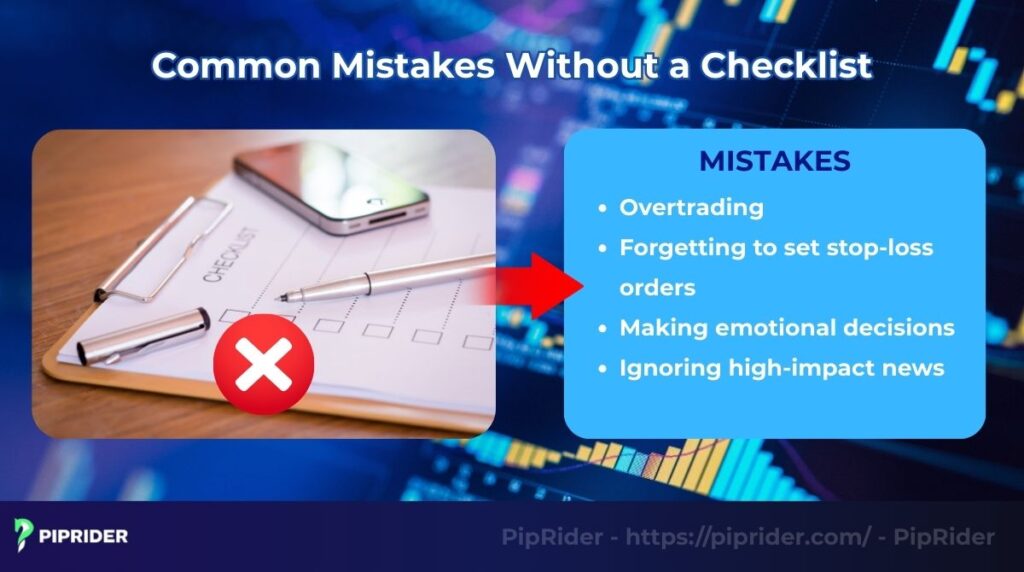
- Overtrading: A checklist forces a trader to wait for high-quality setups that meet all predefined criteria. Without it, the temptation to trade out of boredom or to chase small, insignificant moves can lead to taking too many low-probability trades.
- Forgetting to set stop-loss orders: In the excitement of seeing a setup, it is easy to forget the most critical risk mitigation plan step. A checklist makes setting stop loss orders a mandatory part of the process, ensuring no trade is ever entered without a defined safety net.
- Making emotional decisions: A checklist replaces subjective feelings (“I think the price will go up”) with objective facts (“Does the setup meet my 5 specific rules?”). It acts as a logical barrier against impulsive decisions driven by FOMO or a desire to “win back” a previous loss.
- Ignoring high-impact news: A perfect technical setup can be instantly invalidated by a major economic data release. A checklist item requiring a quick look at the calendar can prevent a trader from unknowingly entering a position just moments before extreme price fluctuations. This requires solid market insight.
7. Frequently Asked Questions (FAQs)
8. Summary: Elevate Your Trading with a Personal Checklist
A trading checklist is far more than just a list of items to tick off; it’s a powerful instrument for instilling emotional control and safeguarding capital through a robust risk mitigation plan.
By consistently applying a checklist before every trade, traders can ensure strict adherence to their defined strategy, effectively mitigate risk, and maintain the discipline required to survive long-term in the markets. It transforms reactive, emotion-based trading into proactive, strategic actions, supported by ongoing education.
To further enhance your trading knowledge and explore more advanced strategies and insights, we invite you to visit the Trading Strategies category on Piprider.