The 1 minute scalping strategy is a high-octane method of fast-paced trading designed to capitalize on the smallest price fluctuations in the Forex market. It’s a game of speed, precision, and discipline, where traders aim to open and close positions in minutes, capturing small but frequent profits.
This guide provides a complete system for navigating this fast-paced environment. While not for the faint of heart, it details the right indicators, market conditions, and concrete entry and exit rules needed for success.
Key Takeaways
- A very short-term retail scalping approach that aims to profit from small price movements (5-10 pips) on the 1-minute chart.
- The strategy typically combines trend-following EMAs (50, 100) with momentum oscillators like the Stochastic or RSI for entry timing.
- It works best during high-liquidity sessions (London/New York overlap) on major Forex pairs with low spreads (e.g., EUR/USD).
- Strict stop-losses and a low risk-per-trade (≤1%) are highly recommended for long-term consistency due to the high volume of trades.
- This strategy demands intense focus, quick decision-making, and strong emotional control; better suited for experienced traders.
1. What Is the 1-Minute Scalping Strategy?
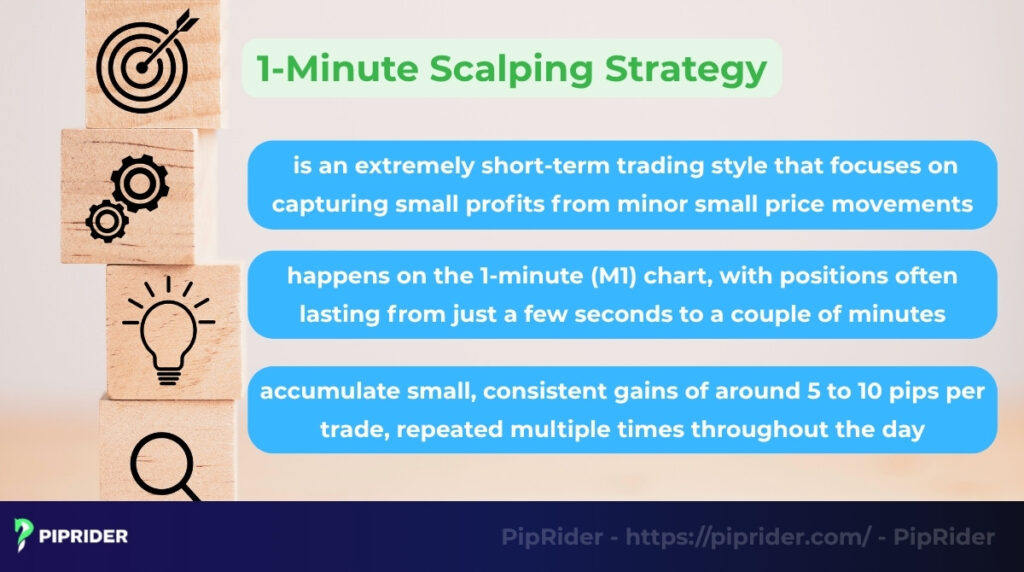
The 1-minute scalping strategy is an extremely short-term trading style that focuses on capturing small profits from minor price movements (Admiral Markets, 2022). As the name suggests, all analysis and trade execution happen on the 1-minute (M1) chart, with positions often lasting from just a few seconds to a couple of minutes.
Instead of aiming for large wins, a scalper’s goal is to accumulate small, consistent gains of around 5 to 10 pips per trade, repeated multiple times throughout the day. This rapid-fire manual trading approach demands lightning-fast reflexes, intense focus, and a trading environment with ultra-low spreads, as transaction costs can quickly erode small profits.
For example, a scalper might see the EUR/USD price tick up from 1.0850 to 1.0858. Their goal is to enter a buy order and exit just moments later to capture a small piece of that move, such as 5 pips of profit. The entire trade is over in less than two minutes, and then they immediately look for the next opportunity.
2. How the 1-Minute Scalping Strategy Works
The 1-minute scalping strategy operates by exploiting micro-trends—tiny, short-lived price movements that last for only a few minutes. It is fundamentally a reactive, not predictive, approach. The objective is to enter the market, capture a small gain from a brief burst of momentum, and exit before the market has a chance to reverse.
Instead of trying to forecast long-term chart patterns, a scalper focuses almost entirely on immediate price action. A trade is typically opened when a specific confluence of signals suggests that a micro-move has enough force to continue for a few more pips. This confirmation usually comes from combining trend filters (like EMAs) with a momentum oscillator (like the Stochastic or RSI).
3. Who Should Use the 1-Minute Scalping Strategy?
This high-speed trading technique is not suitable for everyone. It is best suited for experienced traders who are already proficient with their trading platforms (like MT4 or TradingView) and can execute orders with near-instant precision. The ideal scalper is a decisive, action-oriented individual who thrives under pressure and can dedicate periods of uninterrupted focus to the charts.
Conversely, this strategy is generally not recommended for complete beginners. The extreme speed can be overwhelming, and the constant exposure to market fluctuations requires strong emotional control. Traders who are still working on overcoming anxiety, hesitation, or the urge to “revenge trade” after a loss might find the 1-minute chart counterproductive.
4. Key Components of a Good 1-Minute Scalping Setup
Success in scalping depends heavily on the trading environment. A profitable strategy can fail with the wrong setup. These three components are non-negotiable for anyone serious about the 1-minute scalping strategy.
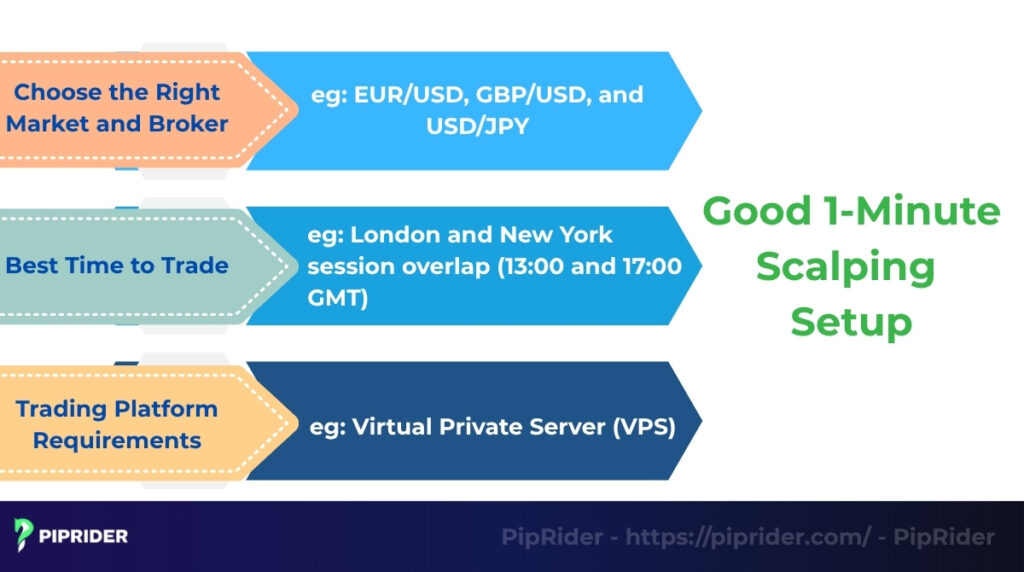
4.1. Choose the Right Market and Broker (The Scalper’s Checklist)
Transaction costs and execution quality are a scalper’s biggest hurdles. The goal is to trade major pairs (like EUR/USD or GBP/USD) where deep liquidity helps maintain ultra-low costs.
Rather than simply looking for a broker labeled as “ECN” or “STP”, terms that are sometimes used loosely in marketing, it is highly recommended to evaluate your broker against this minimum requirements checklist:
- Regulatory Oversight: Before analyzing spreads and latency, it is highly recommended to verify the broker’s legal standing. Trading with an unregulated entity carries significant risk. Understanding how forex broker regulation works can help protect your capital under recognized financial authorities.
- Average Spread (Overlap Hours): Instead of relying on the advertised “minimum spread,” monitor the spread specifically during the London/New York overlap. For a major pair like EUR/USD, a competitive raw account typically prints between 0.0 and 0.2 pips during peak liquidity.
- Commission per Lot: A zero-pip spread is counterproductive if the commission is exorbitant. Factoring in your total round-turn cost (typically around $6 to $7 per standard lot) is vital to ensure your net profit targets remain viable.
- Execution Latency: Aim for a broker setup that provides deep liquidity with minimal latency (ideally under 50 milliseconds). Many professional scalpers consider using a Virtual Private Server (VPS) to reduce ping and maintain uninterrupted uptime. However, keep in mind that a VPS only stabilizes your connection; it cannot compensate for a broker’s inherently slow execution or poor liquidity.
- Slippage Behavior: Observe how the broker fills market orders during minor volatility spikes. While slippage around major news events is expected, consistent negative slippage during standard trend momentum can quickly erode a scalping edge.
- Scalping Restrictions (Minimum Hold Time): This is a critical administrative check. It is strongly advised to review the broker’s Terms of Service. Some retail brokers explicitly prohibit very short-term scalping or require trades to remain open for a minimum duration (e.g., 2-3 minutes) before they can be closed.
4.2. Best Time to Trade
A scalper needs volatility and liquidity, which are highest when major market sessions overlap.
- Optimal trading window: The most active period is the London and New York session overlap, typically occurring between 13:00 and 17:00 GMT, which is widely recognized as the period of maximum liquidity and volatility (Investopedia, 2023). Because these hours shift with Daylight Saving Time (DST), it is highly recommended to verify the exact overlap using your platform’s session clock. During this window, volatility and liquidity are at their peak. Since Spot Forex is a decentralized over-the-counter (OTC) market, this deep liquidity, driven by high tick activity rather than centralized volume, creates the ideal momentum for scalping (Bank for International Settlements, 2025).
- Avoid news: It is crucial to monitor the economic calendar and avoid trading around high-impact news releases. Major news can cause extreme, unpredictable volatility and spread widening, which is a scalper’s worst nightmare.
4.3. Trading Platform Requirements
Speed is everything in micro scalping trading. Any delay can turn a winner into a loser.
- Fast execution speed: Prioritize brokers that offer near-instant order execution. In a 1-minute environment, a delay of even half a second can result in significant slippage, potentially pushing your entry price out of the profitable zone before the order is even filled.
- Reliable connection: A high-speed, stable internet connection is highly critical. Many serious scalpers use a Virtual Private Server (VPS) to co-locate their trading platform with their broker’s servers, ensuring the fastest possible connection and minimizing latency.
5. Best Indicators for the 1-Minute Scalping Strategy
A practical forex scalping trading strategy relies on a clean, fast, and effective combination of indicators. The goal is not to clutter the chart but to use a few specific technical analysis tools that work together to identify trend, momentum, and entry timing. This classic combination is a strong starting point.
5.1. Exponential Moving Averages (EMA 50 & EMA 100)
The foundation of this strategy is a pair of EMAs to define the overall trend direction on the 1-minute chart. These act as a directional filter, helping scalpers align their trades with the dominant micro-trend.
- Function: Identify the primary trend direction.
- Rule: When the EMA 50 is above the EMA 100, the trend is considered bullish, and traders should focus on buy setups. When the EMA 50 is below the EMA 100, the trend is bearish, signaling a focus on sell setups.
5.2. Stochastic Oscillator (5, 3, 3)
The Stochastic Oscillator is the primary entry tool. As a momentum oscillator, it helps pinpoint moments when the market is “oversold” within an uptrend or “overbought” within a downtrend, providing high-probability entry points during a pullback. This is widely considered a highly effective indicator for timing micro-entries.
- Function: Identify optimal entry points during pullbacks.
- Rule: In an uptrend, look for buy setups when the Stochastic crosses up from the oversold level (below 20). In a downtrend, look for sell setups when it crosses down from the overbought level (above 80).
5.3. Alternative and Confirmation Indicators
While EMA and Stochastic form the core, many scalpers add a third indicator for confirmation to filter out false signals.
- The Relative Strength Index (RSI) can confirm momentum, with readings above 50 supporting buys and below 50 supporting sells.
- The MACD indicator can be used to gauge the trend’s momentum. A bullish MACD cross reinforces a buy signal from the main strategy.
- Volatility bands like Bollinger Bands or Keltner Channels help identify market phases, distinguishing between quiet periods (bands contract) and potential momentum bursts (bands expand).
- The Volume Weighted Average Price (VWAP) acts as a dynamic level of support and resistance. (Note: Since Spot Forex lacks centralized volume, VWAP on FX pairs relies on a tick volume proxy. It is most reliable on high-liquidity assets like indices or when using futures data feeds).
6. How to Trade the 1-Minute Scalping Strategy (Step-by-Step)
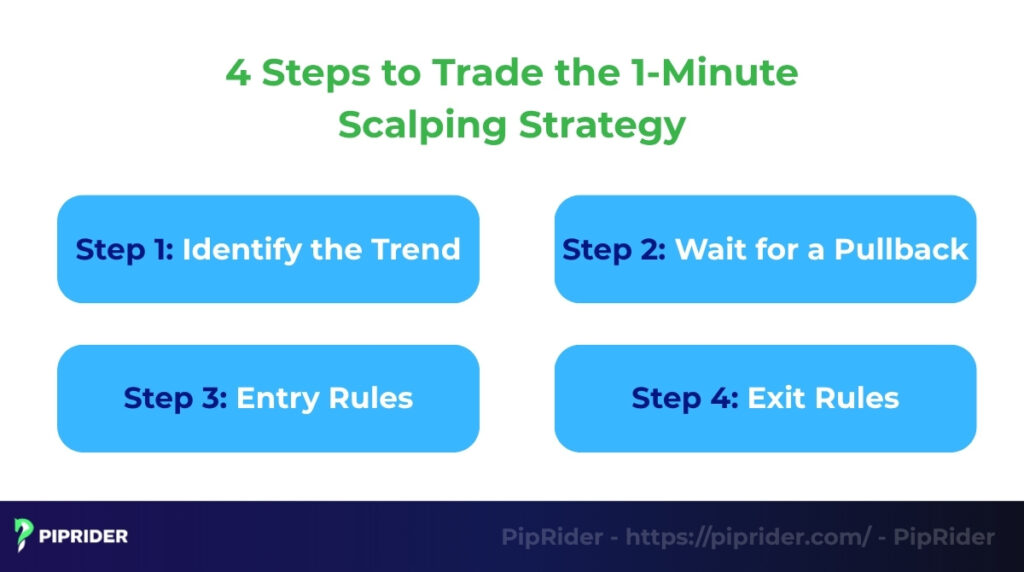
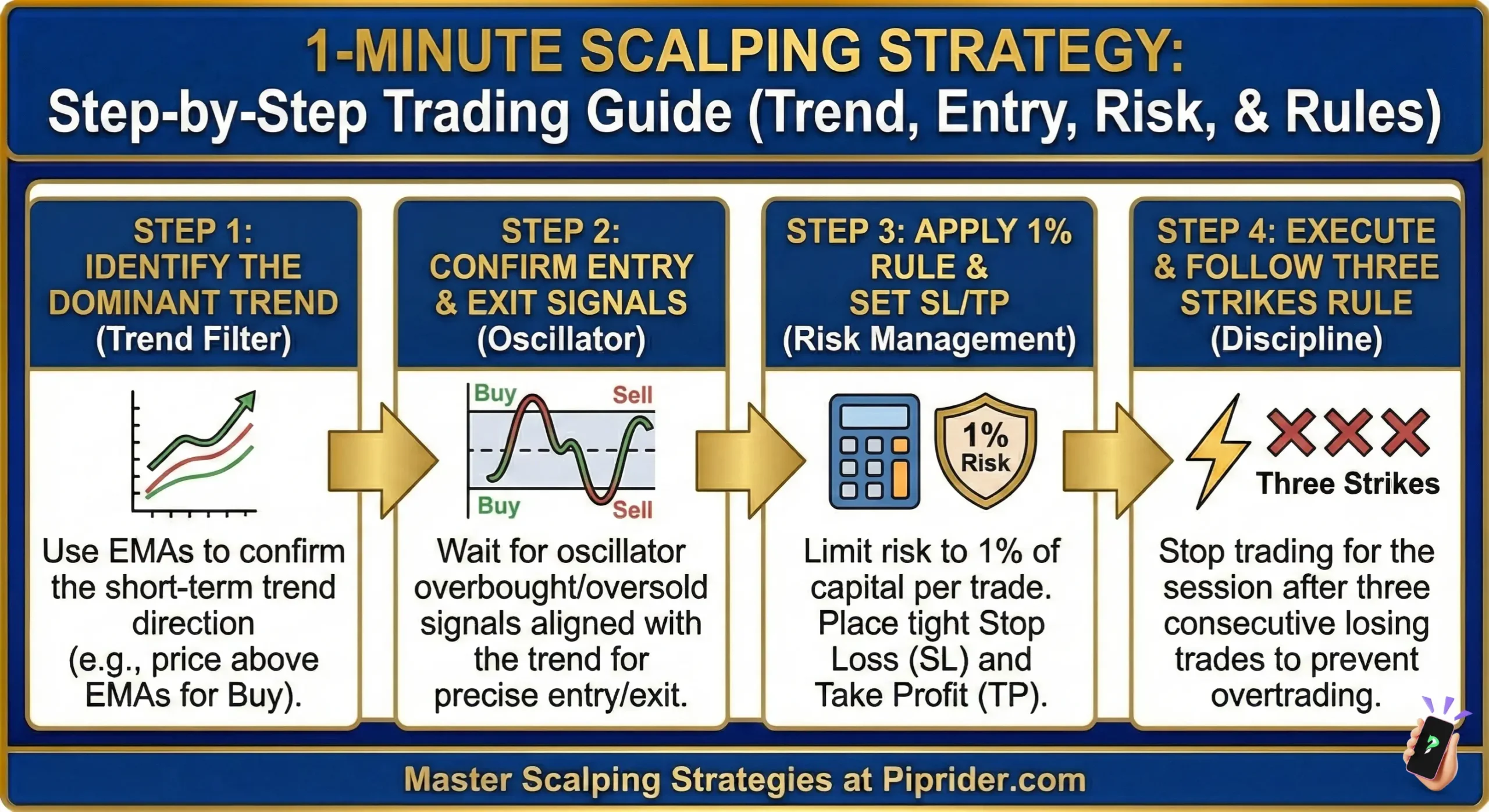
This forex scalping strategy is a rule-based system that combines trend, momentum, and price action. Consistently applying these four steps can help you maintain discipline and avoid impulsive decisions.
6.1. Step 1: Identify the Trend
First, observe your two Exponential Moving Averages (EMAs) to gauge the current micro-trend direction. This acts as your directional filter; it is highly recommended to align your trades with this dominant momentum.
- Uptrend: The EMA 50 is above the EMA 100. Focus primarily on BUY opportunities.
- Downtrend: The EMA 50 is below the EMA 100. Focus primarily on SELL opportunities.
6.2. Step 2: Wait for a Pullback
Once the trend is identified, avoid chasing the price. Wait patiently for a temporary pullback into the “value area” between the two EMAs, which often provides a better entry price. The Stochastic Oscillator helps identify these opportunities.
- In an Uptrend: Wait for the price to pull back towards the EMA zone and for the Stochastic to move into the oversold area (below 20). A cross-check with the RSI nearing the 50 level can add confirmation.
- In a Downtrend: Wait for the price to rally towards the EMA zone and for the Stochastic to move into the overbought area (above 80).
6.3. Step 3: Entry Rules
An entry setup takes shape when the pullback shows signs of exhaustion and momentum returns in the direction of the trend, ideally confirmed by immediate price action.
Buy Setup:
- The EMA 50 is above the EMA 100.
- The Stochastic crosses up and out of the oversold (20) level.
- A bullish confirmation candle forms. (Optional: A bullish MACD crossover can be used as an extra layer of confirmation).
Sell Setup:
- The EMA 50 is below the EMA 100.
- The Stochastic crosses down and out of the overbought (80) level.
- A bearish confirmation candle forms.
6.4. Step 4: Exit Rules (Dynamic & Structure-Based)
Exits in scalping should be mechanical and unemotional, but they also need to adapt to current market conditions. Relying on rigid “fixed pips” can be a trap; instead, experienced traders often use market structure and volatility to define their exits.
- Stop Loss (SL) with Spread Buffer: Instead of a random pip count, consider placing your stop loss just outside the recent market structure, such as below the low of the entry candle or the recent swing low (for a buy setup). Pro Tip: It is highly recommended to add a small “spread buffer” (e.g., 1-2 pips) to this structural level to help avoid being prematurely stopped out by normal spread fluctuations.
- Take Profit (TP): A practical approach is to target the next logical liquidity zone, such as recent structural highs or lows. Ideally, your projected take profit should aim to offer a Risk-to-Reward (R:R) ratio of at least 1:1.5.
- The Volatility Filter (The ATR Rule): Before entering, checking a volatility tool like the 1-minute Average True Range (ATR) can be invaluable. If the ATR is unusually low (indicating a flat market), the potential price movement may not be large enough to comfortably cover your broker’s spread and commission. If the net profit potential doesn’t justify the risk, it’s often best to skip the trade.
7. Example Trade: EUR/USD 1-Minute Scalping
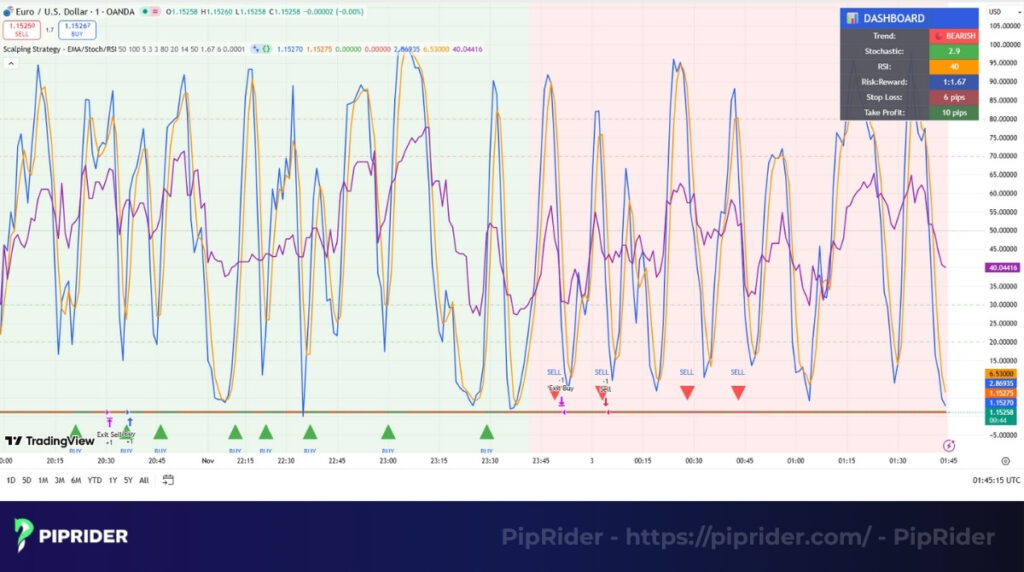
Let’s walk through a hypothetical buy trade on the EUR/USD 1-minute chart to see how this strategy works in practice, incorporating the structure-based rules discussed above.
Setup:
- Indicators: EMA (50/100), Stochastic Oscillator (5, 3, 3), RSI (14).
- Trend: The EMA 50 is trading above the EMA 100, indicating a bullish micro-trend. Buy setups are the primary focus.
Trade Execution:
- Pullback: The price pulls back toward the EMA 50 value area, and the Stochastic Oscillator drops below the 20 level, signaling an oversold condition. The RSI also dips near the 50 level, suggesting a pause in momentum rather than a full reversal.
- Entry: The Stochastic then crosses back up above the 20 line, and a small bullish confirmation candle forms. A trader enters a Buy order at 1.0860.
Exit Plan (Structure-Based):
- Stop Loss (SL): The most recent structural swing low sits at 1.0855. Applying a practical spread buffer, the trader subtracts 1 pip and places the stop loss at 1.0854 (a 6-pip gross risk).
- Take Profit (TP): Targeting the next logical liquidity zone (such as a recent structural high), the take profit is set at 1.0870 (a 10-pip gross reward).
Outcome & Management:
- The gross Risk-to-Reward (R:R) ratio for this trade is approximately 1:1.67 (Note: Factoring in the hidden costs discussed in the Scalper’s Math section, the net R:R remains viable).
- As a dynamic management approach, if the price fails to show positive momentum within a few minutes (e.g., the price stalls near the EMA 50 or the Stochastic quickly crosses back down before reaching the overbought zone), the trader might opt to close the position manually at break-even or a smaller profit to protect capital.
8. Importance of Risk Management in Scalping
In high-frequency scalping, risk management rules are more important than entry signals. Because of the constant market exposure, a single period of undisciplined trading can wipe out dozens of wins.
- Stick to the 1% rule: A widely accepted best practice in professional trading is to cap your risk at 1% of your account balance on a single trade (Elder, 1993). This helps protect your capital during inevitable losing streaks.
- Implement a “three strikes” rule: Stop trading for the day after three consecutive losing trades. This circuit breaker prevents emotional spirals.
- Avoid the urge to ‘revenge trade’: After a trade loss, the urge to immediately jump back in to “win it back” is strong. Respect the rules and wait for the next valid setup.
- Keep a detailed trading journal: Log every trade, including entry/exit points, RR, and win rate. Reviewing your journal weekly helps identify weaknesses and improve performance. A good journal will track which market conditions are most profitable.
Scalper’s Math: The “Hidden Cost” Reality Check
When scalping, your gross Risk-to-Reward (R:R) is often an illusion. Here is what happens when you factor in a typical RAW account cost (e.g., 0.5 pip spread + $6 round-turn commission ≈ 1.1 pips total cost):
- The Setup: Gross Target = 10 pips. Gross Stop Loss = 6 pips (Gross R:R ≈ 1:1.6).
- Net Target (After Costs): 10 pips – 1.1 pips = 8.9 pips of actual profit.
- Net Risk (After Costs): 6 pips + 1.1 pips = 7.1 pips of actual loss.
- The Reality: Your true Net R:R shrinks to 1:1.25. To simply break even, your trading system must maintain a minimum win rate of ~44%, emphasizing why high-probability setups are non-negotiable.
9. Pros and Cons of the 1-Minute Scalping Strategy
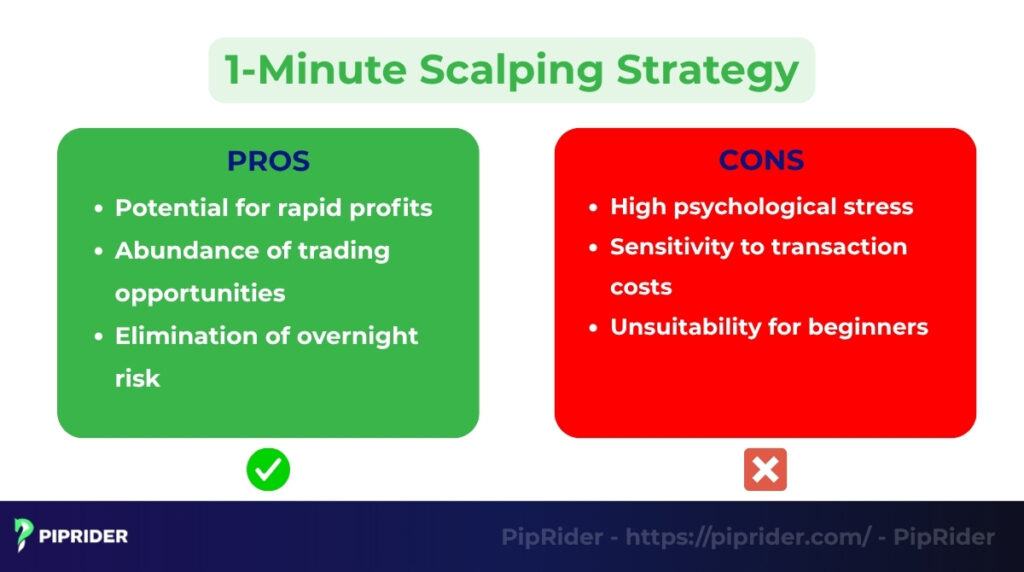
Like all types of short-term trading, the 1-minute strategy comes with a unique set of advantages and significant drawbacks.
9.1. Pros
The primary appeal of this fast-paced approach lies in its potential for quick trade resolutions and constant market engagement.
- Frequent trading opportunities: The 1-minute chart provides numerous setups daily, allowing active traders to capitalize on minor price fluctuations, especially during peak liquidity hours.
- Elimination of overnight risk: Since positions are typically closed within minutes, traders avoid exposure to unpredictable overnight price gaps and daily swap (rollover) fees.
- Reduced market exposure time: A scalper’s capital is at risk in the live market for a very short duration compared to swing trading.
9.2. Cons
However, this high-frequency approach comes with strict technical demands and often underestimated risks.
- High psychological stress: This demanding style requires intense focus and rapid decision-making, which can be mentally exhausting over long trading sessions.
- Sensitivity to transaction costs: As highlighted in the Scalper’s Math concept, spreads and commissions heavily impact the bottom line. A 1-pip spread can easily consume 10-20% of a target move, making true ECN/RAW conditions mandatory.
- Steep learning curve: This strategy is generally not recommended for new traders. It requires precise platform execution and strict emotional control to navigate constant market noise without falling into the trap of overtrading.
10. Frequently asked questions about 1 Minute Scalping Strategy
11. The Bottom Line
The 1-minute scalping strategy can be a highly effective method for disciplined traders who possess the speed, focus, and strict risk controls required to succeed. While the concept of forex scalping often attracts traders with the promise of fast profits, long-term success isn’t about the quantity of trades but the precision and consistency of their execution.
Before attempting this strategy with real capital, it is strongly advised to practice extensively on a demo account or with micro-lots. Master the mechanics, test your emotional discipline, and prove profitability on a small scale before you even consider scaling up.
To discover more powerful Trading Strategies, be sure to follow Piprider. If you have any questions about this strategy, leave them in the comments below!
Infographic Section
-

Pros Cons and Market Conditions -

Rapid Trading on the 1-minute Timeframe -
Step-by-step Trading Guide