Volume precedes price—but only if you know how to read it. The Accumulation/Distribution (A/D) indicator is your window into hidden institutional pressure, revealing whether “smart money” is quietly loading up or dumping positions before a major move.
The Reality Check: A/D is not a magic bullet. It can lag and produce false signals in low-volume, sideways markets. To win, you must use it as a professional-grade confirmation tool, never as a standalone signal.
In this guide, PipRider breaks down the institutional logic and exact strategies needed to turn the A/D line into your decisive trading edge.
Key Takeaways
- Tracks cumulative volume to gauge underlying buying (accumulation) or selling (distribution) pressure.
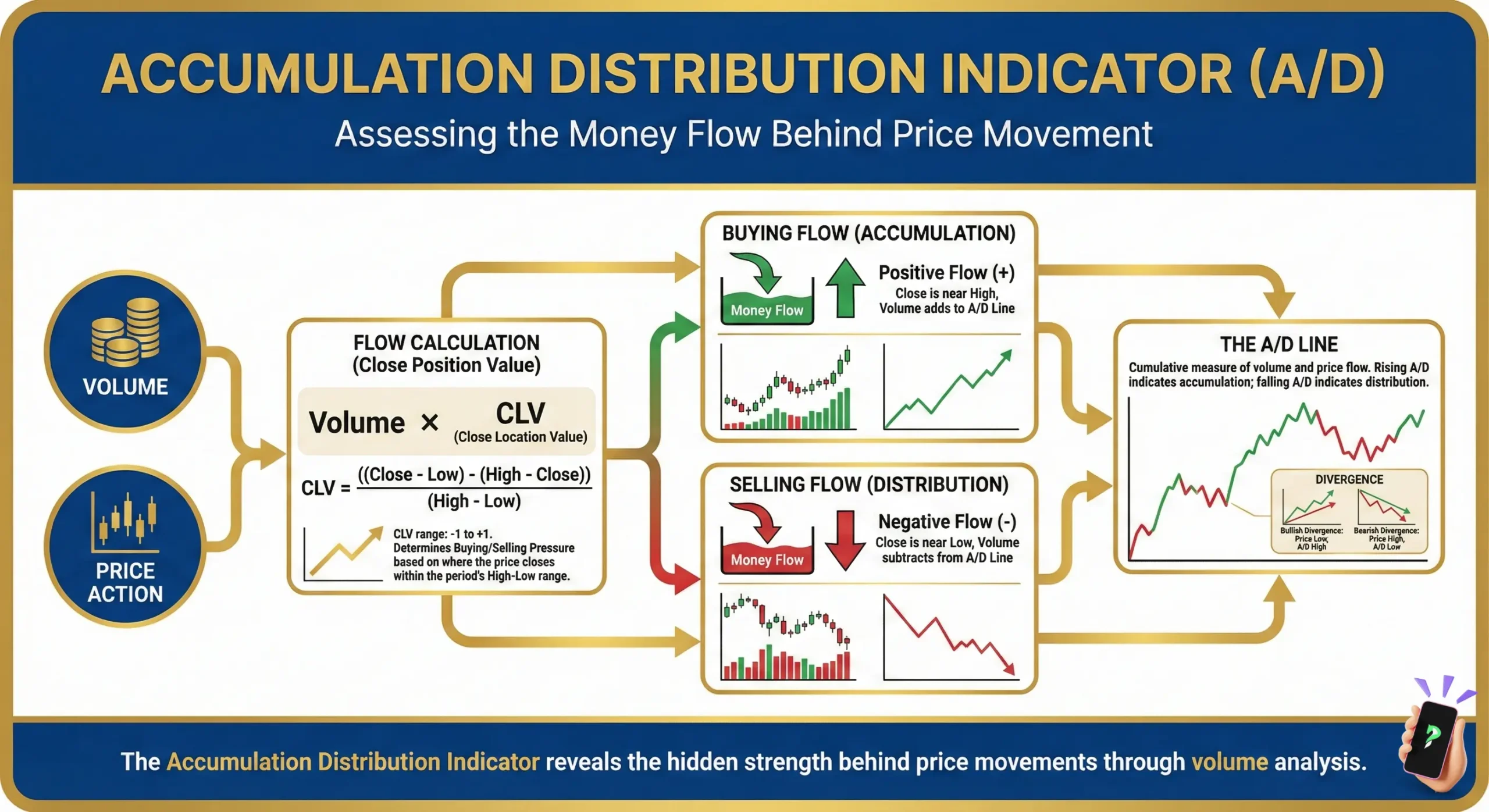
- Calculates flow based on the close within the session’s high-low range, weighted by volume.
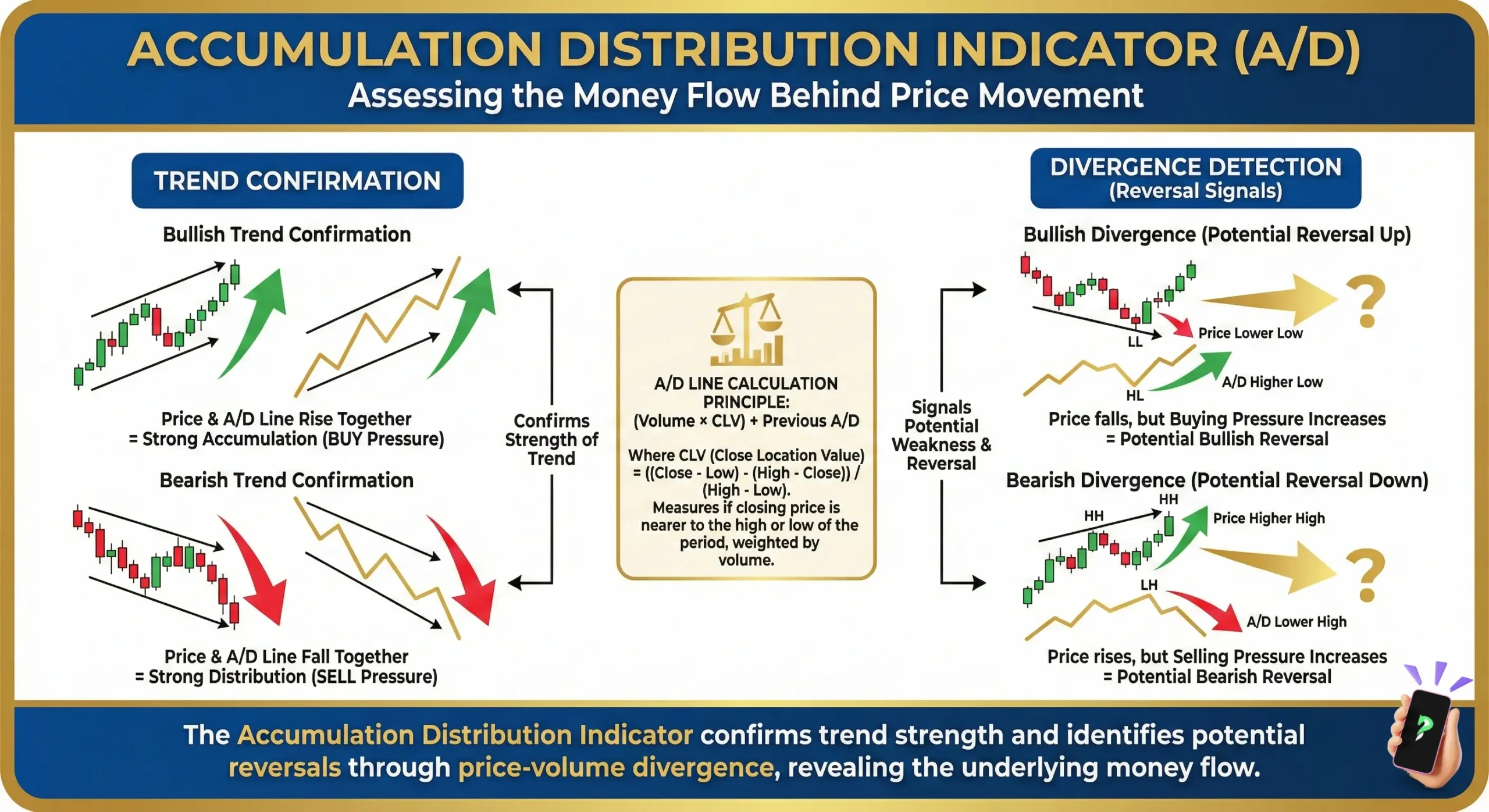
- A rising A/D line supports an uptrend’s health; a falling line confirms downtrend pressure.
- Its main strength is identifying divergence (price vs. A/D moves), signaling potential reversals early.
- Ignores price gaps, which can sometimes distort the money flow reading.
1. What is the accumulation distribution indicator?
The Accumulation Distribution (A/D) Indicator is a volume-based technical tool designed to measure the underlying buying and selling pressure in a market. Developed by Marc Chaikin (StockCharts.com, n.d.), it goes beyond simple price action by incorporating volume to gauge whether an asset is being accumulated (bought) or distributed (sold), particularly by institutional players.
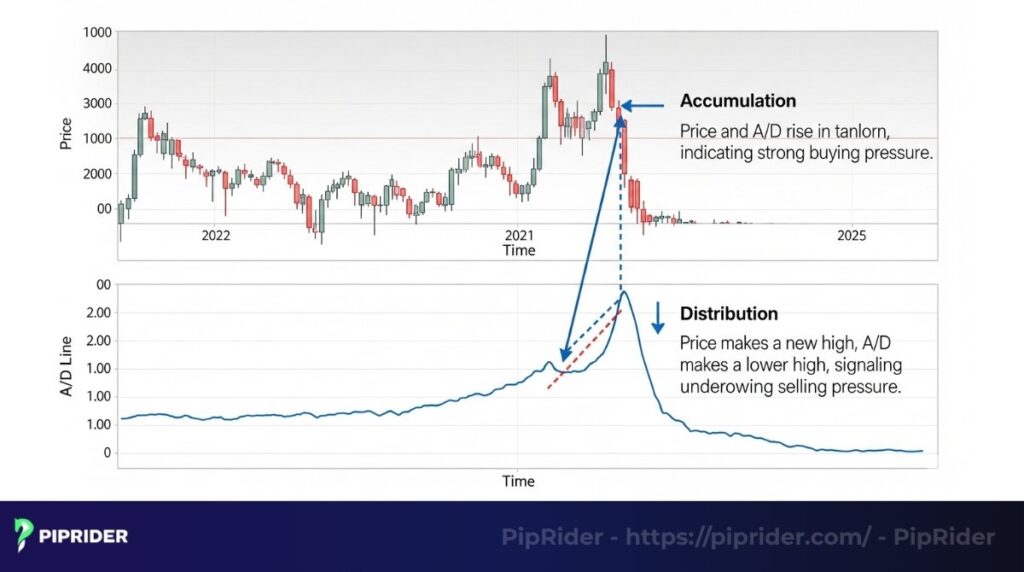
Essentially, the A/D line helps traders see the conviction behind price moves. A rising line suggests strong buying pressure (accumulation), while a falling line indicates selling pressure (distribution).
- Accumulation: This is the act of buying, but not just any buying. It’s the smart money building a position, often quietly, without causing a massive price spike. The A/D line rises when it detects this. This is a strong sign that institutional capital is flowing into the asset.
- Distribution: This is when those same large players begin to sell off their holdings. They might sell into a rising price to maximize profit, a subtle action that the A/D line is designed to detect, often before the price turns.
Think of it as seeing the powerful current beneath the ocean’s surface. Price tells you where the market has been, but the A/D line tells you about the force driving it.
1.1. The Trader’s Edge: Why A/D Beats Standard Tools
Most retail traders rely on standard volume bars and price oscillators (like RSI or MACD). Here is exactly why the Accumulation/Distribution line provides a superior institutional edge:
- The Flaw in Standard Volume: A traditional volume bar is colored green simply if today’s close is higher than yesterday’s. It completely ignores what happened during the trading session.
- The Flaw in Oscillators: Tools like RSI only measure the speed of price changes. They do not factor in the actual money (volume) driving that price.
- The A/D Edge (Revealing Hidden Motives): The A/D formula multiplies volume by the intraday close position (where the price closed relative to its own high and low for that specific day).
- The Practical Example: Imagine a stock gaps up at the open, hits a new high, but then faces massive institutional selling, forcing it to close at the absolute bottom of its daily range (forming a Shooting Star candle). Standard volume will often print a deceptive, massive “green” bar because the close is still technically higher than yesterday. The A/D line, however, immediately registers this heavy volume as Distribution (selling) because the close was at the intraday low. It exposes the smart money offloading their positions.
2. The formula that powers the A/D indicator
You’ll never need to calculate this manually; your charting software does it instantly. But the real edge comes from understanding the why behind the calculation, a step that separates a casual chart reader from a serious analyst.
Step 1: Calculate the money flow multiplier
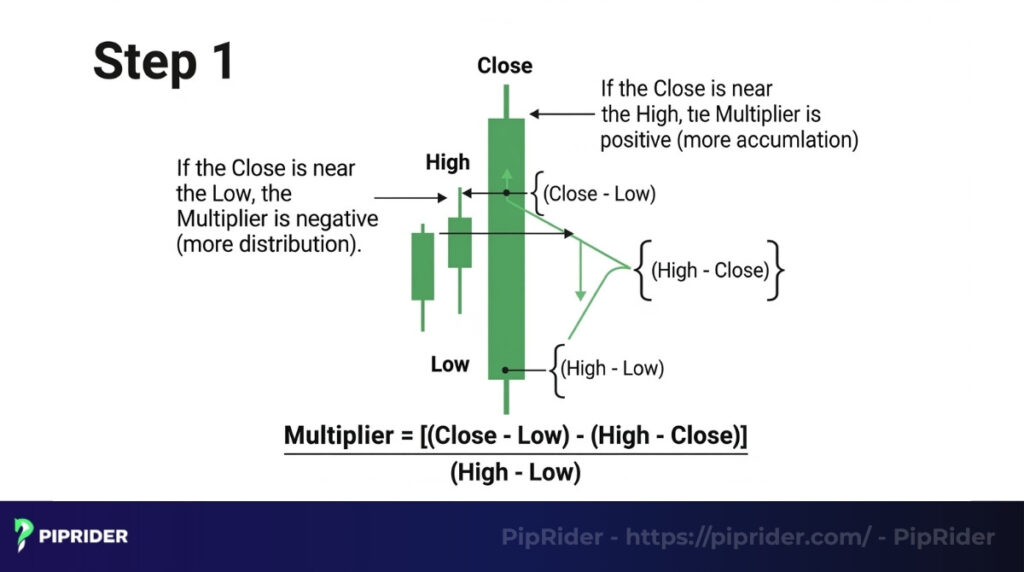
This first step is the engine of the indicator. It asks a simple question: “Where did the price close relative to its range for the day?”
Multiplier = [(Close – Low) – (High – Close)] / (High – Low)
If the stock closes near its high, the multiplier will be positive. If it closes near its low, it will be negative. A close right in the middle results in a zero. It’s a brilliant way to quantify a session’s buying or selling pressure.
Step 2: Determine the money flow volume
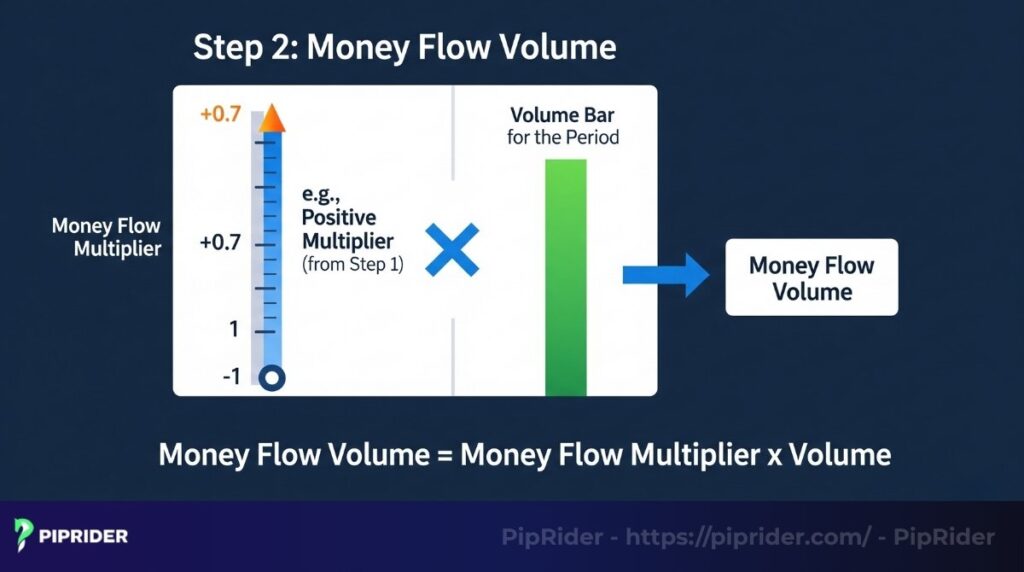
This step connects the pressure reading from Step 1 to the session’s actual volume. A high-conviction day (a strong close with high volume) will have a much greater impact than a low-conviction day. The calculation is:
Money Flow Volume = Money Flow Multiplier x Volume for the Period
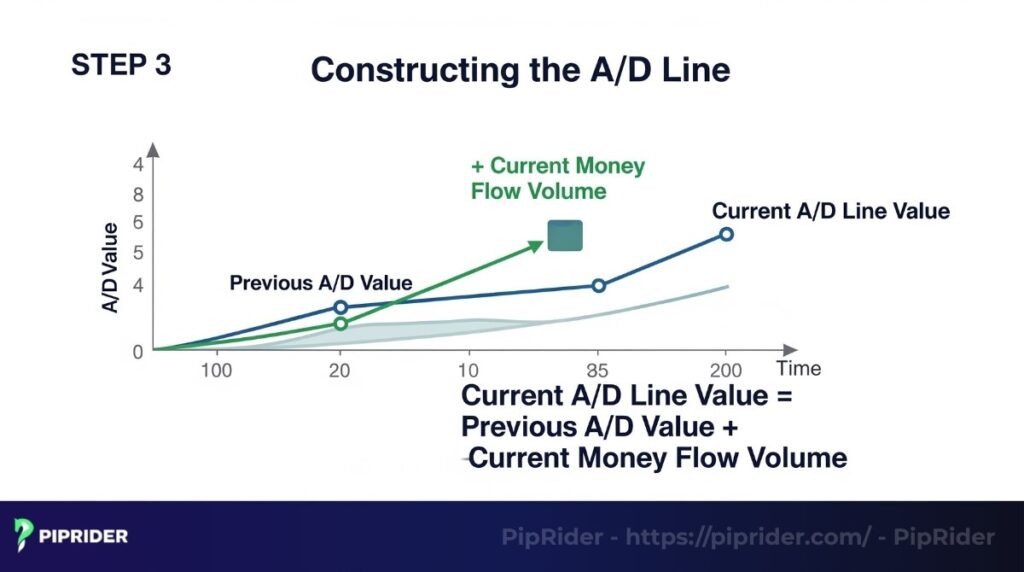
Step 3: Construct the A/D line
Finally, the A/D line itself is just a cumulative total of the Money Flow Volume, creating a running tally that shows the overall trend of money flow over time. The line is formed using this logic:
Current A/D Line Value = Previous A/D Value + Current Money Flow Volume
3. Why the A/D Indicator Works: The Institutional Logic
The A/D line is not just a lagging squiggly line; it is a high-definition window into the “Smart Money” footprints. Here is the core philosophy that makes it work:
3.1. Volume Precedes Price
In the world of institutional trading, “Big Money” cannot enter or exit the market instantly without causing a massive, unfavorable price spike.
- The Logic: Institutions must buy or sell in small blocks over days or weeks. This “quiet” activity often doesn’t move the price much initially, but it always shows up in the volume data.
- The Result: The A/D line begins to trend up (Accumulation) or down (Distribution) before the actual price breakout occurs. Volume is the fuel; price is the car. The fuel gauge moves first.
3.2. Tracking the “Smart Money” Footprints
Retail traders often get fooled by “Green Candles.” They see a stock gap up and rush to buy.
- The Logic: Smart money uses retail FOMO to sell. They might let the price stay green for the day, but they aggressively sell into that strength, forcing the price to close near the bottom of its intraday range.
- The Result: While the price chart looks “Bullish” (green candle), the A/D formula detects the weak close on high volume and turns down. It strips away the “mask” of the price candle to reveal the institutional reality.
3.3. Divergence: The Hidden Shift in Structure
Divergence is the ultimate “tell” in the market. It represents a decoupling between what the public sees (Price) and what the giants are doing (Volume).
- The Logic: When the price makes a new high, but the A/D line makes a lower high, it means the rally is being fueled by fewer and fewer “real” buyers. The “Smart Money” has already left the building.
- The Result: This hidden shift is the first warning of a structural collapse. Divergence isn’t just a signal; it’s a Vulnerability Report on the current trend.
3.4. The A/D Reading Matrix: A Quick Interpretation Guide
To read the A/D line like a professional, you must look at the relationship between the indicator and the price action simultaneously. Use this matrix as your primary filter:
| Price Action | A/D Line Movement | Interpretation (The Truth) |
|---|---|---|
| Rising | Rising | Strong Trend: Volume is actively confirming the move. A healthy uptrend. |
| Flat / Sideways | Rising | Accumulation: Smart money is quietly buying while price stays cheap. Expect a breakout. |
| Rising | Falling | Bearish Divergence: The rally is a “trap” fueled by retail FOMO. Institutions are selling into strength. |
| Falling | Falling | Strong Downtrend: Aggressive selling pressure is confirmed. No signs of a bottom yet. |
| Flat / Sideways | Falling | Distribution: Institutions are offloading positions without crashing the price yet. Expect a breakdown. |
| Falling | Rising | Bullish Divergence: Panic selling is being absorbed by heavy institutional buying. A reversal is imminent. |
4. Applying the A/D Indicator: Practical Strategies
An indicator is only as powerful as the rules that govern its use. To avoid “analysis paralysis,” you must define a specific logical filter—a set of “if-then” conditions that dictate exactly when to trust the A/D line and when to bench it. Use the following framework to transition from theory to professional execution.
4.1. The A/D Rules of Engagement (The Operational Filter)
Before executing a single trade, you must define your “operational boundaries.” Just as a pilot checks weather conditions before takeoff, a trader must verify the liquidity and noise levels of the market to ensure the A/D data is actually reliable.
- The Best Markets: A/D is highly effective in centralized markets like Stocks and Indices (e.g., S&P 500). In Forex, ensure you use a top-tier broker with a high-liquidity data feed so that “tick volume” remains a reliable proxy for institutional flow.
- The Best Timeframes: Stick to the Daily (D1) and 4-Hour (H4) charts. On lower timeframes (5m, 15m), intraday noise distorts the money flow, generating constant false signals that will bleed your account.
- When to IGNORE it: Turn the indicator off during tight, sideways consolidation. Also, ignore A/D immediately after a massive price “Gap.” Because the formula focuses on the intraday range, gaps create empty space that severely distorts the cumulative reading (Murphy, J. J., Technical Analysis of the Financial Markets, 1999).
4.2. Strategy 1: The Institutional Breakout (Volatility Play)
Breakouts are the primary source of retail losses because most are “volume-less” traps designed to hunt liquidity. To trade a breakout successfully, you need objective proof that “Whales” are the ones sponsoring the move, not just a temporary spike in retail FOMO.
- The Setup: As price breaks a major resistance level, the A/D line must show a sharp, aggressive spike to a new high. This confirms that massive capital is being committed to the new direction.
- Entry Trigger: Enter at the close of the breakout candle or on the first successful re-test of the broken level (the “Flip” zone).
- The “Avoid” Filter: If the price breaks the level but the A/D line remains flat or declines, do not enter. This is a “hollow” breakout, likely to result in a rapid reversal (a Bull Trap).
- Invalidation (Stop-Loss): Place your stop-loss strictly below the breakout candle’s low or the re-test wick.
4.3. Strategy 2: The Reversal Hunter (Structural Divergence)
Catching a “falling knife” is a recipe for disaster unless you have a window into institutional accumulation. Reversal strategies using A/D focus on finding the exact moment when the public is panicking (price dropping) while the “Smart Money” is quietly absorbing those sell orders.
- The Setup: Price makes a lower low at a major Support zone, but the A/D line stubbornly forms a higher low (Bullish Divergence). This decoupling proves the selling pressure is exhausted.
- Entry Trigger: Do not enter on the divergence alone. Wait for a definitive momentum shift—a strong confirmation candle (e.g., a Pin Bar or Bullish Engulfing) to close off the structural level.
- Invalidation (Stop-Loss): Place your stop-loss exactly 1 ATR (Average True Range) below the absolute low of the divergence wick.
- Target: Aim for the previous major structural high. This setup allows for a high 1:3 Risk-to-Reward ratio.
4.4. Strategy 3: Trend Confirmation (Momentum Continuation)
In a mature trend, the biggest risk is buying the “last gasp” of momentum. Trend confirmation ensures that you are only entering pullbacks when the institutional “fuel tank” is still full. It keeps you on the right side of the trend until the very last moment.
- The Setup: During an established uptrend, every new price peak must be accompanied by a new A/D high. This confirms that the “Sponsorship” of the move is still active.
- Entry Trigger: Look for a minor price pullback to a key Moving Average or structural support. Enter when price resumes the trend and the A/D line remains resiliently high or breaks to new highs.
- The “Avoid” Filter: Immediately abort or tighten stops if price hits a new high but the A/D line fails to follow. This “hidden weakness” is the primary warning of a macro trend collapse.
4.5. Divergence Masterclass: Trading the Hidden Signals
Divergence is the most potent signal in the A/D arsenal, but most retail traders fail because they don’t distinguish between a “Trend Reversal” and a “Trend Continuation.” To trade safely, you must master the three types of divergence and apply a strict safety protocol to filter out the noise.
4.5.1. Regular vs. Hidden Divergence
- Regular Divergence (The Reversal Signal): Used to identify the exhaustion of an existing trend.
- Bullish: Price makes a Lower Low, but A/D makes a Higher Low.
- Bearish: Price makes a Higher High, but A/D makes a Lower High.
- Hidden Divergence (The Continuation Secret): This is the “pro-level” signal. It suggests that the current trend is merely resting and is about to resume with increased force.
- Hidden Bullish: Price makes a Higher Low (a healthy pullback), but the A/D line makes a Lower Low. This proves that smart money is aggressively “buying the dip” even if the price hasn’t dropped significantly.
- Hidden Bearish: Price makes a Lower High, but the A/D line makes a Higher High. This indicates institutions are “re-loading” short positions during a minor relief rally.
4.5.2. Beware of the False Divergence (The Volume Trap)
A divergence can persist for a surprisingly long time. If retail FOMO is strong enough, the price can continue trending despite institutional selling.
- The Trap: Price continues to trend despite a glaring divergence, hitting your stop-loss before the reversal finally happens.
- Why it happens: This typically occurs during “Parabolic” moves or high-impact news events where raw emotion temporarily overrides volume logic.
4.5.3. How to Trade A/D Divergence Safely (The 3 Golden Rules)
To avoid the “Volume Trap,” never treat a divergence as a blind entry signal. Every setup must pass this 3-step Safety Protocol:
- Rule 1: No Standalone Trades. A divergence is a “warning,” not a “trigger.” It tells you what might happen, but it does not tell you when.
- Rule 2: The Structural Anchor (S/R). Only take a divergence trade if it occurs exactly at a major, higher-timeframe Support or Resistance zone. A divergence in the “middle of nowhere” on your chart is usually just noise.
- Rule 3: The Confirmation Candle. You must wait for a Price Action Trigger. Do not enter until you see a definitive reversal candle (e.g., a strong Pin Bar or Bullish Engulfing) closing off the level. This proves that the hidden pressure detected by the A/D line has finally translated into actual price movement.
5. Real-World Case Studies: Trading the A/D Line
(Note: All historical price action, macroeconomic context, and indicator divergence data in the following case studies are sourced from primary exchanges, including CME Group and OANDA, and verified using historical market data via TradingView)
Amateurs look at charts to imagine hypothetical scenarios. Professionals analyze historical data to extract repeatable mechanics. Let’s break down the exact trade logic behind three real-world institutional setups using historical market data.
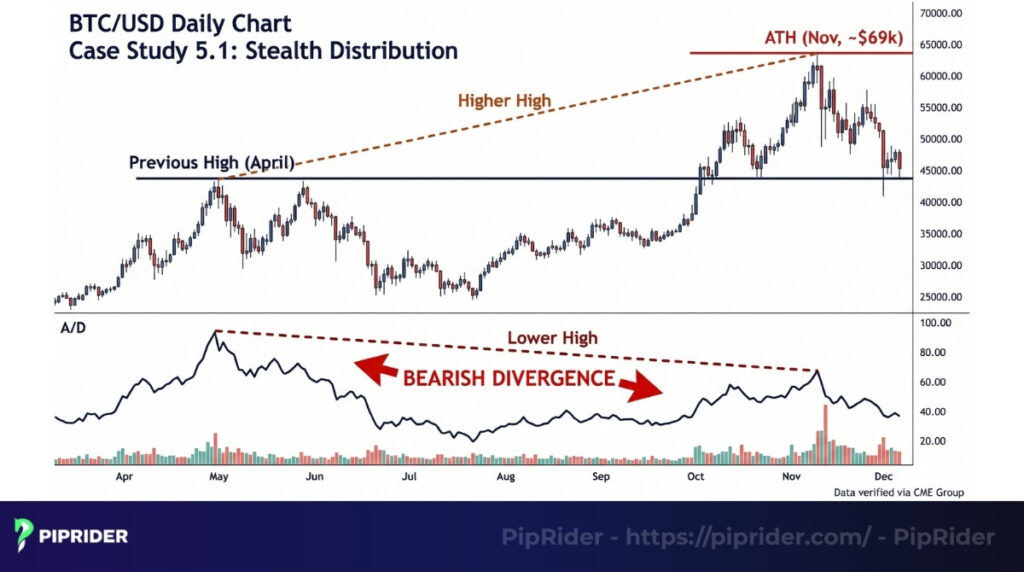
5.1. Case Study 1: The Stealth Distribution (Bitcoin – Nov 2021 Top)
The Historical Context: In November 2021, Bitcoin (BTC/USD) pushed to a euphoric new All-Time High of approximately $69,000 (Data verified via CME Group). Retail FOMO was at an absolute peak, driven by mainstream media hype.
- The Signal (Bearish Divergence): While the price chart successfully printed a higher high (surpassing the previous April peak), the A/D line painted a glaring, massive lower high.
- Trade Logic: This is the ultimate institutional “Bull Trap.” Whales and large funds used the retail buying frenzy as liquidity to unload their heavy positions. They sold heavily into the rally, forcing daily candles to close well below their intraday peaks. The A/D formula detected these weak closes on high volume, causing the indicator to plunge despite the macro price uptrend.
- Execution:
- Entry: A Short position is not triggered blindly at the absolute top. It is triggered when the price breaks below the nearest daily market structure (e.g., breaking back below the $60,000 support level) with the A/D divergence confirming the internal weakness.
- Invalidation: Stop-Loss placed tightly above the $69,000 ATH wick. The risk is strictly defined; the reward was catching a massive macro correction.
5.2. Case Study 2: “Blood in the Streets” Accumulation (EUR/USD – Sept 2022 Parity Drop)
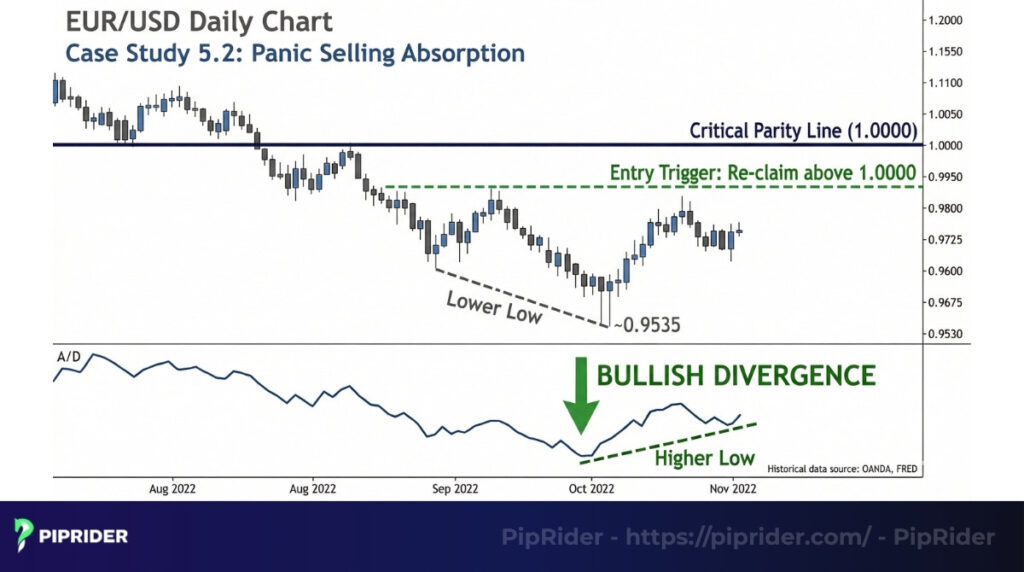
The Historical Context: In September 2022, the EUR/USD crashed below the psychological 1.0000 (parity) level, reaching a 20-year low near 0.9535 (OANDA, 2022). Retail sentiment was purely panicked, dumping the Euro aggressively.
- The Signal (Bullish Divergence): As the price flushed down to form that final lower low at 0.9535, the A/D line stubbornly refused to follow. Instead, it formed a distinct higher low.
- Trade Logic: The aggressive retail selling pressure had exhausted itself. Smart money (central banks and large hedge funds) stepped in to quietly accumulate the Euro at a severe historic discount. They absorbed the panic selling, causing the intraday closes to pull up off the absolute daily bottoms.
- Execution:
- Entry: Long position taken only when the price prints a definitive momentum shift, such as a strong daily candle closing back above the 1.0000 parity level (confirming a deviation/fakeout below support).
- Invalidation: Stop-loss placed exactly 1 ATR below the 0.9535 absolute bottom wick. If the price takes out that low, the accumulation thesis is dead.
5.3. Case Study 3: The Institutional Breakout (Gold XAU/USD – Oct 2023 Rally)
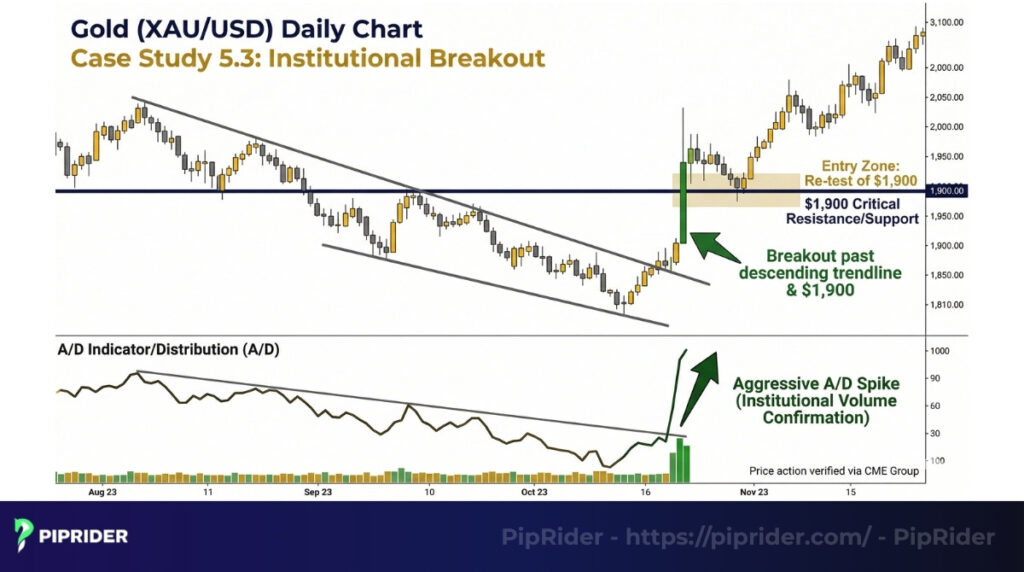
The Historical Context: Gold had suffered a brutal multi-month correction, dropping to the $1,810 support zone in early October 2023 (Price action verified via CME Group).
- The Signal (Trend Confirmation): In mid-October, Gold broke out of its descending trendline and surged past the $1,900 resistance. More importantly, the A/D line didn’t just slowly creep up—it violently broke its own resistance levels, confirming a massive influx of volume.
- Trade Logic: This was not a retail “dead cat bounce.” The aggressive spike in the A/D line proved that massive institutional volume was stepping in (driven by geopolitical tensions), forcing the price to close near the absolute high of the daily ranges. Institutions were actively sponsoring the breakout.
- Execution:
- Entry: Wait for the first minor daily pullback or consolidation above the broken $1,900 level (now acting as support). Enter a Long position on a bullish rejection wick.
- Invalidation: Stop-Loss placed strictly below the breakout origin zone ($1,880). The target is the next major structural liquidity pool near $2,000.
6. A/D vs. OBV vs. Raw Volume: The Ultimate Showdown
Many traders group these volume indicators together, assuming they are interchangeable. They are not. Using the wrong one in the wrong market condition leads to catastrophic fakeouts. To trade like a professional, you must understand the hierarchy of volume analysis.
6.1. The Comparison Matrix: Finding the Right Tool
Volume indicators are not interchangeable. Using the wrong tool for a specific market regime leads to distorted signals and costly fakeouts. Use the matrix below to identify the unique strengths and fatal flaws of each volume pillar.
| Feature | Raw Volume | On-Balance Volume (OBV) | Accumulation/Distribution (A/D) |
|---|---|---|---|
| Indicator Type | The Foundation (Pure Data) | The Momentum Compass | The Precision X-Ray |
| Calculation | Total units traded per session. | Binary logic (Current vs. Previous Close). | Internal price placement (Intra-day range). |
| Biggest Strength | Detects “Volume Climaxes” at key levels. | Confirms broad macro momentum shifts. | Exposes stealth institutional accumulation. |
| Critical Flaw | No Direction: High volume doesn’t identify the winner. | Binary Bias: Ignores volatility and gaps. | The Grinding Trap: Flatline during low-volatility trends. |
6.2. Mathematical Proof: The 1-Day Divergence
To understand why they diverge, look at how OBV and A/D process the exact same trading day:
- Yesterday’s Close: $100
- Today’s High: $105 | Today’s Low: $98 | Today’s Close: $101
- Today’s Volume: 500,000 shares
How OBV sees it (Macro): It asks: “Did we close higher than yesterday?” Since $101 > $100, OBV is bullish. It blindly adds the entire 500,000 volume to the running total.
How A/D sees it (Micro): It asks: “Who won the battle today?” It ignores yesterday. Since $101 is closer to the daily low ($98) than the high ($105), the formula registers a negative multiplier. It subtracts a portion of the volume, flashing a Sell signal.
6.3. The Gap Vulnerability (Where OBV Fails)
OBV has a critical blind spot: Overnight Gaps. Imagine a stock gaps up 5% on “good news.” Retail traders FOMO in, but institutions use that liquidity to dump their shares, forcing the price to close at the bottom of the daily range (a bearish pin bar).
- The OBV Trap: Because the close is still higher than yesterday, OBV adds all that dumping volume to its bullish total. It signals a Buy, leading you into a slaughter.
- The A/D Edge: A/D ignores the empty space of the gap. It only measures the intraday struggle. The A/D line will plunge, correctly exposing the institutional Distribution.
6.4. The Grinding Trend (Where A/D Fails)
A/D’s Achilles’ heel is the slow, low-volatility “grinding” trend—often seen in algorithmic uptrends where price climbs steadily but intraday ranges are tight (Dojis).
- The A/D Trap: If the price constantly closes in the middle of a tight daily range, the A/D multiplier stays near zero. The line stays flat, even as the price marches higher. You might falsely assume a “Bearish Divergence” and miss the entire rally.
- The OBV Edge: OBV is the perfect tool here. It doesn’t care about intraday wicks; it simply sees higher closes day after day and steadily climbs, confirming the healthy trend.
6.5. The Professional Verdict: How to Combine Them
The mark of a professional is using these flaws against each other to map the market:
- Macro Direction (The Compass): Use OBV to confirm the broad, multi-week market direction.
- Micro Execution (The Sniper): Use A/D when the price approaches key Support or Resistance levels to expose hidden institutional activity.
- The Holy Grail Setup: If the price hits a new high and OBV confirms it, but the A/D line forms a lower high, always trust the A/D line. You are cross-referencing Public Momentum against Institutional Conviction. A major reversal is imminent.
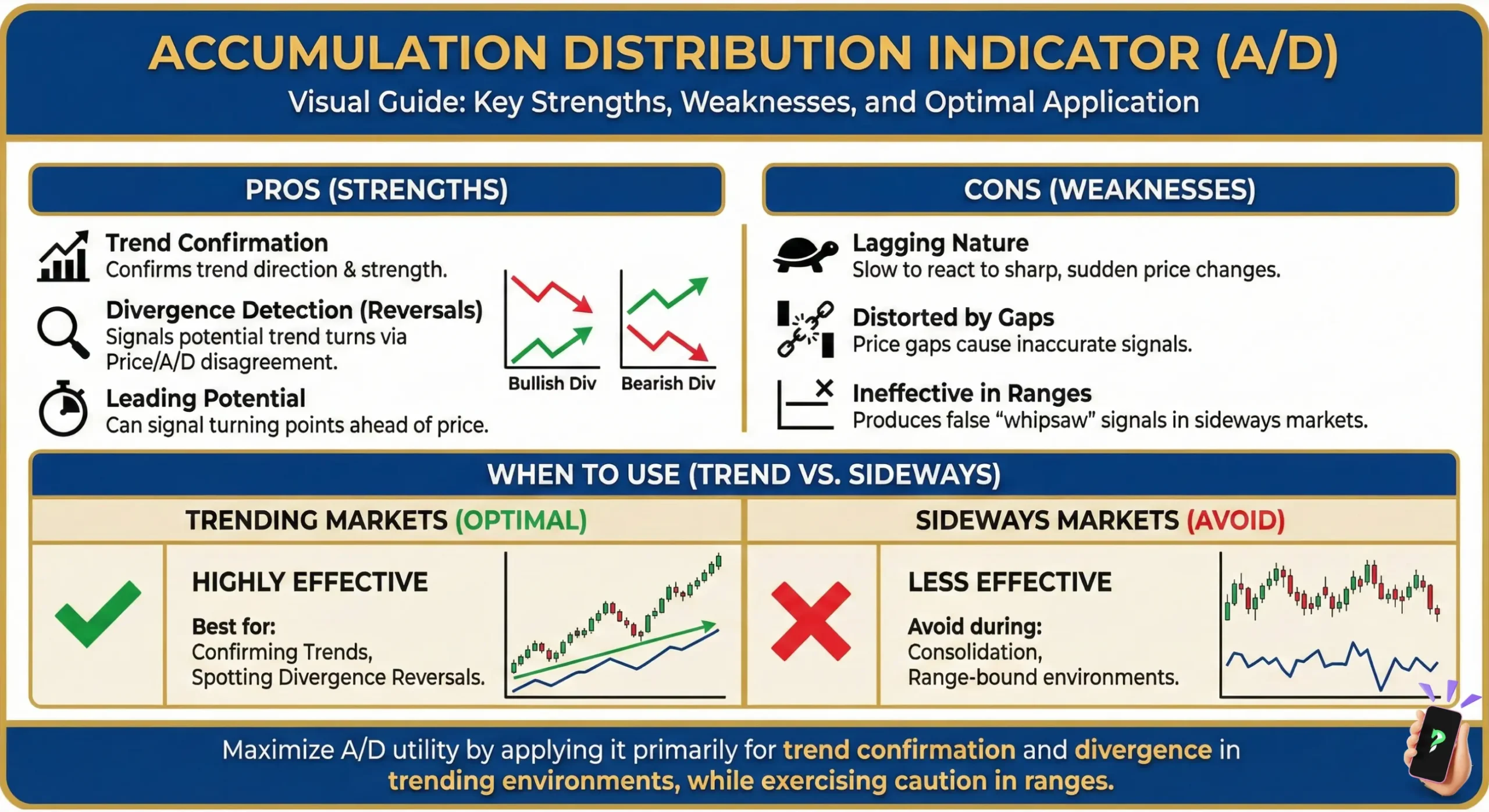
7. Advantages and Limitations of the A/D Indicator
To quickly summarize, the Accumulation/Distribution line is a powerful tool, but it is not infallible. Here is the executive breakdown of its strengths and blind spots:
| The Advantages (Pros) | The Limitations (Cons) |
|---|---|
| Leading Signals: Excellent at spotting divergences, warning you of reversals before the price turns. | The Gap Blind Spot: Completely ignores overnight or earnings price gaps, which can heavily distort the reading. |
| Institutional Insight: Filters out “fake” volume by analyzing the intraday close, revealing what smart money is doing. | Grinding Trend Failure: The A/D line often flatlines during slow, low-volatility uptrends (Doji days). |
| Trend Confirmation: Acts as a strict filter to keep you out of low-volume “bull traps” and false breakouts. | Choppy Markets: Generates noisy and conflicting signals during tight, sideways consolidation ranges. |
8. The Trader’s Decision Framework: Building Your System
An indicator in isolation is just noise. To turn the Accumulation/Distribution line into a professional-grade weapon, you must integrate it into a logical “If-Then” framework. This prevents “analysis paralysis”—that state of overthinking that leads to missed trades or impulsive entries.
Use the following decision matrix as your final filter to ensure you only deploy the A/D indicator when the institutional odds are heavily in your favor.
8.1. A/D vs. RSI: Velocity vs. Conviction
Before adding the A/D line to your chart, you must distinguish between price speed and volume strength. Most retail traders confuse the two, leading them to buy “fast” moves that have zero institutional backing.
- The Logic: RSI measures price velocity (how fast it moves). A/D measures volume conviction (the weight of the money behind the move).
- The Trading Rule: Combine them for “Holy Grail” setups. If RSI is at 20 (oversold) but the A/D line is forming a higher low (Bullish Divergence), you have the ultimate confirmation: Price is “cheap” and smart money is aggressively accumulating.
8.2. Strategy: Standalone or Combined?
One of the most dangerous mistakes a beginner can make is treating the A/D line as a standalone “Buy/Sell” signal. To use it correctly, you must understand its structural limitations.
- The Logic: The A/D line has no concept of absolute price levels. It cannot identify historical Support, Resistance, or Supply/Demand zones on its own. It is a confirming tool, not a leading price generator.
- The Trading Rule: Price Action First. Always map your major structural levels and trendlines on a naked chart first. Only check the A/D line after the price reaches your predetermined zone to see if institutional volume validates your trade thesis.
8.3. Environment: Trend vs. Sideways
Not all market conditions are created equal. The A/D formula thrives in specific environments and fails miserably in others. Knowing when to “turn it off” is just as important as knowing how to use it.
- The Logic: In a trending market, A/D excels at validating breakouts and spotting exhaustion. In a sideways or “choppy” market, intraday closes are often random and lack intent, causing the A/D line to flip-flop erratically.
- The Trading Rule: Trend only. Deploy the A/D indicator when the market is clearly trending or testing a major higher-timeframe boundary. Turn it off during midday consolidation or tight ranges to avoid “death by a thousand cuts.”
8.4. The Decision Matrix: Is the A/D Indicator for You?
Not every trader should use the A/D line in the same way. To avoid “indicator overload,” you must match the tool to your current experience level and the specific asset class you are trading.
8.4.1. Usage Guide by Trader Level
The A/D indicator is versatile, but its application must scale with your expertise. Use the following matrix to match the tool to your current trading level and primary objectives to avoid “indicator overload.”
| Level | Primary Objective | Execution Strategy |
|---|---|---|
| Beginner | Trend Confirmation | Combine with RSI. Look for “Oversold” RSI readings (below 30) accompanied by a rising A/D line to confirm a safe market bottom. |
| Intermediate | Structural Shifts | Master Divergence. Use Regular and Hidden Divergence as a “structural x-ray” to spot when a trend is losing steam before price confirms it. |
| Advanced | Institutional Flow | Track Liquidity. Monitor A/D behavior at major Supply/Demand zones to identify where “Whales” are absorbing retail liquidity. |
8.4.2. The “Red Flags”: When to NOT Use A/D
The A/D formula is only as good as the volume data fed into it. In the following environments, the indicator becomes a liability:
- Low-Volume Markets: In illiquid markets, a single large “block trade” can skew the A/D line, creating a “ghost” signal that has no real trend power.
- Small-Cap Crypto/Altcoins: Avoid A/D on low-cap coins. These markets are prone to “wash trading” (fake volume) (Paz, 2022), which makes the A/D line completely unreliable for tracking real institutional money.
- Sideways Market Noise: During tight, choppy consolidation, intraday closes are often random. Turn the A/D indicator off and stick to pure Price Action until a clear range breakout occurs.
9. Frequently asked questions about accumulation distribution indicator
10. Conclusion: The key to using the A/D successfully
The Accumulation Distribution Indicator is more than just a line on a chart; it’s a window into the market’s true intentions. By learning to interpret its signals, you move beyond being a reactive trader who just follows price and become a proactive analyst who understands the forces driving it.
Your goal is to master two things: using it to confirm the health of a trend and patiently hunting for high-conviction divergence signals. When you combine these skills, the A/D indicator transforms from a simple tool into an invaluable ally, helping you make more informed and confident trading decisions.
Ready to elevate your trading game with in-depth market knowledge? Dive into Piprider to discover the technical indicators list and advanced strategies.
Infographic Section
-
Accumulation Distribution Indicator -
Accumulation Distribution Indicator: Price movement -
Accumulation Distribution Indicator: Pros and Cons