Learning how to trade binary successfully means shifting from gambling to trading with a plan. Success is not about a “secret system”; it is about using a simple trading strategy combined with very strict risk management rules (like the 1-2% rule) to manage the “all-or-nothing” risk.
This guide explains the simple strategies you can use, the risk management that is essential for survival, and the critical regulatory warnings you must know before you begin.
Key Takeaways
- A high-risk, “all-or-nothing” binary options trade where you predict “Yes” or “No” on a price direction.
- Success in binary trading is risk management. Professionals focus on protecting capital, not on “get rich quick” bets.
- Simple trading strategies like Trend Following or Support/Resistance are the most reliable for beginners.
- Never risk more than 1-3% of your total account capital on a single binary trade.
- Binary options are banned for retail traders in many regions (like the UK & Europe by ESMA) due to high risk. The CFTC in the U.S. also warns of fraudulent platforms.
1. What Are Binary Options and How Do They Work?
A binary option is a high-risk financial product where a trader predicts the direction of a price (up or down) within a fixed time frame. There are only two possible outcomes: the trader wins a fixed payout, or the trader loses their entire investment.
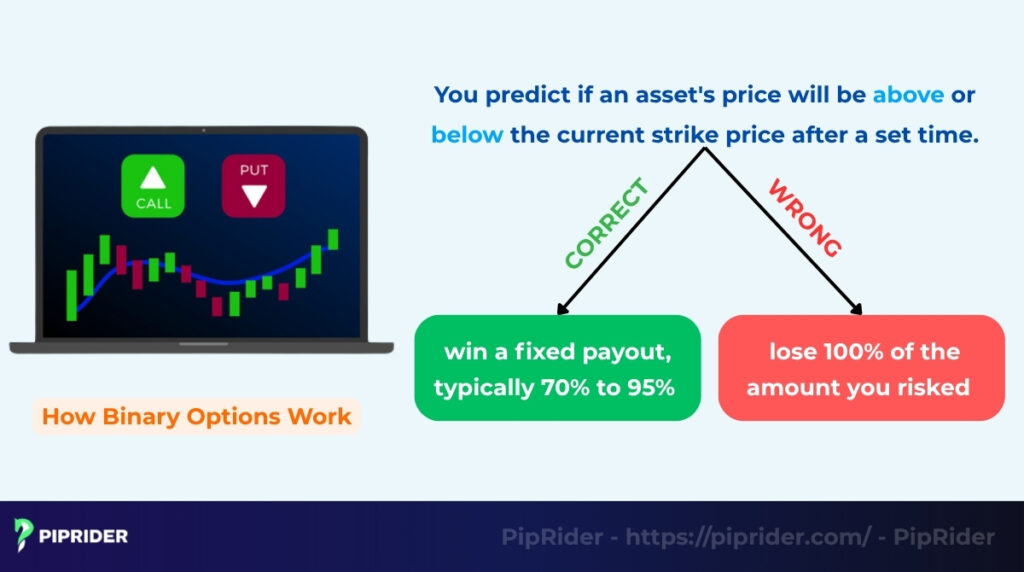
This “all-or-nothing” structure is what makes binary options simple to understand but also very risky. Here is how it works:
- The trade: You predict if an asset’s price will be above or below the current strike price after a set time.
- The payout: If you are correct, you win a fixed payout, typically 70% to 95% of the amount you risked.
- The loss: If you are wrong, you lose 100% of the amount you risked on that single binary options trade.
Traders use binary options on many popular assets, including forex, stocks, indices, crypto, and commodities, though it is vital to understand the difference between forex and binary options before choosing your preferred instrument. The expiration time (or “expiry”) is a key component and can range from as short as 30 seconds to several hours. According to the U.S. Commodity Futures Trading Commission (CFTC), these short-term binary options contracts are a very high-risk form of trading.
2. Understanding the Basics Before You Trade
Before you can trade successfully, you must understand the basic components of any binary options trade: the trade type, the expiration time, and the payout structure.
2.1. The Two Main Types of Binary Trades
While there are many variations, almost all binary options trades fall into two simple categories:
- Call / Put (or High / Low): The most common type. You simply predict if the price will be higher (a “Call” or call option) or lower (a “Put”) than the current strike price when the time expires.
- Touch / No-Touch: This type is less common. You predict if the price will touch (or “hit”) a specific, pre-set strike price at least once before the time expires.
2.2. The Expiration Time Factor
The expiration time defines a trade’s lifespan. This factor is critical because shorter duration leads to higher risk.
An expiration of 30 or 60 seconds is extremely risky because it is mostly influenced by random market “noise,” not a clear trend. Longer expirations (like 5 minutes, 15 minutes, or 1 hour) give a binary options strategy more time to work and are often less random, following the true price movement.
2.3. The Payout Structure
The payout structure is fixed and known before you enter the trade.
- If you win: You receive a fixed payout, typically between 70% and 95% of your investment. (e.g., you risk $10 to win an $8.50 profit).
- If you lose: You lose 100% of the money you risked on that specific trade (you lose your $10).
This uneven payout structure (losing more than you can win) is a key reason why risk management is so important for binary options.
3. Why Do Most Traders Lose in Binary Options?
Most traders lose money in binary options not because of the market, but because they lack a disciplined plan and proper risk management. The “all-or-nothing” payoff creates a high-stress, emotional environment that leads to common psychological traps and ruins good trading strategies.
- No trading plan: The most common mistake is trading based on “gut feelings” or random guesses. Without a clear trading plan that defines what setup to trade, when to trade, and how much to risk, a trader is just gambling.
- Overtrading and chasing losses: After a losing trade, an emotional trader often feels the need to “win it back” immediately. This leads to revenge trading, taking more and more binary options trades to chase the loss, which almost always results in a blown account.
- Ignoring market structure: New traders often trade on very short timeframes (like 60 seconds) and ignore the main trend. They don’t understand market structure or market volatility, so they end up placing trades against the dominant market direction.
- Poor money management: Many traders risk 10% or 20% of their entire account on one binary options trade, hoping for a quick win. This is not a strategy; it’s a recipe for disaster. A single losing streak can wipe out their entire capital.
4. How to Trade Binary Successfully: A Step-by-Step Guide
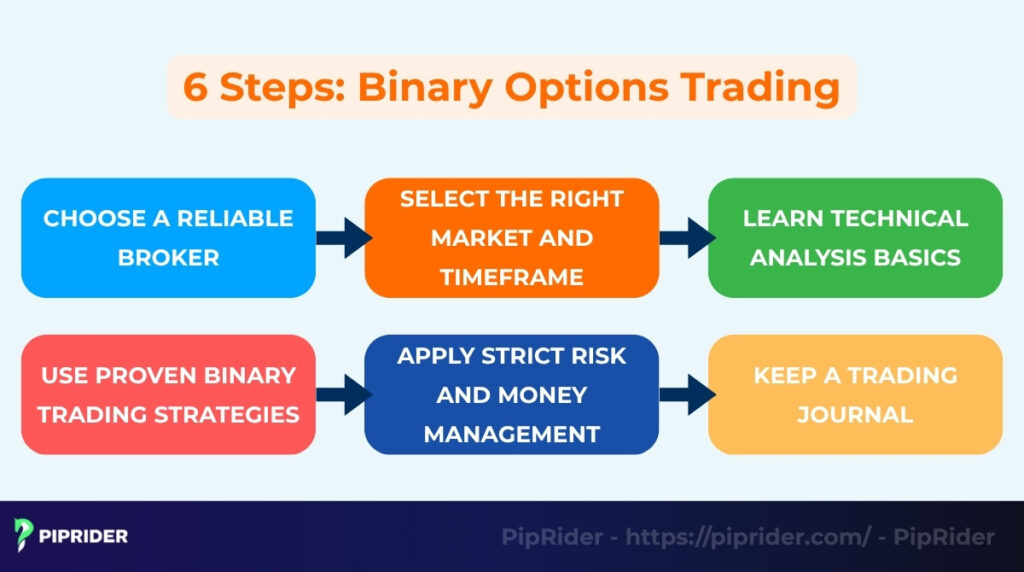
To trade binary options successfully, you must follow a disciplined, step-by-step process. This involves choosing a reliable broker, using technical analysis to find a setup, applying a proven strategy, and managing your risk on every single trade.
4.1. Step 1: Choose a Reliable Broker
Choosing a reliable broker is the most important step for protecting your money. The binary options space has many unregulated platforms.
- Look for regulation: Prioritize brokers that are authorized by a major financial regulator (like ASIC or CySEC). Regulators in many regions, including the UK (FCA) and Europe (ESMA) have banned binary options for retail traders (ESMA, 2018; FCA, 2019), so be aware of your local laws for binary options. If these products are restricted in your region, you might consider an introduction to forex trading as an alternative which is more widely available to retail investors.
- Check broker terms: Look for high payout rates (80-95%), fair withdrawal terms, and a stable trading platform that doesn’t freeze. Always start with their demo account first.
4.2. Step 2: Select the Right Market and Timeframe
Focus on markets with high liquidity and predictable movements.
- Markets: New traders should stick to major forex pairs like EUR/USD or GBP/USD. These markets have high volume and tend to move more smoothly than volatile, low-volume assets.
- Timeframes: Avoid trading during major news hours (like NFP or interest rate decisions) unless you have a specific news trading strategy, as volatility can be extreme and unpredictable.
4.3. Step 3: Learn Technical Analysis Basics
You cannot guess the market’s direction. Learning technical analysis for binary options as part of your overall market analysis. The process involves learning how to:
- Identify the trend using trendlines and moving averages.
- Find key levels using support and resistance.
- Measure momentum using indicators like the RSI or MACD.
- Read basic price action patterns (like pin bars or breakouts) to understand the price movement.
4.4. Step 4: Use Proven Binary Trading Strategies
A binary options strategy is a set of rules that tell you when to trade. Do not trade randomly. Start with a simple, proven strategy:
- Trend-following strategy: Only place “Call” (High) trades when the market is in a clear uptrend, and only “Put” (Low) trades when in a downtrend.
- Reversal strategy: Use the RSI indicator to spot “oversold” (below 30) or “overbought” (above 70) conditions at a key support or resistance level.
- Breakout strategy: Wait for the price to break out of a clear range (consolidation) and trade in the direction of the breakout.
- 5-Minute (M5) strategy: A popular binary options method that involves using a 5-minute chart to identify a micro-trend and taking trades with a 5- or 10-minute expiry.
4.5. Step 5: Apply Strict Risk and Money Management
Applying strict risk management is the key to “success.” You must have rules to protect your capital, including position sizing.
- The 1-3% rule: Never risk more than 1% to 3% of your total account on a single trade. This ensures you can survive a long losing streak.
- Avoid martingale: The Martingale strategy (doubling your bet after every loss) is extremely dangerous in binary options and is a fast way to blow up your account.
4.6. Step 6: Keep a Trading Journal
You cannot improve what you do not measure. A trading journal is a log of all your binary options trades. It is essential to document the following:
- The reason (setup) for your trade.
- The asset and expiry time.
- The outcome (win or loss).
- Your emotions during the trade.
Reviewing your journal every week is the only way to find the patterns in your winning and losing trades, fix your mistakes, and build emotional intelligence. This data is also used for backtesting.
5. What Are the Best Binary Trading Strategies That Actually Work?
The best binary trading strategies are simple, rule-based, and remove guesswork. Instead of reacting to random movements, you wait for a specific, pre-defined setup. Here are five popular trading strategies that beginners can learn.
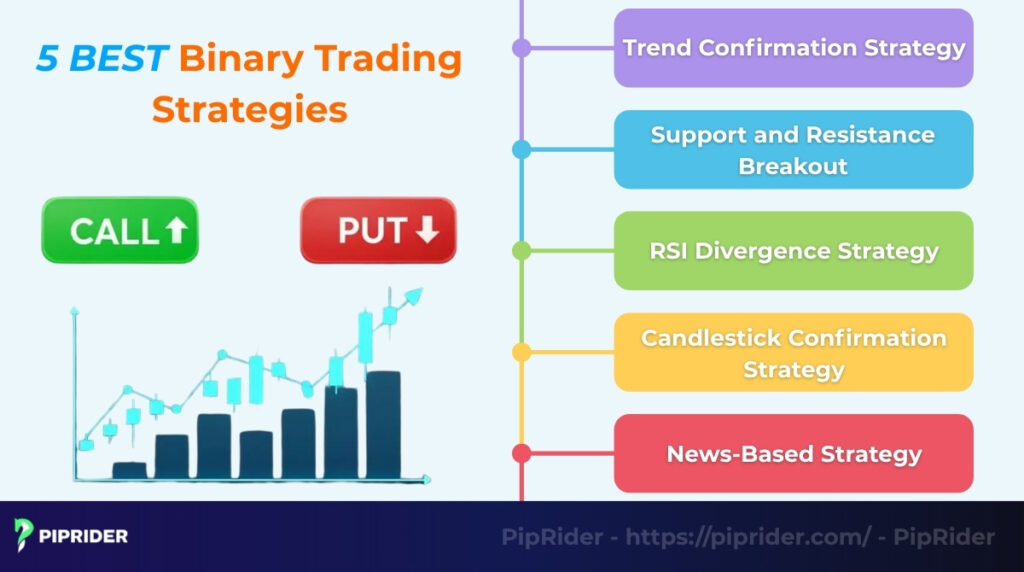
5.1. The Trend Confirmation Strategy
A trend confirmation trading strategy is the most reliable for beginners. The goal is to only trade in the direction of the main market trends.
- Identify the trend: Use a 50-period EMA (Exponential Moving Average). If the price is consistently above the EMA50, the main trend is up. If it is below the EMA50, the trend is down.
- Trade signal:
- Call (Buy) trade: Only enter a “Call” when the price is above the EMA50 and pulls back to it.
- Put (Sell) trade: Only enter a “Put” when the price is below the EMA50 and rallies back to it.
5.2. The Support and Resistance Breakout
A support and resistance breakout strategy involves finding a “range” where the price is trapped between a support (floor) and resistance (ceiling).
- The setup: Wait patiently for the price to break either above the resistance or below the support.
- The entry: Once the price breaks out, you place a trade in the direction of the breakout (a “Call” on a break above resistance, a “Put” on a break below support).
- Confirmation: To help avoid false breakouts, you can check if the RSI indicator has also moved above 50 (for a buy) or below 50 (for a sell).
5.3. The RSI Divergence Strategy
An RSI divergence strategy is a reversal method. It looks for “divergence,” which is when the price and the RSI indicator are moving in opposite directions.
- Bullish divergence (Buy signal): The price makes a new low, but the RSI indicator makes a higher low. This signals that selling momentum is weak and a reversal (up) is possible.
- Bearish divergence (Sell signal): The price makes a new high, but the RSI makes a lower high. This signals that buying momentum is weak and a reversal (down) is possible.
- Expiration: This setup is often used with 5-minute to 15-minute expirations.
5.4. The Candlestick Confirmation Strategy
A candlestick confirmation strategy uses specific patterns to confirm an entry at a key level (like support or resistance).
- The setup: First, you identify a strong key level on your chart.
- The entry: Do not trade just because the price touches the level. Wait for a confirmation candle to form, such as a Pin Bar, an Engulfing pattern, or a Doji. For example, if the price hits support and then forms a strong bullish Pin Bar, you would take a “Call” trade.
5.5. The News-Based Strategy
A news-based strategy (or news trading) is an advanced method and is not recommended for beginners due to extreme volatility.
- The setup: The strategy involves trading after major economic indicators or news releases, like CPI (inflation), NFP (jobs), or a Fed interest rate decision.
- The entry: The trader waits for the initial chaotic price spike (the first 1-2 minutes) and then trades in the direction of the new, strong momentum that forms after the news. This requires skill in fundamental analysis.
6. How Important Is Emotional and Psychological Control?
Emotional and psychological control (or trading psychology) is one of the biggest challenges in binary options trading. The fast-paced, “all-or-nothing” nature of the trades creates a high-stress environment that can easily cause a trader to lose emotional discipline and make costly mistakes.
- Avoid revenge trading: After a loss, the most dangerous impulse is to “revenge trade”, jumping into another binary options trade immediately to try and win your money back. This is a fast way to blow up an account.
- Follow your plan: The only way to win is to stay calm and follow your trading plan. You must make decisions based on your rules, not on the emotional reactions to a win or a loss.
- Know when to stop: A simple, hard rule is to stop trading for the day after 3 or 4 consecutive losses. Regulators in many regions, including the UK (FCA) and Europe (ESMA) have banned binary options for retail traders (ESMA, 2018; FCA, 2019), so be aware of your local laws for binary options. If these products are restricted in your region, you might consider an introduction to forex trading as an alternative which is more widely available to retail investors.
7. How Do You Manage Risk in Binary Options?
Risk management is the most important part of any plan for how to trade binary successfully. Because you can lose 100% of your investment on a single trade, you must have strict rules to protect your capital, incorporating risk management principles beyond binary options to ensure long-term portfolio stability.
7.1. Follow a Fixed Percentage Rule
The most critical rule for binary options is that a trader should never risk more than 1% to 3% of their total account on a single trade. For example, on a $500 account, a 3% risk is only $15 per trade. This rule, a core of position sizing, ensures that a long losing streak cannot wipe out your account.
7.2. Avoid Overlapping Trades
A common beginner mistake is to place multiple trades on the same asset, in the same direction, at the same time. If you place five “Call” trades on EUR/USD, you haven’t made five trades. You have made one oversized binary options trade that is 5x riskier. If the market moves against you, all five positions will lose at once.
7.3. Diversify Expirations and Assets
Do not put all your focus on one setup. Diversify your approach by looking for your binary options strategy on different assets (e.g., EUR/USD and AUD/USD) and on different expiration timeframes (e.g., M5, M15, and H1). Doing so prevents you from overtrading a single pair and helps you find the highest-quality setups across the market.
8. What Does an Example of a Successful Binary Trade Look Like?
Seeing a successful trade setup can help you connect the strategy with the outcome. Here is a simple example using a combination of indicators.
| Step | Action | Detail |
| 1 | Asset | EUR/USD |
| 2 | Strategy | RSI + EMA Crossover |
| 3 | Entry Signal | The RSI crosses above 50 (showing new bullish momentum) AND the price breaks above the 20-period EMA. |
| 4 | Expiry | 5 Minutes |
| 5 | Outcome | The trade expired “In-the-Money” for an +80% payout. |
This binary options trade was successful because it was not a random guess. It was based on a clear, pre-defined strategy where multiple indicators (RSI momentum and an EMA crossover) aligned to confirm the bullish signal.
9. What Are the Most Common Mistakes to Avoid?
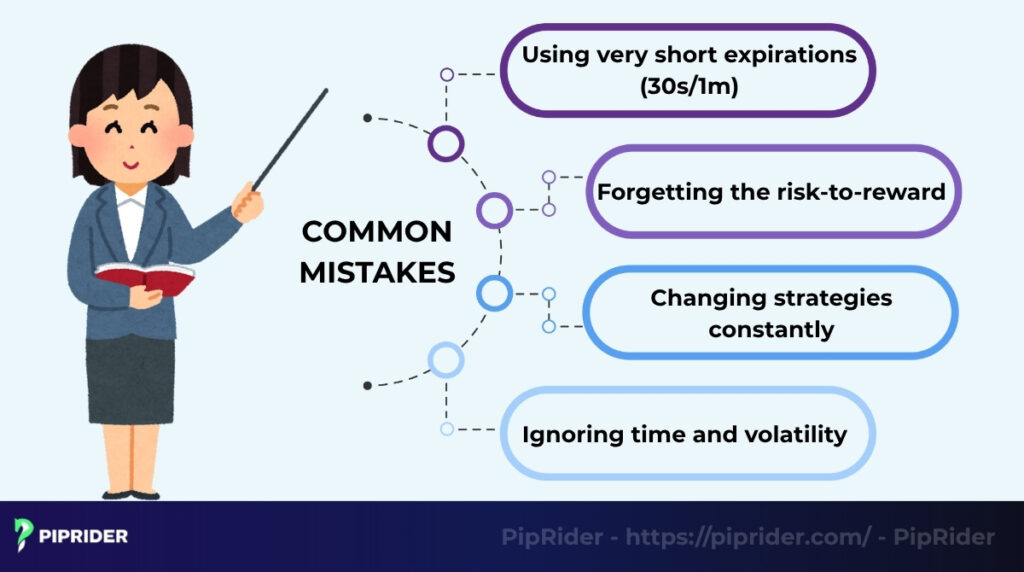
To know how to trade binary successfully, you must not only find a good strategy but also actively avoid the common traps that cause most new traders to fail. These mistakes are almost always related to impatience, poor planning, or a misunderstanding of the platform’s high-risk nature.
- Using very short expirations (30s/1m): Trading on 30-second or 1-minute expirations is closer to gambling than trading. These timeframes are mostly random “market noise,” making it nearly impossible to apply a real binary options strategy.
- Forgetting the risk-to-reward: A common error is focusing on the “+90% payout” while ignoring the “100% loss.” Because the potential loss is larger than the potential gain, you must win more often than you lose just to break even.
- Changing strategies constantly: Jumping to a new strategy after every loss is a mistake. A trading strategy needs time and data (from your journal) for backtesting to be proven. Constantly changing your binary options system prevents you from ever knowing what works.
- Ignoring time and volatility: A good setup can fail at the wrong time. Forgetting to check the economic calendar can get you caught in a news spike. Likewise, trading when market volatility is zero (like the mid-Asian session) is difficult, as the price may not move at all.
10. What Are the Best Tools and Indicators for Binary Trading?
While you can trade with a clean chart, most traders use tools to help them find and confirm setups. The right tools can help your market analysis, set alerts, and avoid dangerous times.
- Charting platform (TradingView): Many traders use TradingView as their main analysis platform. It has powerful charts and allows you to set alerts for when a price hits your key level, so you don’t have to stare at the screen.
- Trading platforms (IQ Option / Pocket Option): These are examples of popular platforms where the actual binary options trading happens. The key is to find one that is easy to use and executes your trades quickly.
- Key indicators: You don’t need many indicators. Most beginners focus on a few key tools:
- RSI & MACD: To measure momentum and spot overbought/oversold levels.
- Bollinger Bands: To see price volatility and how “stretched” a price is.
- EMA Crossover: To quickly identify the direction of the trend.
- Volume Profile: An advanced tool to see where the most trading has occurred.
- Economic Calendar: An economic calendar is a critical tool for risk management and fundamental analysis. You must check it every morning to see what major news (like CPI or NFP) is coming out and other economic indicators. You should avoid trading during these high-volatility times.
11. Frequently asked questions about Trading Binary
12. Conclusion
Success in binary options does not come from a “holy grail” system. Learning how to trade binary successfully is a matter of discipline, statistical analysis, and emotional control. Good emotional intelligence is key.
Understanding the market, managing your capital with strict position sizing, and following a consistent process are the real keys to trade binary over the long term.
To learn more about professional trading strategies, market analysis, and emotional discipline, explore the free educational resources at Piprider.