The Nasdaq 100 (often called NAS100) is one of the most exciting and popular indexes for traders. It is packed with the world’s biggest technology companies, like Apple, Microsoft, and NVIDIA, which makes it very volatile. This high volatility creates many opportunities but also significant risk.
This guide is designed for beginners. It will answer how to trade NAS100, explain what moves it, and help you build a simple strategy to get started.
Key Takeaways
- NAS100 is a tech-heavy index of the 100 largest non-financial companies on the Nasdaq.
- Offers high volatility and liquidity, creating many trading opportunities.
- Driven primarily by US interest rate policy (the Fed) and Big Tech earnings reports.
- How to trade NAS100: use CFDs or Futures on platforms like MT4/MT5.
- High volatility combined with leverage requires strict risk management (stop-losses).
- A simple trend-following strategy is often a good starting point for beginners.
1. What Is NAS100 (Nasdaq 100 Index)?
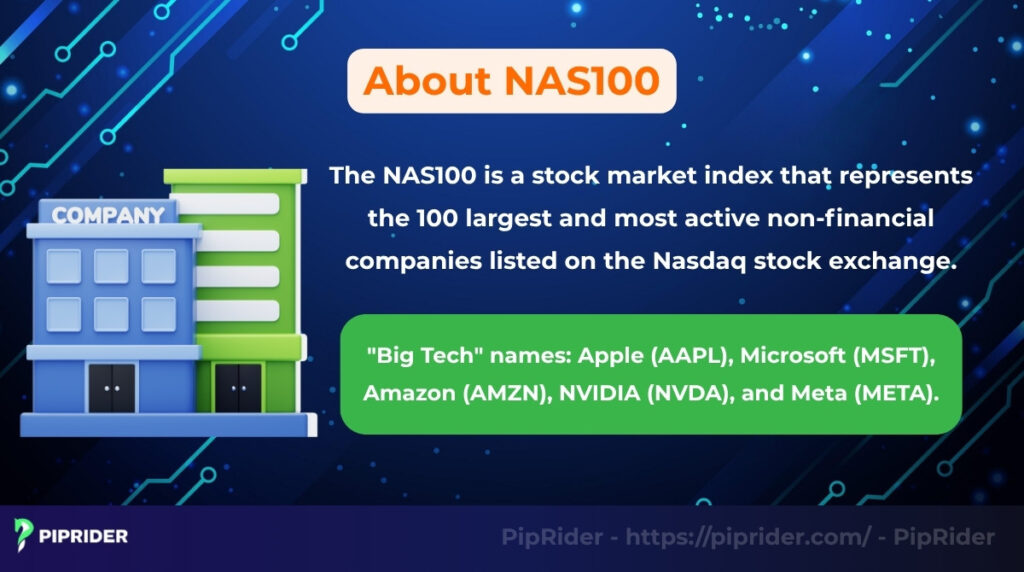
The NAS100 (Nasdaq 100 Index) is a stock market index that represents the 100 largest and most active non-financial companies listed on the Nasdaq stock exchange (Nasdaq, n.d.).
This index is famously “tech-heavy.” It excludes financial companies (like banks) and is instead dominated by the world’s biggest technology and growth corporations. These include “Big Tech” names like Apple (AAPL), Microsoft (MSFT), Amazon (AMZN), NVIDIA (NVDA), and Meta (META).
Because it is full of these growth-focused companies, the NAS100 is known for its high volatility and strong, clear price trends. This high level of price movement is precisely what makes it so attractive to short-term traders, offering many opportunities for scalping, swing, and position trading.
1.1. How Can You Actually Trade It? (Instruments & Tickers)
It is important to understand that you cannot trade the Nasdaq-100 Index (NDX) directly. The Index is just a mathematical score calculated by Nasdaq. To make money from its movement, you must trade a financial derivative that tracks this price.
Here are the specific symbols (Tickers) you will look for depending on your trading method:
| Instrument Type | Common Tickers | Who is it for? | Key Characteristics |
|---|---|---|---|
| The Index (Benchmark) | NDX | Analysts | Cannot be traded. Used only to view the “true” price history and chart data. |
| CFD (Contract for Difference) | NAS100, US100, USTEC | Retail Traders (Beginners) | Most popular on MT4/MT5. • Spot CFDs: No expiry date, but you pay overnight Swaps. • Contract Size: Varies by broker (Check specifications). |
| Futures (CME Exchange) | NQ (E-mini) MNQ (Micro) |
Pro Traders | Centralized market. Contracts have Expiry Dates (Mar, Jun, Sep, Dec). • NQ: $20 per point. • MNQ: $2 per point (Best for small accounts). |
| ETF (Exchange Traded Fund) | QQQ (Invesco) TQQQ (3x Lev) |
Investors | Traded like stock shares on the exchange. • QQQ: Unleveraged (1:1), safer for holding. • TQQQ: 3x Leverage, very risky, for short-term only. |
Important Note for MT4/MT5 Users: If you are using a standard Forex broker, you are likely trading Spot CFDs. You will find the instrument listed as US100, NAS100, or USTEC. Unlike Futures, these typically do not expire, allowing you to hold positions indefinitely (as long as you pay the overnight swap fees).
2. Why Traders Choose to Trade NAS100?
The NAS100 is arguably the most popular index for modern day traders.Its heavy concentration in technology gives it a unique ‘personality’—fast, aggressive, and highly responsive to news. This distinct character sets it apart from the slower, industrial-heavy Dow Jones.
Here is why professionals prefer the Nasdaq 100 over other markets:
2.1. High Volatility & Deep Liquidity (The “Action”)
Volatility is the lifeblood of a day trader. If the market doesn’t move, you cannot make money. The NAS100 is famous for its wide “Average True Range (ATR)“, meaning it can easily move 100-300 points in a single session.
- Opportunity: This constant movement creates frequent setups for both long (buy) and short (sell) trades.
- Safety in Liquidity: Because it is one of the most traded assets globally, you can enter and exit large positions instantly without worrying about “slippage” or getting stuck in a trade.
2.2. Diversified Exposure (Avoiding “Single-Stock Risk”)
Trading individual stocks carries a massive risk known as “Gap Risk.” If you go all-in on Apple and they release a bad earnings report overnight, the stock could open 10% lower, wiping out your account.
- The Index Advantage: Trading the NAS100 eliminates this single-stock risk. You are betting on the entire tech sector, not just one company. If one constituent fails, the strength of the other 99 can balance the index, smoothing out the volatility.
2.3. Nearly 24-Hour Market Access (React to Global News)
Global events do not respect US office hours. Wars, geopolitical tensions, or foreign economic data often break while New York is sleeping.
- The Problem: Stock investors are “trapped” until the market opens at 09:30 AM ET.
- The Solution: Through derivatives like Futures (CME) and CFDs, NAS100 traders can react instantly to breaking news nearly 24 hours a day, 5 days a week. You are never locked out of the market when it matters most.
2.4. Competitive Trading Costs (Volume Drives Value)
In trading, high volume usually leads to lower costs. Because millions of NAS100 contracts change hands daily, liquidity providers can offer much tighter spreads compared to minor indices (like the Russell 2000 or regional indices). However, “cheap” can be deceptive if you don’t check the details:
- Spread: Look for brokers offering 1.0 to 2.0 points during the US session.
- Commissions: Compare “Raw Spread” (commission per lot) vs. “Standard” (no commission but wider spread) accounts.
- Swap Rates: Always check overnight financing fees if you plan to hold trades for more than one day.
3. What Moves the NAS100? (Drivers & Structure)
To trade the NAS100 successfully, you must understand what moves it. The index is not random; its price is heavily influenced by specific economic triggers and its unique internal structure.
3.1. Key Fundamental Drivers
Unlike general indices, the tech-heavy Nasdaq-100 is highly sensitive to these three external factors:
- Interest Rates (Fed Policy): This is the #1 Driver. As a “growth” index, tech companies rely on borrowing money to innovate.
- The Rule: Higher interest rates (Hawkish Fed) are bad for NAS100. Lower rates (Dovish Fed) are fuel for a rally.
- Corporate Earnings: The index is driven by profits. A strong quarterly report from a giant like Apple or NVIDIA can single-handedly pull the entire index up, even if the broader economy is weak.
- Global Risk Sentiment: The NAS100 is the ultimate “Risk-On” asset.
- Risk-On: When investors are optimistic, they buy Tech → NAS100 rises.
- Risk-Off: When investors are fearful (war, recession), they dump Tech first to buy Gold or Bonds → NAS100 falls.
3.2. Market Structure: The “Magnificent Seven” Dominance
This is the most critical structural feature you must understand. The NAS100 is not evenly balanced; it uses a “modified market capitalization weighting” methodology.
- The “Magnificent Seven”: The index is heavily concentrated in just 7 “Megacap” giants: NVIDIA (NVDA), Apple (AAPL), Microsoft (MSFT), Amazon (AMZN), Alphabet (GOOGL), Meta (META), and Tesla (TSLA).
- The Weighting Reality: These few companies account for a massive portion of the index’s movement. Even though Nasdaq has rules to cap the weight of stocks that become too dominant (via Special Rebalancing), the concentration remains high.
- Trading Implication: You essentially cannot trade NAS100 without watching these stocks. If NVIDIA and Apple drop significantly, the entire index will likely fall, even if the other 93 companies are rising.
4. How to Trade NAS100 Like a Pro: Step-by-Step Guide
Trading the Nasdaq-100 requires more than just guessing price direction; it demands a disciplined system. This guide transforms the complex trading process into a strict 7-Step Framework.
Before risking real money, ensure you can tick off every step in this sequence:
- Step 1 & 2 (Setup): Choose a specialized broker and set up your trading platform.
- Step 3 (The Math): Know exactly how much $1 per point is worth (Crucial).
- Step 4 (Analysis): Form a bias using Fundamental and Technical analysis.
- Step 5 (Risk): Calculate the exact Lot Size to limit loss to 2%.
- Step 6 (Practice): Test your strategy on a Demo account first.
- Step 7 (Execution): Enter the trade and manage it (Move SL to Breakeven).
Let’s break down each step in detail.
4.1. Step 1: Choose a Specialized Broker
Do not just pick a broker with a flashy ad. You need a broker optimized for Index Trading.
- Regulation: Ensure they are regulated by top-tier authorities (like ASIC, FCA, or CySEC) to guarantee fund safety.
- Trading Costs: Check the Spread. A competitive spread for NAS100 is between 1.0 – 2.0 points during US market hours. Avoid brokers charging 3.0+ points as this eats into your profits.
- Account Type: Consider a “Raw Spread” or “ECN” account. Although you pay a small commission, the tighter execution is crucial for scalping strategies.
4.2. Step 2: Select Your Platform
Most professionals separate their analysis from their execution.
- For Charting: I recommend using TradingView for analysis because the charts are cleaner and the tools are more modern.
- For Execution: Use MetaTrader 4 (MT4) or MetaTrader 5 (MT5). These are the industry standards for speed and reliability.
- Setup: Add the NAS100 ticker (often listed as US100, USTEC, or NAS100) to your “Market Watch” window immediately.
4.3. Step 3: Understand the “Math” (Point Value)
⚠️ Crucial Step: Before placing a trade, you must know exactly how much money you win or lose for every 1-point move in the Nasdaq 100. This varies heavily between Futures and CFDs.
- Example: If NAS100 moves from 15,000 to 15,010 (+10 points), how much is that in dollars?
Profit/Loss Calculator Table
| Instrument Type | Symbol | Value per 1 Point Move |
|---|---|---|
| E-mini Futures (Professional Standard) |
NQ | $20.00 |
| Micro Futures (Best for Beginners) |
MNQ | $2.00 |
| Standard CFD (Typical Forex Broker) |
US100 / NAS100 | $1.00 (Per 1 Lot)* |
⚠️ CRITICAL WARNING for CFD Traders:
Unlike Futures, CFD Contract Sizes vary by broker. Some brokers set 1 Lot = $10 or even $20 per point!
- The Fix: Always Right-click the symbol in MT4 → Select Specification → Check the “Contract Size” line before your first trade.
4.4. Step 4: Analyze the Market (Form a Bias)
Do not guess. Form a directional bias (Buy or Sell) using a top-down approach:
- Fundamental Check: Is there high-impact news today (CPI, NFP, Fed Rate)? Are “Magnificent Seven” stocks (like NVIDIA or Apple) releasing earnings? If yes, expect volatility.
- Technical Check: Identify the trend on the 4-Hour (H4) chart. Is the price making Higher Highs (Uptrend)?
- Entry Zone: Drop to the 15-minute (M15) chart to find a precise entry level (e.g., a pullback to the EMA 20).
4.5. Step 5: Calculate Risk & Lot Size (The Formula)
Never enter a trade without knowing your max loss. Follow the 2% Rule: never risk more than 1-2% of your account on a single trade.
The Calculation Example:
- Your Account: $1,000 (2% Risk = $20 Max Loss).
- Stop Loss Distance: You analyze the chart and set a Stop Loss 20 points away (e.g., Entry 15,000 → SL 14,980).
- Point Value: $1 per point (Standard CFD).
- The Math: $20 Risk / (20 points × $1) = 1.0 Lot.
- Result: If price hits your Stop Loss, you lose exactly $20.
4.6. Step 6: The “Dry Run” (Demo Trading)
Do not skip this. Before risking a single dollar, open a Demo Account with your chosen broker.
- Goal: Place at least 10 trades using the calculation method in Step 5.
- Check: Did the price move $1 per point as you calculated? Did the spread widen too much? Get comfortable with the lightning-fast speed of NAS100 without the emotional stress of losing money.
4.7. Step 7: Execute & Manage the Trade
Once you go live, placing the trade is only 10% of the work. Managing it is the other 90%.
- Execution: Enter your trade with pre-set Stop Loss and Take Profit levels.
- The “Breakeven” Rule: If the price moves in your favor by 20-30 points, move your Stop Loss to your Entry Price (Breakeven). This creates a “Risk-Free Trade.”
- Partial Profits: If the price hits a resistance level but hasn’t reached your final target, close 50% of the position to lock in profit, and let the rest run.
5. Costs to Trade NAS100 (Spread, Commission, Swap, Slippage)
New traders often obsess over entry signals but ignore costs. In NAS100 trading, hidden fees can turn a winning strategy into a losing one. You must account for these four types of costs to protect your profit margin.
5.1. Spread (The “Variable” Cost)
The spread is the difference between the Buy (Ask) price and Sell (Bid) price.
- It is NOT fixed: Spreads float. They are tightest (cheapest) during the New York Session (09:30 – 16:00 ET) due to high liquidity.
- The Danger Zone: Spreads can widen by 5x to 10x during the market close (17:00 – 18:00 ET) or during major news releases (like CPI).
- Benchmark: A good broker offers NAS100 spreads around 1.0 to 2.0 points during active hours. If your broker charges 4.0+ points, you are overpaying.
5.2. Commission vs. Spread (Choosing Your Account)
Brokers typically offer two account types. Choosing the wrong one can cost you money depending on your style.
| Feature | Standard Account | Raw / ECN Account |
|---|---|---|
| Spread | Wider (e.g., 2.0 – 3.0 points) | Ultra-Tight (e.g., 0.5 – 1.0 points) |
| Commission | $0 (None) | ~$7.00 per Lot (Round turn) |
| Best For? | Swing Traders (Hold for days) |
Scalpers / Day Traders (Many trades) |
| Why? | You don’t care about small spread differences if aiming for large moves. | You need immediate profit. Paying commission is cheaper than fighting a wide spread. |
5.3. Swap Rates (The “Overnight” Fee)
Since CFDs use leverage (borrowed money), you pay interest if you hold a trade past the broker’s server reset time (usually 5:00 PM New York time).
- Long vs. Short: Buying (Long) usually incurs a Negative Swap (Fee). Selling (Short) might sometimes earn a small Positive Swap.
- The “Wednesday” Trap: On Wednesdays, brokers charge Triple Swap (x3) to account for the weekend settlement.
- Tip: If you are a Day Trader, close your positions before 5:00 PM to avoid this nasty fee.
5.4. Slippage (The “Hidden” Cost)
Slippage happens when you order at one price, but get filled at a worse price due to fast market movement.
- When it happens: During high-impact news (NFP, CPI) or Market Open.
- Example: You click “Buy” at 15,000, but get filled at 15,010. You instantly “lost” 10 points before the trade even started.
- How to minimize: Use Limit Orders (Pending Orders) instead of Market Execution during volatile times.
6. Top 4 Proven Trading Strategies for NAS100
High volatility makes the Nasdaq 100 a goldmine for traders, but without a clear plan, it is a casino. Random guessing will wipe out your account faster than any other index.
To succeed, you do not need to master every technique. You simply need one proven system that matches your personality and risk tolerance. Below are the 4 most effective strategies, ranked from Beginner to Advanced.
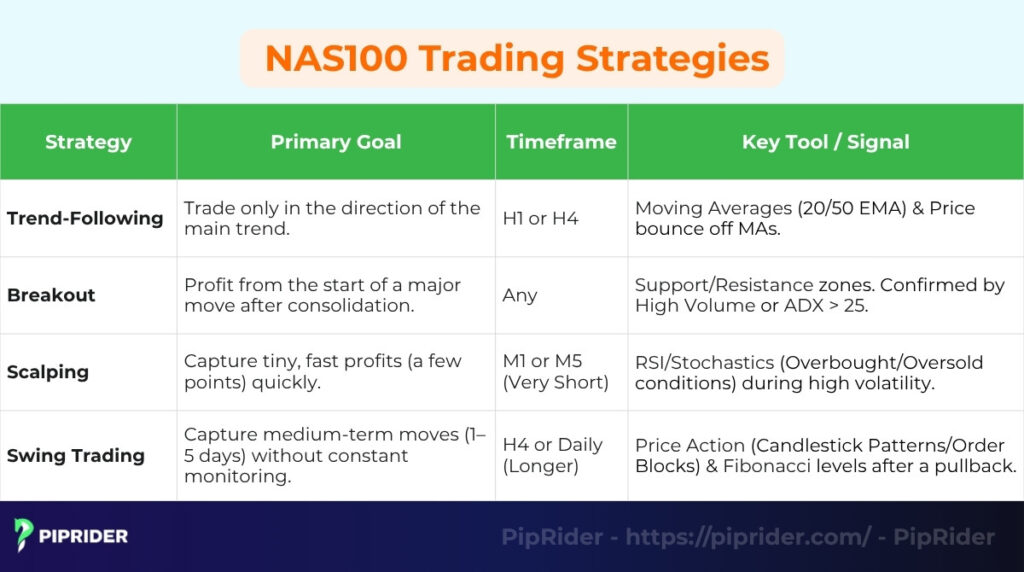
6.1. The “EMA Pullback” (Best for Beginners)
Who is this for? Traders who want safety, clarity, and low stress.
“The trend is your friend” is a cliché, but on the Nasdaq 100, it is the safest way to make money. Instead of trying to guess the top, this strategy simply waits for the price to “rest” before continuing its move.
- Timeframe: H1 (Trend) & M15 (Entry).
- Tools: 20 EMA and 50 EMA.
- The Rules:
- Trend: Price is clearly trading above both EMAs (Uptrend).
- Pullback: Wait for price to dip into the “Dynamic Zone” (the space between the 20 EMA and 50 EMA).
- Trigger: Enter only when a bullish candle CLOSES inside or near the zone. (Do not enter on a wick).
- Exit: TP at the recent High. SL below the 50 EMA.
6.2. The “Breakout & Retest” (Catching Explosions)
Who is this for? Traders who love momentum and big, fast moves.
The NAS100 often pauses in a sideways “box” before exploding. Most beginners lose money here by chasing false breakouts (“Fake-outs”). The secret to survival is patience.
- Timeframe: H1 or H4.
- The “Golden Rule”: Never trade the initial break. Wait for the Retest.
- The Rules:
- Identify: Mark a clear Support & Resistance box.
- Break: Price smashes through the Resistance. Do nothing.
- Retest: Wait for price to drop back and touch the old Resistance (which now acts as Support).
- Trigger: Enter Buy on a bouncing candle at the retest level.
6.3. Swing Trading (Market Structure)
Who is this for? People with full-time jobs or limited screen time. You don’t need to stare at charts all day. This approach is similar to using swing trading signals, you analyze the market once, set your pending orders, and let the price do the work.
- Timeframe: Daily (D1) for bias, H4 for entry.
- Tools: Fibonacci Retracement.
- The Rules:
- Trend: The Daily chart shows clear Higher Highs and Higher Lows.
- Discount: Wait for a deep pullback to the 50% or 61.8% Fibonacci level.
- Trigger: Look for a Pin Bar or Engulfing candle on the H4 chart at these levels.
- Target: Aim for a 1:3 Risk-Reward ratio (Risk $100 to make $300).
6.4. Scalping (Advanced Speed Trading)
Who is this for? Experienced traders with steel nerves and fast execution skills. Scalping aims to steal small profits from the market in minutes. If you love speed, you can apply our specialized 1-minute scalping strategy to the NAS100 for quick entries.
- Timeframe: M1 or M5.
- The Warning: Never scalp during major news (CPI/NFP) or the first 5 minutes of the open due to slippage.
- The Rules:
- Trend Filter: Price must be above the 20 EMA.
- Trigger: Use the Stochastic Oscillator. Buy when the lines cross UP from the oversold zone (below 20).
- Exit: Fast. Take +10 to +15 points fixed profit. Do not be greedy.
Which Strategy Should You Choose?
| Strategy | Difficulty | Time Required | Best For |
|---|---|---|---|
| EMA Pullback | ⭐⭐ (Easy) | Medium | Beginners (Safe & Systematic) |
| Breakout | ⭐⭐⭐ (Med) | Medium | Momentum Lovers |
| Swing Trading | ⭐⭐ (Med) | Low (~30m/day) |
Busy Professionals |
| Scalping | ⭐⭐⭐⭐⭐ (Hard) | High (Intense Focus) |
Full-time / Pro Traders |
7. Best Time to Trade Nasdaq 100 (Schedule & Volatility)
The best time to trade the Nasdaq 100 is strictly during the New York Session, specifically from 09:30 AM to 4:00 PM ET. Unlike Forex pairs, NAS100 liquidity is heavily concentrated in this window. Trading here ensures you get the tightest spreads and the volatility needed for profitable moves.
7.1. The Regular Session (The “Power Hours”)
Although the market is open all day, smart traders focus on specific high-volume windows to maximize efficiency. The US Regular Session drives the index’s true direction. You should focus on these two peak periods:
- The Open (09:30 – 11:30 ET): The first 2 hours offer the highest volume. This is when trends are established and breakout strategies work best.
- The Closing Bell (15:00 – 16:00 ET): Institutional traders rebalance portfolios, causing a final surge in volume and fast price moves before the market closes.
7.2. Time Conversion Table (GMT+7)
Since the US observes Daylight Saving Time (DST), the opening bell in Vietnam shifts twice a year. Use this table to convert the 09:30 AM ET open to your local time:
| Season | US Time (ET) | Vietnam Time (GMT+7) | Note |
|---|---|---|---|
| Summer (DST) (Mid-March to Nov) |
09:30 AM | 20:30 (8:30 PM) | Market opens 1 hour earlier. |
| Winter (Nov to Mid-March) |
09:30 AM | 21:30 (9:30 PM) | Market opens 1 hour later. |
7.3. Pre-Market & Economic News
Volatility often spikes one hour before the official open. This pre-market turbulence is usually caused by high-impact economic data releases that shake the index.
- Key Time: 08:30 AM ET (approx. 19:30 or 20:30 GMT+7).
- Why it matters: Major reports like CPI (Inflation) and NFP (Jobs) are released exactly at this time.
- Advice: Beginners should stay flat (no trade) until the official 09:30 AM open spread stabilizes.
7.4. Times to Avoid (“Dead Zones”)
To preserve your capital, avoid trading during low-liquidity periods. In these “dead zones,” price action is choppy, and spreads can widen significantly.
- The “Lunch Lull” (12:00 – 13:00 ET): Volume drops as Wall Street traders take a break.
- Asian Session: Although Futures (NQ) trade nearly 24 hours via CME Globex, the Asian morning session is usually very slow.
8. What are Fundamental Factors Influencing the Nasdaq 100?
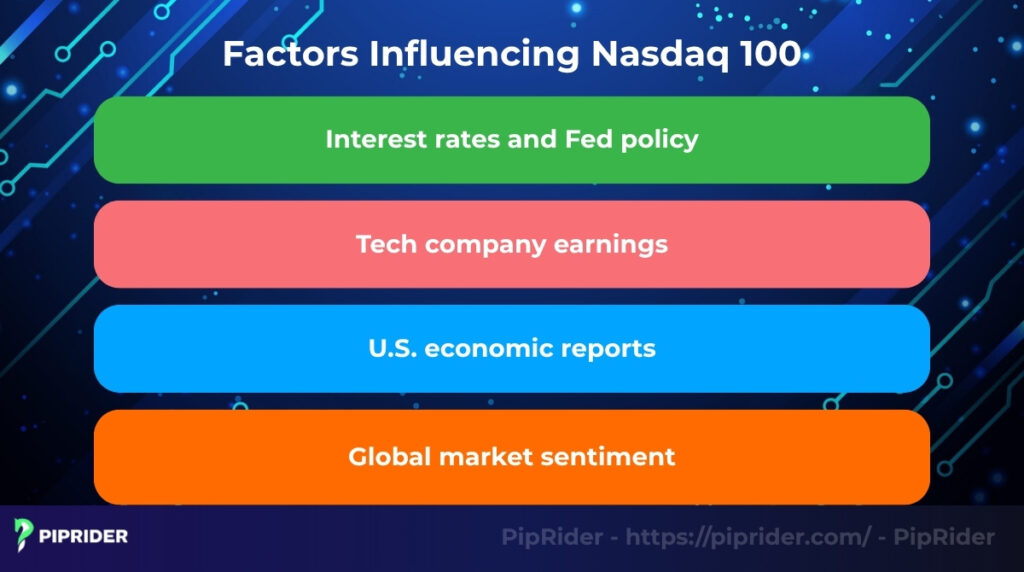
The Nasdaq 100 is highly sensitive to economic news and market sentiment. Understanding what moves the NAS100 is key to a successful trading strategy. These are the main factors to watch.
- Interest rates and Fed policy: This is the most important factor. The NAS100 is an index of “growth” stocks, which are very sensitive to interest rates.
- Higher interest rates (or the fear of them) are generally bad
- Lower interest rates (or “dovish” Fed policy) are generally good
- Tech company earnings: Because the index is dominated by “Big Tech,” its price is directly impacted by the quarterly earnings reports of companies like Apple, Microsoft, NVIDIA, and Amazon. A big miss or beat from one of these companies can move the entire index.
- U.S. economic reports: Key economic data reports can cause high volatility. Traders watch these numbers closely:
- CPI (Inflation)
- GDP (Economic Growth)
- NFP (Non-Farm Payrolls / Jobs)
- PMI (Business activity)
- Global market sentiment: The NAS100 is a “risk-on” asset. When global investors are feeling confident and have a high risk appetite, they buy tech stocks, and the NAS100 rises. When they are fearful (“risk-off”), they sell tech stocks, and the index falls.
9. What are Risk Management Tips for NAS100?
Trading the NAS100 is high-risk due to its volatility. A good strategy is nothing without strong risk management. Here are the most important NAS100 trading tips.
- Always set a clear stop-loss: This is the most important rule. Set a clear stop-loss order for every trade. Never risk more than 1-2% of your total account capital on a single trade. This protects you from large, unexpected losses.
- Avoid trading during major news (Unless Experienced):
- For Beginners: Do not trade exactly when high-impact news (like CPI or Fed Rates) is released. The volatility causes slippage (bad execution prices) and spreads to widen, which can hit your stop-loss instantly. Wait 15-30 minutes for the market to settle.
- For Pros: Some advanced traders specialize in “News Trading,” but they use specialized software and reduced position sizes to handle the risk.
- Use a trailing stop or take partials to protect profits: If your trade is profitable, use a trailing stop. This is a stop-loss that automatically moves up as the price moves in your favor, locking in your profits while still giving the trade room to grow. Taking partials (closing part of your position) is another effective method.
- Keep a trading journal: Write down every trade you take. Record your entry, exit, stop-loss, and the reason you took the trade. Reviewing your trading journal is the best way to find your mistakes, see what works, and optimize your performance over time.
10. What are Common Mistakes When Trading Nasdaq 100?
Many traders are attracted to the NAS100’s volatility but fail because of these common trading mistakes:
- Over-leveraging: The most common error is using too much leverage. Because the NAS100 moves so fast, a small position size can still create large, rapid losses, leading to a margin call.
- Emotional trading (no plan): This involves chasing the price out of “FOMO” (Fear Of Missing Out) or panic-selling during a normal dip, rather than following a tested NAS100 trading strategy.
- Poor stop-loss management: This includes failing to set a stop-loss or, worse, moving a stop-loss further away (widening the risk) during a losing trade.
- Chasing news: Traders often react instantly to a news headline without waiting for technical confirmation. They end up buying the exact top or selling the exact bottom of the move.
11. Frequently asked questions about Trading NAS100 (Nasdaq 100)
12. Conclusion
The NAS100 is an ideal index for traders who are comfortable with high volatility. It offers many opportunities but also carries significant risk.
Successfully learning how to trade NAS100 is not just about a single strategy; it is about combining sound technical analysis, strict risk management, and personal discipline. By mastering this combination, a trader can learn to leverage the power of the Nasdaq 100 to build consistent profits.
To learn more about specific trading strategies, follow PipRider for in-depth guides and analysis.