What separates successful traders from the rest? It’s not luck; it’s a well-defined strategy. Without a clear set of rules for entry, exit, and risk control, trading becomes a gamble driven by speculation. This guide breaks down 12 proven forex trading strategies, from short-term to long-term. It provides a complete playbook for anyone learning to trade currency successfully, all while understanding the power of leverage.
Key Takeaways
- A forex trading strategy is a crucial set of rules that guides a trader’s buy and sell decisions, removing emotion and guesswork.
- 12 popular strategies with key methods including trend following, range trading, and breakout trading.
- Finding an effective forex trading method depends on a trader’s personal style, risk tolerance, and time commitment.
- No model is complete without strict risk control rules, such as using a stop-loss on every trade.
1. What Are Forex Trading Strategies?
Forex trading strategies are a defined set of rules that a trader uses to determine when to buy or sell currency pairs. An effective strategy outlines the exact conditions for entry, exit (both for profit and loss), and how much to risk on a trade, with the goal of removing emotion and creating a consistent, repeatable process.
Forex trading can be broadly categorized based on the intended holding time of the trades. This table provides a clear overview of the main types, from short-term to long-term strategies.
| Category | Holding Period | Primary Goal | Key Trading Styles | Best For |
|---|---|---|---|---|
| Short-Term | Seconds to Hours (Intraday) | Capture small price swings; zero overnight exposure. | Scalping, Day Trading | Active traders with fast reflexes and high daily screen time. |
| Long-Term | Days to Years | Ride macro trends; ignore intraday “market noise.” | Swing Trading, Position Trading | Part-time traders, investors, or those with full-time careers. |
Core Components of an Effective Strategy
A complete system forex traders use must have three non-negotiable components:
- Entry Signals: Clear, objective rules for when to buy or sell currency pairs, based on technical or fundamental analysis.
- Exit Rules: This includes both a take-profit target to lock in gains and, more importantly, a stop-loss to limit potential losses.
- Risk Management: This defines how much to risk on a trade, typically by calculating a position size that adheres to a strict percentage of your total account capital, while effectively utilizing leverage.
2. How to Create a Forex Trading Strategy
Creating a personal forex trading strategy is a crucial step in a trader’s journey. A solid strategy is built on a foundation of self-awareness and clear, objective rules. Here are the four essential steps:
- Define goals and trading style: First, a trader must define their objectives (e.g., long-term growth vs. daily income) and understand their own personality.
- Select markets and timeframe: Next, choose the currency pairs you will focus on and the primary timeframe you will analyze. A beginner should focus on just one or two major pairs to start.
- Choose analysis tools: Decide on the specific tools you will use for entry and exit signals. This could be based on technical indicators (like Moving Averages or RSI) or pure price action (like trading patterns).
- Establish risk management rules: This is the most important step. A trader must define their risk control rules, including the maximum percentage of capital to risk per trade (the 1-2% rule). The method for setting a stop-loss on every position, along with the discipline to manage their leverage, is also a crucial part of these rules.
3. Top 12 Forex Trading Strategies: The Playbook
Below is a breakdown of the 12 most effective forex trading strategies. To use this guide effectively, scan for the methodology that fits your personality and time commitment, review the Strategy Blueprint, and test your chosen method on a demo account before risking real capital.
| Strategy Name | Core Mechanism | Ideal Timeframe |
|---|---|---|
| 1. Trend Trading | Buying pullbacks in an established trend. | 4-Hour, Daily |
| 2. Range Trading | Buying support, selling resistance in sideways markets. | 1-Hour, 4-Hour |
| 3. News Trading | Capturing extreme volatility during economic releases. | 1-Min, 5-Min |
| 4. Retracement (Fibonacci) | Entering trends at calculated mathematical pullback levels. | 1-Hour, 4-Hour |
| 5. Grid Trading | Automated order nets to capture sideways volatility. | 1-Hour, 4-Hour |
| 6. Carry Trade | Profiting from central bank interest rate differentials. | Daily, Weekly |
| 7. 50-Pips-a-Day | Trading the initial London session volume breakout. | 1-Hour |
| 8. One-Hour Forex | Trading the breakout of the previous hour’s extremes. | 1-Hour |
| 9. Day Trading | Capturing daily trends; zero overnight risk. | 15-Min, 1-Hour |
| 10. Scalping | High-frequency trading for micro-profits (5-10 pips). | 1-Min, 5-Min |
| 11. Swing Trading | Holding trades for days to catch structural price waves. | 4-Hour, Daily |
| 12. Position Trading | Macroeconomic investing held for months or years. | Weekly, Monthly |
3.1. Trend Trading (The Pullback Strategy)
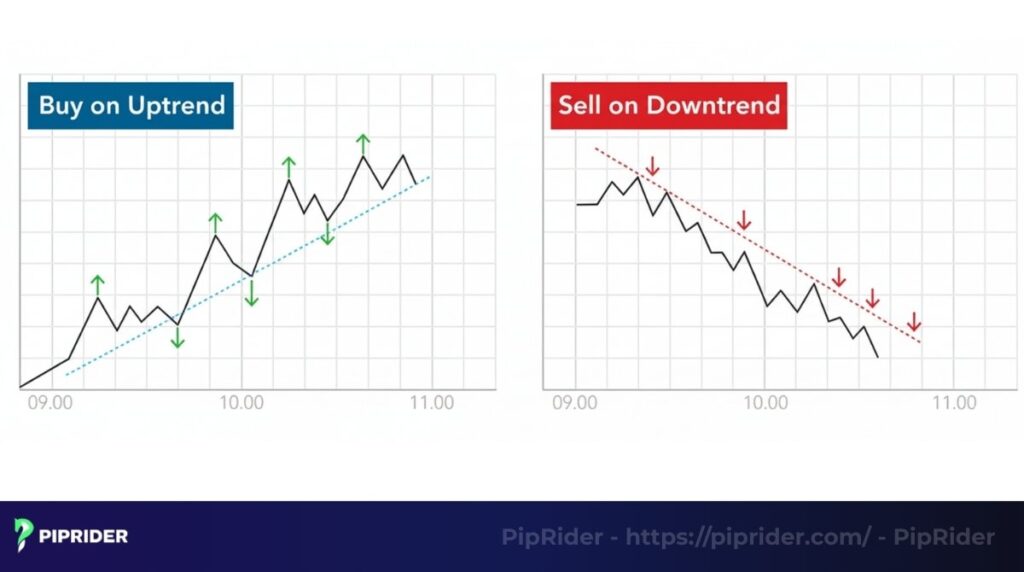
Trend trading involves identifying the market’s primary direction and entering only when the price makes a temporary retreat. Instead of trying to predict exact tops or bottoms, you wait for the market to “breathe” before joining the dominant momentum.
- Best Market Condition: Clear Uptrend or Downtrend (identifiable on Daily/4H charts).
- Entry Trigger: Price pulls back to a dynamic support/resistance level (like the 21 EMA) and prints a reversal candlestick pattern (e.g., a pin bar or engulfing candle).
- Stop-Loss (SL): Placed safely beyond the recent swing point (below the swing low for longs, above the swing high for shorts) to survive market noise.
- Take-Profit (TP): Target the next major structural zone, or trail the stop-loss behind moving averages to ride the trend to exhaustion.
3.2. Range Trading (Support & Resistance Bounce)
Range trading is used when a market is moving sideways between two key price levels. It is a price action strategy based on the concepts of support and resistance. Range traders buy near support and sell near resistance only after confirmation.
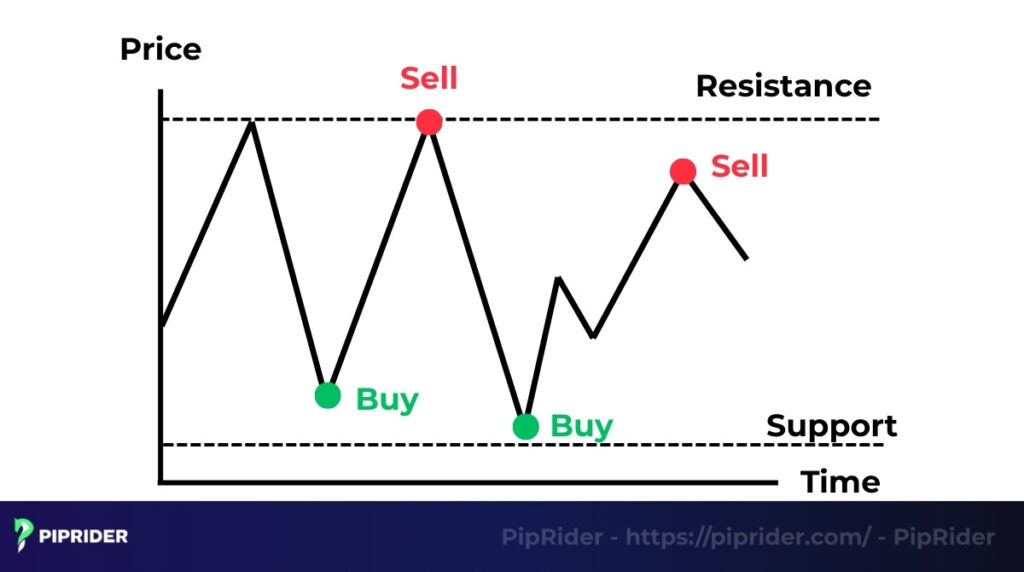
- Entry Trigger (Buy/Sell): For a long entry, wait for the price to test support and print a bullish rejection candle. For a short entry, wait for the price to test resistance and print a bearish rejection candle.
- Stop-Loss (SL): Placed securely beyond the range boundary (below support or above resistance) with a small spread buffer to survive false breakouts.
- Take-Profit (TP): Secure partial profits at the mid-range level first, then target the opposite boundary for the final exit.
- Trade Filter: Strictly avoid trading ranges during high-impact news events, and skip the setup entirely if the range is too tight (which creates a poor Risk/Reward ratio).
3.3. News Trading (Volatility Breakout)
News trading focuses on capturing the massive, instantaneous volatility injected into the market during high-impact economic releases (such as Non-Farm Payrolls or central bank rate decisions). It requires lightning-fast execution.
- Best Market Condition: Extreme volatility immediately following a major, unexpected macroeconomic data release.
- Entry Trigger: Entering a breakout of the pre-news consolidation box, or waiting 5-15 minutes for the initial “whipsaw” to settle before entering a pullback in the direction of the fundamental surprise.
- Stop-Loss (SL): Extremely tight, placed outside the breakout candle. (Pro Tip: Standard stop-losses can suffer severe slippage during news; use a Guaranteed Stop Loss if your broker offers it).
- Take-Profit (TP): A fixed risk multiple (e.g., 1:2 or 1:3 R:R) executed quickly before the market digests the news and retraces.
3.4. Retracement Trading (The Fibonacci Approach)
This strategy uses mathematical ratios to find the end of a pullback. Traders use the Fibonacci retracement tool to measure a previous directional wave and find hidden support/resistance levels where the market is statistically likely to resume its trend.
- Best Market Condition: Trending markets experiencing a standard, orderly correction.
- Entry Trigger: Price touches a key Fibonacci level (typically the 50% or 61.8% retracement) and forms a clear price action reversal pattern.
- Stop-Loss (SL): Placed firmly beyond the 78.6% Fibonacci level, or outside the absolute origin of the measured wave (100% level) to invalidate the setup.
- Take-Profit (TP): The 0% level (the recent extreme high/low), or extended structural targets like the -27% or -61.8% Fibonacci extensions.
3.5. Grid Trading (The Automated Net)
Grid trading does not rely on predicting market direction. It involves placing a mathematical “net” of buy and sell stop orders at set intervals above and below the current price. As the price fluctuates, it automatically opens and closes positions to capture volatility.
- Best Market Condition: Ranging, choppy, or consolidating markets.
- Entry Trigger: Automatic execution when the price hits pre-set pip intervals (e.g., placing orders every 20 pips).
- Stop-Loss (SL): Crucial Rule: While individual orders may not have tight stops, an absolute account equity stop-loss (e.g., max 5% drawdown) must be set to prevent margin calls if a strong, one-directional trend unexpectedly breaks out.
- Take-Profit (TP): A fixed, small pip target for each individual grid level (e.g., 15 pips per grid line).
3.6. Carry Trade (The Interest Earner)
The Carry Trade is a macroeconomic strategy where you profit from the interest rate differential between two countries. You buy a currency with a high-interest rate and fund the trade by selling a currency with a low-interest rate, earning daily “rollover” fees.
- Best Market Condition: Low market volatility, stable global economic growth, and clear central bank policy divergence.
- Entry Trigger: Buying fundamentally strong, high-yield pairs (e.g., historically AUD/JPY or NZD/JPY) when they break long-term resistance or confirm an uptrend on weekly charts.
- Stop-Loss (SL): Very wide, placed below major weekly or monthly structural support to withstand normal market fluctuations.
- Take-Profit (TP): Open-ended. The primary goal is to hold the position for months or years to accumulate continuous interest yield, rather than just capital appreciation.
3.7. 50-Pips-a-Day (The Morning Breakout)
The 50-Pips-a-Day is a popular day trading technique that aims to capture a fixed profit of 50 pips from the early morning volatility of highly liquid pairs like EUR/USD or GBP/USD.
- Entry Trigger: Place a buy-stop order a few pips above the high and a sell-stop order a few pips below the low of the 7:00 AM candle (GMT). Once one order is triggered, the other is automatically cancelled.
- Stop-Loss (SL): Placed at the opposite extreme of the setup candle to limit risk.
- Take-Profit (TP): Strictly fixed at a 50-pip target.
- Crucial Timing Note: Define the setup by the actual London session open window rather than a fixed GMT time if you want consistency during daylight-saving periods (DST shifts).
3.8. One-Hour Forex (The Hourly Momentum)
This strategy capitalizes on short-term intraday momentum shifts. It uses the previous hour’s high and low as a micro-support and resistance box, anticipating a breakout in the current hour’s trading.
- Best Market Condition: Active intraday trading, highly effective during the London and New York session overlaps.
- Entry Trigger: A buy-stop order placed a few pips above the previous hour’s high; a sell-stop order placed below the previous hour’s low.
- Stop-Loss (SL): Placed on the opposite side of the breakout candle, or a fixed 15 to 20-pip stop (whichever is smaller).
- Take-Profit (TP): A quick, fixed target of 20 to 30 pips to capture the immediate momentum burst.
3.9. Day Trading (Intraday Momentum)
Day trading is a broader style where all positions are opened and closed within the same trading day. Day traders rely heavily on volume and intraday technical indicators to capture standard daily moves without overnight exposure.
- Best Market Condition: High intraday volume and a clear directional bias on liquid pairs.
- Entry Trigger: Breakout of the intraday VWAP (Volume Weighted Average Price), a crossover of short-term moving averages, or a break of daily opening ranges.
- Stop-Loss (SL): Tightly placed securely outside the extreme of the setup candle or key intraday moving average.
- Take-Profit (TP): Target the next major intraday resistance/support level, or close manually before the New York session ends, regardless of profit or loss.
3.10. Scalping (High-Frequency Trading)
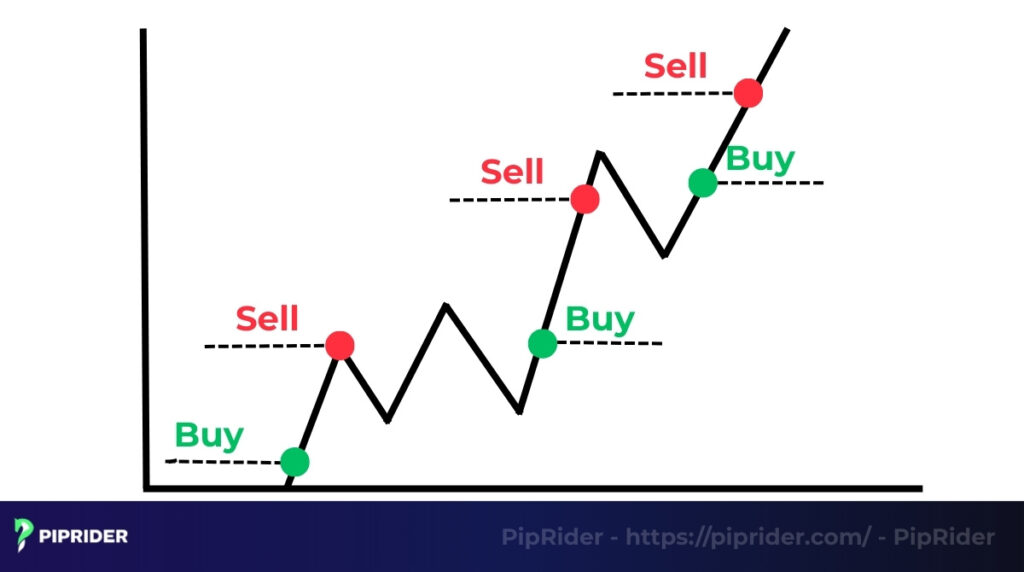
Scalping is the most aggressive and fastest strategy, aiming to capture tiny price movements created by order flows. It requires extreme focus, lightning-fast execution, and a broker offering ultra-low spreads.
- Best Market Condition: Peak liquidity hours with the tightest possible spreads (strictly avoiding major news event times).
- Entry Trigger: Momentum shifts on 1-minute scalping or 5-minute charts, often confirmed by an oscillator (like the Stochastic) crossing from extreme overbought/oversold zones.
- Stop-Loss (SL): Extremely tight, often just 3 to 5 pips below/above the entry to cut losses instantly.
- Take-Profit (TP): Quick, fixed targets of 5 to 10 pips, relying on a high volume of trades to accumulate profit.
3.11. Swing Trading (Riding the Waves)
Swing trading bridges the gap between day trading and long-term investing. The goal is to capture a single “swing” or wave within a larger trend, holding positions for a few days to a few weeks.
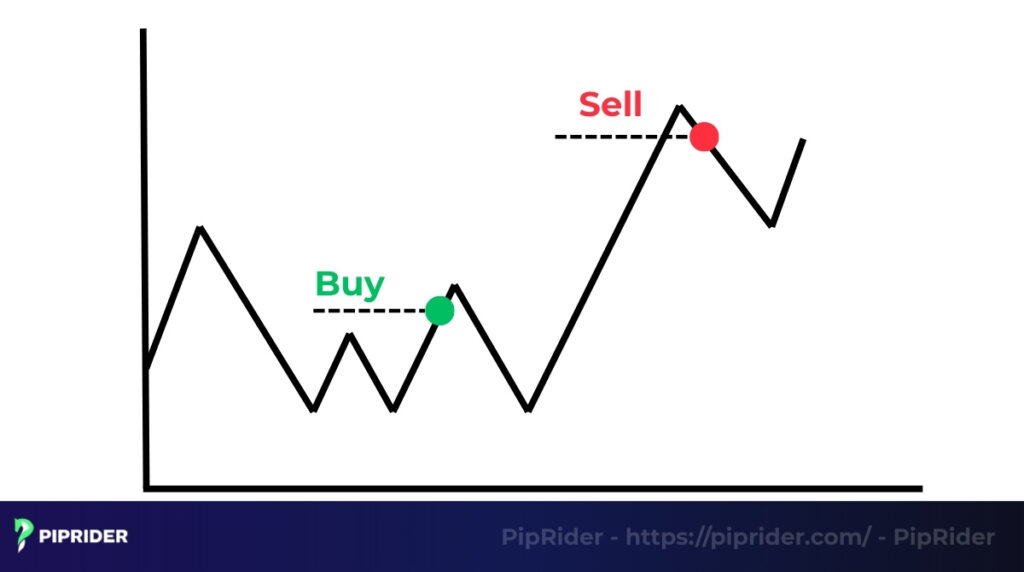
- Best Market Condition: Markets making clear higher highs (uptrend) or lower lows (downtrend) on the Daily chart.
- Entry Trigger: Price action reversal signals (such as an Inside Bar or Pin Bar) forming at major 4H or Daily support/resistance zones.
- Stop-Loss (SL): Placed securely beyond the daily swing point or major structural level to give the trade room to develop.
- Take-Profit (TP): Target the next major weekly or daily structural zone, capturing a larger chunk of the market move.
3.12. Position Trading (The Macro Approach)
Position trading is akin to investing applied to the currency market. Traders ignore daily fluctuations entirely, focusing on macroeconomics, central bank cycles, and long-term geopolitical shifts.
- Best Market Condition: Major macroeconomic shifts, sustained interest rate cycles, and long-term secular trends.
- Entry Trigger: Fundamental divergence (e.g., one country hiking interest rates aggressively while another cuts) confirmed by a technical breakout on the Weekly or Monthly chart.
- Stop-Loss (SL): Very wide, often calculated using a multiple of the Weekly ATR (Average True Range) to survive months of normal volatility and pullbacks.
- Take-Profit (TP): Open-ended. The position is closed only when the fundamental macroeconomic narrative that initiated the trade changes.
4. How to Trade Forex Strategies Effectively
Having a list of strategies is one thing; applying them effectively is another. Here’s how to test, refine, and execute a forex strategy like a professional.
4.1. How to Test a Strategy (Backtesting & Demo)
Never risk real money on an untested system. The two essential testing phases are:
- Backtesting: Manually or automatically go through historical price data to see how your method would have performed in the past. This helps you identify its potential strengths and weaknesses.
- Demo Trading: After successful backtesting, trade the plan in real-time on demo accounts. This tests your ability to execute the framework under live market conditions without risking any real capital.
4.2. When to Change or Combine Strategies
No single strategy works in all market conditions. A common mistake is to abandon a method after a few losses. Give your system a fair test (e.g., at least 20-30 trades). Consider changing or adapting your plan only if it shows a consistent negative performance over a large sample of trades.
Advanced traders often learn to combine tactics, for example, using a trend-following approach on the daily chart while using a range-bound strategy on a 1-hour chart for a different pair.
4.3. A Real-World Case Study
Let’s look at a simple swing trading setup on the GBP/USD:
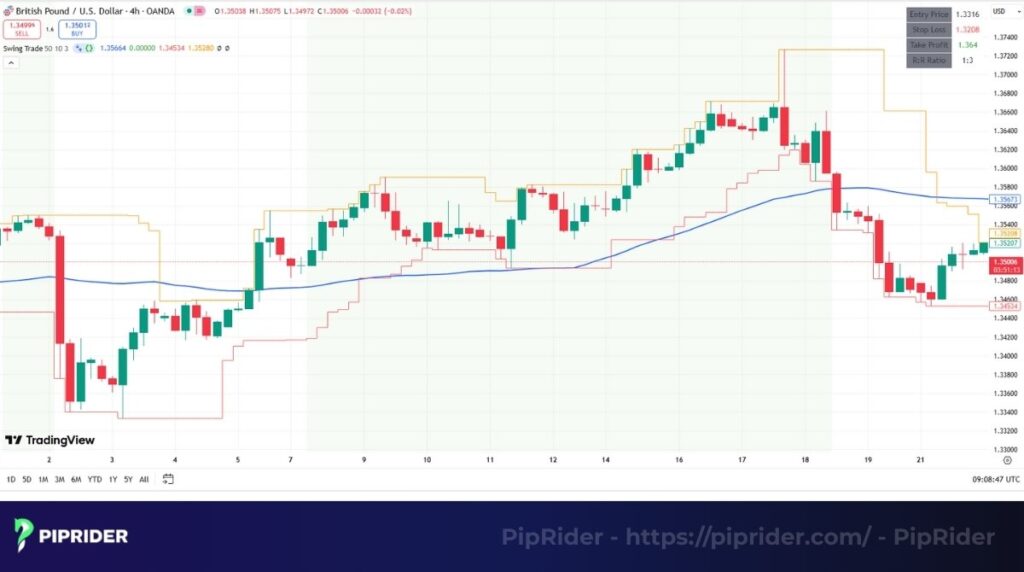
- The Setup: The pair was in a clear daily uptrend. Price pulled back to a key structural support level, which perfectly coincided with the 50-day moving average (creating a zone of confluence).
- The Entry: A bullish engulfing candle formed at this support zone. A long position was executed immediately upon the candle’s close.
- The Exit: The stop-loss was placed safely below both the support level and the moving average. The take-profit targeted the next major daily resistance, establishing a strict 1:3 risk/reward ratio.
- The Result: The price rejected the confluence area and rallied to the take-profit target over the next few days.
5. Advantages and Limitations of Forex Strategies
The primary advantage of employing a defined forex trading methodology is that it provides discipline and a clear sense of direction under specific market conditions. A strictly rule-based approach removes emotional decision-making—such as fear and greed—from the equation. Furthermore, it makes it easy to track a large sample of trades, allowing for objective assessment and continuous improvement.
However, it’s crucial to understand the limitations. Not every strategy is suitable for every trader; a plan must match an individual’s personality, screen time, and risk tolerance. Additionally, even the most robust technical frameworks can be vulnerable to the extreme volatility caused by major news events, which can lead to unexpected losses if leverage and stop-losses aren’t strictly managed.
6. Common Mistakes to Avoid
Developing a strategy is one thing; executing it consistently is another. Here are some of the most common mistakes traders make that can undermine even the best forex trading methods.
- Overtrading: This is especially a risk with short-term tactics like scalping or news trading. Taking too many trades out of impatience or a desire for action often leads to poor-quality setups and mounting transaction costs.
- Trading without a stop loss: Failing to place a stop loss on every single trade turns a calculated risk into an unlimited one, especially when using high leverage.
- Using too many indicators: Cluttering your charts with too many indicators often leads to conflicting signals and indecision. A good strategy for forex trading typically relies on just a few, well-understood tools.
- Blindly copying another trader’s plan: A system that works for one person may not work for another due to differences in psychology and risk tolerance. It’s essential to test and customize any framework to fit your own personal style and your broker’s conditions.
7. Frequently Asked Questions (FAQs)
8. Conclusion
This guide has explored twelve distinct forex trading strategies, from the ultra-fast pace of scalping to the long-term perspective of position trading. It is crucial to remember that there is no single “best” strategy. The most profitable strategy is the one that you can understand, execute with discipline, and that fits your personal goals and risk tolerance.
Our key advice is to choose one or two models that resonate with you, test them thoroughly on demo accounts, and keep a detailed trade journal to track your performance. This is the foundation of how to trade forex successfully.
To continue developing your personal trading system, we encourage you to explore our in-depth guides in the Trading Strategies category on Piprider.