If you’ve ever felt overwhelmed staring at a trading chart cluttered with lines, especially as a beginner, you’re not alone. With hundreds of technical indicators available, it’s easy to fall into the trap of analysis paralysis. But the secret of professional traders isn’t using dozens of tools at once; it’s mastering a select few that work for their strategy.
In this guide, Piprider will cut through the noise. We won’t just list the best technical indicators; we’ll explain how they work in simple terms and help you build a clean, effective analytical process. Think of this as your essential roadmap to understanding what’s really happening on your charts!
Key Takeaways
- Technical indicators use past price/volume data to provide market insights, not guaranteed future predictions.
- Most indicators fall into Trend-Following, Momentum Oscillators, Volatility, or Volume categories, each serving a distinct purpose.
- Combining a few non-correlated indicators from different groups often yields stronger signals than relying on just one.
- Don’t overload charts with redundant indicators, always consider price action, and understand no single indicator is a “holy grail.”
- Professional trading relies on deeply understanding a few chosen indicators within a disciplined strategy, not using dozens superficially.
1. What is a technical indicator? – Basic definition
In essence, a technical indicator runs a mathematical calculation on historical price or volume data, transforming raw numbers into visual market clues.
According to the 2025 BIS Triennial Central Bank Survey, the foreign exchange market turnover has reached a staggering $9.6 trillion per day. In such a massive and high-speed environment, technical indicators are essential tools used by both retail traders and institutional giants to navigate the $9.6 trillion daily flow.
Think of them less as predictive crystal balls and more as analytical co-pilots. Their job is to help you objectively assess market conditions by:
- Identifying the prevailing trend and its strength.
- Gauging the momentum behind price moves.
- Highlighting potential entry and exit zones.
- Understanding market volatility to manage risk.
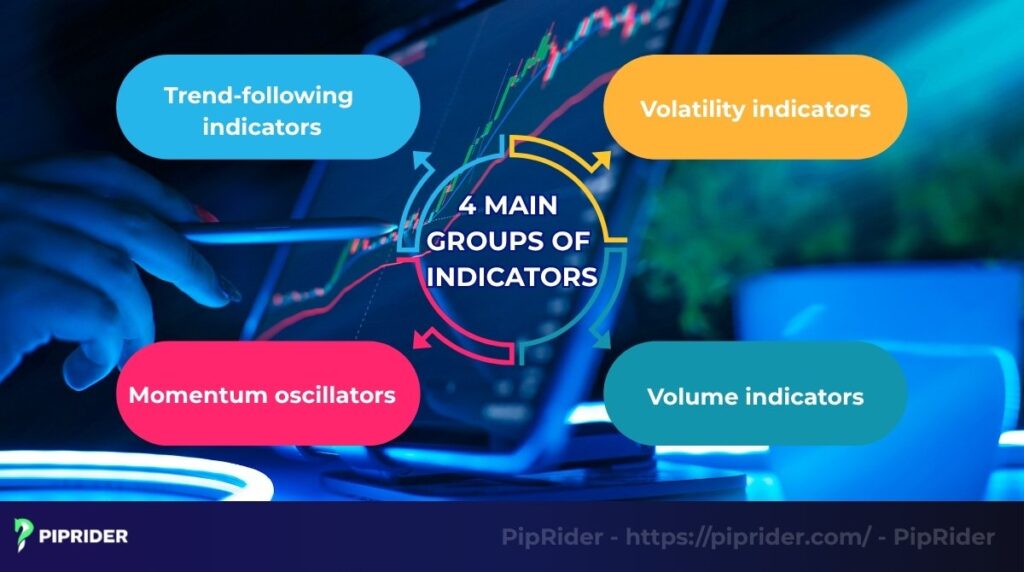
2. The 4 main groups of indicators: A simple classification
To build a coherent trading strategy, it helps to know that most indicators fit into one of four families. Each has a different job, and real insight comes from combining them thoughtfully.
- Trend-following indicators: Their sole purpose is to tell you which direction the market is heading.
- Momentum oscillators: These measure the speed and strength of price changes, often signaling when a market is overbought or oversold.
- Volatility indicators: These tell you how calm or explosive a market is, which is crucial for risk management.
- Volume indicators: These act as a lie detector, using trading volume to confirm whether a trend has real conviction behind it.
3. The Piprider Framework: How to Choose Your Indicators
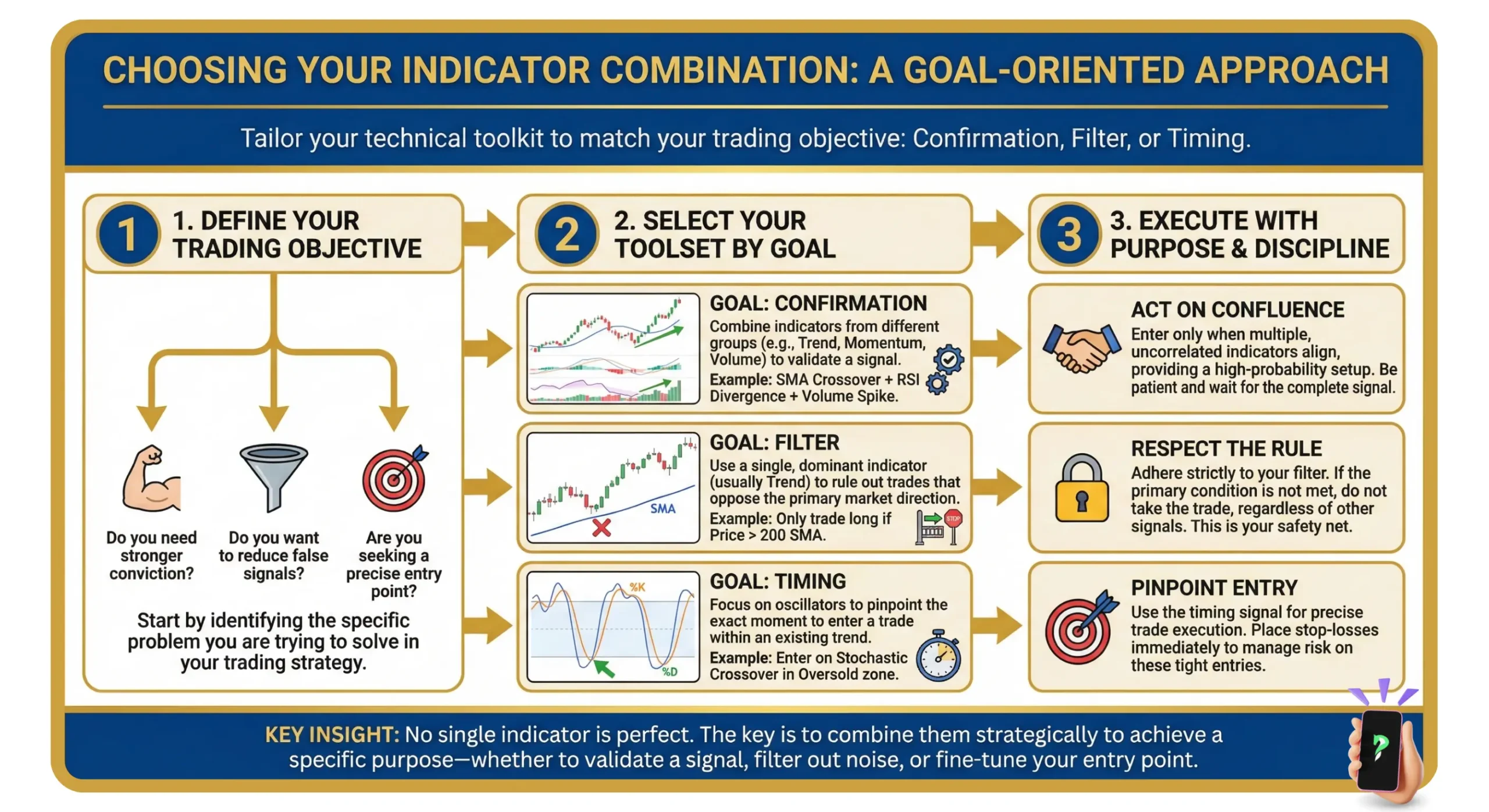
Knowing 15 indicators is useless if you don’t know how to combine them. A common trap for beginners is throwing random tools onto a chart hoping for a magic signal.
First, you need a basic decision framework based on your immediate trading goal:
| Your Trading Goal | The Best Indicator to Use |
|---|---|
| Identify the main trend | Moving Average (MA) |
| Find a potential reversal | Relative Strength Index (RSI) |
| Confirm momentum strength | MACD |
| Measure market volatility | Bollinger Bands |
Once you know what tool serves what purpose, you can avoid redundancy. To build a professional, profitable system, you must follow a strict selection framework.
Here is the 3-Step Piprider Framework for building your chart:
Step 1: Define Your Market Environment
Indicators are highly specialized. Before picking a tool, you must know what the market is doing right now.
- Are you in a strong, trending market? You need Trend-Following tools (like MA or ADX).
- Are you in a sideways, choppy market? Trend tools will give you false signals; you need Momentum Oscillators (like RSI or Stochastic) to trade the range.
Step 2: Apply the “Rule of 3” (Non-Correlation)
Never use indicators from the same category. If you use RSI, MACD, and Stochastic together, you are just looking at the exact same momentum data displayed in three different ways (this is called multicollinearity). The Golden Rule: Choose a maximum of 2 to 3 indicators, and ensure they come from different groups:
- 1 for Direction: (e.g., Moving Average)
- 1 for Timing/Momentum: (e.g., RSI)
- 1 for Risk/Volatility: (e.g., ATR)
Step 3: Price Action is King
Indicators are derivatives of price; they lag behind real-time market action. Your framework should always be: Look at the candlestick structure first, then use the indicator to confirm what your eyes are already seeing. If the indicator contradicts an obvious price action breakout, trust the price.
Beginner Shortcut (The TL;DR)
If you are completely new, don’t overcomplicate things. Follow this simple formula:
Use 1 Trend Indicator (like MA) + 1 Momentum Indicator (like RSI). Avoid using too many tools at once to prevent analysis paralysis!
Quick Selection Cheat Sheet (By Trading Style)
Now that you understand the framework, here is the Piprider cheat sheet tailored to your specific needs. Use this to quickly find the exact combination that matches your trading style:
| Best For… | Top Indicators | Why It Works |
|---|---|---|
| Beginners | Moving Average (MA) & RSI | Simplest to read visually. MA shows the clear trend, while RSI prevents buying at the absolute top. |
| Trend Following | MACD & ADX | ADX confirms if a trend is actually strong enough to trade. MACD helps time the entry into that wave. |
| Day Trading / Scalping | VWAP & Stochastic | VWAP provides the ultimate daily institutional baseline. Stochastic reacts faster to intraday momentum shifts. |
| The “Holy Grail” Combo | MA + RSI + ATR | Combines non-correlated tools: MA for direction, RSI for momentum trigger, and ATR for adaptive stop-loss sizing. |
4. Top 15 best technical indicators for every strategy
Here are the top 15 technical indicators, clearly categorized into four main groups: Trend-Following Indicators, Momentum Oscillators, Volatility Indicators, and Volume Indicators, along with some important supplementary tools.
4.1. Trend-Following Indicators
These indicators are designed to help you identify the direction of the prevailing market trend, allowing you to trade in alignment with the market’s momentum rather than fighting it.
4.1.1. Moving Average (MA)
A Moving Average smooths out price data to create one clear, flowing line, making it far easier to see the underlying trend. As a general rule, a bullish trend is indicated when price action stays consistently above the MA, whereas a bearish trend is suggested by price action remaining below it.
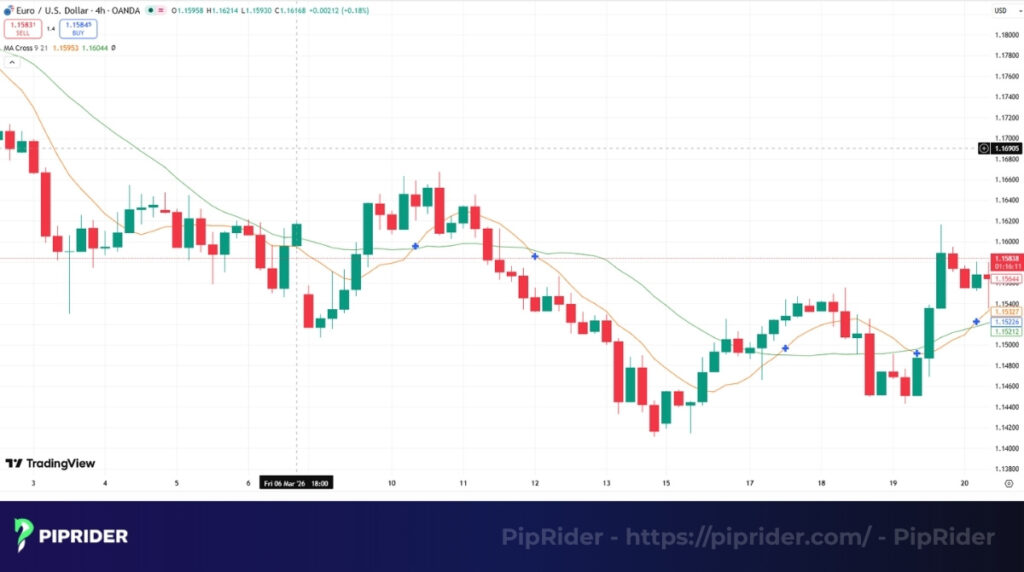
Traders often look for the well-known ‘Golden Cross’, when a shorter-period MA moves over a longer-period one, as a major bullish event. Its bearish counterpart, the ‘Death Cross,’ is treated as a serious sell warning.
- How to use: Use it to smooth the price and identify the main trend. Price above MA suggests an uptrend; below MA suggests a downtrend. Identifying the primary trend through moving averages remains a core concept in market analysis (Murphy, 1999). Look for a “Golden Cross” to buy or a “Death Cross” to sell.
- Standard Settings: Use 20 for short-term, 50 for medium-term, and 200 for long-term trends.
4.1.2. Moving Average Convergence Divergence (MACD)
Developed by Gerald Appel in the late 1970s, the MACD is recognized by institutions like the CFA Institute as one of the most reliable trend-following momentum indicators. This versatile indicator captures both trend and momentum by tracking the relationship between two moving averages. While the MACD is an excellent all-rounder, it can sometimes lag in very short-term setups due to its calculation method.
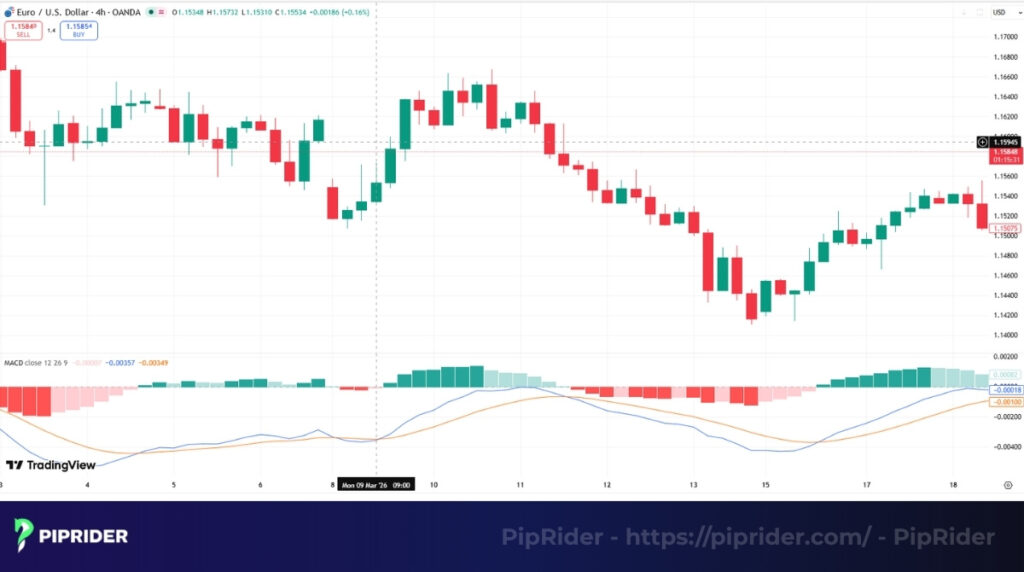
For faster momentum signals, particularly in day trading scenarios, some traders may prefer the Stochastic oscillator. However, for swing trading on daily charts, the MACD is widely regarded for its reliability in identifying sustained moves.
- How to use: Identify momentum and trend changes. A buy signal occurs when the MACD line crosses above the signal line; a sell signal when it crosses below. Also, look for divergence between the price and the MACD.
- Standard Settings: 12, 26, 9 (Fast EMA, Slow EMA, and Signal Line).
4.1.3. Ichimoku Cloud (Kumo)
Despite its complex appearance, the Ichimoku Cloud provides a complete market snapshot. It uses two primary lines: the Tenkan-sen (Conversion Line) for short-term momentum and the Kijun-sen (Base Line) for medium-term trend, alongside the “Cloud” (Kumo) which identifies dynamic support and resistance zones.
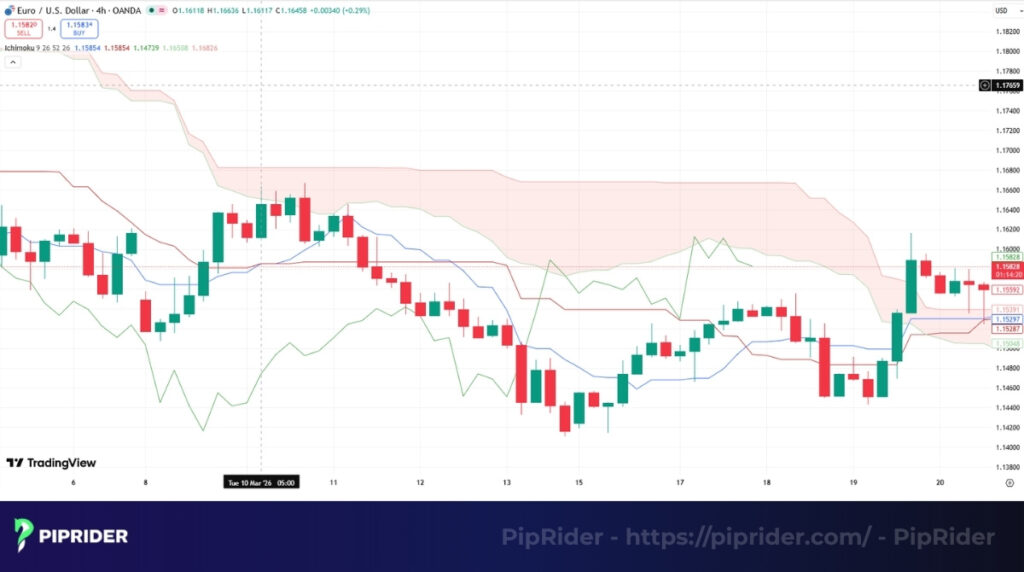
A primary signal is the price’s position relative to the “Cloud” (Kumo) itself. A clean price break above the Cloud is considered a strong bullish signal, while a break below the Cloud suggests bearish control.
- How to use: Provides a holistic view of trend, momentum, support, and resistance. Price above the Cloud indicates an uptrend; price below the Cloud indicates a downtrend.
- Standard Settings: 9, 26, 52 (Tenkan-sen, Kijun-sen, and Senkou Span B).
4.1.4. Parabolic SAR
The Parabolic Stop and Reverse appears as a series of dots on a chart, either above or below the price candles. While it can be used to signal potential entries, its primary strength is often considered to be in trade management.
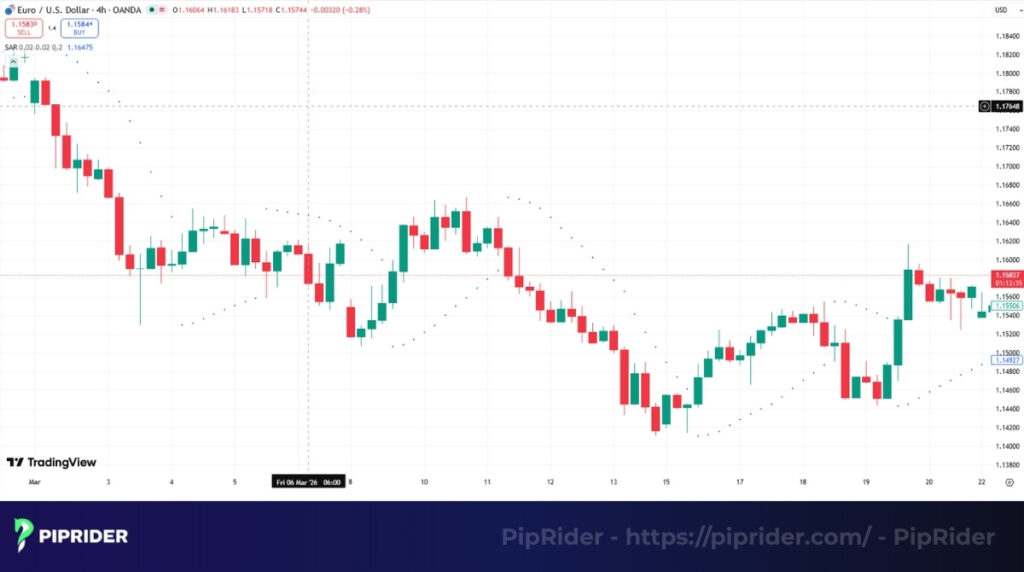
It provides a dynamic trailing stop-loss level that automatically adjusts as the trend progresses. This offers a systematic, non-emotional method for protecting profits during a sustained move.
- How to use: Use to track trends and manage stop-losses. Dots below the price indicate an uptrend; dots above the price indicate a downtrend. A flip in the dots’ position signals a potential stop and reverse point.
- Standard Settings: Step 0.02, Maximum 0.2.
4.2. Momentum Oscillators
These indicators measure the speed and strength of price movements, helping you identify when a market might be overextended or ripe for a reversal.
4.2.1. Relative Strength Index (RSI)
Introduced by J. Welles Wilder Jr. in his seminal 1978 book, New Concepts in Technical Trading Systems, the RSI acts like a momentum speedometer for the market, measuring the speed and magnitude of recent price changes on a scale of 0 to 100. While beginners often focus on the classic overbought (>70) and oversold (<30) levels, divergence is considered its most powerful signal.
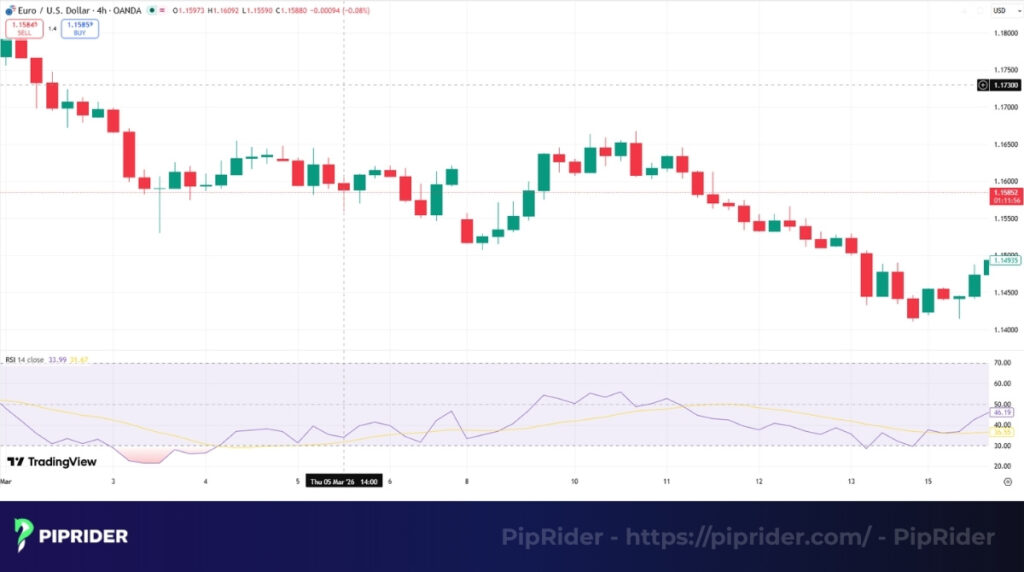
For example, during a strong rally, if the price makes new highs while the RSI simultaneously makes lower highs (bearish divergence), it signals weakening momentum and warns of a potential reversal. This divergence can provide early indication to protect profits or consider counter-trend opportunities.
- How to use: Measures the speed and change of price movements. Readings above 70 are typically considered overbought, while readings below 30 are considered oversold. Look for divergence between the RSI and price action for strong reversal signals.
- Standard Settings: 14 periods. (Watch levels 70/30 or 60/40 for trend-following).
4.2.2. Stochastic Oscillator
The Stochastic Oscillator is another momentum indicator, often considered more sensitive than the RSI. It also identifies overbought (typically >80) and oversold (typically <20) conditions by comparing a closing price to its price range over a specific period.
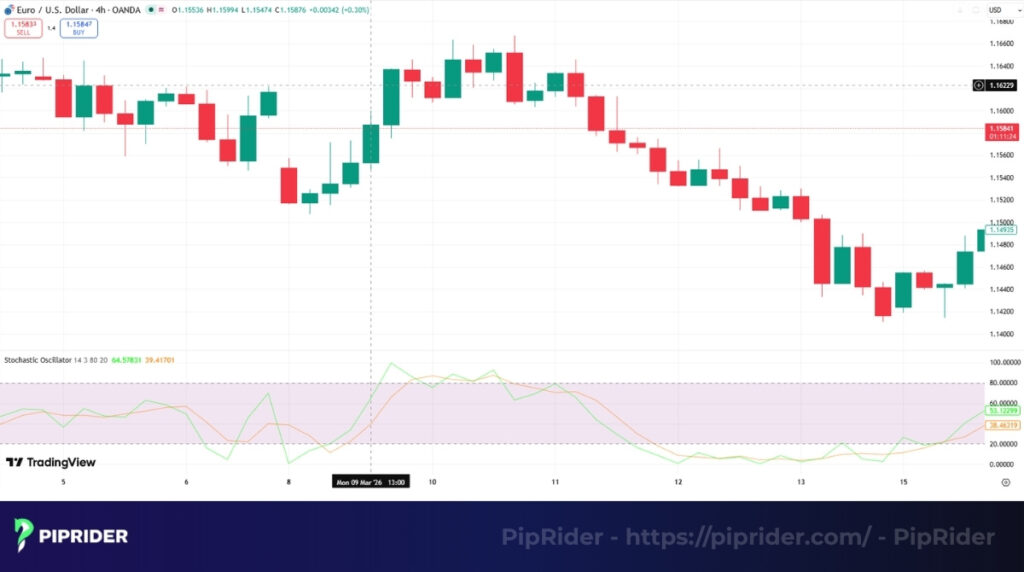
Due to its calculation method, the Stochastic tends to react more quickly to price changes than indicators like the MACD. This responsiveness makes it a popular choice among traders focusing on shorter timeframes.
- How to use: Identifies overbought (>80) and oversold (<20) conditions. Look for crossovers of the %K line (fast line) and %D line (slow line) within these extreme zones as potential entry or exit signals.
- Standard Settings: 14 periods. (Watch levels 70/30 or 60/40 for trend-following).
4.2.3. Williams %R
Created by legendary trader Larry Williams, the Williams %R is a fast and sensitive momentum oscillator that operates similarly to the Stochastic Oscillator but uses an inverted scale ranging from 0 to -100.
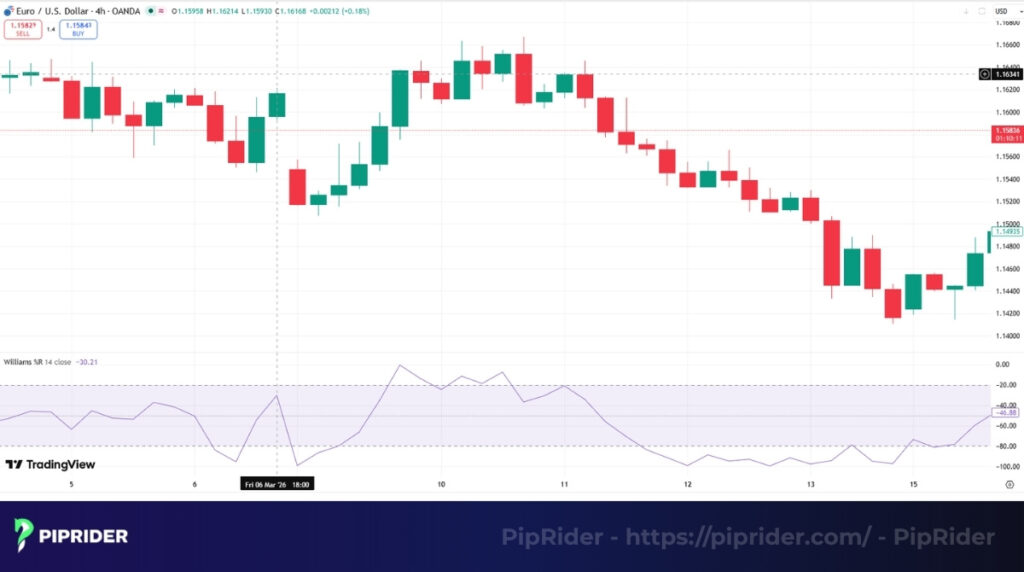
Its calculation makes it particularly responsive to recent price changes, often providing earlier signals of potential overbought (typically >-20) and oversold (typically <-80) conditions compared to other oscillators. This sensitivity makes it a frequently used tool among short-term traders who require quick feedback on momentum shifts.
- How to use: A sensitive oscillator (0 to -100). Readings above -20 are considered overbought; readings below -80 are considered oversold. Often provides earlier momentum signals.
- Standard Settings: 14 periods. (Watch levels 70/30 or 60/40 for trend-following).
4.3. Volatility Indicators
The following indicators tell you how calm or explosive a market is, which is crucial for risk management.
4.3.1. Bollinger Bands
Developed by John Bollinger in the 1980s, Bollinger Bands are mathematically designed to encompass 95% of price action within two standard deviations. These bands are a widely used volatility indicator composed of three lines plotted directly on the price chart:
- A middle band, which is typically a Simple Moving Average (SMA).
- An upper band and a lower band, positioned a set number of standard deviations away from the middle band (usually two).
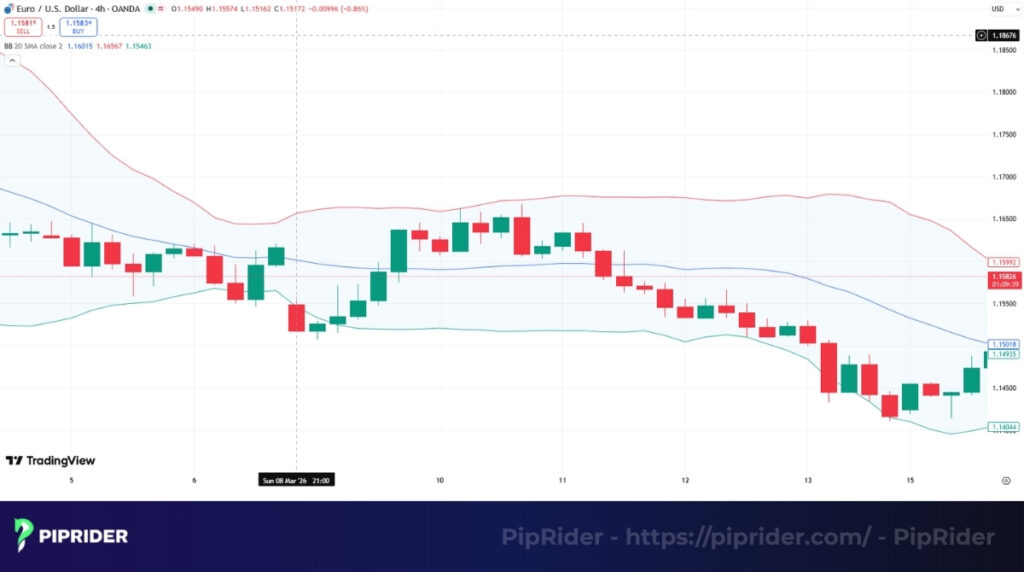
The distance between the upper and lower bands visually represents market volatility.
- When the bands tighten (move closer together), it signals low volatility and is known as a “Squeeze.” This often precedes a significant price move or breakout.
- When the bands widen (move far apart), it indicates high volatility.
How to use: Measures volatility. Band “Squeezes” often precede large price moves. Price touching the outer bands can indicate temporary overbought/oversold conditions relative to the recent average.
Standard Settings: 20-period SMA with 2 Standard Deviations.
4.3.2. Average True Range (ATR)
The Average True Range (ATR) is a volatility indicator primarily used for risk management, not for generating direct buy or sell signals. It measures the average range between high and low prices over a specific period, factoring in any gaps.
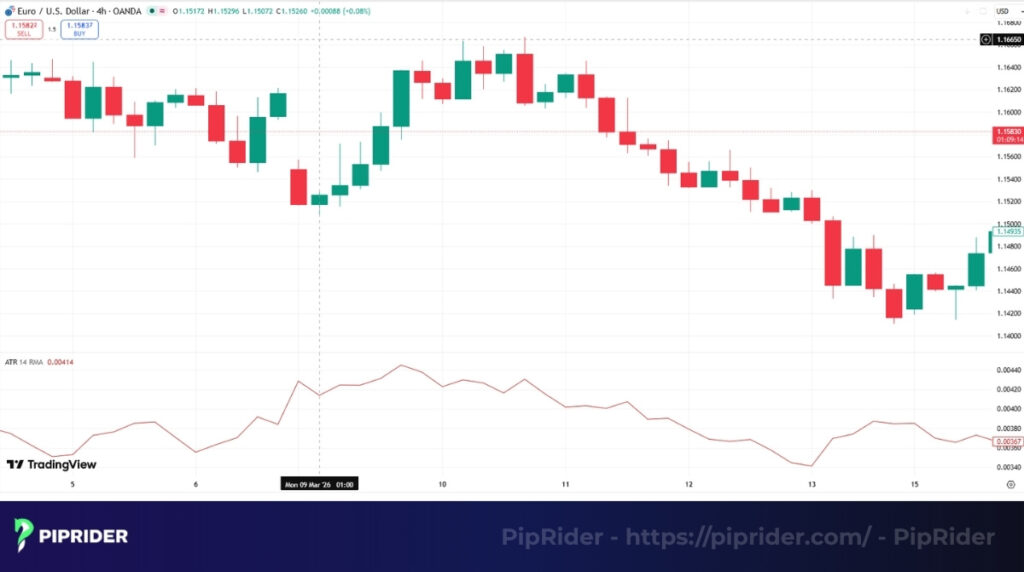
Its primary application is to help traders set stop-losses and take-profit levels that are adaptive to the market’s current volatility. Using an ATR-based stop-loss, for example, allows the stop level to widen during volatile periods and tighten during calmer ones, potentially reducing the chance of being stopped out by normal market “noise.”
- How to use: Measures market volatility. Essential for setting dynamic stop-losses and take-profits that adapt to the asset’s true volatility.
- Standard Settings: 14 periods. (The gold standard for setting stop-losses).
4.3.3. Standard Deviation
Standard Deviation is a statistical indicator that measures the dispersion or volatility of price action around its average (mean). It forms the mathematical basis for Bollinger Bands.
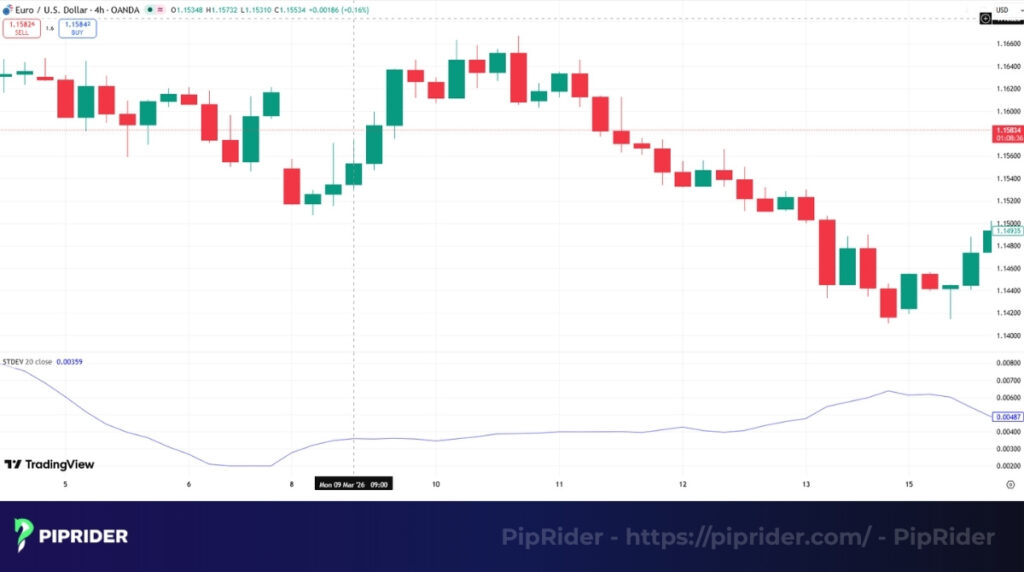
A low Standard Deviation reading indicates that price is trading within a tight range, suggesting low volatility and potential consolidation. Conversely, a high reading signifies that price is spread out over a wider range, indicating elevated volatility.
Traders often monitor for shifts from low to high standard deviation as a potential signal that a period of consolidation is ending and a significant price move or breakout may be imminent.
- How to use: Measures price dispersion (volatility). Low standard deviation suggests a quiet, consolidating market; high suggests elevated volatility. Look for shifts from low to high to anticipate large price moves.
- Standard Settings: 20 periods.
4.4. Volume Indicators
These indicators use trading volume data to confirm the strength of a trend or to spot signs that money flow is changing.
4.4.1. On-Balance Volume (OBV)
The On-Balance Volume (OBV) is a momentum indicator that uses volume flow to predict changes in stock price. Developed by Joseph Granville, it works by keeping a running total of volume: adding volume on days when the price closes higher and subtracting volume on days when the price closes lower.
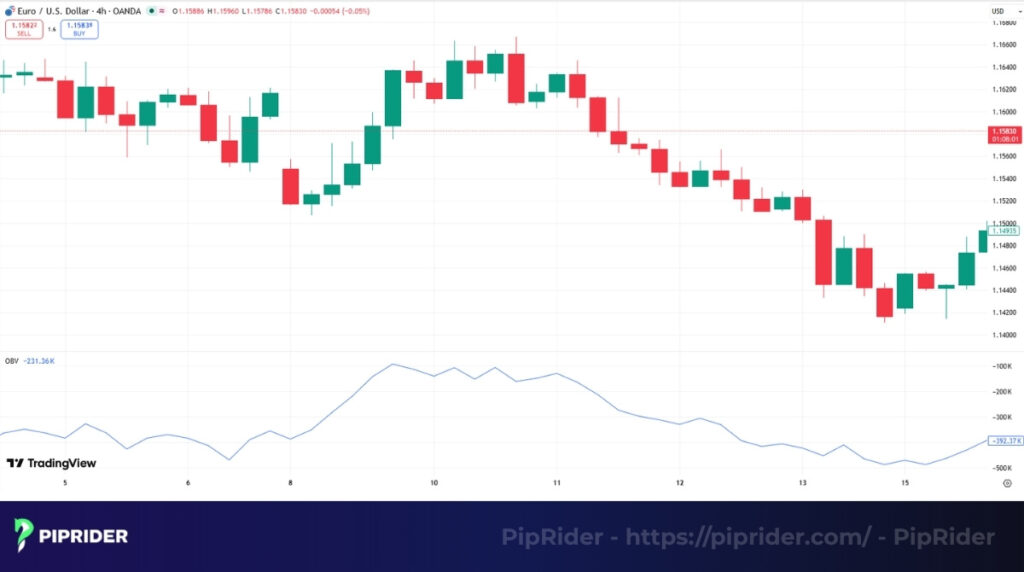
The primary use of OBV is to confirm price trends or identify divergences.
- A rising OBV alongside a rising price confirms bullish momentum.
- A falling OBV alongside a falling price confirms bearish momentum.
- Divergence occurs when price and OBV move in opposite directions (e.g., price rising but OBV falling). This can signal that the current trend lacks volume support and may be weakening.
How to use: Tracks volume flow relative to price. A rising OBV helps confirm an uptrend. Divergence between price and OBV (e.g., rising price but flat/falling OBV) warns of a potentially weak trend.
Standard Settings: Cumulative total (No period setting required).
4.4.2. Accumulation/Distribution Line (A/D Line)
The Accumulation/Distribution Line (A/D Line) is a volume-based indicator designed to measure the cumulative flow of money into or out of an asset. Similar in concept to OBV, it assesses whether traders are primarily accumulating (buying) or distributing (selling).
It achieves this by considering the relationship between the closing price and the high-low range for a period, weighted by volume.
- When the A/D Line trends upwards along with price, it suggests strong buying pressure is supporting the uptrend (accumulation).
- When the A/D Line trends downwards while price falls, it confirms selling pressure (distribution).
- Divergence between the A/D Line and price (e.g., price rising but A/D falling) can indicate underlying weakness in the trend, suggesting a potential shift in money flow.
How to use: Helps determine if institutional money is accumulating or distributing. A rising A/D line confirms strong buying pressure. Divergence between the A/D line and price indicates a potential shift in underlying money flow.
Standard Settings: Cumulative flow (No period setting required)
4.4.3. Volume-Weighted Average Price (VWAP)
The Volume-Weighted Average Price (VWAP) calculates the average price of an asset over a specific time period (typically one day), weighted by the volume traded at each price level. It appears as a single line on intraday charts.
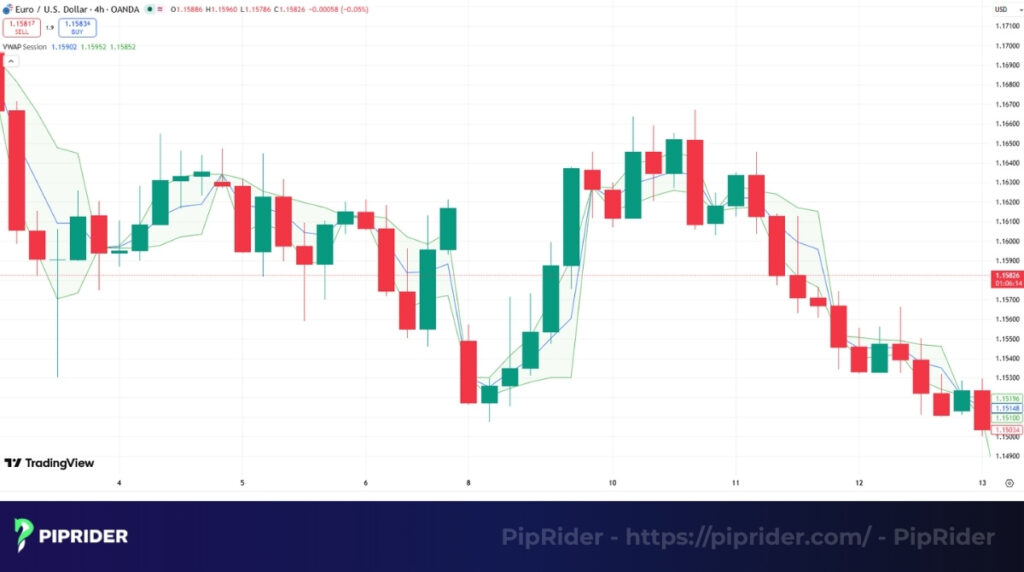
VWAP serves as a crucial intraday benchmark, representing the ‘true’ average price paid per share or contract for the session so far.
- Many traders view prices below VWAP as relatively inexpensive or potentially undervalued for the day.
- Prices above VWAP are often seen as relatively expensive or potentially overvalued for the day.
Because of its calculation method, the VWAP line can also function as a significant level of intraday support or resistance.
- How to use: Represents the volume-weighted average price for the day. Acts as a key intraday benchmark and can serve as strong intraday support or resistance.
- Standard Settings: Resets daily (No period setting required for intraday analysis).
4.5. Supplementary & Cross-Functional Indicators
These indicators don’t strictly fit into one of the four main categories, but they are incredibly important and can add significant depth to your analysis.
4.5.1. Average Directional Index (ADX)
The Average Directional Index (ADX) is an indicator designed specifically to quantify the strength of a prevailing market trend, irrespective of its direction (up or down). It is plotted as a single line, typically ranging from 0 to 100.
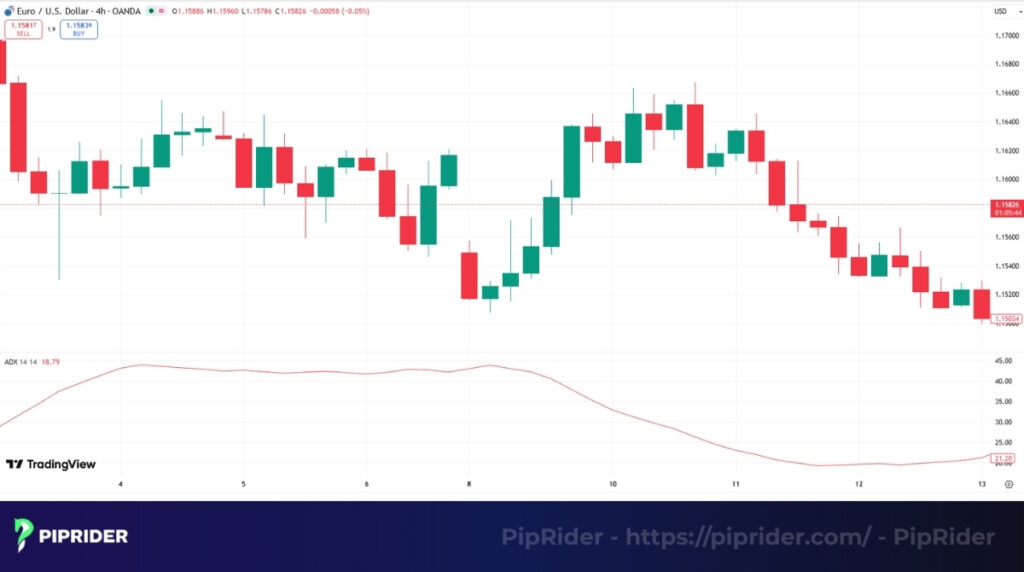
The ADX reading helps traders gauge whether a market is trending strongly or moving sideways:
- A reading above 25 generally indicates a strong, established trend (either bullish or bearish) that might be suitable for trend-following strategies.
- A reading below 20 typically signals a weak, non-trending, or ranging market, suggesting that trend-following approaches may be less effective.
How to use: Measures trend strength, not direction. ADX above 25 indicates a strong trend; ADX below 20 suggests a weak or sideways market.
Standard Settings: 14 periods.
4.5.2. Fibonacci Retracement
Fibonacci Retracement is a popular technical analysis tool used to identify potential support and resistance levels. It is based on key numbers from the Fibonacci sequence, which translate into percentage levels (commonly 23.6%, 38.2%, 50%, 61.8%, and 78.6%).
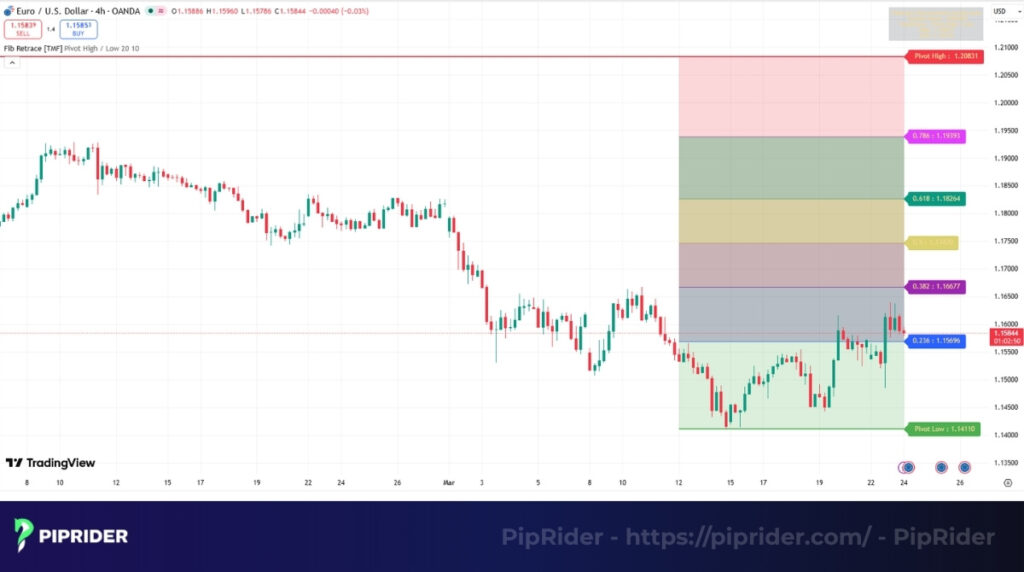
Traders observe that prices often pause or reverse near these calculated levels during a pullback within a larger trend. The tool is applied by drawing it between a significant swing high and swing low on the chart. The resulting horizontal lines indicate potential zones where the price correction might end before resuming the primary trend.
- How to use:Identifies potential support and resistance levels based on Fibonacci ratios. Draw between a significant swing high and low to find price zones where a reversal or consolidation might occur, as these horizontal levels are foundational to technical market analysis (Murphy, 1999).
- Key Levels: Focus on 38.2%, 50%, and 61.8% (The Golden Ratios).
5. Quick trading signals table for new traders
Here are the common Buy and Sell signals for each indicator, presented in a condensed format.
Note: Some supplementary tools like ATR and Standard Deviation are grouped as they serve risk management purposes.
We hope this consolidated table proves to be a valuable tool in your trading journey! Remember, no single indicator is perfect, and combining multiple indicators with overall market analysis will yield the best results.
6. Top 3 Powerful Indicator Combinations for 2026
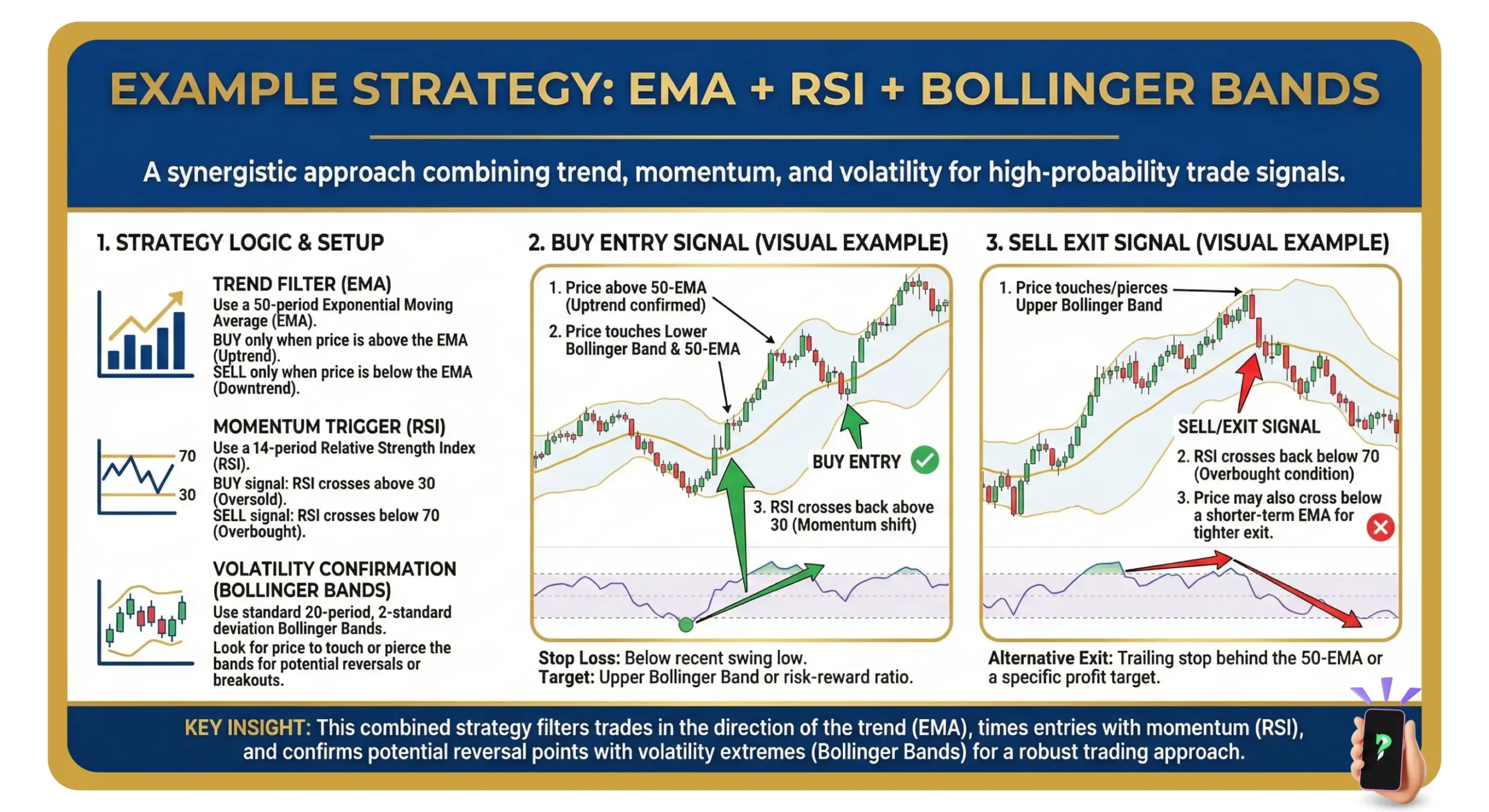
Knowing individual indicators is just the first step. Professional traders rarely rely on a single tool; instead, they build a “confluence” system by combining non-correlated indicators. Here are three highly effective combinations you can start using today:
6.1. The Trend Pullback Combo: Moving Average (MA) + RSI
Trading in the direction of the underlying trend is a proven edge, but entering at the absolute top is a common beginner trap. The MA and RSI combination is designed to help you “buy the dip” safely by identifying moments when a strong trend takes a temporary breather.
- How it works:
- Use a 50-period MA to determine the trend. If the price is consistently above the MA, you are only looking for buy signals.
- Use the RSI (14) to time the entry. In a strong uptrend, wait for the price to pull back toward the MA while the RSI drops to the 40-50 zone (momentum reset).
- The Setup: Enter the trade when price action shows a bullish candlestick (like a hammer) bouncing off the MA, and the RSI starts hooking back up from the 40-50 area.
- Piprider Pro Tip: Never wait for the RSI to hit 30 in a strong uptrend. If RSI hits 30, the trend might already be broken! The 40-50 zone is the “sweet spot” for bull market pullbacks.
6.2. The Volatility Breakout Combo: Bollinger Bands + MACD
Financial markets alternate between long periods of quiet consolidation and sudden, explosive trends. This indicator combination is specifically engineered to keep you out of the choppy, sideways markets and trigger your entry exactly when volatility expands.
- How it works:
- Look for a Bollinger Band “Squeeze” (when the upper and lower bands pinch closely together, indicating extremely low volatility).
- Wait for the price to break and close outside the upper or lower band.
- Use the MACD as your lie detector. If the price breaks the upper band, the MACD line must cross above the signal line (and ideally the zero line) to confirm bullish momentum.
- The Setup: The squeeze builds the energy; the band breakout pulls the trigger; the MACD confirms the bullet is real.
- Piprider Pro Tip: Beware of the “fakeout.” Always wait for the breakout candle to close outside the Bollinger Band before entering. Never trade while the candle is still forming.
6.3. The Reversal Hunter: RSI + Support/Resistance (Price Action)
Technical indicators are mathematical derivatives of price, meaning they naturally lag. However, historical Support and Resistance zones do not. By pairing the momentum-reading power of the RSI with structural price action, you create a high-probability system for catching market reversals.
- How it works:
- Identify a major, historical Support or Resistance zone on a higher timeframe (e.g., Daily or 4H chart).
- As the price approaches this zone, watch the RSI.
- If the price hits the resistance zone and makes a higher high, but the RSI makes a lower high (Bearish Divergence), the uptrend is exhausted exactly where sellers are waiting.
- The Setup: Enter a short position upon seeing a bearish reversal candlestick (like a pin bar or engulfing pattern) at the resistance level, with the RSI divergence serving as your ultimate confirmation.
- Piprider Pro Tip: Divergence is a warning sign, not an entry signal. An RSI divergence can last for a long time. Always use the Price Action (the bearish candlestick at resistance) as your actual trigger to enter.
6.4. Indicator Limitations You Must Know
Even with the best combinations, indicators are not crystal balls. Relying on them blindly without understanding their inherent flaws is a fast track to blowing your account. Here are the three major limitations every trader must accept:
- Lagging: Technical indicators are mathematical formulas applied to historical price data. By definition, they look backward. A Moving Average crossover or an MACD signal only happens after the price has already made a move. Because they reflect past information, they naturally lag behind real-time market action (CFA Institute, 2025). If you wait for perfect indicator alignment, you will often enter the trade late.
- False Signals: Indicators are purely mathematical; they don’t understand market context. A trend-following tool will generate beautiful signals in a strong trend but will produce continuous, account-draining false signals (whipsaws) when the market enters a choppy, sideways range.
- Overfitting (Curve Fitting): This is a dangerous psychological trap. Beginners often tweak an indicator’s settings (e.g., endlessly adjusting the RSI or MACD parameters) so that the buy/sell signals perfectly match the past chart. A system over-optimized for past data will almost always fail in live, unpredictable market conditions.
- Piprider Pro Tip: How do you overcome these limitations? Never trade an indicator signal in isolation. Always use Price Action (candlestick patterns and market structure) as your primary leading indicator, and let the mathematical tools act only as your secondary confirmation.
7. Deadly mistakes to avoid when using indicators
How you don’t use indicators is just as important as how you do.
- Mistake 1: Redundant signals. Using an RSI, a Stochastic, and a Williams %R on the same chart is a common beginner mistake. They are all momentum oscillators and will tell you the same thing, creating a false sense of confirmation.
- Mistake 2: Ignoring price action. Indicators are derived from price; they are not more important than price itself. A bearish divergence on the MACD is far more powerful if it’s accompanied by a bearish candlestick pattern on the chart.
- Mistake 3: The “holy grail” hunt. It’s crucial to remember that no single indicator is infallible. They are tools of probability. Your long-term success will depend on combining them with disciplined risk management.
8. Frequently asked questions about the technical indicators
9. Conclusion
Mastering technical analysis is a journey of discovery. By understanding the core job of each of these tools, new traders can move from a cluttered, confusing chart to a clean dashboard that gives them clear, actionable information.
The goal is never to predict the future, but to put the probabilities on your side. The best technical indicators are simply the ones you understand deeply and can trust to inform your trading decisions as part of a complete, disciplined strategy.
Don’t forget to follow Piprider to learn more useful knowledge in our Learn Forex category.
Infographic Section
-
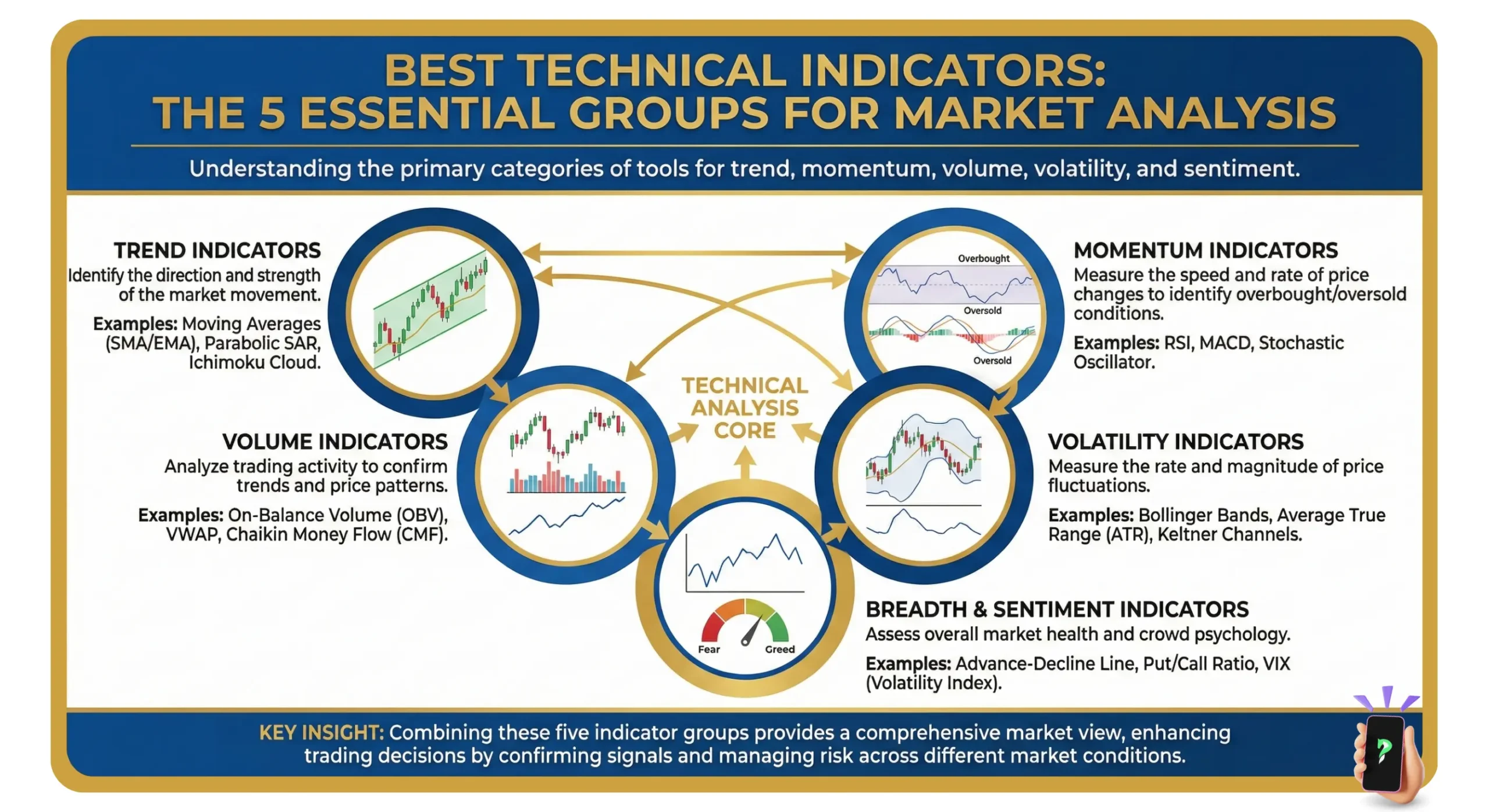
The 5 Essential Groups for Market Analysis -
Choosing Your Indicator Combination -
EMA + RSI + Bollinger Bands