Intraday trading, the practice of buying and selling securities within the same day, offers a fast-paced path to profiting from short-term market fluctuations. However, success requires more than just quick reactions; it demands a clear and disciplined approach.
Disclaimer: Intraday trading involves significant risk. No strategy can guarantee consistent profits, and traders should only risk capital they can afford to lose.
This guide breaks down the most effective intraday day trading strategies, from momentum to breakouts, and provides the essential rules traders need to navigate this high-risk, high-reward environment.
Key Takeaways
- Definition of intraday trading: It involves opening and closing trades within a single day to profit from small price movements.
- A defined intraday trading strategy is critical for managing the high risks and making objective, non-emotional decisions.
- Popular strategies include scalping, momentum, breakout, and range trading, each suited for different market conditions.
- Success hinges on a solid trading plan, strict risk control, and the discipline to follow it consistently.
1. What Is Intraday Trading?
Intraday trading, also known as day trading, is the practice of buying and selling financial assets within the same trading session. All positions are opened and closed before the market closes for the day, meaning no trades are held overnight.
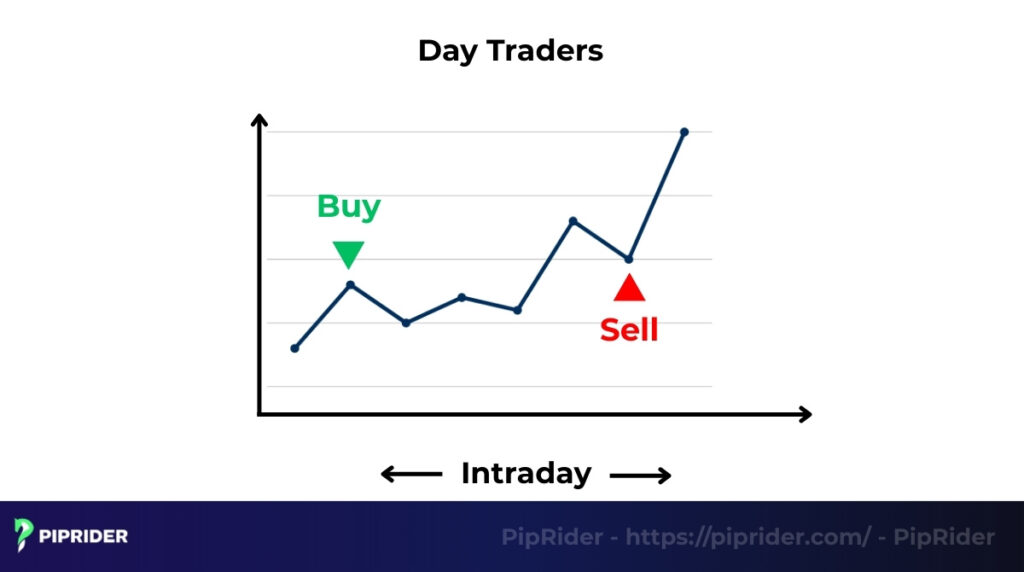
The clear distinction between intraday trading and other methods like swing trading (holding for days or weeks) or investing (holding for months or years) is often referred to as interday vs intraday. While long-term investors focus on fundamental growth, an intraday trader’s sole focus is on profiting from short-term price fluctuations (Mitchell, 2024).
The appeal of intraday trading lies in the potential for quick capital gains and avoiding overnight risk. However, it is also considered high-risk due to the fast-paced nature, increased commission costs from frequent trading, and the need for constant focus and quick decision-making.
2. Key Components of an Intraday Trading Strategy
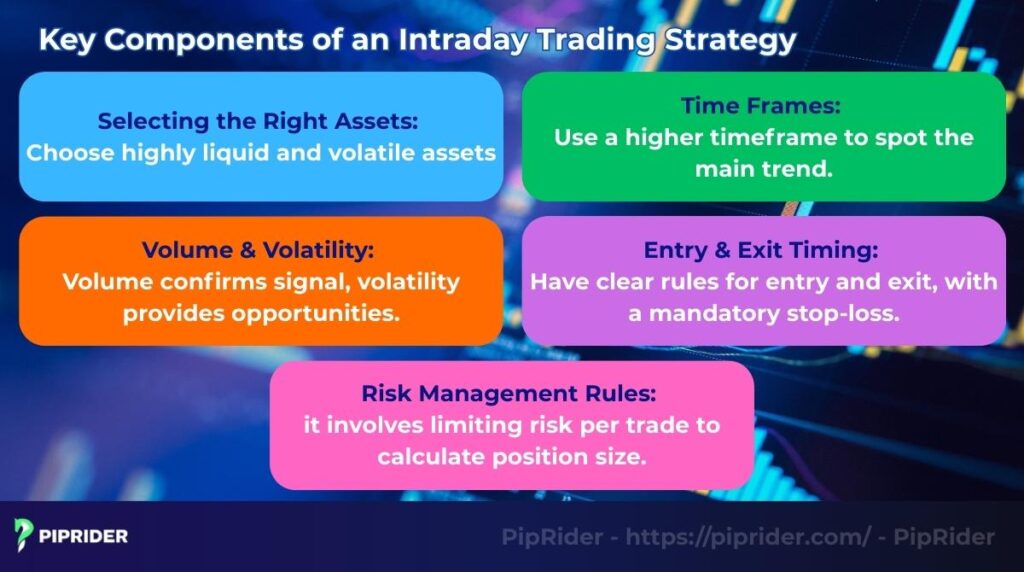
A successful intraday trading strategy is a complete system built on several key components. Each element works together to create a structured, rule-based approach to the market.
2.1. Selecting the Right Stocks / Pairs
Intraday traders thrive on movement. The best candidates for intraday trading stocks or forex pairs are securities with high liquidity (so you can get in and out easily) and high daily volatility (so the price actually moves). For stocks, this often means focusing on large-cap stocks that are in the news. For forex trading, major currency pairs like EUR/USD are popular choices.
2.2. Time Frames
Intraday trading is executed on lower time frames. Traders typically use a higher time frame (like the 1-hour chart) to determine the main trend, and a lower time frame (like the 5-minute or 15-minute chart) to time their precise entries and exits.
2.3. Role of Volume & Volatility
Trade volume is a crucial confirmation tool; a breakout on high volume is more reliable than one on low volume (CME Group, n.d.). Volatility is the lifeblood of an intraday trader. Traders often focus on the most volatile market sessions, like the London-New York overlap in forex, to find the best opportunities.
2.4. Entry & Exit Timing
The strategy must have precise, non-negotiable rules for entry and exit. An entry might be triggered by a specific candlestick pattern or indicator signal. The exit strategy must include both a take-profit target to lock in gains and, more importantly, a stop-loss order to protect the capital.
2.5. Risk Management Rules
This is one of the most critical component. A solid intraday strategy must include strict risk management rules. This means defining your maximum risk per trade (typically 1-2% of your account) and using that to calculate the position size for every single trade.
3. Top Intraday Trading Strategies
Instead of broad categories, professional traders use specific Playbooks. Below are the most effective intraday setups formatted for immediate execution.
| Strategy | Primary Market Condition | Core Objective |
| Momentum Trading | Strong, Trending market | Ride the acceleration of an established short-term move. |
| Breakout Trading | Consolidation followed by high volatility | Capture the explosive move when price exits a key boundary. |
| Range-Bound Trading | Sideways/Ranging market (no clear trend) | Buy low at support and sell high at resistance within a confined range. |
| Reversal / Pullback | Established Trending market | Enter the existing trend at a better, lower-risk price after a temporary dip. |
| Moving Average Crossovers | Established Trending market | Generate simple, rule-based entry signals based on average price shifts. |
| VWAP Strategy | Established Trending market / Daily benchmark | Trade in alignment with the volume-weighted average price (the day’s “true” value). |
| Scalping Techniques | Any market condition (requires high liquidity) | Capture dozens of extremely small profits (pips/cents) through rapid execution. |
3.1. Momentum Trading
- Market Condition: Strong trending market often driven by a news catalyst.
- Setup: Price making a new high or low on the 5-minute chart with high relative volume.
- Trigger: Entry on a 1-minute candle close above the initial 15-minute range high.
- Stop Loss: Placed at the VWAP level or the low of the trigger candle.
- Exit: Take profit at 2:1 Reward-to-Risk or when the fast EMA is breached.
- Common Fail Case: Buying the peak of an “exhaustion” move without volume support.
3.2. Breakout Trading
- Market Condition: Consolidation period or “coiling” price action.
- Setup: Price stuck between a clear horizontal resistance and support level for at least 2 hours.
- Trigger: Buy-stop order placed 2-5 ticks above the resistance level.
- Stop Loss: Placed at the midpoint of the consolidation range.
- Exit: Initial target at the height of the range projected upward from the breakout point.
- Common Fail Case: “Fakeouts” where price spikes above resistance then immediately collapses.
3.3. Range-Bound Trading
- Market Condition: Sideways market with no clear directional trend.
- Setup: Two or more touches on a horizontal support and resistance level.
- Trigger: Rejection candlestick (e.g., Pin Bar or Engulfing) at the range boundary.
- Stop Loss: Placed 5-10 pips/cents outside the range boundary.
- Exit: Target the opposite side of the range.
- Common Fail Case: Holding the position when a breakout begins to gain volume.
This strategy works well when there is no clear trend. Investors often use oscillators like the RSI or Stochastics to identify overbought/oversold conditions at the range boundaries as entry signals.
3.4. Reversal / Pullback Trading
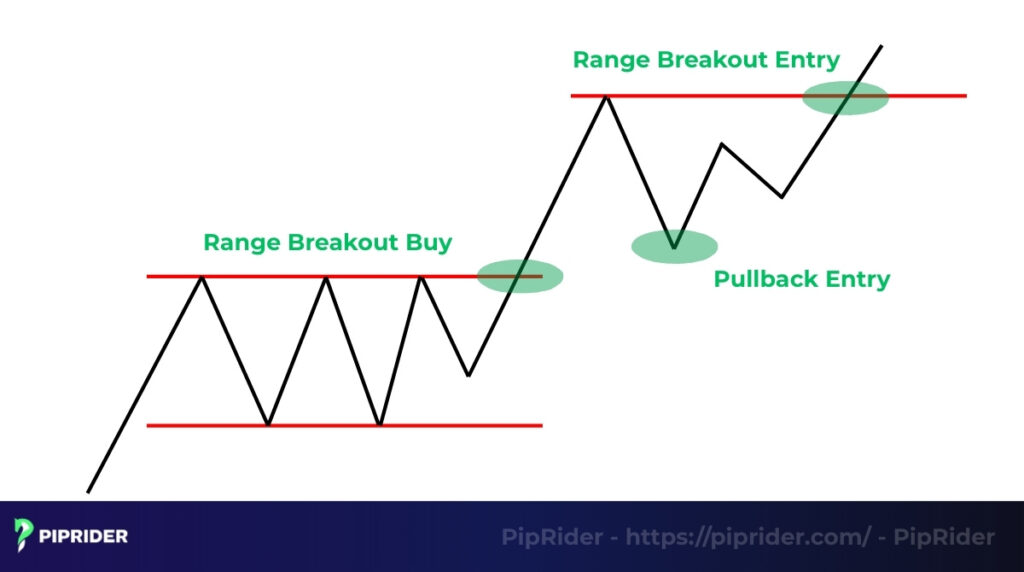
With pullback trading, a trader waits for a temporary dip or “pullback” within a larger intraday trend to enter at a better price. They identify a key support level, such as a moving average or a Fibonacci retracement level, and wait for a bullish trading pattern to form before buying, allowing them to join a strong trend at a lower-risk entry point.
- Market Condition: Established trending market (Higher Highs and Higher Lows).
- Setup: Price retraces to a key technical level like the 20-period EMA or 50% Fibonacci level.
- Trigger: Bullish reversal pattern forming at the technical support level.
- Stop Loss: Placed just below the recent swing low.
- Exit: Target the previous trend high or use a trailing stop.
- Common Fail Case: Mistaking a trend reversal for a simple pullback.
3.5. Moving Average Crossovers
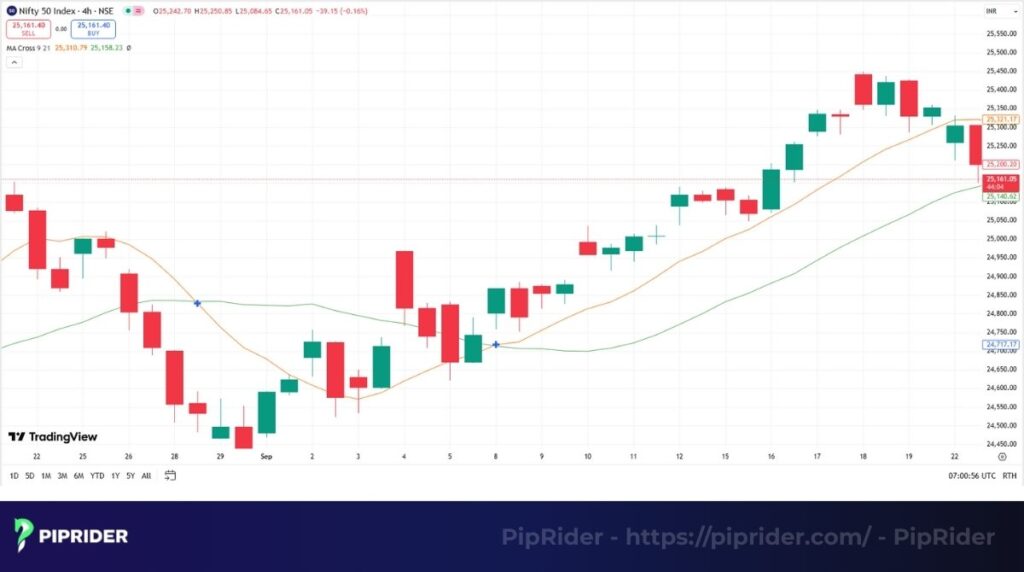
- Market Condition: Strong, established trending market.
- Setup: A combination of a fast-moving average (e.g., 9-period EMA) and a slow-moving average (e.g., 21-period EMA).
- Trigger: Entry occurs when the fast EMA crosses the slow EMA in the direction of the trend.
- Stop Loss: Placed on the opposite side of the slow EMA or at the most recent swing point.
- Exit: Exit when the averages cross back in the opposite direction or when a fixed profit target is reached.
- Common Fail Case: False signals or “whipsaws” during sideways or choppy market phases.
3.6. VWAP Strategy
- Market Condition: Trending market or daily benchmark reversion.
- Setup: Volume-Weighted Average Price (VWAP indicator) line applied to a 5-minute chart.
- Trigger: Entry when price closes above VWAP (long) or below VWAP (short) with volume confirmation.
- Stop Loss: Placed on the opposite side of the VWAP line with a small buffer.
- Exit: Target standard deviation bands or the next major intraday horizontal level.
- Common Fail Case: Trading near the VWAP during low-volume periods when the price oscillates around the line without direction.
3.7. Scalping Techniques
Scalping is the fastest form, where traders enter and exit dozens or hundreds of trades within a day to capture tiny profits (just a few pips or cents).
- Market Condition: High liquidity markets with narrow spreads and high transaction speed.
- Setup: 1-minute chart utilized alongside Level 2 order flow data.
- Trigger: Quick imbalance in the bid/ask spread or a micro-momentum spike in volume.
- Stop Loss: Extremely tight stop, usually just 2 to 5 ticks or pips away from the entry.
- Exit: Rapid exit at a small pre-defined profit target, often just a few cents or pips.
- Common Fail Case: High transaction costs or slippage exceeding the tiny profit margins per trade.
4. How to Trade Intraday Effectively
Having a strategy is the first step, but executing it effectively requires a professional approach to analyzing the market each day. Here are five key techniques to improve your intraday trading.
- Track market leaders and laggards: Before the market opens, identify the stocks or sectors that are strongest (leaders) and weakest (laggards) based on pre-market news or overnight moves. Leaders are often the best candidates for long (buy) trades, while laggards can be good candidates for short (sell) trades.
- Identify liquidity zones: They are simply key support and resistance levels where a high volume of trading is likely to occur. These are often the previous day’s high and low or major intraday swing points. Traders use these zones as targets for entries and exits.
- Use trend-following techniques: Even within a single day, markets trend. One of the most effective techniques is to identify the primary trend (e.g., using a moving average on the 15-minute chart) and only take trades in that direction. Trading with the intraday trend significantly increases the probability of success.
- Prioritize high-impact news & events: Always check the economic calendar before you start your trading day. High-impact news events can cause extreme price fluctuations and invalidate technical analysis setups. You must decide whether to avoid trading around these times or to use a specific news-based trading strategy.
- Know when to exit a trade: A professional trader knows their exit plan before they enter. This means having pre-defined stop-loss orders to limit losses and a clear take-profit target. Never enter a trade without knowing exactly where you will get out, both if you are right and if you are wrong.
5. Pros and Cons of Intraday Trading
The primary appeal of intraday trading is the potential for quick profits, as traders can capitalize on numerous small price movements throughout the day. A key benefit is the avoidance of overnight risk; by closing all positions before the end of the day, traders are not exposed to major news events or market gaps that can occur when the market is closed.
However, the disadvantages are significant. The fast-paced nature of intraday trading can be highly stressful and mentally demanding. It is also a high-risk activity, as the same leverage that amplifies profits can lead to rapid losses. Finally, the high frequency of trades means that transaction costs (commission costs) and spreads can add up quickly, eating into a trader’s profit margins.
6. Real-Life Intraday Trade Setup Examples
Let’s put these concepts together with a real-world example, using a classic breakout strategy.
6.1. Case Study: Equity Breakout on Tesla (TSLA)
- Market Context: TSLA was consolidating in a tight 15-minute range between $250 and $252.
- The Plan: Trade the breakout above $252 with a volume spike confirmation.
- Entry: Buy-stop order triggered at $252.10. Stop Loss: Placed at $249.90 (below the support level).
- Outcome: Price hit the $255 target within 2 hours, resulting in a successful 1.3:1 risk/reward ratio trade.
6.2. Case Study: Forex Trading on GBP/USD
Professional forex trading often involves utilizing different setups depending on the market cycle. Below are two distinct examples of how a trader might approach the GBP/USD pair.
Example A: The Session Open Breakout
- Chart Timeframe: 15-minute.
- Range/Boundary: A 20-pip consolidation range (1.2640 to 1.2660) established during the late Asian session.
- Trigger: A 15-minute candle close above the 1.2660 resistance at the London session open, confirmed by an expansion in volatility.
- Stop Loss: Placed at 1.2635, situated below the breakout candle low including a spread buffer.
- Take Profit: Set at the 1.2710 intraday resistance level, achieving a 2:1 risk/reward ratio.
Example B: The Trend Pullback
- Market Context: GBP/USD entered a strong uptrend following better-than-expected UK GDP data.
- The Plan: Instead of chasing the move, the trader waited for a pullback to the 15-minute 20 EMA.
- Entry: A bullish engulfing candle formed at 1.2650 as price touched the moving average.
- Stop Loss: Placed 15 pips below the entry at 1.2635.
- Outcome: The pair resumed its upward trend, hitting the take-profit target of 1.2680 for a successful trade.
7. Common Mistakes to Avoid
Success in intraday trading is often less about what you do right and more about the mistakes you avoid. Here are the most common pitfalls that can quickly destroy a trading account.
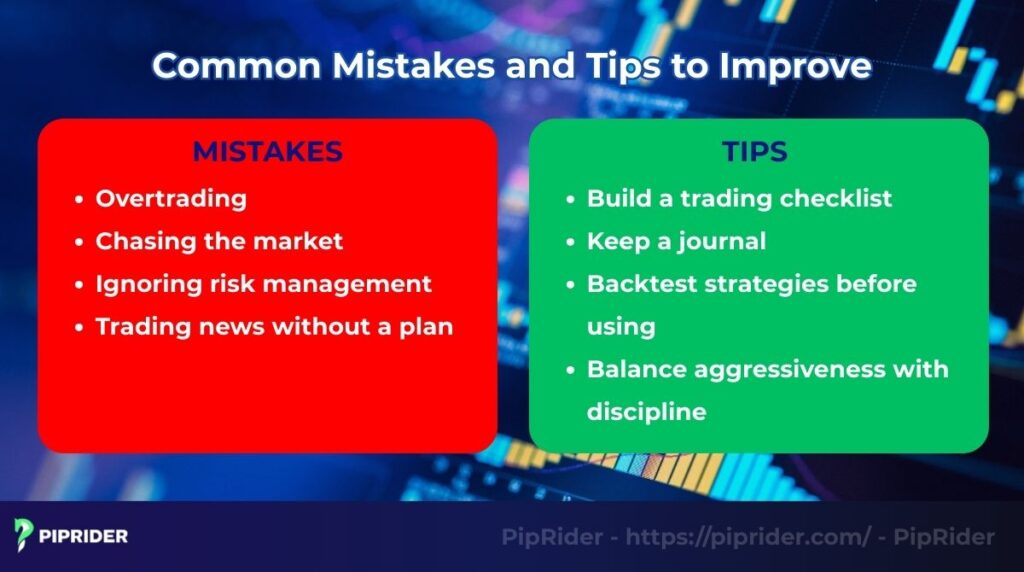
- Overtrading: This is the temptation to trade too frequently, often out of boredom or a desire for constant action. Overtrading leads to taking low-probability setups and racks up transaction costs (spreads and commission costs), eating away at profits.
- Chasing the market: Chasing the market means entering a trade late after a big move has already happened, driven by the Fear Of Missing Out (FOMO). This almost always results in a poor entry price and a high-risk trade, as you are likely buying at the top or selling at the bottom of the move.
- Ignoring risk management: This is the single biggest mistake. Every single trade must have a pre-defined stop-loss order and a position size that adheres to your risk control plan (e.g., the 1-2% rule). Trading without these protections is a recipe for disaster.
- Trading news without a plan: Major news events create extreme price fluctuations. While this can be an opportunity, trading news without a specific, tested strategy is extremely dangerous. The wild price swings and wide spreads can lead to massive, unexpected losses in seconds.
8. Tips for Successful Intraday Trading
Success in intraday trading is built on a foundation of discipline, preparation, and continuous improvement. Here are four essential tips to incorporate into your routine.
- Build a trading checklist: A trading checklist is a non-negotiable tool. It is a simple list of criteria (e.g., market trend, entry signal, risk/reward) that must be met before you enter any trade. This enforces discipline and prevents emotional, impulsive decisions.
- Keep a journal: A trading journal is a personal performance log. After every day of trading, record all trades, including the setup, reasons for entry and exit, and the final outcome. Reviewing the journal is the fastest way to identify strengths and weaknesses.
- Backtest strategies before using: Never risk real money on an untested idea. Before implementing a new strategy, backtest it on historical data to see how it would have performed. If it shows promise, then test it in real-time on a demo account.
- Balance aggressiveness with discipline: Intraday trading requires you to be aggressive in taking opportunities when they appear, but this must be balanced with strict discipline. The discipline to follow your trading plan, cut your losses, and walk away when your rules aren’t met is what separates professional traders from amateurs.
9. FAQs on Intraday Trading
10. Conclusion
In conclusion, intraday trading is a powerful tool for profiting from short-term market movements. However, its fast-paced nature means that success is not just about choosing the right strategy; it is fundamentally about discipline.
The key to long-term success is the consistent combination of a tested intraday day trading strategies, strict risk control, and the unwavering discipline to follow your plan, especially under pressure. With the right training and understanding of your chosen securities, you can use leverage effectively to amplify returns. Furthermore, incorporating a specific news-based trading approach can help navigate volatility.
To continue building your trading system, we encourage you to explore more in-depth guides in our Trading Strategies & Risk Management category on Piprider.